Information Theory Measures with RBIG

A key advantage of RBIG is that information-theoretic quantities fall out naturally from the Gaussianization process. This notebook demonstrates two approaches for estimating them, and compares both against analytical values on Gaussian data where ground truth is available.
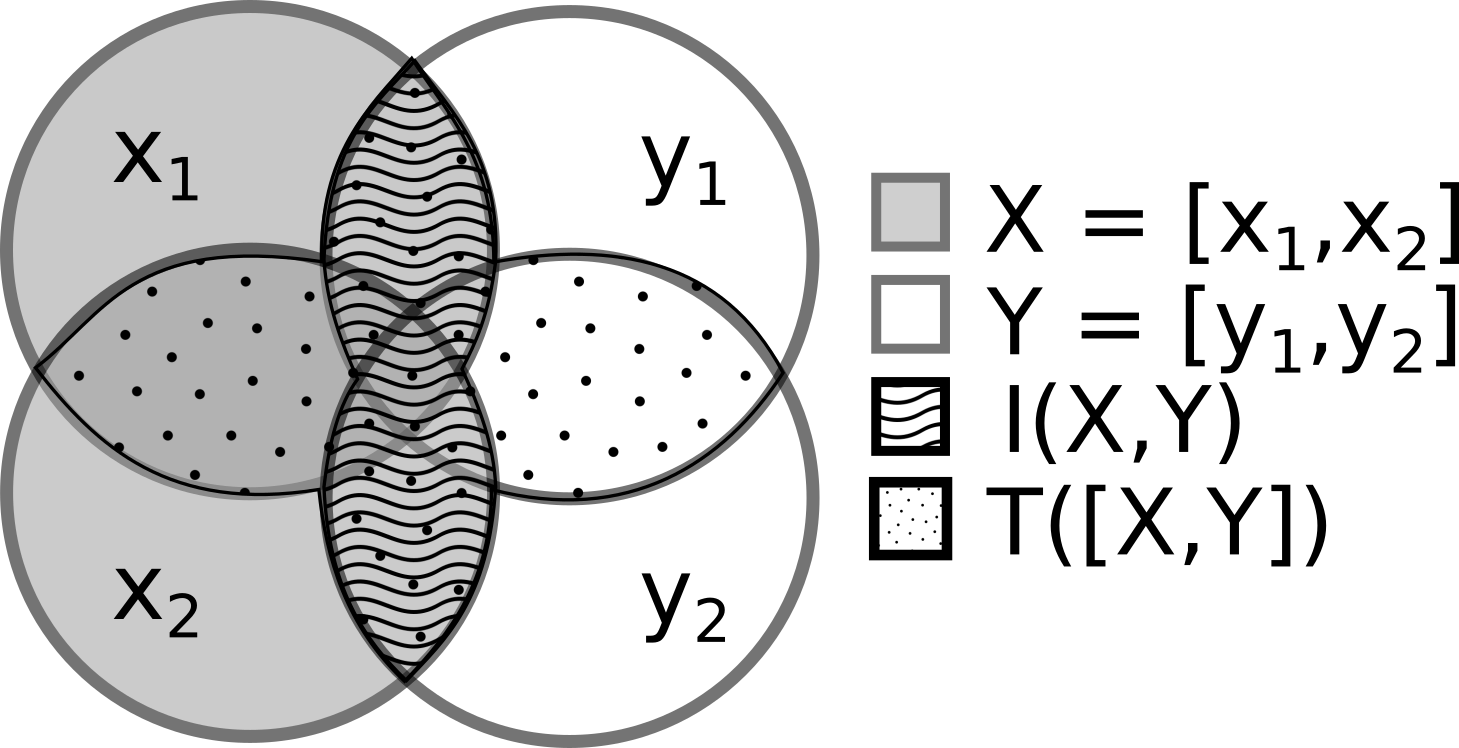
| Approach | How it works | Pros |
|---|---|---|
| Change-of-variables | Fit a full RBIG model, use the learned density | Single model, exact density |
| RBIG-way | Sum per-layer TC reductions | No Jacobian needed, more stable |
Colab / fresh environment? Run the cell below to install
rbigfrom GitHub. Skip if already installed.
!pip install "rbig[all] @ git+https://github.com/jejjohnson/rbig.git" -q
import numpy as np
from scipy import stats

from rbig import (
    AnnealedRBIG,
    entropy_rbig,
    estimate_entropy,
    estimate_kld,
    estimate_mi,
    estimate_tc,
    kl_divergence_rbig,
    marginal_entropy,
    mutual_information_rbig,
    total_correlation_rbig,
)
/anaconda/lib/python3.13/site-packages/tqdm/auto.py:21: TqdmWarning: IProgress not found. Please update jupyter and ipywidgets. See https://ipywidgets.readthedocs.io/en/stable/user_install.html
  from .autonotebook import tqdm as notebook_tqdm
Shared Data Setup
We use correlated Gaussian data throughout so we can compare all estimates against closed-form analytical values.
Note:
n_samplesis kept small for fast execution; increase it (e.g. 10 000+) for closer agreement with analytical values.
seed = 42
rng = np.random.RandomState(seed)
n_samples = 1_000
d = 2  # dimensionality per block

# Joint covariance for [X, Y] with cross-correlations
C_full = np.eye(2 * d)
C_full[0, d] = C_full[d, 0] = 0.8  # x0 ↔ y0
C_full[1, d + 1] = C_full[d + 1, 1] = 0.5  # x1 ↔ y1

joint = rng.multivariate_normal(np.zeros(2 * d), C_full, size=n_samples)
X = joint[:, :d]
Y = joint[:, d:]
XY = joint

# Marginal covariances
CX = C_full[:d, :d]
CY = C_full[d:, d:]

# For KLD: shifted-mean distribution
mu_shift = np.array([0.5, 0.0])
X_shifted = rng.multivariate_normal(mu_shift, CX, size=n_samples)

# Common RBIG settings
rbig_kw = dict(n_layers=20, rotation="pca", patience=10, random_state=seed)
1. Total Correlation
Total correlation measures the overall statistical dependence among all dimensions of a random vector — how far the joint distribution is from being fully independent:
$$\mathrm{TC}(X) = \sum_i H(X_i) - H(X) = D_\text{KL}\left[ p(\mathbf{x}) \| \prod_d p(x_d) \right]$$
TC is zero if and only if all dimensions are independent. In 2D, TC equals the mutual information.
Analytical
tc_true_X = 0.5 * (np.sum(np.log(np.diag(CX))) - np.log(np.linalg.det(CX)))
tc_true_XY = 0.5 * (np.sum(np.log(np.diag(C_full))) - np.log(np.linalg.det(C_full)))
print(f"TC(X)  analytical: {tc_true_X:.4f} nats")
print(f"TC(XY) analytical: {tc_true_XY:.4f} nats")
TC(X)  analytical: 0.0000 nats
TC(XY) analytical: 0.6547 nats
Change-of-variables (single-shot KDE + Gaussian joint)
tc_cov_X = total_correlation_rbig(X)
tc_cov_XY = total_correlation_rbig(XY)
print(f"TC(X)  change-of-vars: {tc_cov_X:.4f} nats")
print(f"TC(XY) change-of-vars: {tc_cov_XY:.4f} nats")
TC(X)  change-of-vars: -0.0059 nats
TC(XY) change-of-vars: 0.6094 nats
RBIG-way (per-layer TC reduction)
tc_rbig_X = estimate_tc(X, **rbig_kw)
tc_rbig_XY = estimate_tc(XY, **rbig_kw)
print(f"TC(X)  RBIG-way: {tc_rbig_X:.4f} nats")
print(f"TC(XY) RBIG-way: {tc_rbig_XY:.4f} nats")
TC(X)  RBIG-way: -0.0062 nats
TC(XY) RBIG-way: 0.6201 nats
2. Entropy
Entropy measures the uncertainty of a random variable — the expected information content:
$$H(X) = -\int p(x) \log p(x) \, dx$$
For Gaussian data: $H(X) = \frac{1}{2}\log\lvert 2\pi e\,\Sigma \rvert$
RBIG-way: $H(X) = \sum_d H(X_d) - \mathrm{TC}(X)$ — marginal entropies minus the RBIG-accumulated total correlation (no Jacobian needed).
Change-of-variables: $H(X) = -\mathbb{E}[\log p(x)]$ using the normalizing-flow density $\log p(x) = \log p_Z(f(x)) + \log\lvert\det J\rvert$.
Analytical
H_X_true = 0.5 * np.log(np.linalg.det(2 * np.pi * np.e * CX))
H_XY_true = 0.5 * np.log(np.linalg.det(2 * np.pi * np.e * C_full))
print(f"H(X)  analytical: {H_X_true:.4f} nats")
print(f"H(XY) analytical: {H_XY_true:.4f} nats")
H(X)  analytical: 2.8379 nats
H(XY) analytical: 5.0211 nats
Change-of-variables
model_X = AnnealedRBIG(**rbig_kw).fit(X)
model_XY = AnnealedRBIG(**rbig_kw).fit(XY)

H_X_cov = model_X.entropy()
H_XY_cov = model_XY.entropy()
print(f"H(X)  change-of-vars: {H_X_cov:.4f} nats")
print(f"H(XY) change-of-vars: {H_XY_cov:.4f} nats")
H(X)  change-of-vars: 2.8450 nats
H(XY) change-of-vars: 4.7623 nats
RBIG-way
H_X_rbig = estimate_entropy(X, **rbig_kw)
H_XY_rbig = estimate_entropy(XY, **rbig_kw)
print(f"H(X)  RBIG-way: {H_X_rbig:.4f} nats")
print(f"H(XY) RBIG-way: {H_XY_rbig:.4f} nats")
H(X)  RBIG-way: 2.8369 nats
H(XY) RBIG-way: 4.9964 nats
3. Mutual Information
Mutual information quantifies how much knowing $X$ tells you about $Y$ (and vice versa). It is zero if and only if $X$ and $Y$ are independent — unlike linear correlation, MI captures all forms of dependence:
$$\mathrm{MI}(X;Y) = H(X) + H(Y) - H(X,Y)$$
RBIG-way: $\mathrm{MI}(X;Y) = \mathrm{TC}([G_X(X),\, G_Y(Y)])$ — Gaussianize each block independently, then measure the TC of the concatenation.
Analytical
H_Y_true = 0.5 * np.log(np.linalg.det(2 * np.pi * np.e * CY))
mi_true = H_X_true + H_Y_true - H_XY_true
print(f"MI(X;Y) analytical: {mi_true:.4f} nats")
MI(X;Y) analytical: 0.6547 nats
Change-of-variables (3 separate RBIG models)
model_Y = AnnealedRBIG(**rbig_kw).fit(Y)
mi_cov = mutual_information_rbig(model_X, model_Y, model_XY)
print(f"MI(X;Y) change-of-vars: {mi_cov:.4f} nats")
MI(X;Y) change-of-vars: 0.8795 nats
RBIG-way (2 models + TC measurement)
mi_rbig = estimate_mi(X, Y, **rbig_kw)
print(f"MI(X;Y) RBIG-way: {mi_rbig:.4f} nats")
MI(X;Y) RBIG-way: 0.6325 nats
4. KL Divergence
KL-divergence measures how one probability distribution $P$ differs from a reference distribution $Q$. It is asymmetric and always non-negative:
$$\mathrm{KL}(P \| Q) = \int p(x) \log\frac{p(x)}{q(x)}\,dx$$
RBIG-way: $\mathrm{KL}(P_X \| P_Y) = \sum_d D(Z_d \| \mathcal{N}(0,1)) + \mathrm{TC}(Z)$ where $Z = G_Y(X)$ — apply Y's Gaussianization to X's samples, then measure per-marginal KL to standard Gaussian plus the TC of Z.
Change-of-variables: Uses cross-scoring of P's density model on Q's samples.
Analytical
Same covariance, shifted mean: $$\mathrm{KL}(\mathcal{N}(\mu, \Sigma) \| \mathcal{N}(0, \Sigma)) = \tfrac{1}{2}\mu^\top \Sigma^{-1} \mu$$
kld_true = 0.5 * mu_shift @ np.linalg.solve(CX, mu_shift)
print(f"KLD analytical: {kld_true:.4f} nats")
KLD analytical: 0.1250 nats
Change-of-variables
# Fit model on the reference (unshifted) distribution
model_ref = AnnealedRBIG(**rbig_kw).fit(X)
kld_cov = kl_divergence_rbig(model_ref, X_shifted)
print(f"KLD change-of-vars: {kld_cov:.4f} nats")
KLD change-of-vars: 0.4802 nats
RBIG-way
kld_rbig = estimate_kld(X_shifted, X, **rbig_kw)
print(f"KLD RBIG-way: {kld_rbig:.4f} nats")
KLD RBIG-way: 0.1123 nats
print(f"{'Measure':<12} {'Analytical':>12} {'Change-of-Vars':>16} {'RBIG-way':>12}")
print("-" * 56)
print(f"{'TC(X)':12} {tc_true_X:12.4f} {tc_cov_X:16.4f} {tc_rbig_X:12.4f}")
print(f"{'TC(X,Y)':12} {tc_true_XY:12.4f} {tc_cov_XY:16.4f} {tc_rbig_XY:12.4f}")
print(f"{'H(X)':12} {H_X_true:12.4f} {H_X_cov:16.4f} {H_X_rbig:12.4f}")
print(f"{'H(X,Y)':12} {H_XY_true:12.4f} {H_XY_cov:16.4f} {H_XY_rbig:12.4f}")
print(f"{'MI(X;Y)':12} {mi_true:12.4f} {mi_cov:16.4f} {mi_rbig:12.4f}")
print(f"{'KLD':12} {kld_true:12.4f} {kld_cov:16.4f} {kld_rbig:12.4f}")
Measure        Analytical   Change-of-Vars     RBIG-way
--------------------------------------------------------
TC(X)              0.0000          -0.0059      -0.0062
TC(X,Y)            0.6547           0.6094       0.6201
H(X)               2.8379           2.8450       2.8369
H(X,Y)             5.0211           4.7623       4.9964
MI(X;Y)            0.6547           0.8795       0.6325
KLD                0.1250           0.4802       0.1123
See Also
- Measuring Dependence: 1D Variables — MI for detecting nonlinear dependence in 1D
- Measuring Dependence: 2D Variables — MI for multivariate dependence
- Information Theory with Synthetic Stock-Market Data — IT measures on financial data
References
- Nonlinear Extraction of "Independent Components" of elliptically symmetric densities using radial Gaussianization — Lyu & Simoncelli (2008) — PDF