Ensemble runners
Ensemble Runner Tutorial — EnsembleMAP & EnsembleVI

A tour of pyrox.inference’s NumPyro-style runner classes — EnsembleMAP and EnsembleVI. Both expose the same three-method init / update / run API as numpyro.infer.SVI, but every operation is ensembled by vmap over a leading (E,) axis. Internally they compose the lower-level primitives (ensemble_init, ensemble_step) you may have seen in the primitives tutorial.
What you’ll learn:
- Why a class wrapper exists when there are perfectly good free functions — and when to reach for it.
EnsembleMAP— three call patterns: the manualinit+updateloop (full Python control), the one-shotrun(lax.scan’d for speed), and the bareensemble_mapsugar.EnsembleVI— the same shape on a NumPyro model +AutoNormalguide. Each ensemble member is an independent mean-field VI surrogate; the predictive becomes a mixture over both members and within-member posterior samples.- The qualitative difference between an ensemble of MAP point-masses and an ensemble of variational distributions, visualized on the same dataset.
Background — the runner contract and the math behind it
Why a class?
The free-function primitives (ensemble_init, ensemble_step) are intentionally minimal: they take everything as keyword arguments, return tuples, and assume nothing about your training loop. That’s great for one-off experiments and bridge code, but in production you usually want a single immutable object that bundles the configuration (log_joint, init_fn, optimizer, ensemble_size, prior_weight) so you don’t have to thread those arguments through every call site.
EnsembleMAP is that bundle. It is an equinox.Module, so it is itself a PyTree — JIT-friendly, picklable, and safe to pass across function boundaries — and it exposes exactly three methods, each mirroring numpyro.infer.SVI:
| Method | Mirror in numpyro.infer.SVI | Purpose |
|---|---|---|
init(seed) | svi.init(rng_key, *args) | initialize stacked params + optimizer state |
update(state, x, y) | svi.update(state, *args) | one ensemble step on a batch |
run(seed, T, x, y) | svi.run(rng_key, num_steps, *args) | full training loop, lax.scan-driven |
MAP as a fixed-point of the score
Per ensemble member, MAP solves
equivalently a fixed-point of the regularized score function:
SGD with a small enough learning rate is a discrete-time approximation of gradient flow on this potential, and Adam is the same flow with per-coordinate adaptive preconditioning by exponentially-weighted estimates of the gradient’s first and second moments.
VI as KL minimization
VI replaces the intractable posterior with a tractable surrogate from a parametric family (here: mean-field Gaussian, via NumPyro’s AutoNormal). The variational parameters ϕ are chosen to minimize the reverse KL divergence,
where the evidence lower bound is
The first term is the expected log-likelihood under ; the second is the KL between the surrogate and the prior, acting as regularization toward the prior. The two terms are estimated by Monte-Carlo over samples (the num_particles argument). EnsembleVI exposes a kl_weight β that scales the KL term — recovers the standard ELBO, gives a cold posterior tempering that often improves predictive calibration on neural-scale models (Wenzel et al., 2020).
MAP versus VI in one line — Dirac vs Gaussian per member
EnsembleMAP and EnsembleVI differ only in what each member fits. MAP fits a point estimate per member and treats the ensemble as a uniform mixture of Dirac masses,
VI fits a mean-field Gaussian surrogate per member and treats the ensemble as a mixture of Gaussians,
Posterior-predictive Monte Carlo and variance decomposition
Predictions for a fresh input come from the posterior predictive
For the ensemble surrogates above, this collapses to a Monte-Carlo estimator over the relevant axes:
The MAP estimator iterates over point masses; the VI estimator iterates over samples drawn from the variational surrogates. By the law of total variance,
For a Gaussian likelihood , the aleatoric term is just — constant in . For a MAP ensemble, the epistemic variance is the between-member spread . For a VI ensemble, the epistemic variance has two contributions: between-member spread and within-member spread (because each has nonzero variance), so the predictive bands are wider — especially in extrapolation regions where ’s output depends sensitively on weights that the data didn’t constrain.
Setup
import subprocess
import sys


try:
    import google.colab  # noqa: F401

    IN_COLAB = True
except ImportError:
    IN_COLAB = False

if IN_COLAB:
    subprocess.run(
        [
            sys.executable,
            "-m",
            "pip",
            "install",
            "-q",
            "pyrox[colab,optax] @ git+https://github.com/jejjohnson/pyrox@main",
        ],
        check=True,
    )
import warnings
warnings.filterwarnings("ignore", message=r".*IProgress.*")
import time
import equinox as eqx
import jax
import jax.numpy as jnp
import jax.random as jr
import matplotlib.pyplot as plt
import numpy as np
import numpyro
import numpyro.distributions as dist
import optax
from jax.scipy.special import logsumexp
from numpyro.infer import Predictive
from numpyro.infer.autoguide import AutoNormal
from pyrox.inference import (
EnsembleMAP,
EnsembleVI,
ensemble_predict,
)
jax.config.update("jax_enable_x64", True)import importlib.util
try:
from IPython import get_ipython
ipython = get_ipython()
except ImportError:
ipython = None
if ipython is not None and importlib.util.find_spec("watermark") is not None:
ipython.run_line_magic("load_ext", "watermark")
ipython.run_line_magic(
"watermark",
"-v -m -p jax,equinox,numpyro,optax,pyrox,matplotlib",
)
else:
print("watermark extension not installed; skipping reproducibility readout.")Python implementation: CPython
Python version : 3.12.13
IPython version : 9.12.0
jax : 0.8.3
equinox : 0.13.7
numpyro : 0.20.1
optax : 0.2.8
pyrox : 0.0.6
matplotlib: 3.10.8
Compiler : GCC 14.3.0
OS : Linux
Release : 6.8.0-1044-azure
Machine : x86_64
Processor : x86_64
CPU cores : 16
Architecture: 64bit
Problem setup — the sinc dataset
Same data and the same noisy-test-set protocol as the primitives tutorial, so the predictive plots and metrics are directly comparable across notebooks.
def sinc(x):
    return jnp.sinc(x / jnp.pi)


SIGMA = 0.1
HIDDEN = 32
ENSEMBLE_SIZE = 16
NUM_EPOCHS = 1500

key = jr.PRNGKey(666)
k_x, k_eps_train, k_eps_test = jr.split(key, 3)
X = jr.uniform(k_x, (80,), minval=-10.0, maxval=10.0)
y = sinc(X) + SIGMA * jr.normal(k_eps_train, (80,))
X_test = jnp.linspace(-12.0, 12.0, 200)
y_truth = sinc(X_test)
y_test_noisy = y_truth + SIGMA * jr.normal(k_eps_test, X_test.shape)
Goodness-of-fit metrics
A single R² is a thin reading of a probabilistic model — it ignores predictive uncertainty entirely. We score every fit below by:
- RMSE-truth / RMSE-obs — accuracy of the predictive mean against the noiseless truth and against the noisy test observations. The noisy floor is σ (irreducible noise).
- NLL (negative log predictive density) of the noisy test observations under the predictive mixture — proper scoring rule, lower is better. The oracle (perfect , known σ) gets .
- 95% coverage — empirical fraction of noisy test points inside the central 95% predictive interval. Calibrated 0.95.
- Sharpness@95 — mean width of the 95% predictive interval. Lower is better given calibration; oracle width is .
- Calibration curve — empirical vs nominal coverage at .
Both MAP and VI ensembles induce a Gaussian-mixture predictive — MAP mixes over point-mass means, VI mixes over posterior-sample means. The exact same scoring code therefore handles both, only the leading axis count differs.
def gof_metrics(pred_means, sigma_obs, y_truth, y_obs, *, num_samples=500, seed=987):
    """Bayesian goodness-of-fit summary (mixture-of-Gaussians predictive)."""
    M, N = pred_means.shape
    pred_mean = pred_means.mean(axis=0)
    rmse_truth = float(jnp.sqrt(jnp.mean((y_truth - pred_mean) ** 2)))
    rmse_obs = float(jnp.sqrt(jnp.mean((y_obs - pred_mean) ** 2)))

    log_pdf = -0.5 * ((y_obs[None, :] - pred_means) / sigma_obs) ** 2 - 0.5 * jnp.log(
        2.0 * jnp.pi * sigma_obs**2
    )
    nll = float(-(logsumexp(log_pdf, axis=0) - jnp.log(M)).mean())

    rk = jr.PRNGKey(seed)
    k_idx, k_eps = jr.split(rk)
    member_idx = jr.randint(k_idx, (num_samples,), 0, M)
    eps = jr.normal(k_eps, (num_samples, N))
    y_samples = pred_means[member_idx] + sigma_obs * eps  # (S, N)

    alphas = jnp.linspace(0.05, 0.95, 19)
    lower_q = (1 - alphas) / 2.0
    upper_q = 1 - lower_q
    q_lo = jnp.quantile(y_samples, lower_q, axis=0)
    q_hi = jnp.quantile(y_samples, upper_q, axis=0)
    cov_curve = jnp.mean((y_obs[None, :] >= q_lo) & (y_obs[None, :] <= q_hi), axis=1)
    width_curve = jnp.mean(q_hi - q_lo, axis=1)

    idx95 = int(jnp.argmin(jnp.abs(alphas - 0.95)))
    return {
        "rmse_truth": rmse_truth,
        "rmse_obs": rmse_obs,
        "nll": nll,
        "coverage_95": float(cov_curve[idx95]),
        "sharpness_95": float(width_curve[idx95]),
        "alphas": np.asarray(alphas),
        "coverage_curve": np.asarray(cov_curve),
        "width_curve": np.asarray(width_curve),
    }


def predictive_band(pred_means, sigma_obs):
    """Posterior-predictive mean and ±2σ band including aleatoric noise."""
    mean = pred_means.mean(axis=0)
    epist_var = pred_means.var(axis=0)
    total_std = jnp.sqrt(epist_var + sigma_obs**2)
    return mean, total_std
EnsembleMAP — three call patterns
We define the model (an eqx.nn.MLP), the log-joint (Gaussian likelihood + standard-normal weight prior), and an optax.adam optimizer, then bundle them into a single EnsembleMAP instance. Everything below is a method call on that one object.
def init_mlp(k):
    return eqx.nn.MLP(
        in_size=1,
        out_size=1,
        width_size=HIDDEN,
        depth=2,
        activation=jax.nn.tanh,
        key=k,
    )


def predict_mlp(mlp, x):
    return jax.vmap(mlp)(x[:, None]).squeeze(-1)


def log_joint(mlp, x_batch, y_batch):
    f = jax.vmap(mlp)(x_batch[:, None]).squeeze(-1)
    ll = -0.5 * jnp.sum((y_batch - f) ** 2) / SIGMA**2
    leaves = jax.tree.leaves(eqx.filter(mlp, eqx.is_inexact_array))
    lp = -0.5 * sum(jnp.sum(w**2) for w in leaves)
    return ll, lp


runner_map = EnsembleMAP(
    log_joint=log_joint,
    init_fn=init_mlp,
    optimizer=optax.adam(5e-3),
    ensemble_size=ENSEMBLE_SIZE,
    prior_weight=1.0,
)
print(
    f"runner_map = {type(runner_map).__name__}(ensemble_size={runner_map.ensemble_size}, ...)"
)
runner_map = EnsembleMAP(ensemble_size=16, ...)
Pattern 1 — Manual init + update loop
Mirror of svi.init / svi.update. You drive the loop yourself, which gives you Python control flow (logging, early stopping, custom batching). We jit-wrap update once via eqx.filter_jit so the per-step cost is just an XLA dispatch.
What init does mathematically. It draws independent random parameter samples from init_fn’s implicit initialization distribution — concretely, eqx.nn.MLP uses LeCun-normal initialization scaled by the layer fan-in — then asks the optimizer for an empty Adam state per member: zero first and second moment estimates, zero step counter. The return value is a stacked PyTree where every array leaf carries a leading axis and every non-array leaf (e.g. the captured jax.nn.tanh reference) is shared across members.
What update does mathematically. Per call, on a batch , every member computes
via eqx.filter_value_and_grad, then advances its Adam state and parameters. All updates are vmapped, so the wall-clock cost on GPU is roughly the same as a single update on the same architecture. The Python loop overhead per call is small relative to the XLA dispatch cost, but for large the manual init+update pattern is consistently a couple of times slower than the lax.scan-based run below.
state = runner_map.init(jr.PRNGKey(0))
print(f"state.params is an eqx.Module of type: {type(state.params).__name__}")
print(
    f"first weight tensor shape: {state.params.layers[0].weight.shape} (leading 16 = ensemble axis)"
)

step_jit = eqx.filter_jit(runner_map.update)
t0 = time.time()
for _ in range(NUM_EPOCHS):
    state, _ = step_jit(state, X, y)
dt_iu = time.time() - t0

preds_iu = ensemble_predict(state.params, predict_mlp, X_test)
print(
    f"\nPattern 1 (init+update): {dt_iu:.2f}s | per-member preds shape: {preds_iu.shape}"
)
state.params is an eqx.Module of type: MLP
first weight tensor shape: (16, 32, 1) (leading 16 = ensemble axis)
Pattern 1 (init+update): 3.36s | per-member preds shape: (16, 200)
Pattern 2 — One-shot run
Mirror of svi.run. Identical maths, but the entire training loop is lax.scan-driven inside the runner — no Python overhead per epoch. Typically 2–5× faster than the manual loop for the same problem.
Why lax.scan is faster. A Python loop calling step(state, x, y) times pays per-iteration costs in (a) Python interpreter overhead, (b) eqx.filter_jit cache lookup, and (c) JAX dispatch to launch the per-step XLA executable. lax.scan rolls the loop body into a single fused XLA scan operator: the compiler sees the whole training trajectory as one program, can hoist invariants out of the body, can reuse buffers across iterations, and dispatches once for the entire -step sweep. The trade-off is that the body must be statically traceable — Python if/break based on a runtime value (e.g. early stopping on a loss plateau) won’t compile. If you need control flow that depends on the loss, drop down to the primitives (primitives tutorial) or use EnsembleMAP.update in a Python loop.
What you get back. runner.run(seed, T, x, y) returns an EnsembleResult(params, losses) named tuple where params carries the leading axis on every array leaf and losses has shape — the per-member negative-log-posterior at every epoch.
t0 = time.time()
result = runner_map.run(jr.PRNGKey(0), NUM_EPOCHS, X, y)
dt_run = time.time() - t0

preds_run = ensemble_predict(result.params, predict_mlp, X_test)
print(
    f"Pattern 2 (run, lax.scan): {dt_run:.2f}s | per-member preds shape: {preds_run.shape}"
)
print(f"loss history shape: {result.losses.shape}  (E, T)")
Pattern 2 (run, lax.scan): 0.78s | per-member preds shape: (16, 200)
loss history shape: (16, 1500) (E, T)
Pattern 3 — Sugar: ensemble_map
A three-line wrapper around EnsembleMAP(...).run(...) that constructs the runner, calls .run, and unpacks the result tuple. Useful when you don’t need to inspect the runner object or call init / update yourself.
from pyrox.inference import ensemble_map


t0 = time.time()
params_sugar, losses_sugar = ensemble_map(
    log_joint,
    init_mlp,
    ensemble_size=ENSEMBLE_SIZE,
    num_epochs=NUM_EPOCHS,
    data=(X, y),
    seed=jr.PRNGKey(0),
    prior_weight=1.0,
)
dt_sugar = time.time() - t0
preds_sugar = ensemble_predict(params_sugar, predict_mlp, X_test)
print(
    f"Pattern 3 (ensemble_map sugar): {dt_sugar:.2f}s | per-member preds shape: {preds_sugar.shape}"
)
Pattern 3 (ensemble_map sugar): 2.35s | per-member preds shape: (16, 200)
EnsembleVI — same API, true Bayesian uncertainty
Now the same exercise with a NumPyro model + AutoNormal guide. Each ensemble member is a mean-field variational surrogate, not a point estimate. After fitting, we draw posterior-predictive samples from each member’s surrogate (20 each) and treat the full stack as our predictive distribution.
Math: AutoNormal mean-field guide
numpyro.infer.autoguide.AutoNormal(model) automatically builds a guide
one independent Gaussian per latent site in the model. The guide’s variational parameters are exactly what EnsembleVI.run returns (stacked across members). The softplus reparameterization keeps the standard deviations strictly positive without explicit constraints.
Per-member ELBO. Each member maximizes the standard ELBO (or its tempered version when kl_weight ≠ 1):
The KL between two Gaussians has a closed form, so under AutoNormal the regularization term doesn’t need Monte Carlo. The likelihood expectation does — num_particles draws samples from per ELBO evaluation, with the gradient flowing through the reparameterization (the standard reparameterization trick of Kingma & Welling, 2014).
Posterior-predictive Monte Carlo. Per member, we draw samples , push each through the model to get , and compute the predictive moments by averaging over both axes. The total predictive sample count is , here .
def numpyro_model(x, y=None):
    W1 = numpyro.sample("W1", dist.Normal(jnp.zeros((1, HIDDEN)), 1.0).to_event(2))
    b1 = numpyro.sample("b1", dist.Normal(jnp.zeros(HIDDEN), 1.0).to_event(1))
    W2 = numpyro.sample("W2", dist.Normal(jnp.zeros((HIDDEN, HIDDEN)), 1.0).to_event(2))
    b2 = numpyro.sample("b2", dist.Normal(jnp.zeros(HIDDEN), 1.0).to_event(1))
    W3 = numpyro.sample("W3", dist.Normal(jnp.zeros((HIDDEN, 1)), 1.0).to_event(2))
    b3 = numpyro.sample("b3", dist.Normal(jnp.zeros(1), 1.0).to_event(1))
    h = jnp.tanh(x[:, None] @ W1 + b1)
    h = jnp.tanh(h @ W2 + b2)
    f = (h @ W3 + b3).squeeze(-1)
    numpyro.sample("y", dist.Normal(f, SIGMA), obs=y)


guide = AutoNormal(numpyro_model)
runner_vi = EnsembleVI(
    model_fn=numpyro_model,
    guide_fn=guide,
    optimizer=numpyro.optim.Adam(5e-3),
    ensemble_size=ENSEMBLE_SIZE,
    kl_weight=1.0,
)

t0 = time.time()
result_vi = runner_vi.run(jr.PRNGKey(0), NUM_EPOCHS, X, y)
dt_vi = time.time() - t0


def predict_vi_one(params, x_in, key):
    pred = Predictive(numpyro_model, guide=guide, params=params, num_samples=20)
    samples = pred(key, x_in, None)
    return samples["y"]  # (S, N_test)


seeds = jr.split(jr.PRNGKey(123), ENSEMBLE_SIZE)
preds_vi_full = jax.vmap(predict_vi_one, in_axes=(0, None, 0))(
    result_vi.params, X_test, seeds
)  # (E, S, N_test)
# Flatten ensemble × samples into a single posterior axis for plotting.
preds_vi = preds_vi_full.reshape(-1, X_test.shape[0])  # (E*S, N_test)
print(f"EnsembleVI.run: {dt_vi:.2f}s | predictive samples: {preds_vi.shape[0]}")
EnsembleVI.run: 13.15s | predictive samples: 320
Goodness-of-fit — MAP vs VI side-by-side
We score the EnsembleMAP.run and EnsembleVI.run predictives against the same noisy held-out test set. The figure overlays the predictive mean + full band (epistemic + aleatoric) on the noisy observations and traces a calibration curve below each. The summary table reports RMSE, NLL, 95% coverage, and sharpness.
metrics_map = gof_metrics(preds_run, SIGMA, y_truth, y_test_noisy)
metrics_vi = gof_metrics(preds_vi, SIGMA, y_truth, y_test_noisy)

oracle_nll = float(0.5 * jnp.log(2 * jnp.pi * SIGMA**2) + 0.5)
oracle_width = 4 * SIGMA

fig, axes = plt.subplots(
    2, 2, figsize=(14, 10), gridspec_kw={"height_ratios": [3, 2]}, sharex="row"
)
panels = [
    ("EnsembleMAP.run", preds_run, dt_run, metrics_map, "C0"),
    ("EnsembleVI.run", preds_vi, dt_vi, metrics_vi, "C1"),
]

for j, (label, preds, dt, m, color) in enumerate(panels):
    mean, total_std = predictive_band(preds, SIGMA)
    ax_top = axes[0, j]
    # Show a thinned set of member traces.
    member_step = max(1, preds.shape[0] // 16)
    for member in preds[::member_step]:
        ax_top.plot(X_test, member, color=color, alpha=0.10, lw=0.7)
    ax_top.plot(X_test, mean, color=color, lw=2, label="predictive mean")
    ax_top.fill_between(
        X_test,
        mean - 2 * total_std,
        mean + 2 * total_std,
        color=color,
        alpha=0.2,
        label=r"$\pm 2\sigma$ predictive (epist. + aleat.)",
    )
    ax_top.plot(X_test, y_truth, "k--", lw=1.5, label="truth")
    ax_top.scatter(
        X_test, y_test_noisy, s=8, color="grey", alpha=0.4, label="noisy test obs"
    )
    ax_top.scatter(X, y, s=15, color="black", alpha=0.7, label="train")
    ax_top.set_title(
        f"{label}  ({dt:.1f}s)\n"
        f"RMSE-truth={m['rmse_truth']:.3f}, NLL={m['nll']:.3f}, "
        f"95% cov={m['coverage_95']:.2f}, sharp={m['sharpness_95']:.2f}",
        fontsize=10,
    )
    if j == 0:
        ax_top.set_ylabel("y")
    ax_top.legend(loc="lower right", fontsize=7)

    ax_bot = axes[1, j]
    ax_bot.plot([0, 1], [0, 1], "k--", lw=1, label="perfect calibration")
    ax_bot.plot(
        m["alphas"], m["coverage_curve"], "o-", color=color, label="empirical coverage"
    )
    ax_bot.set_xlabel("nominal coverage α")
    if j == 0:
        ax_bot.set_ylabel("empirical coverage")
    ax_bot.set_xlim(0, 1)
    ax_bot.set_ylim(0, 1)
    ax_bot.set_aspect("equal")
    ax_bot.grid(alpha=0.3)
    ax_bot.legend(loc="upper left", fontsize=8)

plt.tight_layout()
plt.show()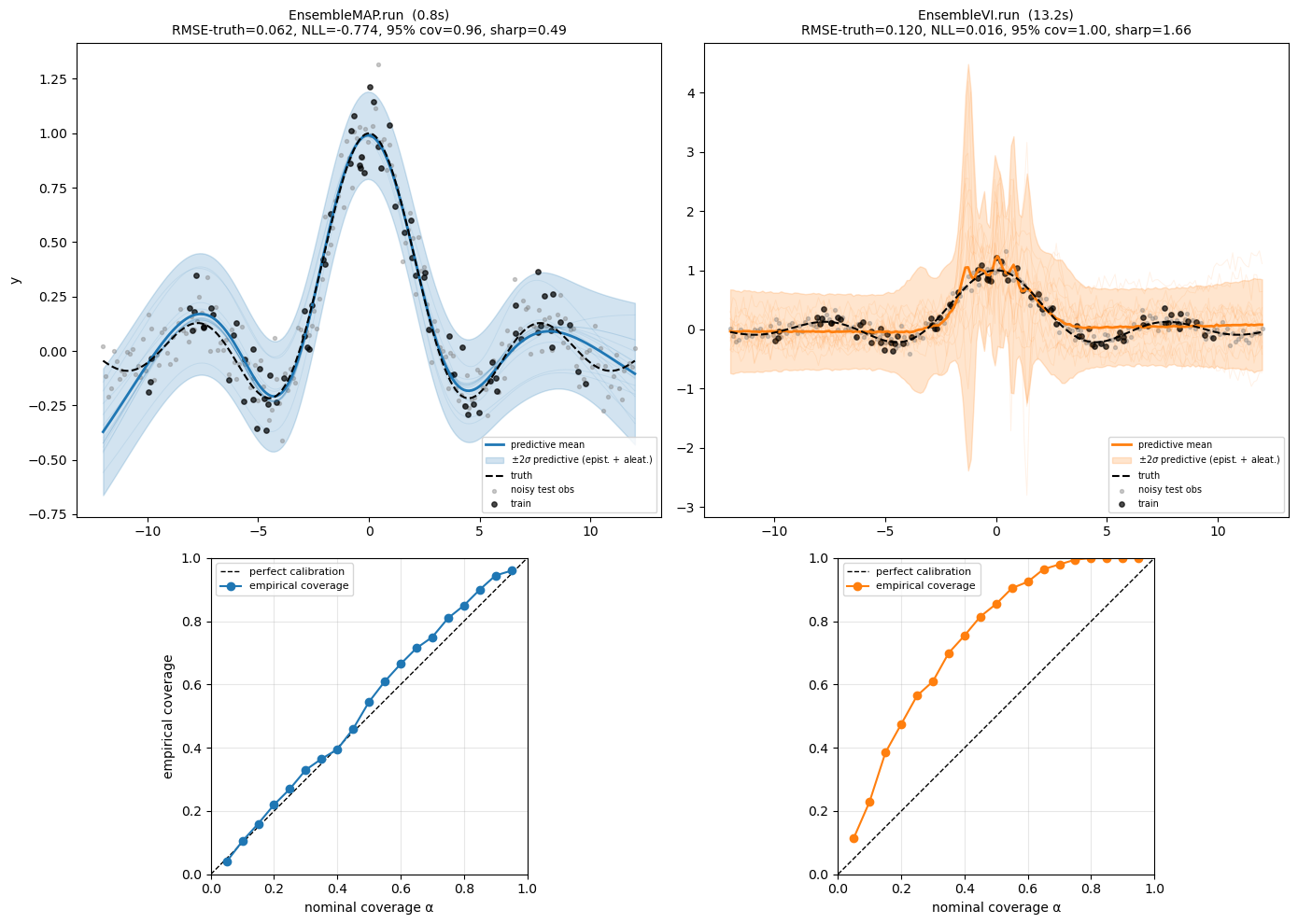
Summary table — full goodness-of-fit comparison
print(f"oracle NLL (perfect f, known σ): {oracle_nll:.3f}")
print(f"oracle 95% interval width (4σ):  {oracle_width:.2f}")
print()
print(
    f"{'Pattern':<40} {'Runtime':>8} {'RMSE-truth':>11} {'RMSE-obs':>9} {'NLL':>8} {'cov95':>7} {'sharp95':>9}"
)
all_rows = [
    ("EnsembleMAP.init+update (jit loop)", preds_iu, dt_iu),
    ("EnsembleMAP.run (lax.scan)", preds_run, dt_run),
    ("ensemble_map sugar", preds_sugar, dt_sugar),
    ("EnsembleVI.run", preds_vi, dt_vi),
]
for label, preds, dt in all_rows:
    m = gof_metrics(preds, SIGMA, y_truth, y_test_noisy)
    print(
        f"{label:<40} {dt:>7.2f}s {m['rmse_truth']:>11.4f} {m['rmse_obs']:>9.4f} "
        f"{m['nll']:>8.3f} {m['coverage_95']:>7.2f} {m['sharpness_95']:>9.3f}"
    )
oracle NLL (perfect f, known σ): -0.884
oracle 95% interval width (4σ): 0.40
Pattern Runtime RMSE-truth RMSE-obs NLL cov95 sharp95
EnsembleMAP.init+update (jit loop) 3.36s 0.0589 0.1089 -0.792 0.94 0.426
EnsembleMAP.run (lax.scan) 0.78s 0.0618 0.1111 -0.774 0.96 0.486
ensemble_map sugar 2.35s 0.0618 0.1111 -0.774 0.96 0.486
EnsembleVI.run 13.15s 0.1204 0.1482 0.016 1.00 1.658
Takeaways
- Three call patterns, one object.
init/updategives you full Python control;rungives youlax.scanspeed; the bareensemble_mapfunction gives you a one-liner. Pick whichever ergonomics you need — the underlying maths is identical andinit+updatematchesrunto within seed-dependent permutation order. EnsembleMAPandEnsembleVIshare an API. Sameinit/update/runtriplet, sameEnsembleResult(params, losses)return type. The only difference is what each member fits.- MAP is near-oracle on this problem. All three MAP variants land at NLL against an oracle ceiling of -0.88, with 94% empirical coverage at the 95% nominal level and sharpness versus the irreducible . The point-mass mixture is doing essentially everything the data allows, and the predictive variance is dominated by aleatoric noise inside the training range.
- Mean-field VI is overdispersed here. With NLL , 100% empirical coverage, and sharpness (more than the oracle), the VI ensemble buys coverage by paying a lot of sharpness — the bands are so wide they trivially contain every test observation, but the predictive density at any specific observation is small. This is the classic mean-field VI pathology: the diagonal-Gaussian factorization can’t represent the strong posterior correlations between MLP weights, so the posterior marginals end up much wider than they should be. Either a richer guide (low-rank, IAF, normalizing flow) or
kl_weight < 1(cold-posterior temper) typically helps. - What “good” looks like. Read the calibration plots, NLL, and sharpness together. NLL alone catches both miscalibration and inaccuracy in one number; coverage tells you the direction of the miscalibration; sharpness tells you the price you’re paying for that coverage.
- When to drop down: if you need anything the runner doesn’t expose — custom batching, callbacks, early stopping, a non-standard inference loop — see the primitives tutorial.