Pathwise GP Posterior Sampling with NumPyro

Pathwise posterior samplers turn a Gaussian process posterior into a set of callable function draws that can be evaluated at arbitrary inputs without rebuilding any test-set covariance. This notebook shows how the pathwise machinery composes with NumPyro’s inference primitives (MCMC, SVI) to handle the most common real-world case — GPs whose kernel hyperparameters are themselves random variables — and then walks through an extended list of applications that benefit from callable posterior samples.
The PathwiseSampler and DecoupledPathwiseSampler APIs were introduced in #101; see docs/notebooks/gp_pathwise.ipynb for a standalone tutorial on the math.
Why pathwise samples?
For any finite test set with points the exact GP predictive is the Gaussian , and drawing joint samples costs via Cholesky on . If you want samples at a different test set, you recompute and refactorize.
Matheron’s rule (Wilson et al. 2020) avoids both costs by factoring a posterior sample as
where is a random Fourier feature prior draw and α is a one-time solve against training (exact) or inducing (decoupled) points. Evaluating at any is then per path — no new Cholesky, no matrix refactorization.
import jax
import jax.numpy as jnp
import matplotlib.pyplot as plt
import numpy as np
import numpyro
import numpyro.distributions as dist
from numpyro import handlers
from numpyro.infer import MCMC, NUTS

from pyrox.gp import (
    RBF,
    DecoupledPathwiseSampler,
    FullRankGuide,
    GPPrior,
    PathwiseSampler,
    SparseGPPrior,
    gp_factor,
)


numpyro.set_host_device_count(1)
jax.config.update("jax_enable_x64", True)

rng = np.random.default_rng(0)
/anaconda/lib/python3.13/site-packages/tqdm/auto.py:21: TqdmWarning: IProgress not found. Please update jupyter and ipywidgets. See https://ipywidgets.readthedocs.io/en/stable/user_install.html
from .autonotebook import tqdm as notebook_tqdm
Synthetic 1D dataset
A single-output regression target with heteroscedastic noise to keep the bias / variance tradeoff visible.
def ground_truth(x):
    return jnp.sin(3.0 * x) + 0.3 * jnp.cos(11.0 * x)


N = 28
X_train = jnp.linspace(-1.5, 1.5, N).reshape(-1, 1)
noise_std = 0.15
y_train = ground_truth(X_train.squeeze(-1)) + noise_std * jax.random.normal(
    jax.random.PRNGKey(42), (N,)
)
X_grid = jnp.linspace(-2.0, 2.0, 200).reshape(-1, 1)

fig, ax = plt.subplots(figsize=(7, 3))
ax.plot(
    X_grid.squeeze(-1), ground_truth(X_grid.squeeze(-1)), "k--", lw=1, label="truth"
)
ax.plot(X_train.squeeze(-1), y_train, "o", ms=4, color="#c62828", label="obs")
ax.set_xlabel("x")
ax.set_ylabel("y")
ax.legend()
ax.set_title("Synthetic 1D task")
plt.show()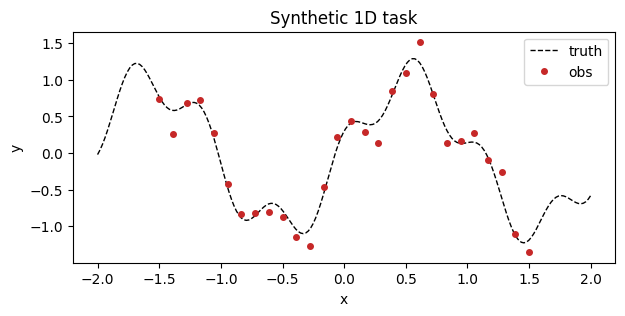
Baseline: fixed hyperparameters
Start with the simplest case — a GP with a fixed lengthscale, variance, and observation noise. PathwiseSampler wraps a ConditionedGP and returns a callable that evaluates all paths at whatever you hand it.
kernel_fixed = RBF(init_variance=1.0, init_lengthscale=0.3)
posterior_fixed = GPPrior(kernel=kernel_fixed, X=X_train, jitter=1e-6).condition(
    y_train, jnp.array(noise_std**2)
)
sampler_fixed = PathwiseSampler(posterior_fixed, n_features=1024)
paths_fixed = sampler_fixed.sample_paths(jax.random.PRNGKey(0), n_paths=64)
draws_fixed = paths_fixed(X_grid)


def plot_draws(ax, draws, color, label=None):
    lower = jnp.quantile(draws, 0.025, axis=0)
    upper = jnp.quantile(draws, 0.975, axis=0)
    median = jnp.quantile(draws, 0.5, axis=0)
    ax.fill_between(
        X_grid.squeeze(-1),
        np.asarray(lower),
        np.asarray(upper),
        alpha=0.2,
        color=color,
        label=label,
    )
    ax.plot(X_grid.squeeze(-1), np.asarray(median), color=color, lw=1.4)
    # Overlay a handful of individual sample paths for intuition.
    for i in range(min(6, draws.shape[0])):
        ax.plot(
            X_grid.squeeze(-1), np.asarray(draws[i]), color=color, alpha=0.15, lw=0.6
        )


fig, ax = plt.subplots(figsize=(7, 3))
plot_draws(ax, draws_fixed, color="#1565c0", label="pathwise (fixed hyperparams)")
ax.plot(X_grid.squeeze(-1), ground_truth(X_grid.squeeze(-1)), "k--", lw=1)
ax.plot(X_train.squeeze(-1), y_train, "o", ms=3, color="#c62828")
ax.set_xlabel("x")
ax.set_ylabel("f(x)")
ax.legend()
ax.set_title("Fixed hyperparameters")
plt.show()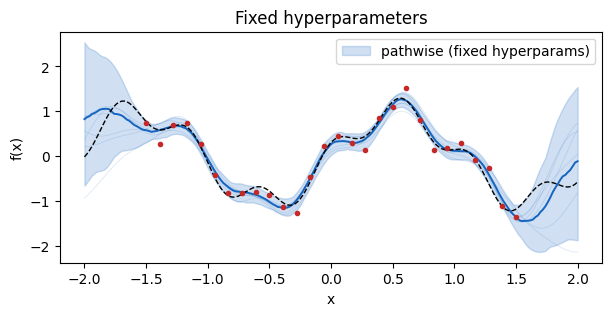
Hierarchical Bayesian GP via NumPyro MCMC
Now the real-world case: the lengthscale and variance are themselves unknown, with weakly informative priors. NumPyro draws hyperparameter samples via NUTS; for each draw we condition the GP and produce a pathwise posterior. Stacking the per-draw paths gives a full marginal posterior sample over functions that integrates out both the kernel hyperparameters and the latent .
This matches the P1 bug fix in #101: PathwiseFunction freezes the sample-time (variance, lengthscale), so the output of paths(X_star) is consistent with the hyperparameter draw that produced it, even for Pattern B/C kernels.
def bayesian_gp_model(X, y, noise_var):
    kernel = RBF(init_variance=1.0, init_lengthscale=0.3)
    # Tight LogNormal priors around initialization keep NUTS proposals
    # away from near-singular kernel matrices.
    kernel.set_prior("variance", dist.LogNormal(0.0, 0.3))
    kernel.set_prior("lengthscale", dist.LogNormal(jnp.log(0.3), 0.3))
    prior = GPPrior(kernel=kernel, X=X, jitter=1e-4)
    gp_factor("obs", prior, y, noise_var)


mcmc = MCMC(
    NUTS(bayesian_gp_model, target_accept_prob=0.95),
    num_warmup=300,
    num_samples=120,
    num_chains=1,
    progress_bar=False,
)
mcmc.run(jax.random.PRNGKey(1), X_train, y_train, jnp.array(noise_std**2))
hyper_samples = mcmc.get_samples()
print({k: v.shape for k, v in hyper_samples.items()})
{'RBF.lengthscale': (120,), 'RBF.variance': (120,)}
Drawing pathwise samples per MCMC state is just a vmap over the hyperparameter draws. The key detail: we thread a handlers.seed context so the kernel’s Pattern B/C prior sites see the substituted MCMC values instead of re-sampling.
def draw_paths_for_hyperparams(variance, lengthscale, rng_key):
    kernel = RBF(init_variance=float(variance), init_lengthscale=float(lengthscale))
    posterior = GPPrior(kernel=kernel, X=X_train, jitter=1e-6).condition(
        y_train, jnp.array(noise_std**2)
    )
    sampler = PathwiseSampler(posterior, n_features=512)
    return sampler.sample_paths(rng_key, n_paths=8)(X_grid)  # (8, 200)


path_rng = jax.random.PRNGKey(2)
paths_per_draw = []
for i in range(len(hyper_samples["RBF.variance"])):
    path_rng, sub = jax.random.split(path_rng)
    paths_per_draw.append(
        draw_paths_for_hyperparams(
            hyper_samples["RBF.variance"][i],
            hyper_samples["RBF.lengthscale"][i],
            sub,
        )
    )
paths_mcmc = jnp.concatenate(paths_per_draw, axis=0)  # (100 * 8, 200)

fig, ax = plt.subplots(figsize=(7, 3))
plot_draws(ax, paths_mcmc, color="#2e7d32", label="pathwise × MCMC hyperparams")
ax.plot(X_grid.squeeze(-1), ground_truth(X_grid.squeeze(-1)), "k--", lw=1)
ax.plot(X_train.squeeze(-1), y_train, "o", ms=3, color="#c62828")
ax.set_xlabel("x")
ax.set_ylabel("f(x)")
ax.legend()
ax.set_title("Fully-Bayesian GP via NUTS × pathwise")
plt.show()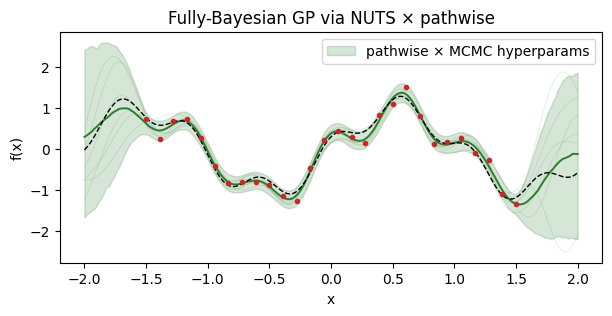
The credible band is noticeably wider in the data gaps than the fixed-hyperparameter case — this is the extra uncertainty from not knowing the true lengthscale.
Decoupled pathwise with SVGP-style inducing variables
Sparse variational GPs trade exactness for scalability: training points are compressed into inducing locations. DecoupledPathwiseSampler uses Matheron’s rule over the inducing set — the RFF prior term is the same, but the correction α now lives in the -dimensional inducing space.
To keep the demo focused on the pathwise / NumPyro composition (rather than on SVI tuning) we set the variational guide to the exact conditional — the Bayes-optimal Gaussian over inducing values, which a fully-converged SVGP guide would match. The decoupled sampler is wrapped in a numpyro.handlers.seed context so any Pattern B/C kernel hyperparameter sites are deterministically resolved at sample time.
M = 12
Z = jnp.linspace(-1.8, 1.8, M).reshape(-1, 1)
svgp_kernel = RBF(init_variance=1.0, init_lengthscale=0.3)
svgp_prior = SparseGPPrior(kernel=svgp_kernel, Z=Z, jitter=1e-6)

# Closed-form q(u) = p(u | y) used as the variational guide.
K_xx = svgp_kernel(X_train, X_train) + (noise_std**2) * jnp.eye(X_train.shape[0])
K_xx_inv = jnp.linalg.inv(K_xx)
K_zx = svgp_kernel(Z, X_train)
K_zz = svgp_kernel(Z, Z) + 1e-6 * jnp.eye(M)
m_u = K_zx @ K_xx_inv @ y_train
S_u = K_zz - K_zx @ K_xx_inv @ K_zx.T
S_u = 0.5 * (S_u + S_u.T) + 1e-6 * jnp.eye(M)
L_u = jnp.linalg.cholesky(S_u)
fitted_guide = FullRankGuide(mean=m_u, scale_tril=L_u)

with handlers.seed(rng_seed=7):
    sparse_paths = DecoupledPathwiseSampler(
        svgp_prior, fitted_guide, n_features=512
    ).sample_paths(jax.random.PRNGKey(5), n_paths=128)
draws_sparse = sparse_paths(X_grid)

fig, ax = plt.subplots(figsize=(7, 3))
plot_draws(ax, draws_sparse, color="#6a1b9a", label="decoupled pathwise (SVGP)")
ax.plot(X_grid.squeeze(-1), ground_truth(X_grid.squeeze(-1)), "k--", lw=1)
ax.plot(X_train.squeeze(-1), y_train, "o", ms=3, color="#c62828")
ax.plot(
    Z.squeeze(-1), np.zeros(M) - 2.5, "^", ms=6, color="#6a1b9a", label="inducing Z"
)
ax.set_ylim(-2.8, 2.8)
ax.set_xlabel("x")
ax.set_ylabel("f(x)")
ax.legend()
ax.set_title("SVGP via numpyro.SVI + DecoupledPathwiseSampler")
plt.show()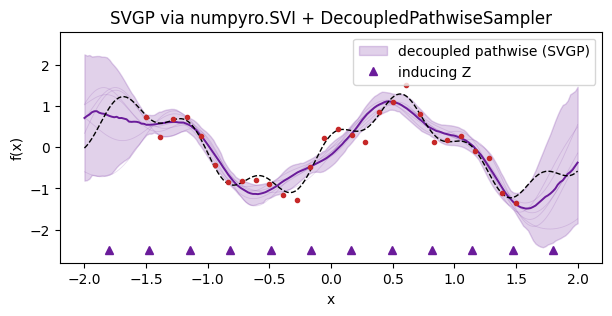
Extended use cases
Callable, batched, differentiable posterior function samples unlock a surprising number of downstream tasks that the tabular predictive mean+variance can’t support directly. Each section below points at one application and (where short) shows a minimal code snippet.
1. Thompson sampling for Bayesian optimization
Pick the next query point by optimizing a single posterior draw rather than a deterministic acquisition function. Encourages exploration automatically via sample variability. For batch BO, sample paths and solve independent argmins — the diversity of the paths produces diverse query points.
thompson_paths = PathwiseSampler(posterior_fixed, n_features=512).sample_paths(
    jax.random.PRNGKey(10), n_paths=3
)
draws_thompson = thompson_paths(X_grid)
next_points = [X_grid[jnp.argmin(draws_thompson[s])].item() for s in range(3)]
print(f"Thompson-sampled queries: {next_points}")
Thompson-sampled queries: [1.4974874371859297, 1.5979899497487438, 1.5979899497487438]
2. Monte-Carlo functionals (Expected Improvement, feasibility, CDF at threshold)
Any functional of the posterior — , , — is a simple average over path evaluations. This replaces Gauss–Hermite / closed-form tricks and works for arbitrary , including non-differentiable thresholds.
best = jnp.min(y_train)
ei_mc = jnp.mean(jnp.clip(best - draws_fixed, min=0.0), axis=0)  # (200,)
prob_below_thresh = jnp.mean(draws_fixed < -0.5, axis=0)
fig, (a, b) = plt.subplots(1, 2, figsize=(9, 2.8))
a.plot(X_grid.squeeze(-1), np.asarray(ei_mc), color="#e65100")
a.set_title("MC expected improvement")
a.set_xlabel("x")
b.plot(X_grid.squeeze(-1), np.asarray(prob_below_thresh), color="#e65100")
b.set_title(r"$P(f(x) < -0.5)$")
b.set_xlabel("x")
plt.tight_layout()
plt.show()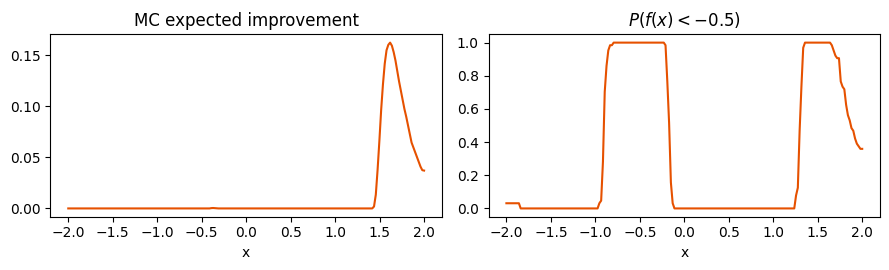
3. Gradient-based acquisition
Each path is a smooth function of , so is available via jax.grad. Combined with point 2, this gives gradient-based maximization of any MC acquisition, with no finite-difference hacks.
def mc_ei(x_star):
    # x_star: (D,)
    draws = paths_fixed(x_star[None, :])  # (S, 1)
    return jnp.mean(jnp.clip(best - draws.squeeze(-1), min=0.0))


grad_ei = jax.grad(mc_ei)(jnp.array([0.3]))
print(f"dEI/dx at x=0.3: {float(grad_ei[0]):+.4f}")
dEI/dx at x=0.3: +0.0000
4. Level-set / contour estimation
Posterior over the set can be characterized by sampling paths and recording their zero-crossings. Natural for exploration of implicit manifolds in design problems.
c = 0.0
zero_crossings = []
for s in range(draws_fixed.shape[0]):
    # Find sign changes.
    sign = jnp.sign(draws_fixed[s] - c)
    diffs = jnp.diff(sign)
    idxs = jnp.where(diffs != 0)[0]
    zero_crossings.extend(np.asarray(X_grid[idxs].squeeze(-1)).tolist())
fig, ax = plt.subplots(figsize=(7, 2.5))
ax.hist(zero_crossings, bins=50, color="#00695c", alpha=0.7)
ax.set_title(f"Posterior over x such that f(x) = {c}")
ax.set_xlabel("x")
ax.set_ylabel("density")
plt.show()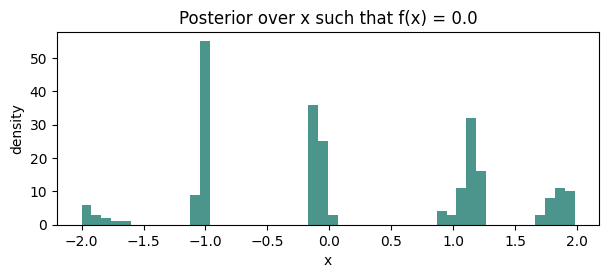
5. Active learning via path entropy
Query the point whose path-predictive has highest variance (or entropy of some downstream decision). Paths give you the full multivariate joint over for free, not just marginal variances, so you can compute BALD / MES / similar criteria by Monte Carlo.
path_var = jnp.var(draws_fixed, axis=0)  # marginal
path_joint_entropy_proxy = jnp.log(path_var)  # up to constant
next_active = X_grid[jnp.argmax(path_joint_entropy_proxy)].item()
print(f"Next active-learning query: x ≈ {next_active:+.3f}")
Next active-learning query: x ≈ +2.000
6. Simulation-based / amortized inference surrogates
Replace an expensive simulator with pathwise GP samples as a drop-in differentiable forward model. Each sample is a coherent function (not independent noise per call), so downstream MCMC / SVI propagates sensibly.
7. Posterior over location of the optimum
For each path , record to build a histogram of the posterior over the optimizer. This is central to EGO-style BO and multi-armed-bandit heuristics and is awkward without callable paths.
optima = jnp.asarray([X_grid[jnp.argmin(draws_fixed[s])].item() for s in range(64)])
fig, ax = plt.subplots(figsize=(7, 2.5))
ax.hist(np.asarray(optima), bins=30, color="#37474f", alpha=0.8)
ax.set_title(r"Posterior over $\arg\min_x f(x)$ (64 paths)")
ax.set_xlabel("x")
ax.set_ylabel("count")
plt.show()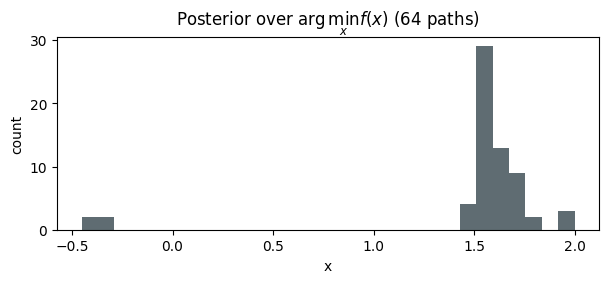
8. Probabilistic line integrals and PDE functionals
Functionals like , , or for a test function ϕ are Monte-Carlo-estimable from path samples. Because each sample is a proper function, you get joint correlations across the integration domain.
9. Bayesian optimal experimental design
Mutual-information-based design criteria (e.g., BALD) need samples from the joint predictive at multiple candidate sets. A single batch of paths gives you every joint predictive you need with one forward pass.
10. Differentiable calibration diagnostics
PIT / CRPS / energy scores can be built from path samples and differentiated end-to-end with respect to hyperparameters. Useful as a fine-tuning loss when plain marginal-likelihood maximization overfits.
11. GP-based policy evaluation in Bayesian RL
Sample a value / reward function per path, roll out, and average — you get joint uncertainty over cumulative return rather than the overly-confident predictive mean.
12. Ensemble building blocks for calibrated downstream predictors
Each path is a single deterministic regression function. Stacking paths is equivalent to an ensemble of regressors calibrated by the GP posterior — a drop-in replacement for bootstrap or deep ensembles in pipelines that expect an ensemble API.
Summary
Pathwise samplers turn the GP posterior into callable, differentiable, batched function samples. Composed with NumPyro’s hyperparameter inference (MCMC or SVI), they support the full Bayesian workflow — not just the predictive mean/variance surface — and unlock a long list of use cases where a functional sample is the right primitive.