Catalog — build → query → load (intro)
Catalog intro — build → query → load on a real Sentinel-2 archive
This notebook walks the canonical geocatalog flow against a real
Sentinel-2 L2A archive over Lake Tahoe — eight scenes spanning June
2024 pulled from Microsoft Planetary Computer. We:
- Discover items via STAC, sign their asset URLs.
- Build a
GeoCatalogfrom the signed URLs (one row per scene). - Run spatial + temporal queries.
- Mosaic and time-stack matching rows into
GeoTensors.
No synthetic GeoTIFFs, no tempfile setup — the catalog flow is the
only substrate, and the URLs are real.
import json

import geocatalog as gc
import matplotlib.pyplot as plt
import numpy as np
import pandas as pd
from geostack import LAKE_TAHOE_BBOX, LAKE_TAHOE_TILE, load_stac_items
1. Discover scenes via STAC
Eight cloud-free Sentinel-2 L2A items over Lake Tahoe in June 2024 —
load_stac_items does the search + signing.
items = load_stac_items(
    "sentinel-2-l2a",
    LAKE_TAHOE_BBOX,
    "2024-06-01/2024-07-31",
    tile=LAKE_TAHOE_TILE,
    max_cloud_cover=15,
)
print(f"found {len(items)} S2 L2A items on MGRS tile {LAKE_TAHOE_TILE}")
for it in items[:5]:
    print(f"  {it.id}  cloud_cover={it.properties['eo:cloud_cover']:.2f}%")
found 22 S2 L2A items on MGRS tile 10SGJ
S2A_MSIL2A_20240729T183921_R070_T10SGJ_20240730T023050 cloud_cover=0.00%
S2B_MSIL2A_20240614T183919_R070_T10SGJ_20240615T003207 cloud_cover=0.01%
S2A_MSIL2A_20240709T183921_R070_T10SGJ_20240710T024627 cloud_cover=0.01%
S2A_MSIL2A_20240629T183921_R070_T10SGJ_20240630T032941 cloud_cover=0.01%
S2B_MSIL2A_20240604T183919_R070_T10SGJ_20240604T233744 cloud_cover=0.02%
2. Build a raster catalog from the signed URLs
build_raster_catalog reads each file’s bounds (via rasterio —
/vsicurl/ for remote URLs) and a date from the filename via the
(?P<date>…) named group. Sentinel-2 product IDs follow the pattern
S2X_MSIL2A_YYYYMMDDTHHMMSS_… — we extract the YYYYMMDD chunk.
# One asset per scene — pick B04 (Red, 10 m). The catalog stores the
# URL + the metadata; we'll pull pixel data lazily on `load_raster`.
urls = [it.assets["B04"].href for it in items]

catalog = gc.build_raster_catalog(
    urls,
    filename_regex=r".*_(?P<date>\d{8})T\d{6}_.*\.tif",
    target_crs="EPSG:32610",
)
print(f"len(catalog): {len(catalog)}")
print(f"catalog.backend: {catalog.backend!r}")
print(f"catalog.total_bounds: {tuple(round(x, 1) for x in catalog.total_bounds)}")
print(f"catalog.temporal_extent: {catalog.temporal_extent}")
len(catalog): 22
catalog.backend: 'raster'
catalog.total_bounds: (699960.0, 4290240.0, 809760.0, 4400040.0)
catalog.temporal_extent: [2024-06-02 00:00:00, 2024-07-29 23:59:59.999999]
Inspect the underlying GeoDataFrame — one row per scene with a
geometry column (footprint polygon) and an IntervalIndex row
index carrying the time interval.
catalog.gdf[["filepath", "start_time", "end_time"]].head()3. Query
Build a GeoSlice over the western shore of Lake Tahoe for the
first week of June. Ask the catalog which rows intersect.
# UTM 10N coordinates for the Lake Tahoe AOI:
aoi_bounds_utm = (752000.0, 4320000.0, 760000.0, 4330000.0)
aoi_week1 = gc.GeoSlice(
    bounds=aoi_bounds_utm,
    interval=pd.Interval(
        pd.Timestamp("2024-06-01"), pd.Timestamp("2024-06-07"), closed="both"
    ),
    resolution=(10.0, 10.0),
    crs="EPSG:32610",
)
hits = catalog.query(aoi_week1)
print(f"first-week hits: {len(hits)}")
print(hits.gdf[["start_time", "filepath"]].to_string())
first-week hits: 3
start_time filepath
datetime
[2024-06-04 00:00:00, 2024-06-04 23:59:59.999999] 2024-06-04 https://sentinel2l2a01.blob.core.windows.net/sentinel2-l2/10/S/GJ/2024/06/04/S2B_MSIL2A_20240604T183919_N0510_R070_T10SGJ_20240604T233744.SAFE/GRANULE/L2A_T10SGJ_A037848_20240604T185042/IMG_DATA/R10m/T10SGJ_20240604T183919_B04_10m.tif?st=2026-05-25T14%3A11%3A18Z&se=2026-05-26T14%3A56%3A18Z&sp=rl&sv=2025-07-05&sr=c&skoid=9c8ff44a-6a2c-4dfb-b298-1c9212f64d9a&sktid=72f988bf-86f1-41af-91ab-2d7cd011db47&skt=2026-05-26T10%3A36%3A29Z&ske=2026-06-02T10%3A36%3A29Z&sks=b&skv=2025-07-05&sig=8kjQCo2Nd32T7uTnppbDEH5pCgxEL7pq1YqAFpTPEqs%3D
[2024-06-07 00:00:00, 2024-06-07 23:59:59.999999] 2024-06-07 https://sentinel2l2a01.blob.core.windows.net/sentinel2-l2/10/S/GJ/2024/06/07/S2B_MSIL2A_20240607T184919_N0510_R113_T10SGJ_20240608T003436.SAFE/GRANULE/L2A_T10SGJ_A037891_20240607T185839/IMG_DATA/R10m/T10SGJ_20240607T184919_B04_10m.tif?st=2026-05-25T14%3A11%3A18Z&se=2026-05-26T14%3A56%3A18Z&sp=rl&sv=2025-07-05&sr=c&skoid=9c8ff44a-6a2c-4dfb-b298-1c9212f64d9a&sktid=72f988bf-86f1-41af-91ab-2d7cd011db47&skt=2026-05-26T10%3A36%3A29Z&ske=2026-06-02T10%3A36%3A29Z&sks=b&skv=2025-07-05&sig=8kjQCo2Nd32T7uTnppbDEH5pCgxEL7pq1YqAFpTPEqs%3D
[2024-06-02 00:00:00, 2024-06-02 23:59:59.999999] 2024-06-02 https://sentinel2l2a01.blob.core.windows.net/sentinel2-l2/10/S/GJ/2024/06/02/S2A_MSIL2A_20240602T184921_N0510_R113_T10SGJ_20240603T032329.SAFE/GRANULE/L2A_T10SGJ_A046728_20240602T185554/IMG_DATA/R10m/T10SGJ_20240602T184921_B04_10m.tif?st=2026-05-25T14%3A11%3A18Z&se=2026-05-26T14%3A56%3A18Z&sp=rl&sv=2025-07-05&sr=c&skoid=9c8ff44a-6a2c-4dfb-b298-1c9212f64d9a&sktid=72f988bf-86f1-41af-91ab-2d7cd011db47&skt=2026-05-26T10%3A36%3A29Z&ske=2026-06-02T10%3A36%3A29Z&sks=b&skv=2025-07-05&sig=8kjQCo2Nd32T7uTnppbDEH5pCgxEL7pq1YqAFpTPEqs%3D
Cross-CRS query
Same query but with the AOI specified in EPSG:4326. The catalog reprojects the bbox internally — silent empty-result bugs from CRS mismatches are caught at the boundary.
aoi_4326 = gc.GeoSlice(
    bounds=LAKE_TAHOE_BBOX,
    interval=aoi_week1.interval,
    resolution=(0.0001, 0.0001),
    crs="EPSG:4326",
)
hits_4326 = catalog.query(aoi_4326)
print(f"same query via EPSG:4326: {len(hits_4326)} hits")
same query via EPSG:4326: 3 hits
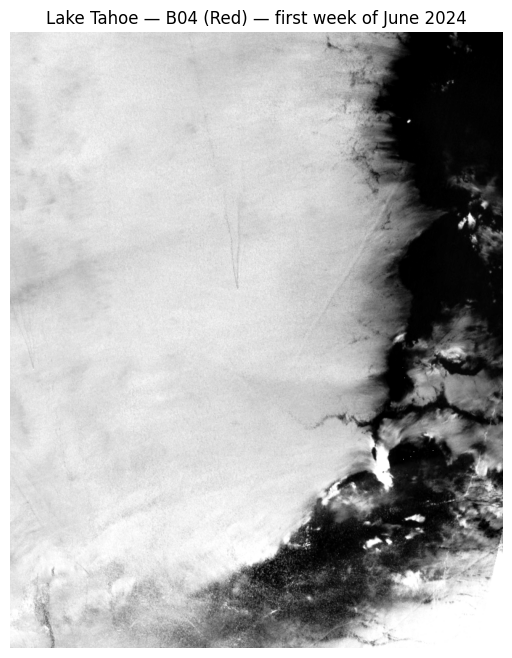
4. Load a single-scene mosaic
load_raster mosaics every catalog row that intersects the slice
into one GeoTensor. With one row, this is a windowed read; with
multiple, the merge is controlled by merge_method.
mosaic_week1 = gc.load_raster(catalog, aoi_week1, merge_method="last")
print(f"mosaic shape: {mosaic_week1.values.shape}  dtype={mosaic_week1.values.dtype}")
print(f"mosaic crs:   {mosaic_week1.crs}")

fig, ax = plt.subplots(figsize=(7, 8))
arr = mosaic_week1.values.squeeze()
ax.imshow(arr, cmap="Greys_r", vmin=np.percentile(arr, 2), vmax=np.percentile(arr, 98))
ax.set_title("Lake Tahoe — B04 (Red) — first week of June 2024")
ax.axis("off")
plt.show()
mosaic shape: (1, 1000, 800) dtype=uint16
mosaic crs: EPSG:32610
5. Time-series stacking
load_raster_timeseries walks the catalog day by day and stacks the
daily mosaics along a leading time axis. Over the full eight-week
AOI we get one B04 mosaic per acquisition date.
aoi_full = gc.GeoSlice(
    bounds=aoi_bounds_utm,
    interval=pd.Interval(
        pd.Timestamp("2024-06-01"), pd.Timestamp("2024-07-31"), closed="both"
    ),
    resolution=(10.0, 10.0),
    crs="EPSG:32610",
)
series = gc.load_raster_timeseries(catalog, aoi_full)
print(f"time-series shape: {series.values.shape}")
print(f"  T = {series.values.shape[0]} distinct acquisition dates")

T = series.values.shape[0]
fig, axes = plt.subplots(1, T, figsize=(2.6 * T, 3.5))
for i, ax in enumerate(np.atleast_1d(axes)):
    arr = series.values[i].squeeze()
    ax.imshow(
        arr,
        cmap="Greys_r",
        vmin=np.percentile(arr, 2),
        vmax=np.percentile(arr, 98),
    )
    ax.set_title(f"t={i}", fontsize=9)
    ax.set_xticks([])
    ax.set_yticks([])
plt.suptitle("Per-date B04 mosaics over Lake Tahoe (June–July 2024)")
plt.tight_layout()
plt.show()
time-series shape: (22, 1, 1000, 800)
T = 22 distinct acquisition dates

6. get_config()
Every catalog returns a JSON-serialisable summary — handy for logging and reproducibility audits.
print(json.dumps(catalog.get_config(), indent=2)){
"backend": "raster",
"len": 22,
"crs": "EPSG:32610"
}
Where next
- 02_backends — raster (here), xarray, and vector catalog backends on heterogeneous real data.
- 03_set_algebra —
query/intersect/unionover multiple real catalogs. - 04_duckdb —
DuckDBGeoCatalogagainst the Overture buildings GeoParquet (billions of rows). - 05_patching_bridge —
CatalogDomainplugs the catalog into the sameSpatialPatcherpipeline from the patching deep dives.