Lorenz-96 (single-level) — analysis-then-forecast setup
The higher-dimensional sibling of Lorenz-63: a ring of coupled scalar variables with periodic boundary conditions,
With and the system is fully chaotic, with a Lyapunov time of about time units. We use a 0.5-time-unit assim window inside a 5-time-unit total run (~10 Lyapunov times) so the free-forecast covers many e-fold times — the standard PyDA pattern, scaled to L96’s faster Lyapunov clock.
This notebook covers decisions, simulation, observation design,
and sanity checks. The benchmark itself —
10_lorenz96_benchmark — runs the
seven AnalysisStep methods on the resulting problem.
from __future__ import annotations

import jax
import jax.numpy as jnp
import matplotlib.pyplot as plt

from assimilation import Lorenz96Forward, generate_l96_problem
1. Decisions
| Parameter | Value | Rationale |
|---|---|---|
| 40 | Canonical chaotic dimension. | |
| 8.0 | Standard L96 chaotic forcing. | |
| 0.01 | RK4 step. | |
| 50 (0.5 time units) | About one Lyapunov time; long enough for sparse obs, short enough for 4DVar’s BFGS to converge. | |
| 500 (5 time units) | ~10 Lyapunov times of free-forecast. | |
| 1.0 | Obs noise std (~10% of typical state magnitude). | |
| 5.0 | Background-error std. |
2. Simulate a long trajectory + Hovmöller
fwd_long = Lorenz96Forward(K=40, F=8.0, dt=0.01)
x0 = 8.0 * jnp.ones(40) + 0.01 * jax.random.normal(jax.random.PRNGKey(0), (40,))


def _scan(state, _):
    new = fwd_long.step(state, fwd_long.dt)
    return new, new


state, _ = jax.lax.scan(_scan, x0, None, length=500)  # burn-in
_, traj_long = jax.lax.scan(_scan, state, None, length=500)
print(f"long trajectory: {traj_long.shape}")
long trajectory: (500, 40)
fig, ax = plt.subplots(figsize=(10, 4))
t = jnp.arange(500) * 0.01
im = ax.imshow(
    traj_long.T, aspect="auto", cmap="RdBu_r", origin="lower",
    extent=(0, float(t[-1]), 0, 40), vmin=-12, vmax=12,
)
ax.set_xlabel("time")
ax.set_ylabel("grid index $k$")
ax.set_title("Lorenz-96 ground truth — Hovmöller diagram ($K=40$, $F=8$)")
fig.colorbar(im, ax=ax, label="$x_k$")
fig.tight_layout()
plt.show()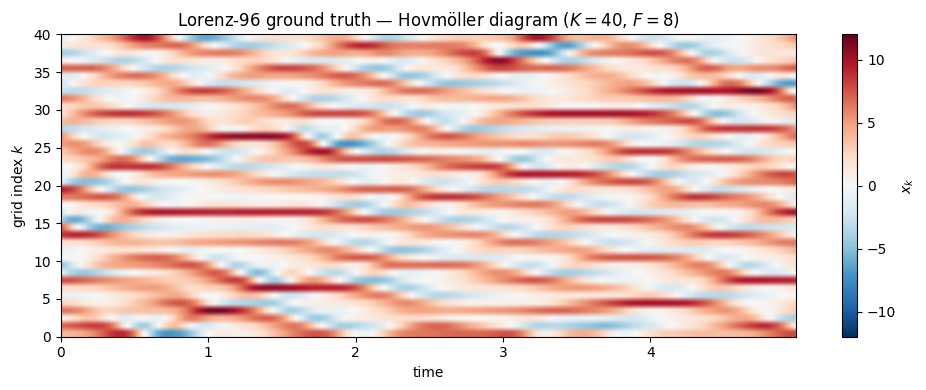
3. Observation design for forecast-mode benchmark
Inside the assim window: observe every 4th grid point at every 0.05 time units (every 5 model steps). 10 spatial × 11 temporal = 110 scalar obs in a 0.5-time-unit window — enough information for strong-4DVar to recover tightly.
Free-forecast window: no obs. Each method’s analysis is rolled forward 4.5 time units through the L96 forward.
prob = generate_l96_problem(key=jax.random.PRNGKey(0))
print(f"K={prob.K}, T_assim={prob.T_assim} (assim {prob.T_assim * prob.dt} time units)")
print(f"T_total={prob.T_total} (total {prob.T_total * prob.dt} time units)")
print(f"obs density: {int(prob.mask.sum())} / {prob.mask.size} entries in assim window")
K=40, T_assim=50 (assim 0.5 time units)
T_total=250 (total 2.5 time units)
obs density: 110 / 2040 entries in assim window
fig, axs = plt.subplots(1, 3, figsize=(13, 4), sharey=True)
extent = (0, prob.K, 0, prob.T_assim_plus_1)
for ax, field, title, cmap in zip(
    axs,
    [prob.truth[: prob.T_assim_plus_1], prob.obs, prob.mask],
    ["truth (assim window)", "observations", "binary mask"],
    ["RdBu_r", "RdBu_r", "Greys"],
    strict=False,
):
    im = ax.imshow(field, aspect="auto", cmap=cmap, origin="lower", extent=extent,
                   vmin=-12 if cmap == "RdBu_r" else None,
                   vmax=12 if cmap == "RdBu_r" else None)
    ax.set_xlabel("grid index $k$")
    ax.set_title(title)
    fig.colorbar(im, ax=ax, fraction=0.04)
axs[0].set_ylabel("time step $t$")
fig.tight_layout()
plt.show()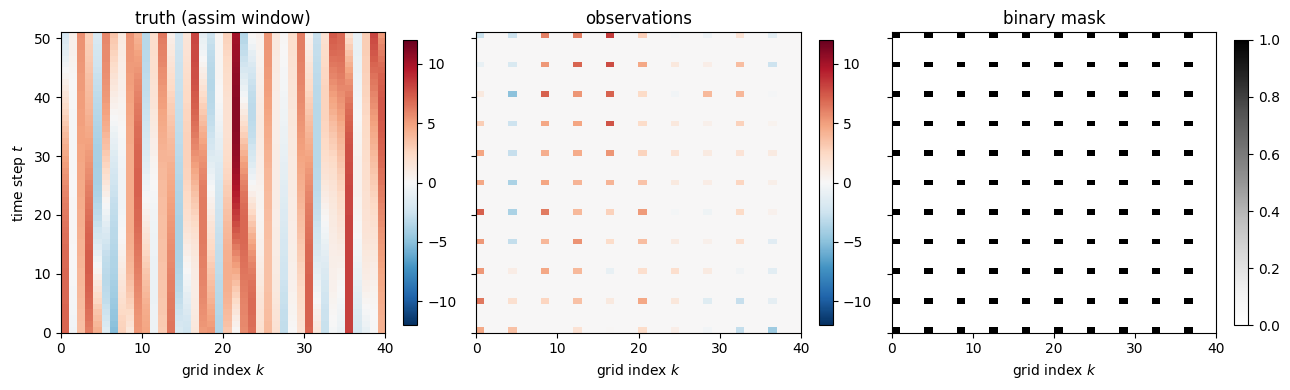
4. Forward roundtrip sanity check
fwd = Lorenz96Forward(K=prob.K, F=prob.F, dt=prob.dt)


def step(s, _):
    new = fwd.step(s, fwd.dt)
    return new, new


_, traj_rt = jax.lax.scan(step, prob.truth[0], None, length=prob.T_total)
truth_rt = jnp.concatenate([prob.truth[0][None, :], traj_rt], axis=0)
print(f"roundtrip max abs error: "
      f"{float(jnp.max(jnp.abs(truth_rt - prob.truth))):.2e}")
roundtrip max abs error: 0.00e+00
5. Truth Hovmöller over the full forecast window
10 Lyapunov times of L96 ground truth. The forecast methods aim to reconstruct this entire image from the bottom-left assim window (yellow-bordered region).
fig, ax = plt.subplots(figsize=(11, 4.5))
t_axis = jnp.arange(prob.T_total_plus_1) * prob.dt
im = ax.imshow(prob.truth.T, aspect="auto", cmap="RdBu_r", origin="lower",
               extent=(0, float(t_axis[-1]), 0, prob.K), vmin=-12, vmax=12)
ax.axvline(prob.T_assim * prob.dt, color="yellow", lw=3,
           label="assim / forecast boundary")
ax.axvspan(0, prob.T_assim * prob.dt, color="yellow", alpha=0.15)
ax.set_xlabel("time")
ax.set_ylabel("grid index $k$")
ax.set_title("L96 truth — assim window (yellow) + free-forecast horizon")
ax.legend(loc="upper right")
fig.colorbar(im, ax=ax)
fig.tight_layout()
plt.show()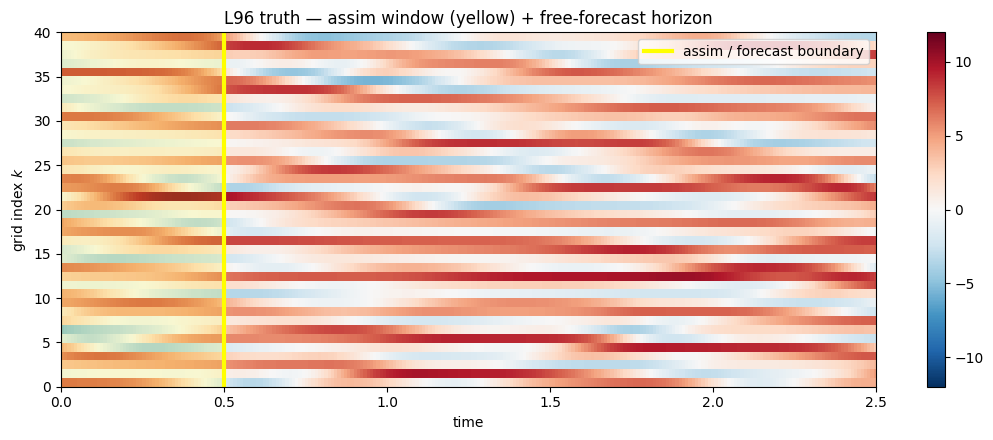
6. Next
Continue to 10_lorenz96_benchmark
to see how each of the seven AnalysisStep methods recovers the
initial state and how long the resulting forecast tracks the
truth across the 10-Lyapunov-time horizon.