GP Regression with NumPyro + gaussx
This notebook shows how to use gaussx.MultivariateNormal inside a
NumPyro model for full Bayesian Gaussian process regression. Because
gaussx distributions accept lineax operators as covariances, we
get structured linear algebra (Cholesky, Woodbury, etc.) for free
while using NumPyro’s MCMC and predictive machinery.
What you’ll learn:
- Defining a GP model with
gaussx.MultivariateNormal - Inferring kernel hyperparameters via NUTS
- Posterior predictive sampling with
numpyro.infer.Predictive - Comparing against the analytic GP posterior
Background
In standard GP regression, hyperparameters θ (kernel variance, lengthscale, noise) are set by maximizing the log-marginal likelihood -- a point estimate (type-II ML). Full Bayesian treatment places priors on θ and integrates them out:
This integral is intractable, but MCMC (here NUTS; Hoffman & Gelman, 2014) samples from and averages the GP predictive over those samples. The result is better-calibrated uncertainty that accounts for hyperparameter uncertainty -- important when data is scarce or hyperparameters are poorly identified.
Setup
from __future__ import annotations

import warnings


warnings.filterwarnings("ignore", message=r".*IProgress.*")

import jax
import jax.numpy as jnp
import lineax as lx
import matplotlib.pyplot as plt
import numpyro
import numpyro.distributions as dist
from numpyro.infer import MCMC, NUTS

import gaussx


jax.config.update("jax_enable_x64", True)
Generate data
We sample from a smooth function with additive Gaussian noise.
key = jax.random.PRNGKey(42)
n_train = 30
noise_std = 0.2

f_true = lambda x: jnp.sin(2 * x) * jnp.exp(-0.3 * x)

key, subkey = jax.random.split(key)
X_train = jnp.sort(jax.random.uniform(subkey, (n_train,), minval=-2, maxval=5))
key, subkey = jax.random.split(key)
y_train = f_true(X_train) + noise_std * jax.random.normal(subkey, (n_train,))

X_test = jnp.linspace(-2.5, 5.5, 200)

print(f"Training points: {n_train}")
print(f"Test points:     {len(X_test)}")
Training points: 30
Test points: 200
Define the NumPyro model
We place log-normal priors on the RBF kernel hyperparameters
(variance, lengthscale) and a half-normal prior on the observation
noise. The likelihood uses gaussx.MultivariateNormal with a
lineax PSD operator.
def gp_model(X, y=None):
    # Priors on kernel hyperparameters
    var = numpyro.sample("kernel_var", dist.LogNormal(0.0, 1.0))
    length = numpyro.sample("kernel_length", dist.LogNormal(0.0, 1.0))
    noise = numpyro.sample("noise", dist.HalfNormal(0.5))

    # RBF kernel matrix
    diff = X[:, None] - X[None, :]
    K = var * jnp.exp(-0.5 * diff**2 / length**2) + noise**2 * jnp.eye(len(X))

    # Wrap as lineax PSD operator
    K_op = lx.MatrixLinearOperator(K, lx.positive_semidefinite_tag)

    # Likelihood via gaussx
    numpyro.sample("obs", gaussx.MultivariateNormal(jnp.zeros(len(X)), K_op), obs=y)
Run NUTS
We use NumPyro’s NUTS sampler to infer the kernel hyperparameters.
The gaussx.MultivariateNormal.log_prob is fully differentiable
via JAX, so NUTS can compute gradients through the structured
linear algebra.
kernel = NUTS(gp_model)
mcmc = MCMC(kernel, num_warmup=300, num_samples=500, progress_bar=False)
mcmc.run(jax.random.PRNGKey(0), X_train, y=y_train)
mcmc.print_summary()
                     mean       std    median      5.0%     95.0%     n_eff     r_hat
  kernel_length      0.74      0.23      0.70      0.38      1.07    130.19      1.00
     kernel_var      0.75      0.83      0.47      0.12      1.59     83.70      1.01
          noise      0.20      0.04      0.19      0.14      0.26    288.93      1.00

Number of divergences: 0
samples = mcmc.get_samples()
print("Posterior shapes:")
for k, v in samples.items():
    print(f"  {k}: {v.shape}")
Posterior shapes:
kernel_length: (500,)
kernel_var: (500,)
noise: (500,)
Posterior hyperparameter distributions
The MCMC samples give us full posteriors over the kernel hyperparameters. Let’s visualize them.
fig, axes = plt.subplots(1, 3, figsize=(14, 3.5))

for ax, name, true_val in zip(
    axes,
    ["kernel_var", "kernel_length", "noise"],
    [None, None, noise_std],
    strict=True,
):
    ax.hist(samples[name], bins=30, density=True, alpha=0.7, color="steelblue")
    ax.set_title(name)
    ax.set_xlabel("value")
    if true_val is not None:
        ax.axvline(true_val, color="red", ls="--", label=f"true={true_val}")
        ax.legend(fontsize=9)
    ax.grid(True, which="major", alpha=0.3)
    ax.grid(True, which="minor", alpha=0.1)
    ax.minorticks_on()

fig.suptitle("Posterior hyperparameter distributions (NUTS)", fontsize=13)
plt.tight_layout()
plt.show()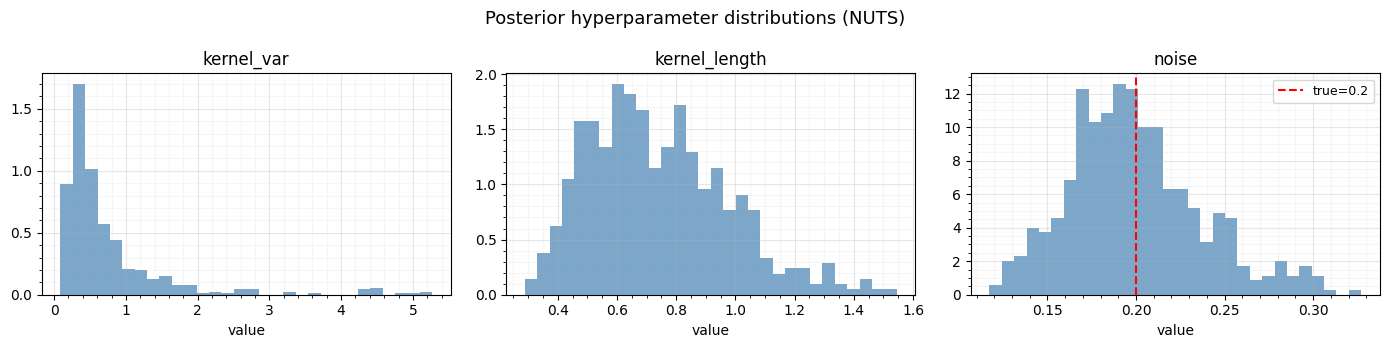
Posterior predictive
For each posterior sample of hyperparameters, we compute the analytic GP predictive mean and variance at test locations.
The total predictive variance decomposes via the law of total variance:
def gp_predict(X_train, y_train, X_test, var, length, noise):
    """Analytic GP posterior mean and variance at test points."""
    # Training kernel
    diff_tr = X_train[:, None] - X_train[None, :]
    K_tr = var * jnp.exp(-0.5 * diff_tr**2 / length**2)
    K_tr += noise**2 * jnp.eye(len(X_train))

    # Cross kernel
    diff_ts = X_test[:, None] - X_train[None, :]
    K_ts = var * jnp.exp(-0.5 * diff_ts**2 / length**2)

    # Test kernel diagonal
    K_tt_diag = var * jnp.ones(len(X_test))

    # Solve via gaussx (vector solves, vmapped over test columns)
    K_tr_op = lx.MatrixLinearOperator(K_tr, lx.positive_semidefinite_tag)
    alpha = gaussx.solve(K_tr_op, y_train)

    # Predictive mean and variance
    mu = K_ts @ alpha
    # gaussx.solve is a vector solver; vmap over columns for matrix RHS
    solve_col = lambda col: gaussx.solve(K_tr_op, col)
    v = jax.vmap(solve_col, in_axes=1, out_axes=1)(K_ts.T)  # (n_train, n_test)
    var_pred = K_tt_diag - jnp.sum(K_ts * v.T, axis=1)
    return mu, var_pred


# Predict for each posterior sample
predict_fn = jax.vmap(
    lambda var, length, noise: gp_predict(X_train, y_train, X_test, var, length, noise)
)

mus, vars_ = predict_fn(
    samples["kernel_var"], samples["kernel_length"], samples["noise"]
)

mu_mean = jnp.mean(mus, axis=0)
mu_std = jnp.std(mus, axis=0)

# Law of total variance:
#   Var(y*|D) = E_θ[Var(y*|θ,D)] + Var_θ(E[y*|θ,D])
# vars_ is latent function variance; add observation noise per sample
noise_vars = samples["noise"] ** 2  # (num_samples,)
aleatoric_var = jnp.mean(vars_ + noise_vars[:, None], axis=0)
total_var = mu_std**2 + aleatoric_var
total_var = jnp.clip(total_var, a_min=0.0)  # guard against roundoff
total_std = jnp.sqrt(total_var)

print(f"Predictive mean shape: {mu_mean.shape}")
print(f"Total std shape:       {total_std.shape}")
Predictive mean shape: (200,)
Total std shape: (200,)
Plot predictions
The shaded bands show total predictive uncertainty, combining both hyperparameter uncertainty (from MCMC) and observation noise.
fig, ax = plt.subplots(figsize=(12, 5))

# True function
ax.plot(X_test, f_true(X_test), "k--", lw=1.5, label="True function", zorder=4)

# Predictive mean and uncertainty
ax.plot(X_test, mu_mean, "C0-", lw=2, label="Predictive mean", zorder=3)
ax.fill_between(
    X_test,
    mu_mean - 2 * total_std,
    mu_mean + 2 * total_std,
    color="C0",
    alpha=0.2,
    label=r"$\pm 2\sigma$ (total)",
)

# A few posterior function draws
for i in range(10):
    ax.plot(X_test, mus[i * 50], "C0-", alpha=0.1, lw=0.5)

# Training data
ax.scatter(
    X_train,
    y_train,
    s=30,
    c="C1",
    edgecolors="k",
    linewidths=0.5,
    label="Training data",
    zorder=5,
)

ax.set_xlabel("x")
ax.set_ylabel("y")
ax.set_title("GP Regression with NumPyro MCMC + gaussx")
ax.legend(loc="upper right", fontsize=9)
ax.grid(True, which="major", alpha=0.3)
ax.grid(True, which="minor", alpha=0.1)
ax.minorticks_on()
plt.tight_layout()
plt.show()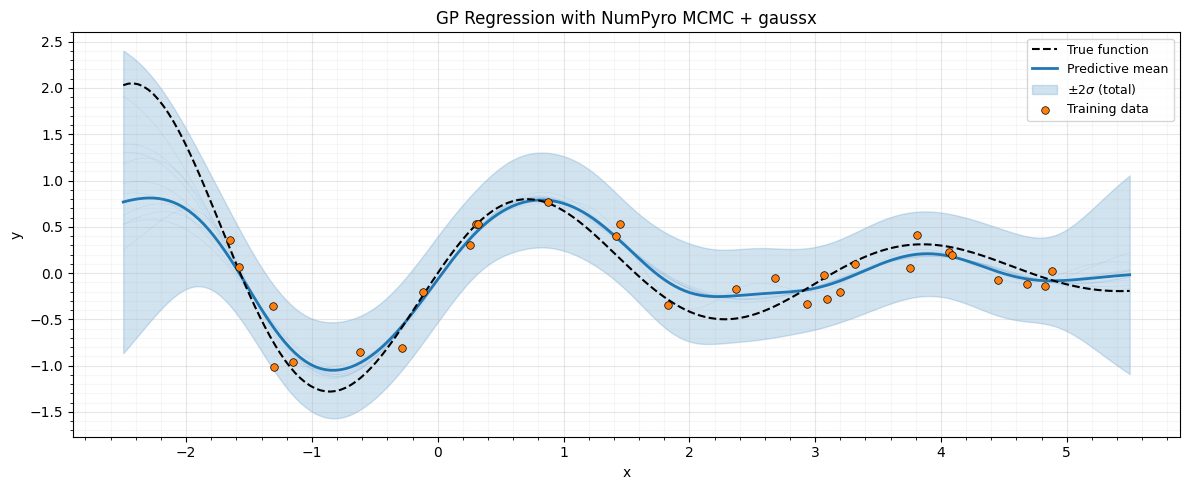
Summary
gaussx.MultivariateNormalplugs directly into NumPyro models, enabling NUTS inference over GP hyperparameters.- The distribution’s
log_probuses gaussx structural dispatch (Cholesky for PSD operators), and is fully differentiable for gradient-based sampling. - Posterior predictive predictions combine hyperparameter uncertainty (from MCMC) with observation noise for calibrated uncertainty estimates.
- The same pattern works with structured covariances (Kronecker, BlockDiag, LowRankUpdate) for scalable GP models.
References
- Hoffman, M. D. & Gelman, A. (2014). The No-U-Turn Sampler. JMLR, 15, 1593--1623.
- Rasmussen, C. E. & Williams, C. K. I. (2006). Gaussian Processes for Machine Learning. MIT Press. (Section 5.2 on Bayesian hyperparameter treatment)
- Phan, D., Pradhan, N., & Jankowiak, M. (2019). Composable effects for flexible and accelerated probabilistic programming in NumPyro. arXiv:1912.11554.