Pattern 2 — `PyroxModule`
Regression Masterclass — Pattern 2: PyroxModule + pyrox_sample

Same seven Bayesian regression models as Pattern 1 (eqx.tree_at), rewritten on top of pyrox._core.PyroxModule. Every weight self-registers its prior inside __call__ via self.pyrox_sample(...). The model function shrinks to two lines of likelihood plumbing — and the layer reuse story shines: pyrox.nn.MCDropout and pyrox.nn.RBFFourierFeatures slot in for Models 3, 6, and 7 with no glue code.
What you’ll learn:
- The
PyroxModuleself-registration pattern:self.pyrox_sample(name, prior)inside a@pyrox_method-decorated__call__. - How site scoping works (
pyrox_namecontrols the prefix; sites becomef"{pyrox_name}.{name}"inside the trace). - How the Pattern 1 model functions collapse from ~10 lines to ~3 once layers self-register.
- How
pyrox.nn.MCDropoutandpyrox.nn.RBFFourierFeaturesplug into aPyroxModulecomposite — one bonus:RBFFourierFeaturesputs a prior on the spectral frequencies, so we get a richer model than Pattern 1’s fixed-frequency RFF for free.
Background — what PyroxModule adds on top of eqx.Module
Pattern 1 had a clean separation: every numpyro.sample("w", ...) call lived in the model function, and eqx.tree_at injected the result into a frozen Equinox module. This works, but the model function ends up doing a lot of bookkeeping: declare each prior, sample it, splice it into the right leaf via a (sometimes-tuple) selector, then call the module.
pyrox._core.PyroxModule collapses that bookkeeping by moving the numpyro.sample calls into the layer itself. Concretely:
class MyLayer(PyroxModule):
    pyrox_name: str = "my_layer"          # scope for site names

    @pyrox_method                          # activates the per-call cache
    def __call__(self, x):
        w = self.pyrox_sample("w", dist.Normal(0.0, 1.0).expand([D]).to_event(1))
        b = self.pyrox_sample("b", dist.Normal(0.0, 1.0))
        return x @ w + b
A few things are happening:
PyroxModuleis aneqx.Module, so it stays a frozen JAX PyTree — no behaviour changes forvmap/jit/grad. The “weights” simply do not need to be PyTree leaves; they’re random variables drawn fresh on each call.self.pyrox_sample(name, prior)is sugar fornumpyro.sample(f"{scope}.{name}", prior), wherescope = self.pyrox_name. The@pyrox_methoddecorator activates a per-call cache so two reads ofself.pyrox_sample("w", ...)inside one__call__collapse to one numpyro site.pyrox_namecontrols the trace key. Withpyrox_name="mlp", the weight site appears in the numpyro trace as"mlp.w". Two instances of the same class need distinct names, otherwise their sites collide.- Composition is straightforward. A composite
PyroxModulewhose fields are otherPyroxModules simply calls them; each child registers its own sites under its ownpyrox_name.
Pattern 1 → Pattern 2 in one diff
Pattern 1’s Bayesian linear model:
class LinearRegressor(eqx.Module):
    weight: jax.Array
    degree: int = eqx.field(static=True)
    def __init__(self, degree):
        self.degree = degree
        self.weight = jnp.zeros(degree + 1)
    def __call__(self, x):
        return einsum(self.features(x), self.weight, "n feat, feat -> n")

def model_linear(x, y=None, *, degree):
    net = LinearRegressor(degree=degree)
    w = numpyro.sample("w", dist.Normal(jnp.zeros(degree + 1), 1.0))
    net = eqx.tree_at(lambda m: m.weight, net, w)
    f = numpyro.deterministic("f", net(x))
    sigma = numpyro.sample("sigma", dist.HalfNormal(1.0))
    numpyro.sample("obs", dist.Normal(f, sigma), obs=y)
Pattern 2’s version — the prior moves into __call__, the placeholder leaf disappears, and the model function shrinks:
class LinearRegressor(PyroxModule):
    degree: int = eqx.field(static=True)
    pyrox_name: str = "lin"

    @pyrox_method
    def __call__(self, x):
        w = self.pyrox_sample(
            "w", dist.Normal(jnp.zeros(self.degree + 1), 1.0).to_event(1)
        )
        return einsum(self.features(x), w, "n feat, feat -> n")

def model_linear(x, y=None, *, net):
    f = numpyro.deterministic("f", net(x))
    sigma = numpyro.sample("sigma", dist.HalfNormal(1.0))
    numpyro.sample("obs", dist.Normal(f, sigma), obs=y)
The “Equinox owns architecture / NumPyro owns probability” boundary still holds — but the layer carries its own probabilistic semantics, and the model function degenerates to just the likelihood. That’s the win.
Inference is unchanged
MCMC(NUTS(model_fn)), SVI(model_fn, AutoDelta(model_fn), ...), and Predictive(model_fn, ...) all work exactly as in Pattern 1. The auto-guides automatically discover the pyrox_sample sites (they’re plain numpyro.sample sites under the hood, just with auto-scoped names). Every Bayesian story from the Pattern 1 Background section — Bayes’ rule, marginal likelihood, posterior predictive integral, NUTS, ELBO — applies verbatim.
Setup
Detect Colab and install pyrox[colab] (which transitively pulls in numpyro, equinox, einops, matplotlib, and watermark) only when running there.
import subprocess
import sys


try:
    import google.colab  # noqa: F401

    IN_COLAB = True
except ImportError:
    IN_COLAB = False

if IN_COLAB:
    subprocess.run(
        [
            sys.executable,
            "-m",
            "pip",
            "install",
            "-q",
            "pyrox[colab] @ git+https://github.com/jejjohnson/pyrox@main",
        ],
        check=True,
    )
import warnings
warnings.filterwarnings("ignore", message=r".*IProgress.*")
import equinox as eqx
import jax
import jax.numpy as jnp
import jax.random as jr
import matplotlib.pyplot as plt
import numpyro
import numpyro.distributions as dist
from einops import einsum
from numpyro.infer import MCMC, NUTS, SVI, Predictive, Trace_ELBO
from numpyro.infer.autoguide import AutoDelta
from numpyro.optim import Adam
from pyrox._core import PyroxModule, pyrox_method
from pyrox.nn import MCDropout, RBFFourierFeatures
jax.config.update("jax_enable_x64", True)import importlib.util
try:
from IPython import get_ipython
ipython = get_ipython()
except ImportError:
ipython = None
if ipython is not None and importlib.util.find_spec("watermark") is not None:
ipython.run_line_magic("load_ext", "watermark")
ipython.run_line_magic(
"watermark",
"-v -m -p jax,equinox,numpyro,einops,pyrox,matplotlib",
)
else:
print("watermark extension not installed; skipping reproducibility readout.")Python implementation: CPython
Python version : 3.12.13
IPython version : 9.12.0
jax : 0.8.3
equinox : 0.13.7
numpyro : 0.20.1
einops : 0.8.2
pyrox : 0.0.6
matplotlib: 3.10.8
Compiler : GCC 14.3.0
OS : Linux
Release : 6.8.0-1044-azure
Machine : x86_64
Processor : x86_64
CPU cores : 16
Architecture: 64bit
Toy dataset
Identical to Pattern 1: noisy sinc, 100 training points in , dense test grid in the same range. Same RNG seed, so the Pattern 2 fits are directly comparable to Pattern 1’s.
key = jr.PRNGKey(666)
k_data, *k_models = jr.split(key, 16)


def latent(x):
    return jnp.sinc(x / jnp.pi)


k1, k2 = jr.split(k_data)
x_train = jr.uniform(k1, (100,), minval=-10.0, maxval=10.0)
y_train = latent(x_train) + 0.05 * jr.normal(k2, (100,))
x_test = jnp.linspace(-10.0, 10.0, 400)
y_test = latent(x_test)


def r2(y_true, y_pred):
    ss_res = jnp.sum((y_true - y_pred) ** 2)
    ss_tot = jnp.sum((y_true - y_true.mean()) ** 2)
    return float(1.0 - ss_res / ss_tot)


def plot_fit(ax, x_train, y_train, x_test, y_test, mean, lo=None, hi=None, title=""):
    ax.plot(x_test, y_test, "k--", lw=1.5, label="True $f(x) = \\sin(x)/x$", zorder=4)
    ax.plot(x_test, mean, "C0-", lw=2, label="Posterior mean", zorder=3)
    if lo is not None and hi is not None:
        ax.fill_between(x_test, lo, hi, color="C0", alpha=0.2, label="95% interval")
    ax.scatter(
        x_train,
        y_train,
        s=20,
        c="C1",
        edgecolors="k",
        linewidths=0.5,
        label="Training data",
        zorder=5,
    )
    ax.set_xlabel("x")
    ax.set_ylabel("y")
    ax.set_title(title)
    ax.legend(loc="lower center", fontsize=8, ncol=2)


print(f"Training points: {x_train.shape[0]}")
print(f"Test points:     {x_test.shape[0]}")
Training points: 100
Test points: 400
Model 1 — Bayesian linear regression
Polynomial features, Gaussian prior on the weights. The LinearRegressor is now a PyroxModule whose __call__ declares the weight prior in line. The model function loses its numpyro.sample("w", ...) and eqx.tree_at lines — what’s left is just the likelihood.
class LinearRegressor(PyroxModule):
    degree: int = eqx.field(static=True)
    pyrox_name: str = "lin"

    def features(self, x):
        return jnp.stack([x**p for p in range(self.degree + 1)], axis=-1)

    @pyrox_method
    def __call__(self, x):
        w = self.pyrox_sample(
            "w", dist.Normal(jnp.zeros(self.degree + 1), 1.0).to_event(1)
        )
        return einsum(self.features(x), w, "n feat, feat -> n")


def model_linear(x, y=None, *, net):
    f = numpyro.deterministic("f", net(x))
    sigma = numpyro.sample("sigma", dist.HalfNormal(1.0))
    numpyro.sample("obs", dist.Normal(f, sigma), obs=y)


net_linear = LinearRegressor(degree=1)
mcmc_linear = MCMC(
    NUTS(model_linear), num_warmup=300, num_samples=500, progress_bar=False
)
mcmc_linear.run(k_models[0], x_train, y_train, net=net_linear)
samples_linear = mcmc_linear.get_samples()
print(f"Sample sites in trace: {sorted(samples_linear)}")  # ['lin.w', 'sigma']

preds_linear = Predictive(model_linear, posterior_samples=samples_linear)(
    k_models[1], x_test, net=net_linear
)["obs"]
mean_linear = preds_linear.mean(0)
lo_linear, hi_linear = jnp.quantile(preds_linear, jnp.array([0.025, 0.975]), axis=0)
r2_linear = r2(y_test, mean_linear)

print(f"Bayesian linear (degree=1) R² = {r2_linear:.4f}")
assert r2_linear < 0.3, "Degree-1 polynomial should NOT fit sinc; R² should be near 0."

fig, ax = plt.subplots(figsize=(12, 5))
plot_fit(
    ax,
    x_train,
    y_train,
    x_test,
    y_test,
    mean_linear,
    lo_linear,
    hi_linear,
    title=f"Model 1 — Bayesian linear (degree=1), R²={r2_linear:.3f}",
)
plt.show()
Sample sites in trace: ['f', 'lin.w', 'sigma']
Bayesian linear (degree=1) R² = -0.0171
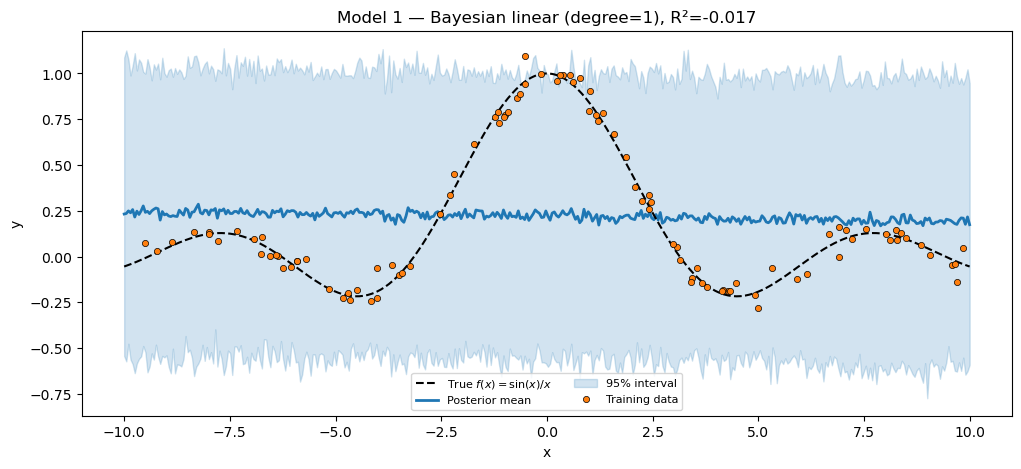
Note the trace key: lin.w. The pyrox_name="lin" field set the scope; the name="w" argument to pyrox_sample set the leaf. Multiple instances of LinearRegressor would need distinct pyrox_names to avoid collisions.
Models 2 & 4 — MLP, MAP and full Bayesian
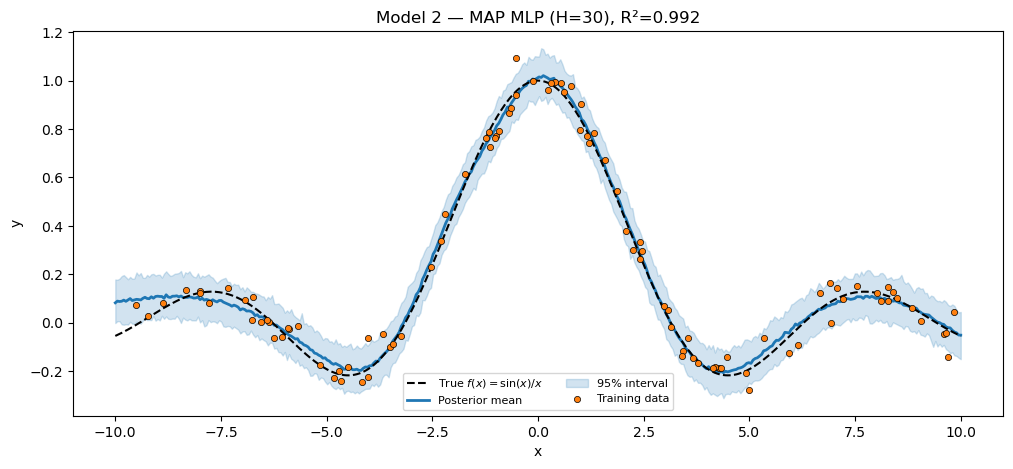
A single hidden-layer MLP that self-registers four weight priors plus a sample-noise prior. One class — BayesianMLP(PyroxModule) — drives both Model 2 (MAP via SVI + AutoDelta) and Model 4 (full posterior via NUTS). The only thing that changes between the two is the inference call.
This is the cleanest demonstration of the “module owns probability, not the inference loop” principle: the same Bayesian object yields a delta posterior when paired with AutoDelta and a full posterior when paired with NUTS. The prior_scale field controls weight-prior tightness — small values regularize, large values free up the network.
class BayesianMLP(PyroxModule):
    hidden_dim: int = eqx.field(static=True)
    prior_scale: float = 1.0
    pyrox_name: str = "mlp"

    @pyrox_method
    def __call__(self, x):
        H = self.hidden_dim
        s = self.prior_scale
        W1 = self.pyrox_sample("W1", dist.Normal(jnp.zeros((1, H)), s).to_event(2))
        b1 = self.pyrox_sample("b1", dist.Normal(jnp.zeros(H), s).to_event(1))
        W2 = self.pyrox_sample("W2", dist.Normal(jnp.zeros((H, 1)), s).to_event(2))
        b2 = self.pyrox_sample("b2", dist.Normal(0.0, s))
        h = jnp.tanh(einsum(x, W1, "n, one h -> n h") + b1)
        return einsum(h, W2, "n h, h one -> n") + b2


def model_nnet(x, y=None, *, net):
    f = numpyro.deterministic("f", net(x))
    sigma = numpyro.sample("sigma", dist.HalfNormal(1.0))
    numpyro.sample("obs", dist.Normal(f, sigma), obs=y)
Model 2 — MAP. AutoDelta(model_nnet) constructs a delta guide over every sample site, including the mlp.W1 / mlp.b1 / etc. ones registered by BayesianMLP. SVI then maximizes the joint log-density.
net_mlp_map = BayesianMLP(hidden_dim=30, pyrox_name="mlp_map")
guide_nnet = AutoDelta(model_nnet)
svi_nnet = SVI(model_nnet, guide_nnet, Adam(5e-3), Trace_ELBO())
svi_result_nnet = svi_nnet.run(
    k_models[2], 2000, x_train, y_train, net=net_mlp_map, progress_bar=False
)
preds_nnet = Predictive(
    model_nnet, params=svi_result_nnet.params, num_samples=200, guide=guide_nnet
)(k_models[3], x_test, net=net_mlp_map)["obs"]
mean_nnet = preds_nnet.mean(0)
lo_nnet, hi_nnet = jnp.quantile(preds_nnet, jnp.array([0.025, 0.975]), axis=0)
r2_nnet = r2(y_test, mean_nnet)

print(f"MAP MLP (H=30) R² = {r2_nnet:.4f}")
assert r2_nnet > 0.85, f"MAP MLP should fit sinc well; got R²={r2_nnet:.3f}."

fig, ax = plt.subplots(figsize=(12, 5))
plot_fit(
    ax,
    x_train,
    y_train,
    x_test,
    y_test,
    mean_nnet,
    lo_nnet,
    hi_nnet,
    title=f"Model 2 — MAP MLP (H=30), R²={r2_nnet:.3f}",
)
plt.show()
MAP MLP (H=30) R² = 0.9917
Model 4 — full Bayesian via NUTS. Same module, fresh instance with a smaller hidden dim (NUTS over a hundred-parameter MLP is the limit of what mixes well in a few seconds). The inference call is the only difference from Model 2.
net_mlp_nuts = BayesianMLP(hidden_dim=15, prior_scale=1.0, pyrox_name="mlp_nuts")
mcmc_bnnet = MCMC(NUTS(model_nnet), num_warmup=300, num_samples=500, progress_bar=False)
mcmc_bnnet.run(k_models[6], x_train, y_train, net=net_mlp_nuts)
samples_bnnet = mcmc_bnnet.get_samples()
preds_bnnet = Predictive(model_nnet, posterior_samples=samples_bnnet)(
    k_models[7], x_test, net=net_mlp_nuts
)["obs"]
mean_bnnet = preds_bnnet.mean(0)
lo_bnnet, hi_bnnet = jnp.quantile(preds_bnnet, jnp.array([0.025, 0.975]), axis=0)
r2_bnnet = r2(y_test, mean_bnnet)

print(f"Bayesian MLP via NUTS (H=15) R² = {r2_bnnet:.4f}")
assert r2_bnnet > 0.70, f"Bayesian MLP via NUTS should fit sinc; got R²={r2_bnnet:.3f}."

fig, ax = plt.subplots(figsize=(12, 5))
plot_fit(
    ax,
    x_train,
    y_train,
    x_test,
    y_test,
    mean_bnnet,
    lo_bnnet,
    hi_bnnet,
    title=f"Model 4 — Bayesian MLP via NUTS (H=15), R²={r2_bnnet:.3f}",
)
plt.show()
Bayesian MLP via NUTS (H=15) R² = 0.9945
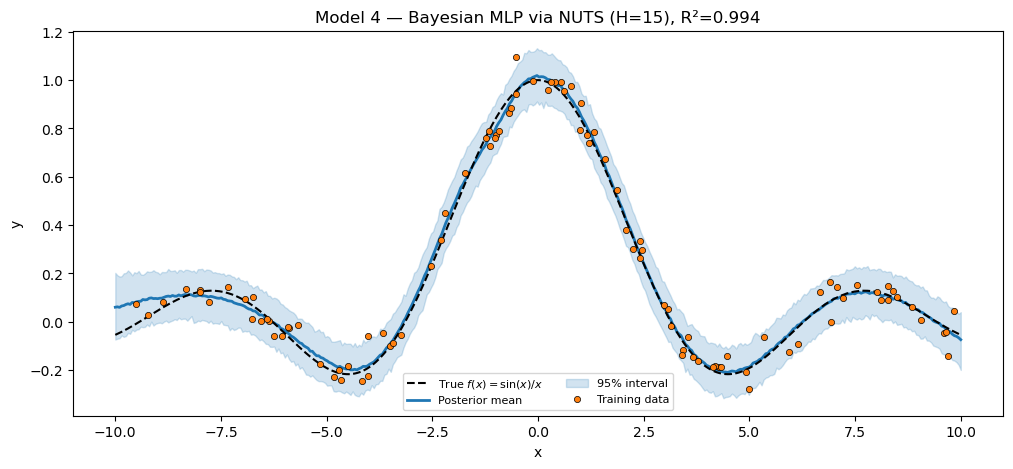
Two BayesianMLP instances with distinct pyrox_names coexist in the trace because their site keys are namespaced (mlp_map.W1 vs mlp_nuts.W1). Reuse without surgery.
Model 3 — MC-Dropout MLP via pyrox.nn.MCDropout
Pattern 1 had to write its own dropout layer that called numpyro.prng_key() inside the model function. Pattern 2 reuses pyrox.nn.MCDropout directly — it is a plain eqx.Module that takes an explicit key argument, and our BayesianMLPDropout pulls a fresh key per trace via numpyro.prng_key(). Composition is the only new code.
Generative model (same as Pattern 1):
class BayesianMLPDropout(PyroxModule):
    hidden_dim: int = eqx.field(static=True)
    dropout: MCDropout  # plain eqx.Module — takes (x, key=...)
    pyrox_name: str = "mlpd"

    @pyrox_method
    def __call__(self, x):
        H = self.hidden_dim
        W1 = self.pyrox_sample("W1", dist.Normal(jnp.zeros((1, H)), 1.0).to_event(2))
        b1 = self.pyrox_sample("b1", dist.Normal(jnp.zeros(H), 1.0).to_event(1))
        W2 = self.pyrox_sample("W2", dist.Normal(jnp.zeros((H, 1)), 1.0).to_event(2))
        b2 = self.pyrox_sample("b2", dist.Normal(0.0, 1.0))
        h = jnp.tanh(einsum(x, W1, "n, one h -> n h") + b1)
        # numpyro.prng_key() is fresh per trace — different mask per SVI step
        # AND per Predictive draw. No discrete latent in the trace, no funsor.
        h = self.dropout(h, key=numpyro.prng_key())
        return einsum(h, W2, "n h, h one -> n") + b2


net_dropout = BayesianMLPDropout(hidden_dim=30, dropout=MCDropout(rate=0.1))
guide_dropout = AutoDelta(model_nnet)
svi_dropout = SVI(model_nnet, guide_dropout, Adam(5e-3), Trace_ELBO())
svi_result_dropout = svi_dropout.run(
    k_models[4], 2000, x_train, y_train, net=net_dropout, progress_bar=False
)
preds_dropout = Predictive(
    model_nnet,
    params=svi_result_dropout.params,
    num_samples=100,
    guide=guide_dropout,
)(k_models[5], x_test, net=net_dropout)["obs"]
mean_dropout = preds_dropout.mean(0)
lo_dropout, hi_dropout = jnp.quantile(preds_dropout, jnp.array([0.025, 0.975]), axis=0)
r2_dropout = r2(y_test, mean_dropout)

print(f"MC-Dropout MLP (H=30, p=0.1) R² = {r2_dropout:.4f}")
assert r2_dropout > 0.80, f"MC-Dropout should fit sinc; got R²={r2_dropout:.3f}."

fig, ax = plt.subplots(figsize=(12, 5))
plot_fit(
    ax,
    x_train,
    y_train,
    x_test,
    y_test,
    mean_dropout,
    lo_dropout,
    hi_dropout,
    title=f"Model 3 — MC-Dropout MLP, R²={r2_dropout:.3f}",
)
plt.show()
MC-Dropout MLP (H=30, p=0.1) R² = 0.9081
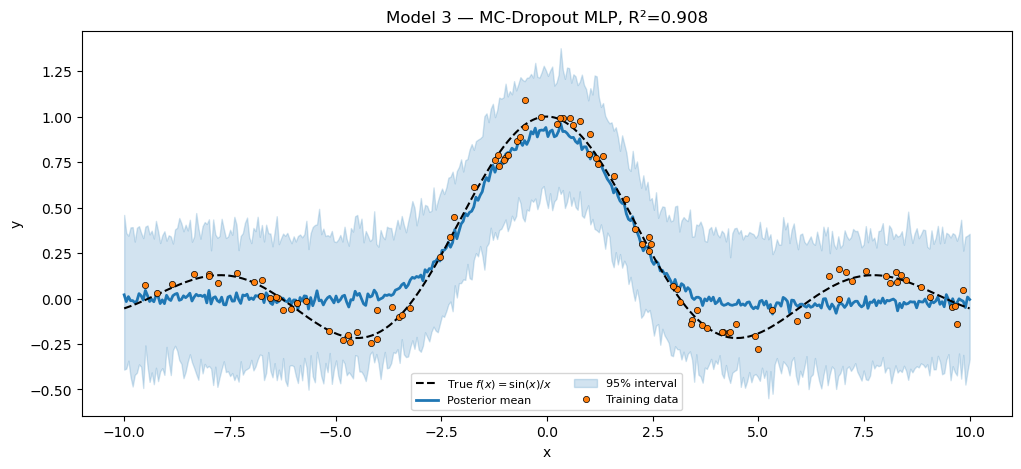
pyrox.nn.MCDropout is not a PyroxModule — it’s a plain eqx.Module with a key kwarg, because dropout’s randomness has nothing to do with priors. Drawing the key from numpyro.prng_key() plugs it into the trace machinery without making the mask itself a sample site.
Model 5 — SVR via Random Fourier Features (fresh PyroxModule)
A from-scratch RFF feature map with fixed spectral frequencies (matching Pattern 1), wrapped as a PyroxModule. Only the linear weights are sampled; the frequencies ω and phases are deterministic constants stored as jax.Array fields.
class FixedRFF(PyroxModule):
    omega: jax.Array
    bias: jax.Array
    n_features: int = eqx.field(static=True)
    pyrox_name: str = "rff"

    @classmethod
    def init(cls, n_features, lengthscale, *, key, name="rff"):
        k1, k2 = jr.split(key)
        omega = jr.normal(k1, (n_features,)) / lengthscale
        bias = jr.uniform(k2, (n_features,), minval=0.0, maxval=2.0 * jnp.pi)
        return cls(omega=omega, bias=bias, n_features=n_features, pyrox_name=name)

    @pyrox_method
    def __call__(self, x):
        proj = einsum(x, self.omega, "n, d -> n d")
        Phi = jnp.sqrt(2.0 / self.n_features) * jnp.cos(proj + self.bias)
        w = self.pyrox_sample(
            "w", dist.Normal(jnp.zeros(self.n_features), 1.0).to_event(1)
        )
        return einsum(Phi, w, "n d, d -> n")


net_svr = FixedRFF.init(n_features=40, lengthscale=1.0, key=k_models[8], name="svr_rff")
mcmc_svr = MCMC(NUTS(model_linear), num_warmup=300, num_samples=500, progress_bar=False)
mcmc_svr.run(k_models[9], x_train, y_train, net=net_svr)
samples_svr = mcmc_svr.get_samples()
preds_svr = Predictive(model_linear, posterior_samples=samples_svr)(
    k_models[10], x_test, net=net_svr
)["obs"]
mean_svr = preds_svr.mean(0)
lo_svr, hi_svr = jnp.quantile(preds_svr, jnp.array([0.025, 0.975]), axis=0)
r2_svr = r2(y_test, mean_svr)

print(f"SVR via fixed RFF (D=40) R² = {r2_svr:.4f}")
assert r2_svr > 0.80, f"SVR via RFF should fit sinc well; got R²={r2_svr:.3f}."

fig, ax = plt.subplots(figsize=(12, 5))
plot_fit(
    ax,
    x_train,
    y_train,
    x_test,
    y_test,
    mean_svr,
    lo_svr,
    hi_svr,
    title=f"Model 5 — SVR via fixed RFF (D=40), R²={r2_svr:.3f}",
)
plt.show()
SVR via fixed RFF (D=40) R² = 0.9957
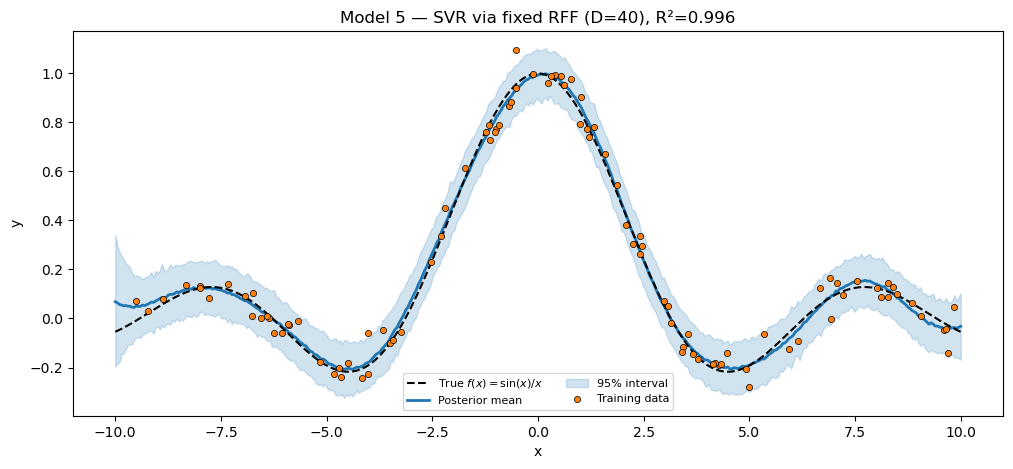
Notice the model function is the same model_linear we wrote for Model 1: any PyroxModule whose __call__ returns a (N,) mean fits this generic likelihood-only template. That is the boilerplate-collapse story made concrete.
Model 6 — Approximate GP via pyrox.nn.RBFFourierFeatures
Time to lean on the package. pyrox.nn.RBFFourierFeatures is a PyroxModule whose __call__ self-registers two priors:
- for the spectral frequencies (this is the RBF spectral density),
- for the lengthscale.
So our Pattern 2 Model 6 is richer than Pattern 1’s: where Pattern 1 fixed both ω and , this version learns posteriors over both, alongside the amplitude and linear weights. We add the amplitude prior + linear weights in our composite, and the package layer handles everything underneath.
Output shape note. RBFFourierFeatures returns the concatenated basis with columns, so the linear weight vector has length .
class GPviaPackagedRFF(PyroxModule):
    rff: RBFFourierFeatures  # learns W and lengthscale as priors
    pyrox_name: str = "gp_rff"

    @pyrox_method
    def __call__(self, x):
        Phi = self.rff(x.reshape(-1, 1))  # (N, 2 * n_features)
        D = Phi.shape[-1]
        amplitude = self.pyrox_sample("amplitude", dist.HalfNormal(1.0))
        w = self.pyrox_sample("w", dist.Normal(jnp.zeros(D), amplitude).to_event(1))
        return einsum(Phi, w, "n d, d -> n")


def model_gp(x, y=None, *, net):
    f = numpyro.deterministic("f", net(x))
    sigma = numpyro.sample("sigma", dist.HalfNormal(0.1))
    numpyro.sample("obs", dist.Normal(f, sigma), obs=y)


rff_gp = RBFFourierFeatures(
    in_features=1, n_features=20, init_lengthscale=1.0, pyrox_name="gp_rff.rff"
)
net_gp = GPviaPackagedRFF(rff=rff_gp)
mcmc_gp = MCMC(NUTS(model_gp), num_warmup=300, num_samples=500, progress_bar=False)
mcmc_gp.run(k_models[11], x_train, y_train, net=net_gp)
samples_gp = mcmc_gp.get_samples()
preds_gp = Predictive(model_gp, posterior_samples=samples_gp)(
    k_models[12], x_test, net=net_gp
)["obs"]
mean_gp = preds_gp.mean(0)
lo_gp, hi_gp = jnp.quantile(preds_gp, jnp.array([0.025, 0.975]), axis=0)
r2_gp = r2(y_test, mean_gp)

print(f"Approx GP via packaged RFF R² = {r2_gp:.4f}")
print(f"Sample sites in trace: {sorted(samples_gp)}")
assert r2_gp > 0.80, f"Approx-GP via packaged RFF should fit sinc; got R²={r2_gp:.3f}."

fig, ax = plt.subplots(figsize=(12, 5))
plot_fit(
    ax,
    x_train,
    y_train,
    x_test,
    y_test,
    mean_gp,
    lo_gp,
    hi_gp,
    title=f"Model 6 — Approx GP via pyrox.nn.RBFFourierFeatures, R²={r2_gp:.3f}",
)
plt.show()
Approx GP via packaged RFF R² = 0.9978
Sample sites in trace: ['f', 'gp_rff.amplitude', 'gp_rff.rff.W', 'gp_rff.rff.lengthscale', 'gp_rff.w', 'sigma']
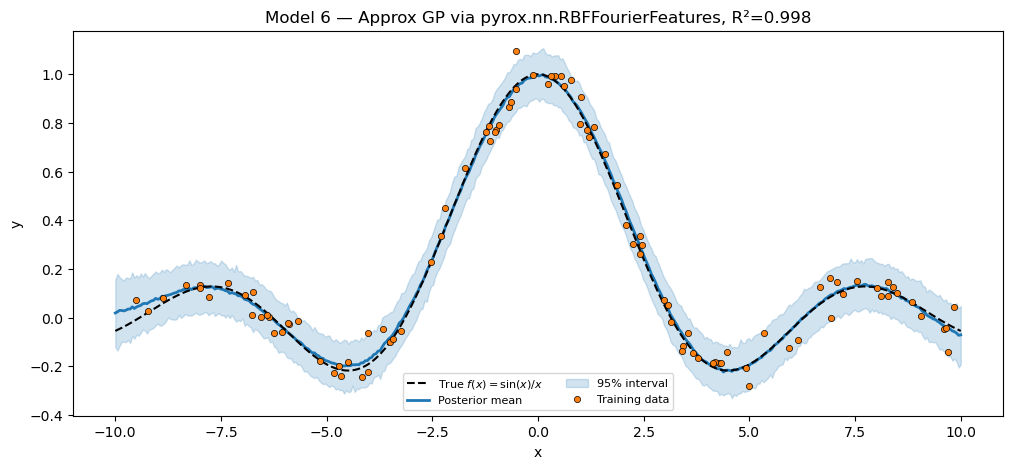
Inspect the trace keys printed above: gp_rff.rff.W, gp_rff.rff.lengthscale, gp_rff.amplitude, gp_rff.w, sigma. The dotted scoping comes from the nested pyrox_names — the inner layer’s pyrox_name="gp_rff.rff" includes the outer scope as a prefix because we set it that way at construction. (Nothing magical: it’s just a string.)
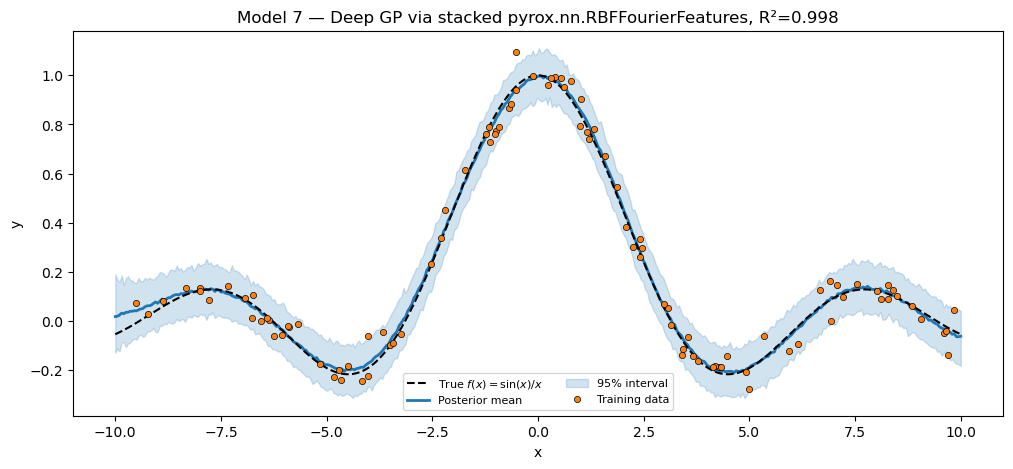
Model 7 — Deep GP via two stacked pyrox.nn.RBFFourierFeatures
Same Cutajar et al. (2017) deep-RFF architecture as Pattern 1, but now both RFF layers are package classes that learn their own and . The inter-layer linear map and the output linear weights are this composite’s own pyrox_sample sites.
Implementation note. Pattern 1’s deep model called rff2 inside a Python for j in range(inner_dim): loop — fine when rff2 had no priors. With the packaged RBFFourierFeatures that does sample sites, calling it times in a loop would register the same site name times and crash. The fix is to call rff2 once with a batched input of shape (N, inner_dim, 1), then mean-reduce over the inner_dim axis:
class DeepGPviaPackagedRFF(PyroxModule):
    rff1: RBFFourierFeatures
    rff2: RBFFourierFeatures
    inner_dim: int = eqx.field(static=True)
    pyrox_name: str = "deep"

    @pyrox_method
    def __call__(self, x):
        # Layer 1: scalar input -> (N, 2*D1) -> linear map W1 -> (N, inner_dim)
        Phi1 = self.rff1(x.reshape(-1, 1))
        D1 = Phi1.shape[-1]
        W1 = self.pyrox_sample(
            "W1", dist.Normal(jnp.zeros((D1, self.inner_dim)), 1.0).to_event(2)
        )
        h = einsum(Phi1, W1, "n d1, d1 inner -> n inner")
        # Layer 2: rff2 takes (*batch, D_in=1). Broadcast h to (N, inner_dim, 1)
        # and call rff2 ONCE, then mean over inner_dim — no Python loop, no
        # site-name collision.
        Phi2 = self.rff2(h[..., None]).mean(axis=1)  # (N, 2*D2)
        D2 = Phi2.shape[-1]
        w2 = self.pyrox_sample("w2", dist.Normal(jnp.zeros(D2), 1.0).to_event(1))
        return einsum(Phi2, w2, "n d2, d2 -> n")


rff1 = RBFFourierFeatures(
    in_features=1, n_features=8, init_lengthscale=1.0, pyrox_name="deep.rff1"
)
rff2 = RBFFourierFeatures(
    in_features=1, n_features=5, init_lengthscale=1.0, pyrox_name="deep.rff2"
)
net_deep = DeepGPviaPackagedRFF(rff1=rff1, rff2=rff2, inner_dim=4)
mcmc_deep = MCMC(NUTS(model_gp), num_warmup=200, num_samples=300, progress_bar=False)
mcmc_deep.run(k_models[13], x_train, y_train, net=net_deep)
samples_deep = mcmc_deep.get_samples()
preds_deep = Predictive(model_gp, posterior_samples=samples_deep)(
    k_models[14], x_test, net=net_deep
)["obs"]
mean_deep = preds_deep.mean(0)
lo_deep, hi_deep = jnp.quantile(preds_deep, jnp.array([0.025, 0.975]), axis=0)
r2_deep = r2(y_test, mean_deep)

print(f"Deep GP via stacked packaged RFF R² = {r2_deep:.4f}")
assert r2_deep > 0.70, f"Deep RFF should fit sinc; got R²={r2_deep:.3f}."

fig, ax = plt.subplots(figsize=(12, 5))
plot_fit(
    ax,
    x_train,
    y_train,
    x_test,
    y_test,
    mean_deep,
    lo_deep,
    hi_deep,
    title=f"Model 7 — Deep GP via stacked pyrox.nn.RBFFourierFeatures, "
    f"R²={r2_deep:.3f}",
)
plt.show()
Deep GP via stacked packaged RFF R² = 0.9977
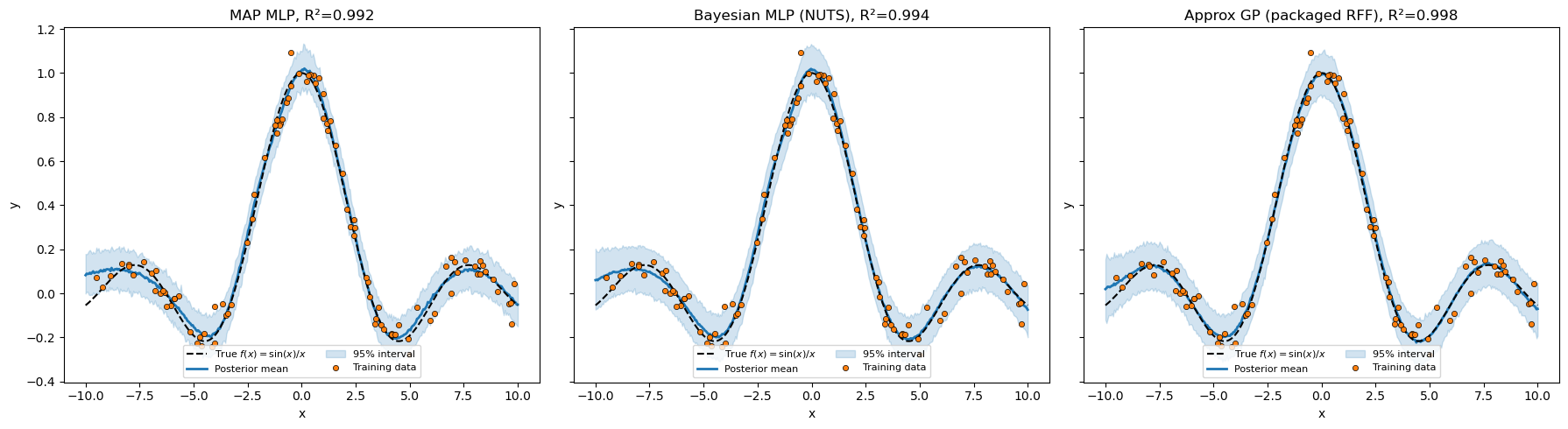
Side-by-side summary
All seven models. The 1×3 panel below stacks three representative posteriors so the qualitative shape of the predictive bands is visible.
print(f"{'Model':<42} {'Inference':<11} {'R²':>7}")
print("-" * 62)
print(f"{'1. Bayesian linear (degree=1)':<42} {'NUTS':<11} {r2_linear:>7.3f}")
print(f"{'2. MAP MLP':<42} {'SVI+Delta':<11} {r2_nnet:>7.3f}")
print(f"{'3. MC-Dropout MLP (MCDropout)':<42} {'SVI+Delta':<11} {r2_dropout:>7.3f}")
print(f"{'4. Bayesian MLP':<42} {'NUTS':<11} {r2_bnnet:>7.3f}")
print(f"{'5. SVR via fixed RFF (D=40)':<42} {'NUTS':<11} {r2_svr:>7.3f}")
print(f"{'6. Approx GP (RBFFourierFeatures)':<42} {'NUTS':<11} {r2_gp:>7.3f}")
print(f"{'7. Deep GP (stacked RBFFourierFeatures)':<42} {'NUTS':<11} {r2_deep:>7.3f}")

fig, axes = plt.subplots(1, 3, figsize=(18, 5), sharey=True)
plot_fit(
    axes[0],
    x_train,
    y_train,
    x_test,
    y_test,
    mean_nnet,
    lo_nnet,
    hi_nnet,
    title=f"MAP MLP, R²={r2_nnet:.3f}",
)
plot_fit(
    axes[1],
    x_train,
    y_train,
    x_test,
    y_test,
    mean_bnnet,
    lo_bnnet,
    hi_bnnet,
    title=f"Bayesian MLP (NUTS), R²={r2_bnnet:.3f}",
)
plot_fit(
    axes[2],
    x_train,
    y_train,
    x_test,
    y_test,
    mean_gp,
    lo_gp,
    hi_gp,
    title=f"Approx GP (packaged RFF), R²={r2_gp:.3f}",
)
plt.tight_layout()
plt.show()
Model Inference R²
--------------------------------------------------------------
1. Bayesian linear (degree=1) NUTS -0.017
2. MAP MLP SVI+Delta 0.992
3. MC-Dropout MLP (MCDropout) SVI+Delta 0.908
4. Bayesian MLP NUTS 0.994
5. SVR via fixed RFF (D=40) NUTS 0.996
6. Approx GP (RBFFourierFeatures) NUTS 0.998
7. Deep GP (stacked RBFFourierFeatures) NUTS 0.998
Pattern 1 vs Pattern 2 — what changed
| Aspect | Pattern 1 (tree_at) | Pattern 2 (PyroxModule) |
|---|---|---|
| Where priors live | In the model function as numpyro.sample calls | Inside __call__ as self.pyrox_sample calls |
| Bridge into the module | eqx.tree_at(selector, net, w) | None — the layer is the trace site |
| Model function size | ~10 lines per model | ~3 lines (just the likelihood) |
| Layer reusability | Define a fresh eqx.Module each time | Same BayesianMLP instance (with a unique pyrox_name) drives MAP + NUTS |
Reuse of pyrox.nn | None | MCDropout, RBFFourierFeatures slot in via composition |
| Site naming | Flat ("W1", "w", ...) | Scoped ("mlp.W1", "gp_rff.rff.W", ...) |
Inference machinery is unchanged: MCMC(NUTS(model_fn)), SVI(...), Predictive(...) work identically against both patterns.
What’s next
- Pattern 3 —
Parameterized+PyroxParam. Constraints, priors, and autoguide selection become declarative class fields registered insetup(). Models 6–7 swap their RFF approximations for the actual exact-GP primitives (pyrox.gp.GPPrior+ConditionedGP) — that’s where the abstraction replaces the workaround. Seeregression_masterclass_parameterized.ipynbonce it lands.