Kronecker-multiplicative GP — spatially varying warming rates
Annual temperature extremes over Spain — part 2: a spatially varying climate response
A direct follow-up to 01_spain_extremes. Same
block-maxima data, same xtremax GEV likelihood, same Iberian grid — but we
upgrade β from a scalar to a spatial GP, so each location gets its
own warming amplification rate.
Notebook 01 fit an additive field with a single scalar β. Here we replace β with a spatial GP , giving a multiplicative (rank-1 space–time) interaction
and drops the temporal residual. As in nb 01 the model is a NumPyro program:
latent spatial fields via pyrox.gp whitened gp_sample, an xtremax GEV
likelihood, and SVI with an AutoNormal guide.
Background — the multiplicative model
From scalar to field
- — the constant spatial residual (the time-invariant climate offset of each location).
- — the spatially varying warming rate. Prior mean = “one degree of global warming raises local extremes by one degree”.
The latent field on the grid is with , and observations are .
Covariance on the full grid — a sum of two Kronecker products
Since μ and are a priori independent GPs,
a sum of two Kronecker products (gaussx.SumKronecker). Both right-hand
factors are rank-1, so the prior’s time-rank is 2 — the hallmark of the
multiplicative model. We display this operator below for intuition, though the
inference works directly with the two spatial GPs.
Identifiability
Two traps, both handled by centering the latent fields (so owns the global level and owns the mean warming rate):
- vs at — centering around its mean spreads β information over the whole record.
- vs the mean of — centering to be zero-mean pins the mean rate on .
Setup
import time

import jax
import jax.numpy as jnp
import jax.random as jr
import matplotlib.pyplot as plt
import numpy as np
import optax
import cartopy.crs as ccrs
import cartopy.feature as cfeature
import lineax as lx
import numpyro
import numpyro.distributions as dist
from numpyro.infer import SVI, Predictive, Trace_ELBO, autoguide
from numpyro.infer.initialization import init_to_value
from jaxtyping import Array, Float
from scipy.stats import genextreme

import gaussx
from pyrox.gp import GPPrior, Matern, gp_sample
from pyrox.gp._src.kernels import matern_kernel  # used in the SumKronecker prior demo
from xtremax import GeneralizedExtremeValueDistribution as GEV
from xtremax import gev_return_level
from xtremax.simulations import generate_gmst_trajectory, generate_spatial_field

jax.config.update("jax_enable_x64", True)
/home/user/research_notebook/projects/gaussian_processes/.venv/lib/python3.12/site-packages/tqdm/auto.py:21: TqdmWarning: IProgress not found. Please update jupyter and ipywidgets. See https://ipywidgets.readthedocs.io/en/stable/user_install.html
from .autonotebook import tqdm as notebook_tqdm
Synthetic data — a warming Spain with heterogeneous response
Stations and GMST are identical to nb 01 so the two can be compared directly.
SPAIN_BBOX = (-9.5, 3.5, 36.0, 43.8)

S = 40
T = 40
YEAR_0 = 1985
YEARS = jnp.arange(YEAR_0, YEAR_0 + T)

# Stations from xtremax.simulations — on-land Iberian sites (lat/lon/elevation).
_field = generate_spatial_field(n_sites=S, bounds=SPAIN_BBOX, seed=2024)
stations = jnp.stack([jnp.asarray(_field.lon.values), jnp.asarray(_field.lat.values)], axis=1)
lon_st, lat_st = stations[:, 0], stations[:, 1]

key = jr.PRNGKey(2024)
GMST proxy — xtremax.simulations.generate_gmst_trajectory (same as nb 01)
gmst = jnp.asarray(
    generate_gmst_trajectory(
        n_years=T, start_year=YEAR_0, trend_type="linear", noise_std=0.05, seed=2024
    ).values
)
d_vec = gmst - jnp.mean(gmst)  # centred GMST anomaly
print(f"GMST range:  {float(gmst[0]):.2f}  ->  {float(gmst[-1]):.2f} °C")
print(f"d range:     {float(d_vec.min()):+.2f}  ->  {float(d_vec.max()):+.2f} °C (centred)")
GMST range: 0.15 -> 0.90 °C
d range: -0.38 -> +0.41 °C (centred)
Ground-truth drawn from a Matern GP
is drawn from a spatial GP with a known kernel so the GP prior is
well-specified. Prior mean ; fluctuations from a zero-mean
Matern-3/2 kernel (variance 0.25, lengthscale ), drawn from pyrox
GP priors via GPPrior.sample.
TRUTH = {
    "mu0": 35.0, "k_s_var": 4.0, "k_s_ls": 2.0,
    "k_beta_var": 0.25, "k_beta_ls": 3.0, "beta0": 1.2,
    "gev_sigma": 1.8, "gev_xi": 0.12,
}

# Ground-truth fields from pyrox GP priors (zero-mean) via GPPrior.sample.
key, key_mu, key_beta = jr.split(key, 3)
mu_truth = GPPrior(
    kernel=Matern(init_variance=TRUTH["k_s_var"], init_lengthscale=TRUTH["k_s_ls"], nu=1.5), X=stations
).sample(key_mu)
beta_truth = TRUTH["beta0"] + GPPrior(
    kernel=Matern(init_variance=TRUTH["k_beta_var"], init_lengthscale=TRUTH["k_beta_ls"], nu=1.5), X=stations
).sample(key_beta)
print(f"beta*(s) range:  {float(beta_truth.min()):.2f}  ->  {float(beta_truth.max()):.2f}  "
      f"(mean {float(beta_truth.mean()):.2f}, truth beta0 {TRUTH['beta0']:.2f})")

f_truth = TRUTH["mu0"] + mu_truth[:, None] + beta_truth[:, None] * d_vec[None, :]  # (S, T)
beta*(s) range: 0.61 -> 2.05 (mean 1.53, truth beta0 1.20)
GEV observation model — from xtremax, verified vs scipy
y_grid = jnp.linspace(-2.0, 25.0, 60)
ours = GEV(loc=3.0, scale=1.5, concentration=0.2).log_prob(y_grid)
theirs = genextreme.logpdf(np.asarray(y_grid), c=-0.2, loc=3.0, scale=1.5)
print(f"xtremax GEV vs scipy (ξ=0.2)  max|Δ| = {float(jnp.max(jnp.abs(ours - theirs))):.2e}")

key, key_obs = jr.split(key)
y_obs = GEV(loc=f_truth, scale=TRUTH["gev_sigma"], concentration=TRUTH["gev_xi"]).sample(key_obs)
Y_MEAN = float(jnp.mean(y_obs))
print(f"y_obs shape: {y_obs.shape}  range: [{float(y_obs.min()):.1f}, {float(y_obs.max()):.1f}] °C")
xtremax GEV vs scipy (ξ=0.2) max|Δ| = 5.12e-13
y_obs shape: (40, 40) range: [27.6, 61.9] °C
Inspecting the truth
(a) spatial offset ; (b) the new ingredient ; (c) yearly-max timeseries at four stations spanning the range.
def plot_stations(ax, values, *, cmap: str, vlim: tuple, label: str) -> None:
    ax.set_extent([SPAIN_BBOX[0] - 1, SPAIN_BBOX[1] + 1, SPAIN_BBOX[2] - 1, SPAIN_BBOX[3] + 1], crs=ccrs.PlateCarree())
    ax.add_feature(cfeature.COASTLINE, linewidth=0.5)
    ax.add_feature(cfeature.BORDERS, linestyle=":", linewidth=0.5)
    ax.add_feature(cfeature.OCEAN, facecolor="#e8f3fa")
    ax.add_feature(cfeature.LAND, facecolor="#fdf9ec")
    sc = ax.scatter(
        np.asarray(lon_st), np.asarray(lat_st), c=np.asarray(values), cmap=cmap,
        vmin=vlim[0], vmax=vlim[1], s=55, edgecolors="k", linewidths=0.4,
        transform=ccrs.PlateCarree(), zorder=5,
    )
    gl = ax.gridlines(draw_labels=True, linewidth=0.2, alpha=0.4)
    gl.top_labels = gl.right_labels = False
    plt.colorbar(sc, ax=ax, shrink=0.75, label=label)


fig = plt.figure(figsize=(16, 4.6))
ax_mu = fig.add_subplot(1, 3, 1, projection=ccrs.PlateCarree())
plot_stations(ax_mu, mu_truth, cmap="RdBu_r", vlim=(-5, 5), label=r"$\mu^*(s)$ [°C]")
ax_mu.set_title(r"Ground-truth spatial offset $\mu^*(s)$")
ax_beta = fig.add_subplot(1, 3, 2, projection=ccrs.PlateCarree())
plot_stations(ax_beta, beta_truth, cmap="viridis", vlim=(0.0, 2.4), label=r"$\beta^*(s)$")
ax_beta.set_title(r"Ground-truth amplification $\beta^*(s)$")
order_beta = jnp.argsort(beta_truth)
picks = jnp.array([order_beta[0], order_beta[S // 3], order_beta[2 * S // 3], order_beta[-1]])
ax_ts = fig.add_subplot(1, 3, 3)
for s in picks:
    s_i = int(s)
    ax_ts.plot(YEARS, y_obs[s_i, :], "o-", lw=1.2, ms=4, alpha=0.8, label=rf"$\beta^*={float(beta_truth[s_i]):.2f}$")
ax_ts.set_xlabel("year")
ax_ts.set_ylabel("yearly max [°C]")
ax_ts.set_title(r"Timeseries — 4 stations spanning $\beta^*$")
ax_ts.legend(loc="upper left", fontsize=9)
ax_ts.grid(alpha=0.3)
plt.tight_layout()
plt.show()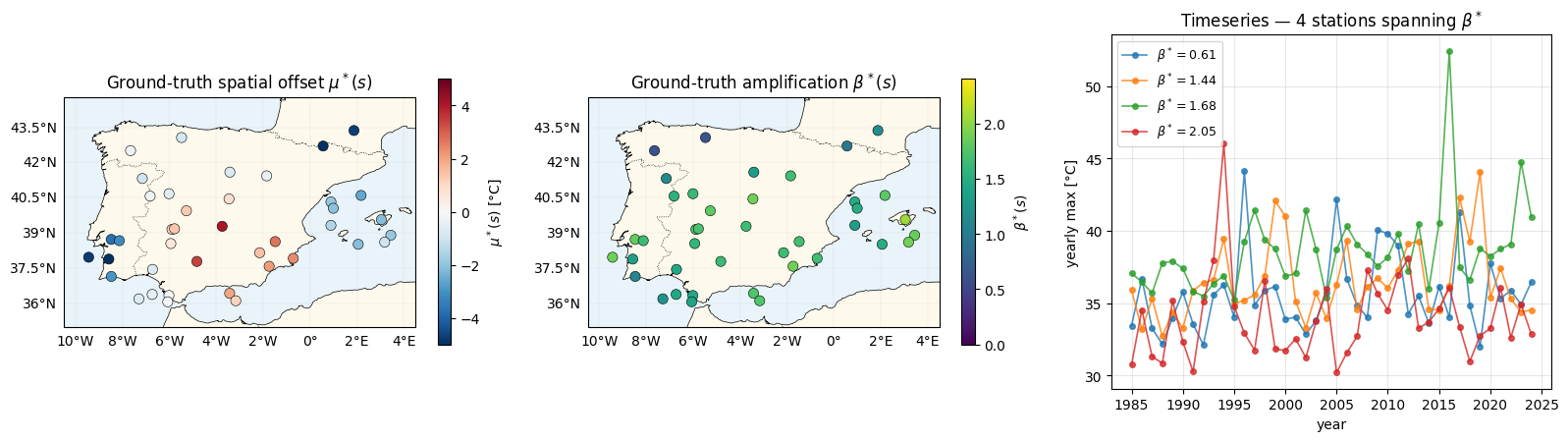
The multiplicative prior covariance as a gaussx.SumKronecker
Purely pedagogical: assemble the full-grid prior covariance with gaussx
operators (kernels from pyrox.matern_kernel) and inspect its storage cost.
We never materialise it during training.
K_s0 = matern_kernel(stations, stations, jnp.asarray(2.0), jnp.asarray(2.0), nu=1.5)
K_beta0 = matern_kernel(stations, stations, jnp.asarray(0.2), jnp.asarray(3.0), nu=1.5)
J_t = jnp.ones((T, T))
dd_t = jnp.outer(d_vec, d_vec)

K_mu_full = gaussx.Kronecker(
    lx.MatrixLinearOperator(K_s0, lx.positive_semidefinite_tag),
    lx.MatrixLinearOperator(J_t, lx.positive_semidefinite_tag),
)
K_beta_full = gaussx.Kronecker(
    lx.MatrixLinearOperator(K_beta0, lx.positive_semidefinite_tag),
    lx.MatrixLinearOperator(dd_t, lx.positive_semidefinite_tag),
)
K_tau = gaussx.SumKronecker(K_mu_full, K_beta_full)
print(f"prior operator:   {type(K_tau).__name__}")
print(f"  logical shape:  ({K_tau.in_size()}, {K_tau.in_size()})  = ({S}·{T}, {S}·{T})")
print(f"  storage cost:   {2 * (S * S + T * T)} entries (vs {(S * T) ** 2} dense, "
      f"{(S * T) ** 2 / (2 * (S * S + T * T)):.0f}× compression)")
print("  time-rank:      1 + 1 = 2  (J_T and dd^T each rank 1)")
prior operator: SumKronecker
logical shape: (1600, 1600) = (40·40, 40·40)
storage cost: 6400 entries (vs 2560000 dense, 400× compression)
time-rank: 1 + 1 = 2 (J_T and dd^T each rank 1)
The model — two spatial GPs + xtremax GEV likelihood
A NumPyro program with two pyrox spatial GPs ( and ,
distinct pyrox_names so their hyperprior sites don’t collide), both centered,
a trainable intercept , and an xtremax GEV likelihood. SVI with an
AutoNormal guide replaces nb 01’s hand-rolled scaffold.
def model(stations, d_vec, y=None):
    k_mu = Matern(pyrox_name="k_mu", nu=1.5)
    k_mu.set_prior("variance", dist.LogNormal(jnp.log(2.0), 0.5))
    k_mu.set_prior("lengthscale", dist.LogNormal(jnp.log(2.0), 0.5))
    k_beta = Matern(pyrox_name="k_beta", nu=1.5)
    k_beta.set_prior("variance", dist.LogNormal(jnp.log(0.2), 0.5))
    k_beta.set_prior("lengthscale", dist.LogNormal(jnp.log(3.0), 0.5))

    mu_s = gp_sample("mu_s", GPPrior(kernel=k_mu, X=stations), whitened=True)
    beta_tilde = gp_sample("beta_tilde", GPPrior(kernel=k_beta, X=stations), whitened=True)
    mu_s = mu_s - jnp.mean(mu_s)            # level -> mu0
    beta_tilde = beta_tilde - jnp.mean(beta_tilde)  # mean rate -> beta0

    mu0 = numpyro.sample("mu0", dist.Normal(Y_MEAN, 5.0))
    beta0 = numpyro.sample("beta0", dist.Normal(1.0, 0.5))
    log_sigma = numpyro.sample("log_sigma", dist.Normal(jnp.log(2.0), 0.4))
    xi = numpyro.sample("xi", dist.Normal(0.1, 0.1))
    sigma = jnp.exp(log_sigma)

    beta_s = beta0 + beta_tilde
    loc = mu0 + mu_s[:, None] + beta_s[:, None] * d_vec[None, :]

    numpyro.deterministic("mu_field", mu_s)
    numpyro.deterministic("beta_field", beta_s)
    numpyro.deterministic("sigma", sigma)
    numpyro.sample("y", GEV(loc=loc, scale=sigma, concentration=xi), obs=y)
Inference — SVI
guide = autoguide.AutoNormal(
    model,
    init_loc_fn=init_to_value(
        values={"mu0": Y_MEAN, "beta0": 1.0, "log_sigma": float(jnp.log(2.0)), "xi": 0.1}
    ),
)
optimizer = numpyro.optim.optax_to_numpyro(
    optax.chain(optax.zero_nans(), optax.clip_by_global_norm(10.0), optax.adam(3e-3))
)
svi = SVI(model, guide, optimizer, Trace_ELBO())

t0 = time.time()
svi_result = svi.run(jr.PRNGKey(0), 6000, stations, d_vec, y_obs, progress_bar=False)
losses = np.asarray(svi_result.losses)
post = Predictive(model, guide=guide, params=svi_result.params, num_samples=600)(
    jr.PRNGKey(3), stations, d_vec
)
lat = guide.sample_posterior(jr.PRNGKey(4), svi_result.params, sample_shape=(600,))
print(f"SVI finished in {time.time() - t0:.1f}s")

beta_field = post["beta_field"]
print(f"fitted μ₀    = {float(lat['mu0'].mean()):.2f}  (truth {TRUTH['mu0']})")
print(f"fitted β₀    = {float(lat['beta0'].mean()):.2f}  (truth mean β* {float(beta_truth.mean()):.2f})")
print(f"fitted β(s)  range [{float(beta_field.mean(0).min()):.2f}, {float(beta_field.mean(0).max()):.2f}]  "
      f"(truth [{float(beta_truth.min()):.2f}, {float(beta_truth.max()):.2f}])")
print(f"fitted σ     = {float(post['sigma'].mean()):.2f}  (truth {TRUTH['gev_sigma']})")
print(f"fitted ξ     = {float(lat['xi'].mean()):.3f}  (truth {TRUTH['gev_xi']})")
SVI finished in 17.1s
fitted μ₀ = 34.33 (truth 35.0)
fitted β₀ = 1.27 (truth mean β* 1.53)
fitted β(s) range [1.10, 1.52] (truth [0.61, 2.05])
fitted σ = 1.83 (truth 1.8)
fitted ξ = 0.144 (truth 0.12)
Loss curve
fig, ax = plt.subplots(figsize=(10, 3.2))
finite = np.isfinite(losses)
ax.plot(np.arange(len(losses))[finite], losses[finite], "C2-", lw=1.2)
ax.set_xlabel("SVI step")
ax.set_ylabel("−ELBO")
ax.set_yscale("symlog", linthresh=100.0)
ax.set_title("SVI training — multiplicative GP + xtremax GEV likelihood")
ax.grid(alpha=0.3, which="both")
plt.show()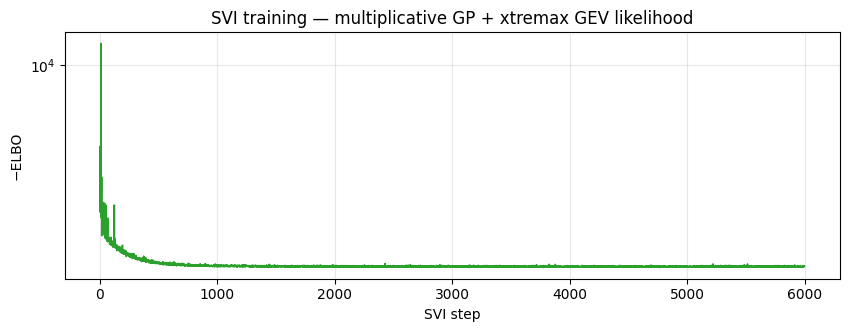
Parameter recovery
The headline is the map: recovering a smoothly-varying warming rate from 40 stations × 40 years of GEV maxima. The GP prior shrinks the posterior amplitude toward , but the spatial pattern is recovered.
beta_mean = beta_field.mean(0)
beta_std = beta_field.std(0)
mu_mean = post["mu_field"].mean(0)
mu_std = post["mu_field"].std(0)
vlim_beta, vlim_mu = (0.0, 2.4), (-5.0, 5.0)

fig = plt.figure(figsize=(16, 9))
ax = fig.add_subplot(2, 3, 1, projection=ccrs.PlateCarree())
plot_stations(ax, beta_truth, cmap="viridis", vlim=vlim_beta, label=r"$\beta^*(s)$")
ax.set_title(r"$\beta^*(s)$ — truth")
ax = fig.add_subplot(2, 3, 2, projection=ccrs.PlateCarree())
plot_stations(ax, beta_mean, cmap="viridis", vlim=vlim_beta, label=r"$\hat\beta(s)$")
ax.set_title(r"$\hat\beta(s)$ — posterior mean")
ax = fig.add_subplot(2, 3, 3)
ax.errorbar(np.asarray(beta_truth), np.asarray(beta_mean), yerr=2 * np.asarray(beta_std),
            fmt="o", color="C2", ms=4, alpha=0.75, capsize=2)
ax.plot(vlim_beta, vlim_beta, "k--", lw=1)
ax.set_xlim(*vlim_beta)
ax.set_ylim(*vlim_beta)
ax.set_xlabel(r"$\beta^*(s)$ truth")
ax.set_ylabel(r"$\hat\beta(s)$ posterior $\pm 2\sigma$")
ax.set_title(r"$\beta$ recovery — per-station")
ax.grid(alpha=0.3)
ax = fig.add_subplot(2, 3, 4, projection=ccrs.PlateCarree())
plot_stations(ax, mu_truth, cmap="RdBu_r", vlim=vlim_mu, label=r"$\mu^*(s)$ [°C]")
ax.set_title(r"$\mu^*(s)$ — truth")
ax = fig.add_subplot(2, 3, 5, projection=ccrs.PlateCarree())
plot_stations(ax, mu_mean, cmap="RdBu_r", vlim=vlim_mu, label=r"$\hat\mu(s)$ [°C]")
ax.set_title(r"$\hat\mu(s)$ — posterior mean")
ax = fig.add_subplot(2, 3, 6)
ax.errorbar(np.asarray(mu_truth), np.asarray(mu_mean), yerr=2 * np.asarray(mu_std),
            fmt="o", color="C0", ms=4, alpha=0.75, capsize=2)
ax.plot(vlim_mu, vlim_mu, "k--", lw=1)
ax.set_xlim(*vlim_mu)
ax.set_ylim(*vlim_mu)
ax.set_xlabel(r"$\mu^*(s)$ truth")
ax.set_ylabel(r"$\hat\mu(s)$ posterior $\pm 2\sigma$")
ax.set_title(r"$\mu$ recovery — per-station")
ax.grid(alpha=0.3)
plt.tight_layout()
plt.show()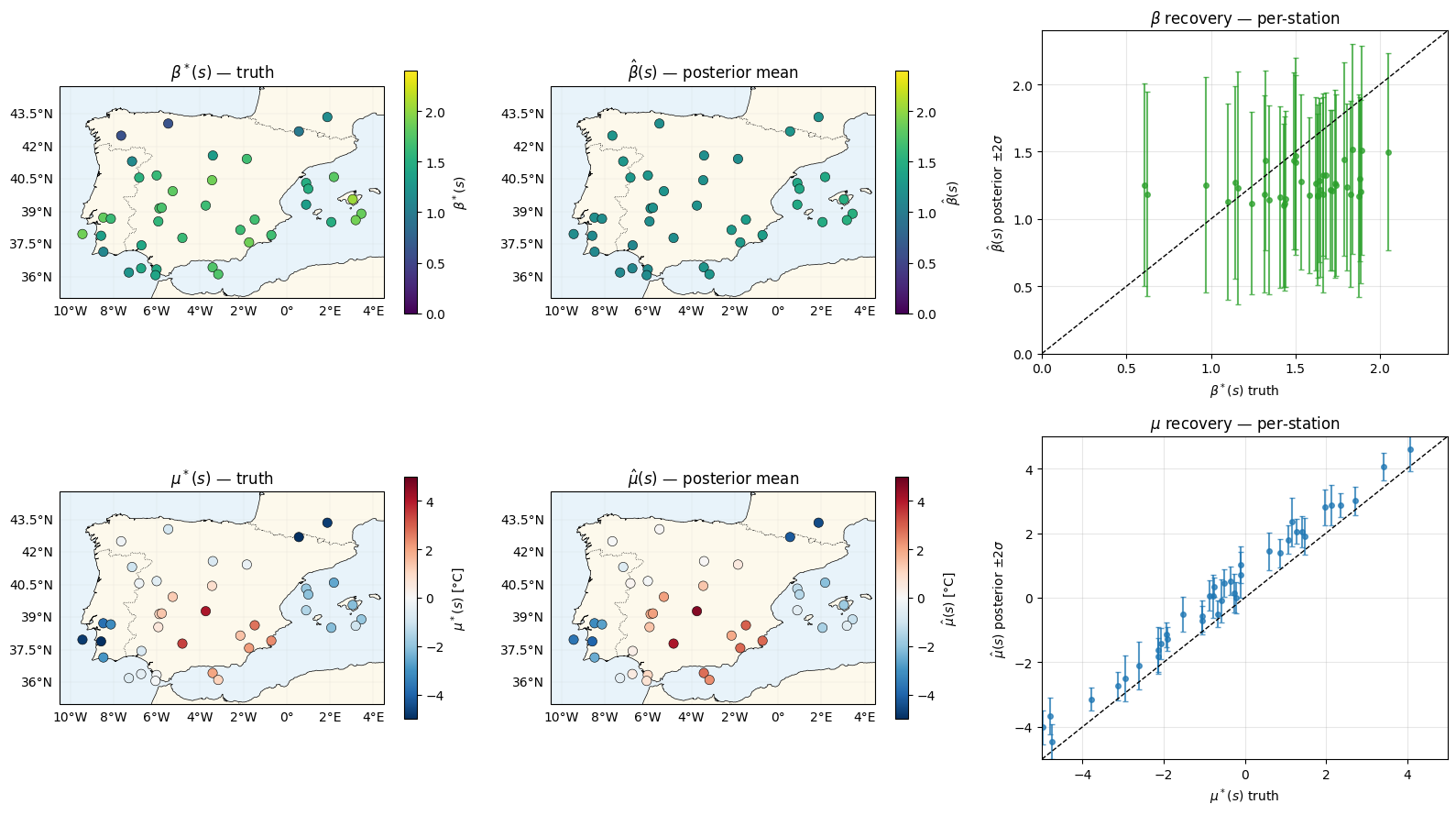
GEV tail recovery
fig, axes = plt.subplots(1, 2, figsize=(11, 3.8))
for ax, (name, truth_val, draws, xr) in zip(
    axes,
    [(r"$\sigma$ (GEV scale)", TRUTH["gev_sigma"], post["sigma"], (1.0, 2.6)),
     (r"$\xi$ (GEV shape)", TRUTH["gev_xi"], lat["xi"], (-0.05, 0.3))],
    strict=True,
):
    ax.hist(np.asarray(draws).ravel(), bins=40, color="C2", alpha=0.6, density=True)
    ax.axvline(truth_val, color="k", ls="--", lw=2, label="truth")
    ax.axvline(float(np.mean(draws)), color="C3", lw=2, label="posterior mean")
    ax.set_xlim(*xr)
    ax.set_title(name)
    ax.legend(loc="upper right")
    ax.grid(alpha=0.3)
plt.tight_layout()
plt.show()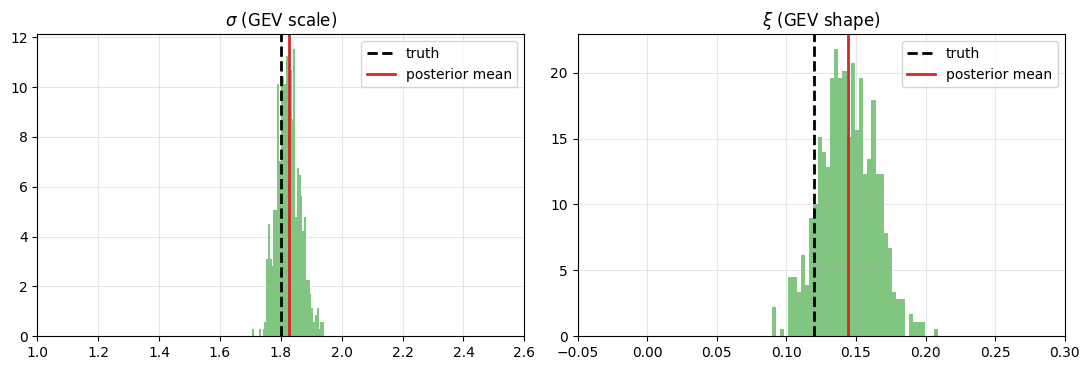
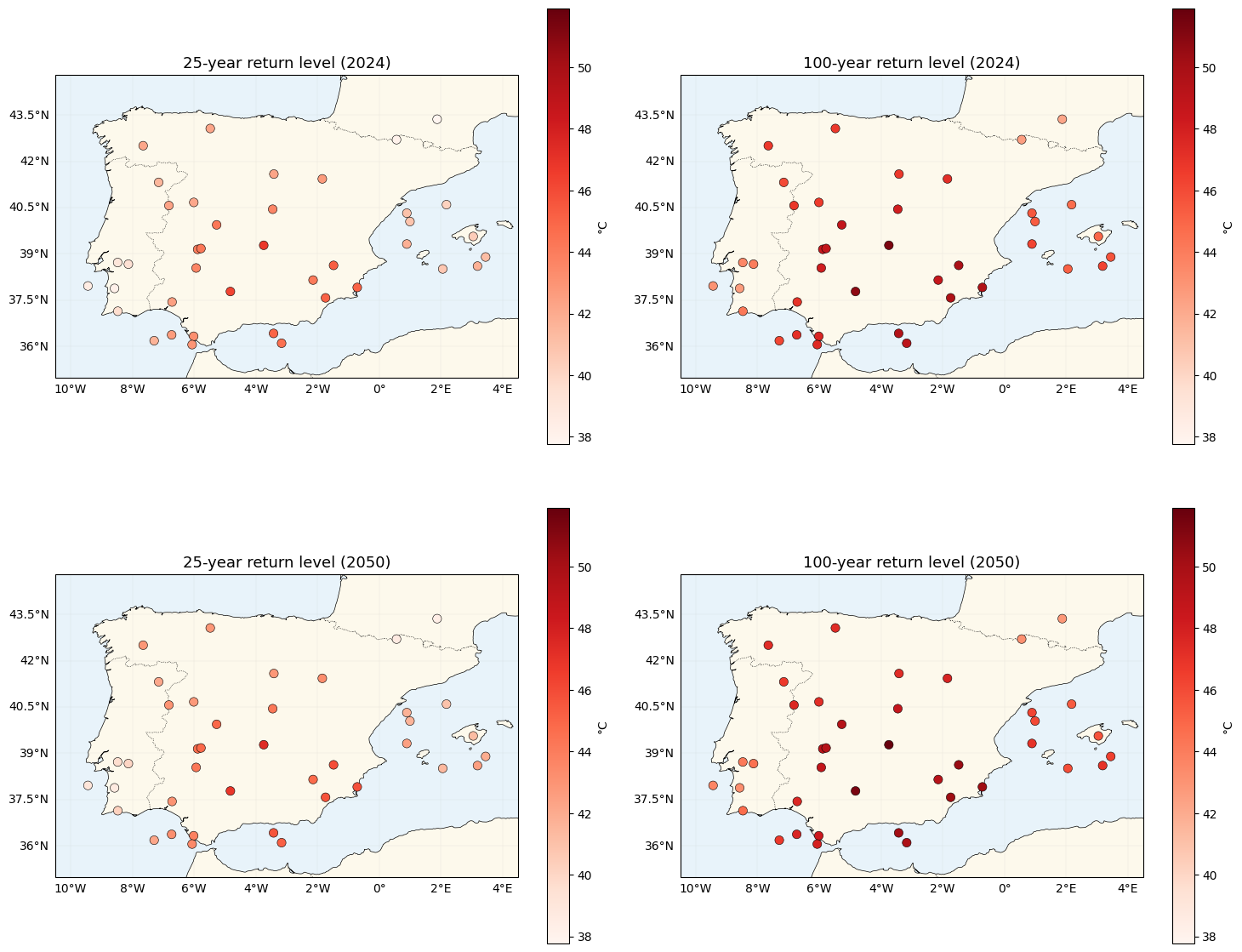
Return-level maps — now spatially varying
, then
gev_return_level. Because is location-dependent,
the 2024 → 2050 warming shift is non-uniform — the key difference from nb 01.
mu0_p = float(lat["mu0"].mean())
beta_field_mean = beta_field.mean(0)
mu_field_mean = post["mu_field"].mean(0)
sigma_p = float(post["sigma"].mean())
xi_p = float(lat["xi"].mean())

gmst_2024 = gmst[-1]
gmst_2050 = gmst[-1] + (gmst[-1] - gmst[0]) / (T - 1) * (2050 - (YEAR_0 + T - 1))
tau_2024 = mu0_p + mu_field_mean + beta_field_mean * (gmst_2024 - jnp.mean(gmst))
tau_2050 = mu0_p + mu_field_mean + beta_field_mean * (gmst_2050 - jnp.mean(gmst))

z25_2024 = gev_return_level(25.0, tau_2024, sigma_p, xi_p)
z100_2024 = gev_return_level(100.0, tau_2024, sigma_p, xi_p)
z25_2050 = gev_return_level(25.0, tau_2050, sigma_p, xi_p)
z100_2050 = gev_return_level(100.0, tau_2050, sigma_p, xi_p)
shift_100 = z100_2050 - z100_2024

stacked = jnp.stack([z25_2024, z100_2024, z25_2050, z100_2050])
vmin, vmax = float(jnp.min(stacked)), float(jnp.max(stacked))
print(f"100-yr return shift 2024→2050:  mean {float(jnp.mean(shift_100)):.2f} °C,  "
      f"range [{float(shift_100.min()):.2f}, {float(shift_100.max()):.2f}] °C")
print("  (spatial spread is the new feature; nb 01 had zero spread here)")

fig, axes = plt.subplots(2, 2, figsize=(15, 13), subplot_kw={"projection": ccrs.PlateCarree()})
for ax, values, title in zip(
    axes.flat, [z25_2024, z100_2024, z25_2050, z100_2050],
    ["25-year return level (2024)", "100-year return level (2024)",
     "25-year return level (2050)", "100-year return level (2050)"],
    strict=True,
):
    plot_stations(ax, values, cmap="Reds", vlim=(vmin, vmax), label="°C")
    ax.set_title(title, fontsize=13)
plt.tight_layout()
plt.show()
100-yr return shift 2024→2050: mean 0.63 °C, range [0.55, 0.76] °C
(spatial spread is the new feature; nb 01 had zero spread here)
The spatial pattern of warming
directly. Under nb 01 this map would be constant; here it tracks .
shift_abs = float(jnp.max(jnp.abs(shift_100)))
fig, ax = plt.subplots(figsize=(6.8, 5.5), subplot_kw={"projection": ccrs.PlateCarree()})
plot_stations(ax, shift_100, cmap="RdPu", vlim=(0.0, 1.1 * shift_abs),
              label=r"$z_{100}(2050) - z_{100}(2024)$ [°C]")
ax.set_title(r"2024 $\to$ 2050 shift in 100-year return level")
plt.tight_layout()
plt.show()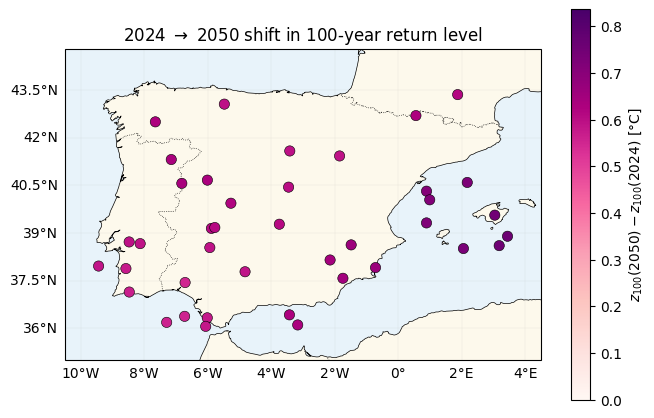
Contrast with the additive model (nb 01)
| Aspect | Additive (nb 01) | Multiplicative (this nb) |
|---|---|---|
| Temporal structure | , one β | , per-station rate |
| Prior covariance | ||
| Time rank | full () | 2 |
| Latent fields | , | , |
| 2050 warming map | constant | spatially varying |
Both share the same machinery — pyrox GP latents, xtremax GEV likelihood,
NumPyro SVI — with only 's definition and the second GP changing.
Summary
- The multiplicative model’s prior is
gaussx.SumKroneckerof two rank-1 Kronecker products; time-rank 2 because is a known covariate. - Inference reuses the nb 01 stack verbatim: two
pyroxspatial GPs via whitenedgp_sample, anxtremaxGEV likelihood, NumPyro SVI; centering both fields fixes the and identifiabilities. - The payoff is a spatially heterogeneous warming signal: high-β regions warm faster, so the 100-year return-level shift is a map, not a constant.
Follow-ups
- Non-stationary GEV — let σ, ξ vary across space via their own spatial GPs (nb 03).
- Higher-rank coregionalisation — a 3–4 component temporal basis with β a matrix of location weights.