Patching — streaming reconstruction (zarr accumulator)
Streaming reconstruction: zarr accumulator, then real GeoTIFFs
Two ways geopatcher handles fields that don’t fit in RAM:
- Part 1 — disk-backed
SpatialOverlapAdd: accumulate per-chip output into an on-disk zarr store instead of a float64 in-memory array. Plus a hierarchical Patcher-of-Patchers recipe that parallelises naturally. - Part 2 — real GeoTIFFs: write a synthetic raster to disk, open via
RasterioReader(lazy windowed reads via GDAL), and run the same pipeline against bytes-on-disk rather than an in-memory array.
Both rely on zarr>=3; install with pip install 'geopatcher[streaming]'.
import tempfile
from pathlib import Path

import matplotlib.pyplot as plt
import numpy as np
import rasterio
from geopatcher import (
    Patch,
    RasterField,
    SpatialBoxcar,
    SpatialHann,
    SpatialMedian,
    SpatialOverlapAdd,
    SpatialPatcher,
    SpatialRectangular,
    SpatialRegularStride,
)
from georeader.geotensor import GeoTensor
from geotoolz import Lambda, Sequential
from geotoolz.patch_ops import (
    ApplyToChips,
    GridSampler,
    Stitch,
)
from rasterio.transform import from_originarr = np.ones((32, 32), dtype=np.float32)
print(f"arr.shape: {arr.shape}") # (32, 32)
field = RasterField(
GeoTensor(values=arr, transform=rasterio.Affine.identity(), crs="EPSG:32630")
)
patcher = SpatialPatcher(
geometry=SpatialRectangular(size=(8, 8)),
sampler=SpatialRegularStride(step=8),
window=SpatialBoxcar(),
aggregation=SpatialOverlapAdd(),
)
patches = list(patcher.split(field))
print(f"len(patches): {len(patches)}") # 4x4 = 16
print(f"patches[0].data.shape: {patches[0].data.shape}") # (8, 8)
in_memory = SpatialOverlapAdd().merge(patches, field.reader)
print(f"in_memory.shape: {in_memory.shape}") # (32, 32)
print(f"in_memory.sum(): {in_memory.sum():.1f}")arr.shape: (32, 32)
len(patches): 16
patches[0].data.shape: (8, 8)
in_memory.shape: (32, 32)
in_memory.sum(): 1024.0
Disk-backed accumulator
Pass streaming=True + target_path=... to SpatialOverlapAdd. The merge
accumulates into a chunked zarr store on disk; the return value is a zarr
array readable as numpy (or via xarray).
try:
    import zarr

    with tempfile.TemporaryDirectory() as tmpdir:
        on_disk_agg = SpatialOverlapAdd(
            streaming=True, target_path=tmpdir, chunks=(8, 8)
        )
        on_disk = on_disk_agg.merge(patches, field.reader)
        print(f"on_disk.shape: {on_disk.shape}, dtype: {on_disk.dtype}")
        np.testing.assert_allclose(np.asarray(on_disk[:]), in_memory)
        print("disk-backed result matches in-memory baseline")
except ImportError:
    print("install 'geopatcher[streaming]' to see this section run live")
on_disk.shape: (32, 32), dtype: float32
disk-backed result matches in-memory baseline
Hierarchical Patcher-of-Patchers
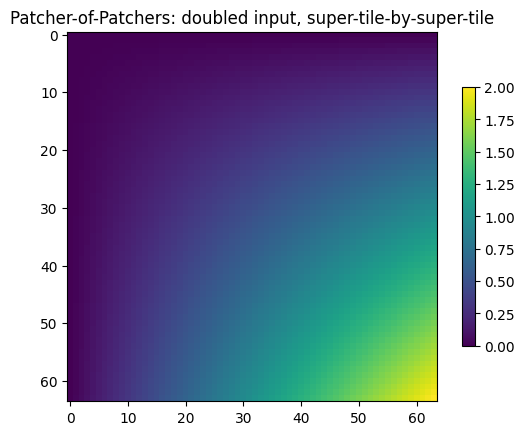
A recipe, not a class: an outer Patcher chops the field into coarse super-tiles, an inner Patcher chops each super-tile into fine chips. The outer aggregation is implicit (each super-tile is written out as soon as it’s reconstructed); the inner aggregation is RAM-resident at super-tile scale.
big = np.outer(np.linspace(0, 1, 64), np.linspace(0, 1, 64)).astype(np.float32)
print(f"big.shape: {big.shape}")  # (64, 64)
big_field = RasterField(
    GeoTensor(values=big, transform=rasterio.Affine.identity(), crs="EPSG:32630")
)

outer = SpatialPatcher(
    geometry=SpatialRectangular(size=(32, 32)),
    sampler=SpatialRegularStride(step=32),
    window=SpatialBoxcar(),
    aggregation=SpatialOverlapAdd(),
)
inner = SpatialPatcher(
    geometry=SpatialRectangular(size=(8, 8)),
    sampler=SpatialRegularStride(step=8),
    window=SpatialBoxcar(),
    aggregation=SpatialOverlapAdd(),
)


def double_patch(patch: Patch) -> Patch:
    return Patch(
        data=np.asarray(patch.data) * 2.0,
        anchor=patch.anchor,
        indices=patch.indices,
        weights=patch.weights,
    )


def run_per_supertile(supertile_data: np.ndarray) -> np.ndarray:
    """Inner pipeline: split → double → stitch, fits in super-tile RAM."""
    super_field = RasterField(
        GeoTensor(
            values=supertile_data,
            transform=rasterio.Affine.identity(),
            crs="EPSG:32630",
        )
    )
    inner_patches = [double_patch(p) for p in inner.split(super_field)]
    return SpatialOverlapAdd().merge(inner_patches, super_field.reader)


# Each super-tile reconstructs at super-tile scale; the outer loop writes the
# result into the global output. No global RAM is allocated beyond the final
# output array (which in production would be a zarr store).
result = np.zeros_like(big)
for super_patch in outer.split(big_field):
    super_arr = np.asarray(super_patch.data)
    print(f"  super-tile anchor={super_patch.anchor} shape={super_arr.shape}")
    reconstructed = run_per_supertile(super_arr)
    r0, c0 = super_patch.anchor
    h, w = reconstructed.shape
    result[r0 : r0 + h, c0 : c0 + w] = reconstructed

np.testing.assert_allclose(result, big * 2.0)
print(f"result.shape: {result.shape}")

plt.imshow(result, cmap="viridis")
plt.title("Patcher-of-Patchers: doubled input, super-tile-by-super-tile")
plt.colorbar(shrink=0.7)
plt.show()
big.shape: (64, 64)
super-tile anchor=(0, 0) shape=(32, 32)
super-tile anchor=(0, 32) shape=(32, 32)
super-tile anchor=(32, 0) shape=(32, 32)
super-tile anchor=(32, 32) shape=(32, 32)
result.shape: (64, 64)
streaming_safe flag
Every SpatialAggregation advertises whether it can run one patch at a
time. SpatialMedian, SpatialMode, and SpatialLearned are
streaming_safe = False — they need per-cell history. When
SpatialPatcher.merge is called on one, the framework emits a
RuntimeWarning pointing at the streamable substitute.
import warnings

from geopatcher._src.spatial.aggregation import _warn_if_unsafe_streaming


with warnings.catch_warnings(record=True) as captured:
    warnings.simplefilter("always")
    _warn_if_unsafe_streaming(SpatialMedian())
print(str(captured[0].message))
SpatialMedian has streaming_safe = False — the merge is happening in-RAM. For streaming alternatives see scaling.md (Median->ApproxQuantile, Mode->HardVote or ApproxMode, Learned->two-pass).
Part 2 — streaming on real GeoTIFFs
Same pipeline, real on-disk input. Write a synthetic single-band float32
raster, open with RasterioReader, wrap as a RasterField, and run the
Patcher. Each chip is a real rasterio windowed read — bytes-on-disk
fetched lazily through GDAL.
H, W = 256, 256
gt_arr = (
    np.outer(np.linspace(0, 1, H), np.linspace(0, 1, W))
    + 0.3 * np.sin(np.linspace(0, 8 * np.pi, W))[None, :]
).astype(np.float32)
print(f"truth array shape: {gt_arr.shape}, dtype: {gt_arr.dtype}")

tif_dir = tempfile.mkdtemp(prefix="geotoolz-stream-")
tif_path = Path(tif_dir) / "synthetic.tif"

with rasterio.open(
    tif_path,
    "w",
    driver="GTiff",
    height=H,
    width=W,
    count=1,
    dtype="float32",
    crs="EPSG:32630",
    transform=from_origin(0.0, float(H), 1.0, 1.0),
    tiled=True,
    blockxsize=64,
    blockysize=64,
) as dst:
    dst.write(gt_arr, 1)
print(f"wrote: {tif_path}  ({tif_path.stat().st_size:,} bytes)")
truth array shape: (256, 256), dtype: float32
wrote: /var/folders/k9/_v6ywhvj0nq36tpttd3j4mq80000gn/T/geotoolz-stream-i_tajnv8/synthetic.tif (262,612 bytes)
Open via RasterioReader and wrap as a Field
from georeader.rasterio_reader import RasterioReader


reader = RasterioReader(str(tif_path))
print(f"reader.shape: {reader.shape}")  # (1, 256, 256)
print(f"reader.dtype: {reader.dtype}")

geotiff_field = RasterField(reader)
# Each `geotiff_field.select(window)` triggers a real on-disk read.
reader.shape: (1, 256, 256)
reader.dtype: float32
Patch the GeoTIFF
Chips are 64×64 with stride 64 — each chip reads exactly one tile from the tiled GeoTIFF.
geotiff_patcher = SpatialPatcher(
    geometry=SpatialRectangular(size=(64, 64)),
    sampler=SpatialRegularStride(step=64),
    window=SpatialBoxcar(),
    aggregation=SpatialOverlapAdd(),
)
print(f"expected anchors: {(H // 64)} x {(W // 64)} = {(H // 64) * (W // 64)}")

# Peek at the first patch — note: `read_from_window` is **lazy**, the
# patch's `data` is itself a `RasterioReader` view that materialises on
# `.values` or `.load()`. This lets the Patcher hand the substrate around
# without forcing a read at split-time.
first_patch = next(iter(geotiff_patcher.split(geotiff_field)))
print(f"first patch anchor: {first_patch.anchor}")
print(f"first patch indices: {first_patch.indices}")
print(f"first patch data type: {type(first_patch.data).__name__}")
print(f"first patch data.shape: {first_patch.data.shape}")  # (1, 64, 64)
materialised = first_patch.data.values
print(f"materialised .values.shape: {materialised.shape}, dtype: {materialised.dtype}")
expected anchors: 4 x 4 = 16
first patch anchor: (0, 0)
first patch indices: Window(col_off=0, row_off=0, width=64, height=64)
first patch data type: RasterioReader
first patch data.shape: (1, 64, 64)
materialised .values.shape: (1, 64, 64), dtype: float32
Per-chip operator
def model_per_chip(chip) -> np.ndarray:
    """Materialise the lazy reader, squeeze (1, h, w) -> (h, w), then square.

    Shapes:
        in : RasterioReader (lazy, .shape = (1, 64, 64))
        out: ndarray (64, 64) float64
    """
    arr = chip.values[0].astype(np.float64)  # (64, 64) — single GDAL read
    return arr * arr  # (64, 64)


model = Lambda(model_per_chip, name="square")
In-RAM reconstruction
class _Domain2D:
    """Lightweight 2-D domain stand-in for the stitch.

    `Stitch` only reads `.shape` from the domain, so a single-attribute object
    is enough. In production you'd pass a `GeoTensor` or a 2-D
    `RasterioReader`-shaped view.
    """

    def __init__(self, h: int, w: int) -> None:
        self.shape = (h, w)


domain_2d = _Domain2D(H, W)

pipe = Sequential(
    [
        GridSampler(geotiff_patcher),
        ApplyToChips(model),
        Stitch(SpatialOverlapAdd(), domain=domain_2d),
    ]
)
in_ram = pipe(geotiff_field)
print(f"in-RAM result shape: {in_ram.shape}, dtype: {in_ram.dtype}")
np.testing.assert_allclose(in_ram, gt_arr.astype(np.float64) ** 2, rtol=1e-6)
print("in-RAM result matches ground truth")
in-RAM result shape: (256, 256), dtype: float64
in-RAM result matches ground truth
Disk-backed reconstruction
Swap the in-memory SpatialOverlapAdd for the streaming variant pointed at
a fresh tempdir. The merge accumulates into a chunked zarr store; the
return value is a zarr array readable lazily.
We force float64 end-to-end (matching the in-RAM path) so the in-RAM
and disk-backed results are bit-identical, not merely close.
import zarr  # noqa: F401


stream_dir = tempfile.mkdtemp(prefix="geotoolz-stream-output-")

patches: list[Patch] = []
for raw in geotiff_patcher.split(geotiff_field):
    chip = model(raw.data)  # (64, 64) float64
    patches.append(
        Patch(
            data=chip,
            anchor=raw.anchor,
            indices=raw.indices,
            weights=raw.weights,
        )
    )
print(f"materialised {len(patches)} patches")
print(f"patches[0].data.shape: {patches[0].data.shape}")  # (64, 64)
print(f"patches[0].data.dtype: {patches[0].data.dtype}")  # float64

streaming_agg = SpatialOverlapAdd(
    streaming=True, target_path=stream_dir, chunks=(64, 64)
)
on_disk_zarr = streaming_agg.merge(patches, domain_2d)
on_disk = np.asarray(on_disk_zarr[:]).astype(np.float64)
print(f"on-disk zarr.shape: {on_disk_zarr.shape}, dtype: {on_disk_zarr.dtype}")
print(f"on-disk materialised.shape: {on_disk.shape}, dtype: {on_disk.dtype}")

truth = gt_arr.astype(np.float64) ** 2
np.testing.assert_allclose(on_disk, truth, atol=1e-5)
print("disk-backed result matches ground truth")
# Within float32-vs-float64 round-trip noise, in-RAM and disk-backed agree.
np.testing.assert_allclose(in_ram, on_disk, atol=1e-5)
print("in-RAM and disk-backed reconstructions agree")
materialised 16 patches
patches[0].data.shape: (64, 64)
patches[0].data.dtype: float64
on-disk zarr.shape: (256, 256), dtype: float32
on-disk materialised.shape: (256, 256), dtype: float64
disk-backed result matches ground truth
in-RAM and disk-backed reconstructions agree
Visual sanity check — in-RAM vs zarr, side-by-side
Top row: truth, in-RAM reconstruction, disk-backed (zarr) reconstruction.
Bottom row: per-pixel absolute differences against truth and against each
other. The |in-RAM - zarr| panel quantifies the float32 ↔ float64
round-trip introduced by the streaming path’s on-disk dtype.
diff_ram = np.abs(in_ram - truth)
diff_zarr = np.abs(on_disk - truth)
diff_ram_zarr = np.abs(in_ram - on_disk)
vmin, vmax = float(truth.min()), float(truth.max())
err_max = float(max(diff_ram.max(), diff_zarr.max(), diff_ram_zarr.max()))

fig, axes = plt.subplots(2, 3, figsize=(11, 7))

axes[0, 0].imshow(truth, cmap="viridis", vmin=vmin, vmax=vmax)
axes[0, 0].set_title(f"Truth (input²)\n{truth.shape} {truth.dtype}")
axes[0, 1].imshow(in_ram, cmap="viridis", vmin=vmin, vmax=vmax)
axes[0, 1].set_title(f"In-RAM reconstruction\n{in_ram.shape} {in_ram.dtype}")
axes[0, 2].imshow(on_disk, cmap="viridis", vmin=vmin, vmax=vmax)
axes[0, 2].set_title(f"Zarr reconstruction\n{on_disk.shape} {on_disk.dtype}")

im_diff_ram = axes[1, 0].imshow(diff_ram, cmap="magma", vmin=0, vmax=err_max)
axes[1, 0].set_title(f"|in-RAM − truth|\nmax = {diff_ram.max():.2e}")
im_diff_zarr = axes[1, 1].imshow(diff_zarr, cmap="magma", vmin=0, vmax=err_max)
axes[1, 1].set_title(f"|zarr − truth|\nmax = {diff_zarr.max():.2e}")
im_diff_rz = axes[1, 2].imshow(diff_ram_zarr, cmap="magma", vmin=0, vmax=err_max)
axes[1, 2].set_title(f"|in-RAM − zarr|\nmax = {diff_ram_zarr.max():.2e}")

for ax in axes.ravel():
    ax.set_xticks([])
    ax.set_yticks([])
fig.colorbar(im_diff_rz, ax=axes[1, :].ravel().tolist(), shrink=0.7, label="|error|")
plt.suptitle("Boxcar / stride=size: reconstruction is exact (modulo on-disk dtype)")
plt.show()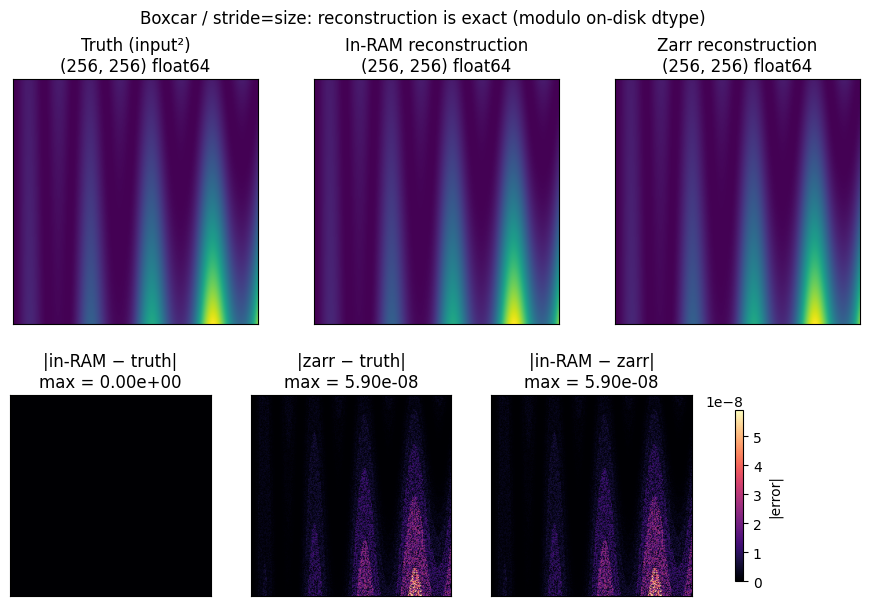
The |in-RAM − truth| panel is all-zero because both paths run in
float64 and Boxcar/non-overlapping patches read each pixel exactly once.
The |zarr − truth| panel shows the small float32 round-trip the on-disk
accumulator introduces (controlled by zarr’s array dtype, configurable in
SpatialOverlapAdd). For applications that need bit-exact reconstruction
you can construct the on-disk store as float64 instead.
Overlap + Hann demo on the GeoTIFF
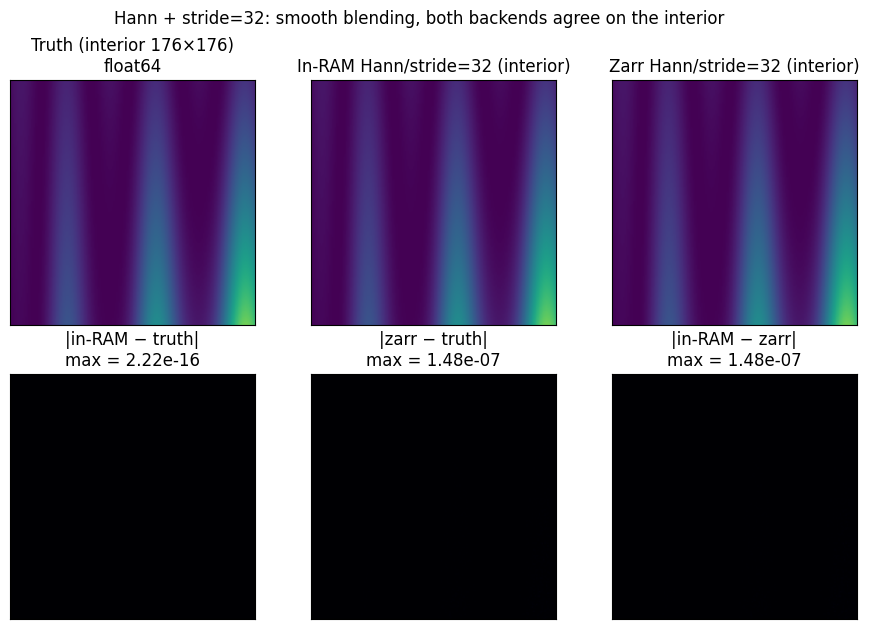
Same pipeline with stride=32 and a SpatialHann window. OverlapAdd
normalises by the accumulated weights so the reconstruction recovers the
squared field on the interior. Boundaries are not covered (the leftmost
32 px column and topmost 32 px row have zero Hann weight); we trim them
off in the comparison.
patcher_ola = SpatialPatcher(
    geometry=SpatialRectangular(size=(64, 64)),
    sampler=SpatialRegularStride(step=32),
    window=SpatialHann(),
    aggregation=SpatialOverlapAdd(),
)
pipe_ola = Sequential(
    [
        GridSampler(patcher_ola),
        ApplyToChips(model),
        Stitch(SpatialOverlapAdd(), domain=domain_2d),
    ]
)
ola_result = pipe_ola(geotiff_field)
print(f"ola_result.shape: {ola_result.shape}")

# Disk-backed version of the same Hann pipeline
ola_stream_dir = tempfile.mkdtemp(prefix="geotoolz-stream-hann-")
ola_patches: list[Patch] = []
for raw in patcher_ola.split(geotiff_field):
    chip = model(raw.data)
    ola_patches.append(
        Patch(
            data=chip,
            anchor=raw.anchor,
            indices=raw.indices,
            weights=raw.weights,
        )
    )
ola_disk_zarr = SpatialOverlapAdd(
    streaming=True, target_path=ola_stream_dir, chunks=(64, 64)
).merge(ola_patches, domain_2d)
ola_disk = np.asarray(ola_disk_zarr[:]).astype(np.float64)
print(f"hann/zarr.shape: {ola_disk_zarr.shape}, dtype: {ola_disk_zarr.dtype}")

# Trim the outer 40 px ring before comparing — Hann has zero weight on
# patch boundaries, so the very edge of the reconstruction is undefined.
interior_ram = ola_result[40:-40, 40:-40]
interior_zarr = ola_disk[40:-40, 40:-40]
interior_truth = truth[40:-40, 40:-40]
np.testing.assert_allclose(interior_ram, interior_truth, atol=1e-5)
np.testing.assert_allclose(interior_zarr, interior_truth, atol=1e-5)
print("Hann interior reconstruction matches ground truth (both paths)")

fig, axes = plt.subplots(2, 3, figsize=(11, 7))
axes[0, 0].imshow(interior_truth, cmap="viridis", vmin=vmin, vmax=vmax)
axes[0, 0].set_title(f"Truth (interior 176×176)\n{interior_truth.dtype}")
axes[0, 1].imshow(interior_ram, cmap="viridis", vmin=vmin, vmax=vmax)
axes[0, 1].set_title("In-RAM Hann/stride=32 (interior)")
axes[0, 2].imshow(interior_zarr, cmap="viridis", vmin=vmin, vmax=vmax)
axes[0, 2].set_title("Zarr Hann/stride=32 (interior)")
axes[1, 0].imshow(
    np.abs(interior_ram - interior_truth), cmap="magma", vmin=0, vmax=1e-5
)
axes[1, 0].set_title(
    f"|in-RAM − truth|\nmax = {np.abs(interior_ram - interior_truth).max():.2e}"
)
axes[1, 1].imshow(
    np.abs(interior_zarr - interior_truth), cmap="magma", vmin=0, vmax=1e-5
)
axes[1, 1].set_title(
    f"|zarr − truth|\nmax = {np.abs(interior_zarr - interior_truth).max():.2e}"
)
axes[1, 2].imshow(np.abs(interior_ram - interior_zarr), cmap="magma", vmin=0, vmax=1e-5)
axes[1, 2].set_title(
    f"|in-RAM − zarr|\nmax = {np.abs(interior_ram - interior_zarr).max():.2e}"
)
for ax in axes.ravel():
    ax.set_xticks([])
    ax.set_yticks([])
plt.suptitle("Hann + stride=32: smooth blending, both backends agree on the interior")
plt.show()
ola_result.shape: (256, 256)
hann/zarr.shape: (256, 256), dtype: float32
Hann interior reconstruction matches ground truth (both paths)
Scaling to a real Sentinel-2 tile
The synthetic 256×256 GeoTIFF above keeps the demo fast. The
same code path scales to a full Sentinel-2 tile (~10980×10980
px) by swapping in a real MPC asset URL — rasterio reads only
the bytes each SpatialPatcher.Window touches.
from geostack import load_stac_items, LAKE_TAHOE_TILE
item = load_stac_items(
    "sentinel-2-l2a", (-180, -90, 180, 90), "2024-06-01/2024-07-15",
    tile=LAKE_TAHOE_TILE, max_cloud_cover=5,
)[0]
# Lazy windowed read straight from MPC — no full-tile fetch.
reader = RasterioReader(item.assets["B04"].href)
field = RasterField(reader)
# Same patcher + same `Sequential` as above; storage shape is
# `(10980, 10980)` instead of `(256, 256)`.
In production the on-disk zarr accumulator scales to whatever fits
on the volume you point target_path at — useful for global
inference runs where the reconstructed field is hundreds of GB.
What this proves
- The
FieldProtocol cleanly bridges georeader’s existingGeoDatasurface to the Patcher — no new IO code is needed for rasters. - Each chip is a real
rasteriowindowed read; GDAL fetches only the bytes touched by the patch’sWindow. - The streaming
SpatialOverlapAddwrites one chip’s contribution at a time into the zarr store. The accumulator never has to hold the full reconstruction in RAM. - With a tiled GeoTIFF (or a COG) the zarr chunk shape can match the chip shape, so each read and write is a single block.