Differential Beer-Lambert plume retrieval from the LUT
Beer–Lambert forward model & differential plume-enhancement retrieval¶
This notebook closes the loop between the offline-generated CH4 cross-section LUT (notebook 01) and the plume-simulation sub-project. The LUT’s job is to make the runtime forward model fast — ~1 ms per pixel instead of ~1 s for a direct line-by-line call. The forward model’s job is to simulate the transmittance ratio that a satellite spectrometer measures when looking at a plume pixel vs a nearby background pixel. The retrieval’s job is to invert that ratio for the column enhancement .
Structure:
- Load the LUT built in notebook 01, verify it against a direct HAPI call.
- Single-layer forward model — compute at background VMR.
- Differential Beer–Lambert — build for a menu of values.
- Tie to
gauss_plume— take a synthetic plume fromsimulate_plume, convert its column enhancement to a VMR enhancement, and build the corresponding measured-ratio spectrum. - Retrieve from a noisy simulated ratio via least squares, pixel by pixel.
See Beer–Lambert radiative transfer and the HAPI absorption LUT for the physics and CH4 absorption cross-section LUT for the LUT build.
import warnings
from pathlib import Path

warnings.filterwarnings("ignore")

import matplotlib.pyplot as plt
import numpy as np
import xarray as xr

from plume_simulation.gauss_plume import simulate_plume
from plume_simulation.hapi_lut import (
    ATMOSPHERIC_GASES,
    beers_law_from_lut,
    number_density,
    plume_ratio_spectrum,
)
from plume_simulation.hapi_lut.beers import ATM_TO_PA, BOLTZMANN_J_PER_K

rng = np.random.default_rng(0)

REPO_ROOT = Path.cwd()
while not (REPO_ROOT / "pixi.toml").exists() and REPO_ROOT != REPO_ROOT.parent:
    REPO_ROOT = REPO_ROOT.parent
LUT_PATH = REPO_ROOT / "projects" / "plume_simulation" / "data" / "hapi_lut" / "ch4_absorption_lut.nc"
assert LUT_PATH.exists(), f"Run 01_hapi_lut_ch4.ipynb first — missing {LUT_PATH}"

ch4_lut = xr.open_dataset(LUT_PATH)
ch4_lut1. Reference atmosphere and geometry¶
Mid-troposphere state: K, atm. The mapping from viewing geometry to the two-way AMF follows the plane-parallel formula . At nadir () this is exactly 2.
T_K = 260.0
p_atm = 0.6
SZA_deg = 30.0
VZA_deg = 0.0   # nadir-looking
L_vert_cm = 8e5  # 8 km tropospheric column

# Background CH4 mixing ratio: ~1.9 ppm (current global mean).
VMR_BG = 1.9e-6
2. Single-layer forward transmittance¶
beers_law_from_lut chains:
- bilinear interp of the LUT at ,
- with ,
- .
At background VMR the methane band produces ~5 % dips in the clearest lines.
tau_bg = beers_law_from_lut(
    ch4_lut,
    vmr=VMR_BG, T_K=T_K, p_atm=p_atm,
    l_vert_cm=L_vert_cm, sza_deg=SZA_deg, vza_deg=VZA_deg,
)

fig, ax = plt.subplots(1, 1, figsize=(10, 3.5))
ax.plot(tau_bg["wavenumber"], tau_bg, lw=0.4, color="C0")
ax.set_xlabel(r"Wavenumber $\nu$ [cm$^{-1}$]")
ax.set_ylabel(r"$\tau_{\mathrm{bg}}(\nu)$")
ax.set_title(rf"Background single-layer transmittance (VMR = {VMR_BG:.2e}, SZA = {SZA_deg}°, VZA = {VZA_deg}°)")
ax.set_ylim(0.8, 1.005)
ax.grid(alpha=0.3)
plt.tight_layout()
plt.show()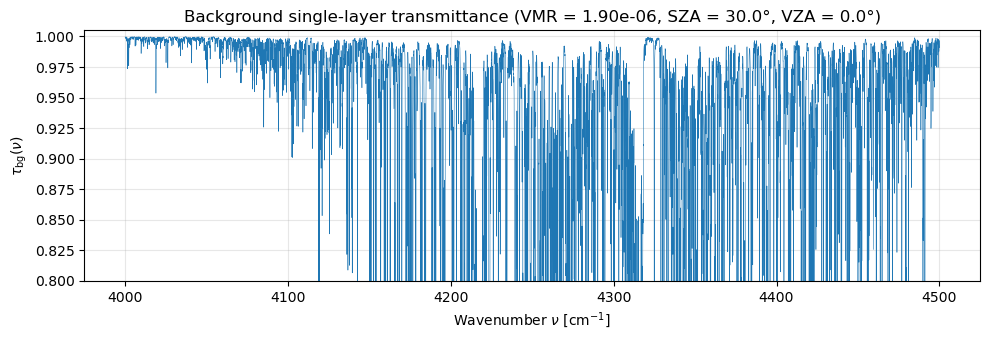
3. Differential Beer–Lambert: vs ¶
The key physics (§5 of the derivation note) is that dividing a plume pixel’s transmittance by a nearby background pixel’s transmittance cancels out the solar spectrum, surface albedo, aerosol, and target-gas background — leaving only the narrow-band enhancement signature
We build a menu of such ratios for .
enhancements = [0.00, 0.05, 0.10, 0.20]

fig, ax = plt.subplots(1, 1, figsize=(10, 4))
for eps in enhancements:
    ratio = plume_ratio_spectrum(
        ch4_lut,
        vmr_background=VMR_BG,
        vmr_total=(1.0 + eps) * VMR_BG,
        T_K=T_K, p_atm=p_atm,
        l_vert_cm=L_vert_cm, sza_deg=SZA_deg, vza_deg=VZA_deg,
    )
    ax.plot(ratio["wavenumber"], ratio, lw=0.4, label=rf"$\varepsilon$ = {eps*100:.0f}%")
ax.set_xlabel(r"Wavenumber $\nu$ [cm$^{-1}$]")
ax.set_ylabel(r"$\tau_{\mathrm{enh}}(\nu)$")
ax.set_title(r"Differential transmittance — enhancement signature grows linearly in $\varepsilon$")
ax.legend()
ax.grid(alpha=0.3)
plt.tight_layout()
plt.show()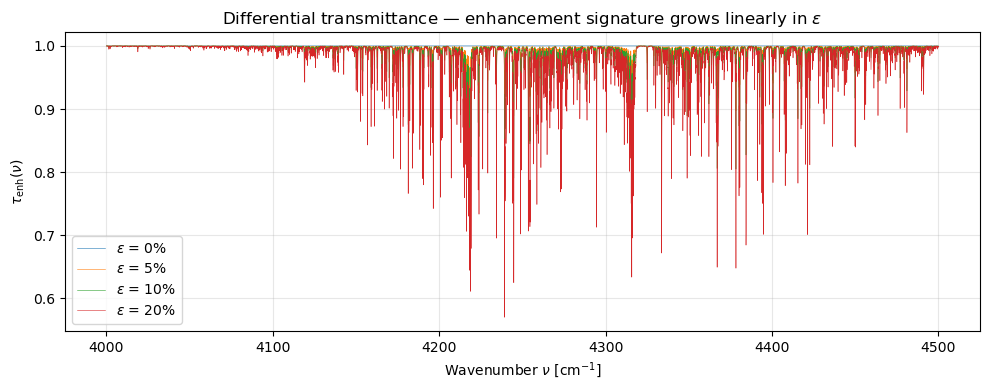
The depth of the absorption signature scales roughly linearly with in the small-enhancement regime — that’s the regime where classical matched-filter retrievals have a closed-form MLE.
4. Tie in the Gaussian plume — column enhancement → VMR enhancement¶
Use the steady-state Gaussian plume forward model to get column CH4 enhancement [kg/m²] over a 2-D ground footprint. Emission: kg/hr from a ground-level source, wind 5 m/s from the west (meteo convention: wind_direction = 270°), neutral stability (class D).
Q_kg_per_s = 500.0 / 3600.0
plume_ds = simulate_plume(
    emission_rate=Q_kg_per_s,
    source_location=(0.0, 0.0, 2.0),
    wind_speed=5.0,
    wind_direction=270.0,
    stability_class="D",
    domain_x=(-200.0, 1200.0, 141),
    domain_y=(-400.0, 400.0, 81),
    domain_z=(0.0, 100.0, 21),
)
col_ch4 = plume_ds["column_concentration"]  # [kg/m²], shape (x, y)
print(f"column CH4 enhancement range: [{float(col_ch4.min()):.2e}, {float(col_ch4.max()):.2e}] kg/m²")
column CH4 enhancement range: [0.00e+00, 6.73e-03] kg/m²
4a. Column → VMR mapping¶
The background CH4 column mass density follows from the hydrostatic air column and the CH4 mass fraction :
The fractional enhancement is then .
M_CH4 = 16.04e-3   # kg/mol
M_AIR = 28.97e-3   # kg/mol
G_MS2 = 9.81       # m/s²
P_SURF_PA = 101325.0

air_column_kg_m2 = P_SURF_PA / G_MS2
ch4_bg_column_kg_m2 = air_column_kg_m2 * VMR_BG * (M_CH4 / M_AIR)
print(f"air column:       {air_column_kg_m2:.0f} kg/m²")
print(f"CH4 bg column:    {ch4_bg_column_kg_m2*1e3:.3f} g/m² (VMR_bg = {VMR_BG:.2e})")

eps_field = (col_ch4 / ch4_bg_column_kg_m2).values  # shape (n_x, n_y)
print(f"peak ε:           {eps_field.max()*100:.2f}%")
air column: 10329 kg/m²
CH4 bg column: 10.866 g/m² (VMR_bg = 1.90e-06)
peak ε: 61.90%
4b. Synthetic scene — ε(x, y) footprint¶
fig, ax = plt.subplots(1, 1, figsize=(10, 4))
im = ax.pcolormesh(
    plume_ds["x"], plume_ds["y"], eps_field.T * 100,
    cmap="magma_r", vmin=0.0, vmax=float(eps_field.max()) * 100,
    shading="auto",
)
ax.set_xlabel("x [m]   (downwind)")
ax.set_ylabel("y [m]   (crosswind)")
ax.set_title("Column-averaged CH$_4$ enhancement $\\varepsilon$ [%]")
ax.scatter([0], [0], s=80, marker="*", color="cyan", edgecolor="k", label="source")
ax.legend(loc="upper right")
plt.colorbar(im, ax=ax, label=r"$\varepsilon$ [%]")
plt.tight_layout()
plt.show()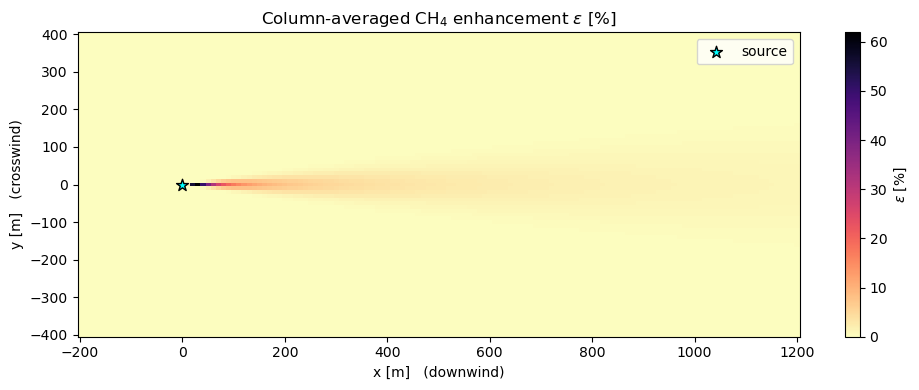
5. Per-pixel differential retrieval¶
We now retrieve from a simulated noisy ratio spectrum at each pixel. Forward model for the simulated ratio at pixel with true enhancement :
Taking the log linearises the problem: in the small-enhancement limit , so the MLE is a single closed-form projection (matched filter):
This is the matched-filter kernel used in operational retrievals (Thompson et al., Thorpe et al.). Below we precompute once from the LUT and project every pixel’s synthetic noisy log-ratio onto it.
# Precompute the kernel K from the LUT.
# We use a pinned reference enhancement ε_ref = 1% and rescale.
# (Rescaling avoids numerical overflow from the direct ε=1.0 call which
# can produce τ → 0 in strong lines.)
eps_ref = 0.01
K_full = np.log(
    plume_ratio_spectrum(
        ch4_lut, vmr_background=VMR_BG, vmr_total=(1.0 + eps_ref) * VMR_BG,
        T_K=T_K, p_atm=p_atm, l_vert_cm=L_vert_cm, sza_deg=SZA_deg, vza_deg=VZA_deg,
    ).values
) / eps_ref

# Restrict the fit to the strong-absorption portion of the band (4150–4400 cm^-1)
# where the matched-filter SNR is highest.
nu = ch4_lut["wavenumber"].values
fit_mask = (nu >= 4150.0) & (nu <= 4400.0)
K = K_full[fit_mask]
print(f"kernel support: {K.size} pts over {nu[fit_mask].min():.0f}-{nu[fit_mask].max():.0f} cm^-1")


def retrieve_eps(eps_true: float, noise_sigma: float) -> float:
    """One-shot synthetic retrieval — build τ_enh at ε_true, add noise, project."""
    tau_true = plume_ratio_spectrum(
        ch4_lut, vmr_background=VMR_BG, vmr_total=(1.0 + eps_true) * VMR_BG,
        T_K=T_K, p_atm=p_atm, l_vert_cm=L_vert_cm, sza_deg=SZA_deg, vza_deg=VZA_deg,
    ).values[fit_mask]
    # Measurement = multiplicative noise on the ratio (constant relative error).
    noisy = tau_true * np.exp(rng.normal(0.0, noise_sigma, size=tau_true.size))
    y = np.log(noisy)
    return float(np.dot(y, K) / np.dot(K, K))
kernel support: 5000 pts over 4150-4400 cm^-1
5a. Single-pixel smoke test¶
eps_true = 0.10
eps_hat = retrieve_eps(eps_true, noise_sigma=0.003)
print(f"ε_true = {eps_true*100:.2f}%   ε_hat = {eps_hat*100:.3f}%")
ε_true = 10.00% ε_hat = 10.002%
5b. Retrieval sweep across the plume¶
We downsample the 2-D footprint to a coarser retrieval grid (every 5th x-pixel × every 5th y-pixel) to keep wallclock reasonable, then plot vs on a scatter diagram.
sub = eps_field[::5, ::5]
eps_true_flat = sub.ravel()

noise_sigma = 0.003  # 0.3% multiplicative noise on the τ ratio
eps_hat_flat = np.array([retrieve_eps(eps, noise_sigma) for eps in eps_true_flat])

fig, axes = plt.subplots(1, 2, figsize=(12, 4))
ax1, ax2 = axes

ax1.scatter(eps_true_flat * 100, eps_hat_flat * 100, s=6, alpha=0.6)
eps_min = float(min(eps_true_flat.min(), eps_hat_flat.min())) * 100
eps_max = float(max(eps_true_flat.max(), eps_hat_flat.max())) * 100
ax1.plot([eps_min, eps_max], [eps_min, eps_max], "k--", lw=1, label="1:1")
ax1.set_xlabel(r"$\varepsilon_{\mathrm{true}}$ [%]")
ax1.set_ylabel(r"$\hat\varepsilon$ [%]")
ax1.set_title(r"Per-pixel differential retrieval, $\sigma_n = 0.3\%$")
ax1.legend()
ax1.grid(alpha=0.3)

residuals = (eps_hat_flat - eps_true_flat) * 100
ax2.hist(residuals, bins=40, color="C0", alpha=0.85)
ax2.axvline(0, color="k", lw=1)
ax2.set_xlabel(r"$\hat\varepsilon - \varepsilon_{\mathrm{true}}$ [%]")
ax2.set_ylabel("count")
ax2.set_title(rf"residual histogram — RMSE = {residuals.std():.3f}%")
ax2.grid(alpha=0.3)

plt.tight_layout()
plt.show()

print(f"retrieval bias:  {residuals.mean():+.4f}%")
print(f"retrieval RMSE:  {residuals.std():.4f}%")
print(f"retrieval N:     {residuals.size} pixels")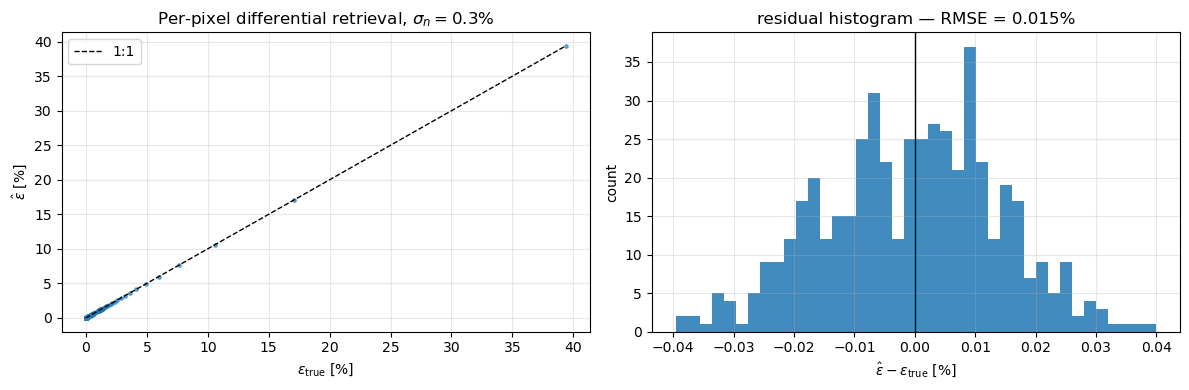
retrieval bias:  -0.0006%
retrieval RMSE:  0.0145%
retrieval N:     493 pixels
6. Takeaways¶
- The LUT lets us evaluate at arbitrary in ~1 ms per pixel — fast enough for per-pixel retrievals over full satellite scenes.
- The differential form cancels every nuisance factor that is common to the plume and the reference pixel. The matched filter exploits this to retrieve linearly in the small-enhancement regime.
- Coupling to
gauss_plumegives us a physics-consistent synthetic scene: the column-enhancement field from the Gaussian plume provides the “truth” , which the LUT-driven retrieval then reconstructs from a simulated spectrometer measurement.
Next directions (not implemented here):
- Layered atmospheres. Replace the single-layer AMF with a per-layer VOD sum. The LUT stays the same; the forward model sums transmittances layer-wise.
- Instrument spectral response. Convolve with an ISRF before the retrieval to match a specific sensor’s bandpass.
- Joint gas retrieval. Extend to a matrix with columns for CH4, H2O, CO2 enhancements and use the combined LUT from notebook 02.
- Optimal estimation. The matched filter is the MLE in the small-enhancement linear limit; adding a Gaussian prior gives the Rodgers optimal-estimation form with posterior covariance.