Iberian station data
Real daily surface-air-temperature records from the Copernicus CDS
Abstract
Everything in this curriculum is built on real station data: daily near-surface air temperature from the Copernicus Climate Data Store in-situ land archive, across the Iberian peninsula and its surroundings. This notebook introduces that dataset — where it comes from, how the shared loader cleans it, what the station network looks like, and how the daily series behave through the seasons — so later notebooks can focus on the modelling.
We are going to model temperature extremes in space, and that starts with good data. This notebook simply looks at the data: the station network, the daily records, and their seasonal behaviour. No modelling yet.
Background
The data is the Copernicus Climate Data Store (CDS) product in-situ observations of surface land meteorological variables (DOI Lopez (2021)) — daily near-surface air temperature collated and quality-controlled by C3S together with NOAA’s National Centers for Environmental Information, the WMO World Data Centre for meteorology.
The shared loader spatial_extremes.data does the fetching (via
xrreader) and cleaning: it restricts to
the Iberian bounding box, keeps 1995–2020, converts Kelvin to °C, retains
only quality-flag-0 observations, and reduces each station-day to its daily
maximum. When the real CDS cache is absent it transparently falls back to a
deterministic synthetic series, so the notebooks always run.
Setup
import sys
import pathlib

try:
    import spatial_extremes  # noqa: F401  installed editable in the project venv
except ModuleNotFoundError:
    _here = pathlib.Path.cwd().resolve()
    _roots = (_here, *_here.parents)
    _cands = [r / "src" for r in _roots]
    _cands += [r / "projects" / "spatial_extremes" / "src" for r in _roots]
    _src = next((c for c in _cands if (c / "spatial_extremes").exists()), None)
    if _src is None:
        raise RuntimeError("cannot locate spatial_extremes/src") from None
    sys.path.insert(0, str(_src))
from __future__ import annotations
import warnings
warnings.filterwarnings("ignore", message=r".*IProgress.*")
import numpy as np
import pandas as pd
import matplotlib.pyplot as plt
import seaborn as sns
sns.set_theme(style="whitegrid", context="notebook", palette="deep")
from spatial_extremes import data
from spatial_extremes.places import country_from_id, station_label
from spatial_extremes.viz import iberia_axes, scatter_field, mark_points, mark_stardf, is_real = data.load_station_daily()
print("source:", "REAL CDS cache" if is_real else "synthetic fallback")
print(f"rows: {len(df):,} | stations: {df.station_id.nunique()}")
print(f"date range: {df.time.min().date()} -> {df.time.max().date()}")
df.head()source: REAL CDS cache
rows: 6,823,690 | stations: 198
date range: 1896-11-01 -> 2026-01-11
The station network
Each station is a GHCN/WMO-coded site with a longitude, latitude and a daily temperature series. We decode the country prefix and tag each with its nearest city for readability, then map the network — coloured by each station’s mean daily-maximum temperature, which already shows the warm south / cool north-and-altitude gradient.
stations = df.groupby("station_id").agg(
    lon=("lon", "first"), lat=("lat", "first"),
    mean_tmax=("value", "mean"), n_days=("value", "size"),
)
stations["country"] = [country_from_id(s) for s in stations.index]
print("stations by country:")
print(stations["country"].value_counts().to_string())
stations by country:
country
Spain 198
ax = iberia_axes(figsize=(8, 7))
scatter_field(ax, stations["lon"], stations["lat"], stations["mean_tmax"],
              label="mean daily-max temperature (°C)", cmap="RdYlBu_r", s=30)
ax.set_title(f"{len(stations)} stations across Iberia and surroundings")
plt.show()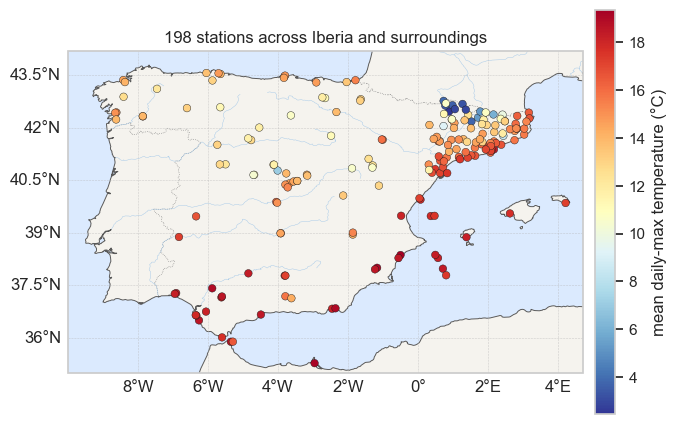
A look at the daily records
Three stations along a south-to-north transect show the shared seasonal cycle and the cooler, more variable records further north / inland. We plot daily maxima as a scatter of observations rather than a line — it reads more honestly for irregular, gappy station data.
transect = stations.sort_values("lat").iloc[[0, len(stations) // 2, -1]]
fig, axes = plt.subplots(len(transect), 1, figsize=(11, 6), sharex=True)
for ax, (sid, row) in zip(axes, transect.iterrows()):
    s = df[df.station_id == sid].sort_values("time")
    ax.scatter(s.time, s.value, s=3, alpha=0.2, color="#C44E52")
    ax.set_ylabel("°C")
    ax.set_title(station_label(sid, row.lon, row.lat), fontsize=9, loc="left")
axes[-1].set_xlabel("date")
fig.suptitle("Daily maximum temperature along a S–N transect", y=1.0)
fig.autofmt_xdate(rotation=30)
fig.tight_layout()
plt.show()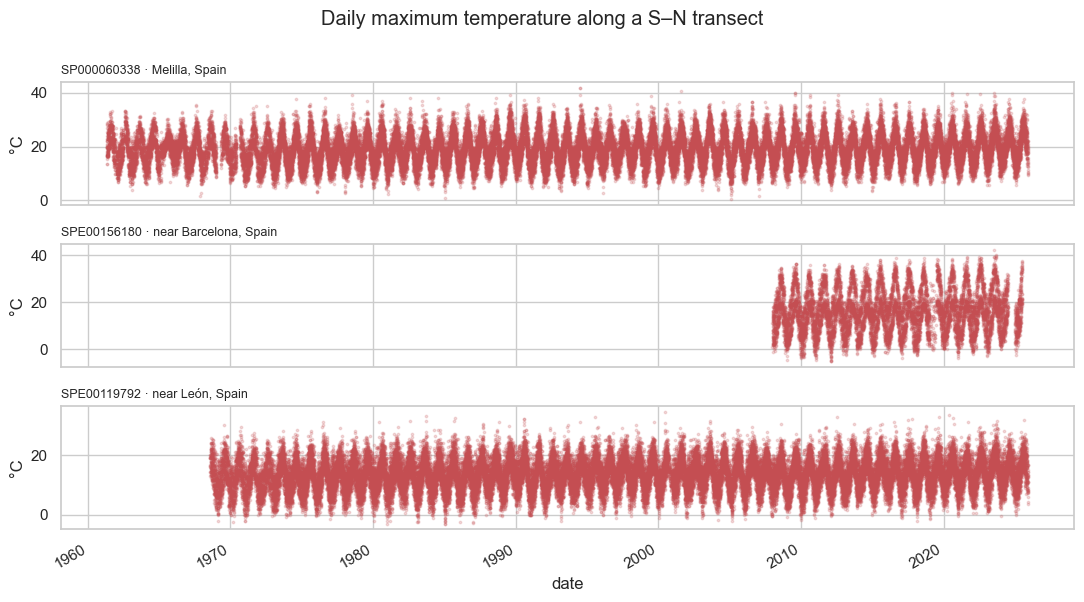
The seasonal cycle
Pooling every station-day and grouping by month makes the seasonal swing explicit — the single biggest source of variation in the raw series, and the reason the next notebook reduces each year to a single block maximum.
dd = df.copy()
dd["month"] = dd.time.dt.month
fig, ax = plt.subplots(figsize=(9, 4.5))
sns.violinplot(data=dd, x="month", y="value", ax=ax, inner="quartile",
               color="#4C72B0", linewidth=0.8, cut=0)
ax.set(xlabel="month", ylabel="daily maximum (°C)",
       title="Seasonal cycle of daily maximum temperature (all stations)")
ax.set_xticks(range(12), ["J", "F", "M", "A", "M", "J", "J", "A", "S", "O", "N", "D"])
plt.show()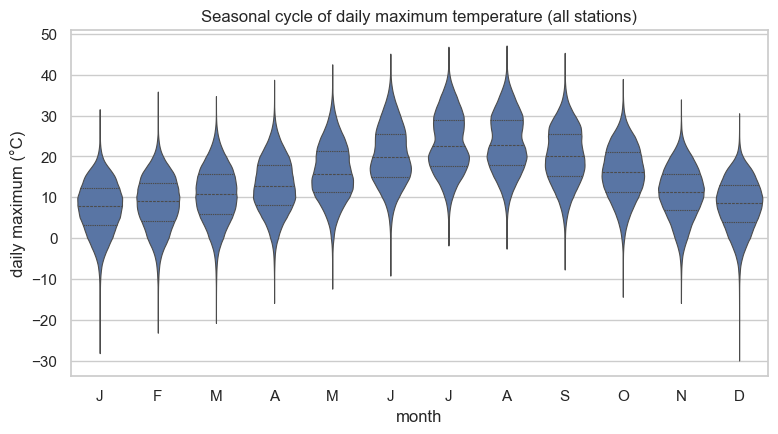
Recap & where next
We have a clean, real, multi-decade network of daily maximum temperatures over Iberia, dominated by a strong seasonal cycle. In Block maxima we reduce these daily records to block maxima — the hottest day per block — and see how the choice of block length (week, month, season, year) shapes what we get.
- Lopez, A. (2021). Global land surface atmospheric variables from 1755 to 2020 from comprehensive in-situ observations. ECMWF. 10.24381/CDS.CF5F3BAC