03 · Return levels and return periods
Engineers and planners rarely want directly — they want the return level : the value exceeded on average once every years. It is just a high quantile of the GEV,
xtremax gives this two ways: the distribution method .return_level(T) and the
pure primitive gev_return_level(T, loc, scale, shape). Because we have a
posterior over the parameters, we get a posterior over the whole return-level
curve — i.e. honest uncertainty bands.
import sys
import pathlib

try:
    import spatial_extremes  # noqa: F401  installed editable in the project venv
except ModuleNotFoundError:
    _here = pathlib.Path.cwd().resolve()
    _roots = (_here, *_here.parents)
    _cands = [r / "src" for r in _roots]
    _cands += [r / "projects" / "spatial_extremes" / "src" for r in _roots]
    _src = next((c for c in _cands if (c / "spatial_extremes").exists()), None)
    if _src is None:
        raise RuntimeError("cannot locate spatial_extremes/src") from None
    sys.path.insert(0, str(_src))
import jax
jax.config.update("jax_enable_x64", True)import numpy as np
import jax
import jax.numpy as jnp
import jax.random as jr
import matplotlib.pyplot as plt
import numpyro
import numpyro.distributions as ndist
from numpyro.infer import MCMC, NUTS
from numpyro.infer.initialization import init_to_median
from xtremax import GeneralizedExtremeValueDistribution as GEV
from xtremax import gev_return_level
from spatial_extremes import data
maxima, stations, years, is_real = data.load_annual_maxima(min_years=20)
order = np.isfinite(maxima).sum(1) + np.nan_to_num(np.nanmean(maxima, 1)) / 1e3
sidx = int(np.argmax(order))
m_ = np.isfinite(maxima[sidx])
y = jnp.asarray(maxima[sidx][m_])
y_mean, y_std = float(jnp.mean(y)), float(jnp.std(y)) # constants, not tracers
def gev_model(obs):
mu = numpyro.sample("mu", ndist.Normal(y_mean, 5.0))
sigma = numpyro.sample("sigma", ndist.HalfNormal(y_std))
xi = numpyro.sample("xi", ndist.Normal(0.0, 0.25))
numpyro.sample("obs", GEV(loc=mu, scale=sigma, concentration=xi), obs=obs)
mcmc = MCMC(NUTS(gev_model, target_accept_prob=0.95, init_strategy=init_to_median),
num_warmup=800, num_samples=800, num_chains=1, progress_bar=False)
mcmc.run(jr.PRNGKey(0), y)
post = mcmc.get_samples()
print("source:", "REAL" if is_real else "SYNTHETIC", "| station", sidx)source: REAL | station 12
periods = jnp.array([2., 5., 10., 20., 50., 100., 200., 500.])

# posterior return-level curve: vmap over posterior draws
def rl(mu, sigma, xi):
    return GEV(loc=mu, scale=sigma, concentration=xi).return_level(periods)

rls = jax.vmap(rl)(post["mu"], post["sigma"], post["xi"])  # (n_draws, n_periods)
med = np.median(rls, 0)
lo, hi = np.quantile(rls, 0.025, 0), np.quantile(rls, 0.975, 0)

# sanity check: the pure primitive agrees with the distribution method
prim = gev_return_level(100., float(np.median(post["mu"])),
                        float(np.median(post["sigma"])), float(np.median(post["xi"])))
print(f"100-yr return level (median): {med[5]:.1f} °C  "
      f"(primitive check: {float(prim):.1f} °C)")
100-yr return level (median): 43.4 °C (primitive check: 43.4 °C)
Empirical return levels (Gringorten plotting positions) let us eyeball the fit:
ys = np.sort(np.asarray(y))
n = ys.size
emp_p = (np.arange(1, n + 1) - 0.44) / (n + 0.12)   # Gringorten
emp_T = 1.0 / (1.0 - emp_p)

fig, ax = plt.subplots(figsize=(7, 4.5))
ax.fill_between(np.asarray(periods), lo, hi, alpha=0.25, color="crimson",
                label="95% credible band")
ax.plot(np.asarray(periods), med, color="crimson", lw=2, label="posterior median")
ax.scatter(emp_T, ys, color="k", s=20, zorder=5, label="empirical")
ax.axvline(100, ls=":", color="0.5")
ax.set_xscale("log")
ax.set_xlabel("return period T (years)")
ax.set_ylabel("return level (°C)")
ax.set_title("Return-level curve with posterior uncertainty")
ax.legend()
plt.show()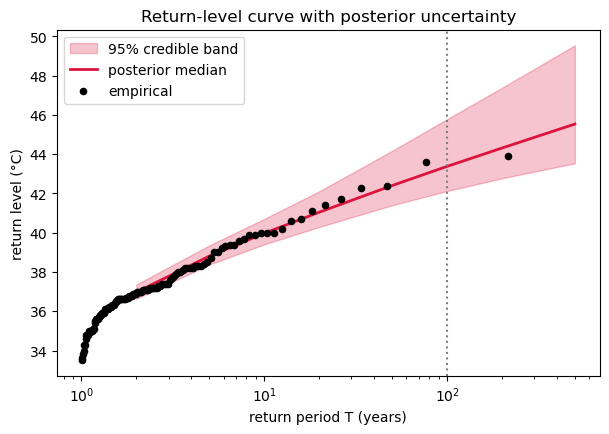
Next: do this for every station and map the parameters — exposing why we need to pool information across space.