04 — Image processing (Caldor fire dNBR)
Image processing — radiometry, cloud masks, indices
Walk through the three RS operator modules end-to-end on a real burn-scar scenario: the 2021 Caldor fire in El Dorado County, California, just south-west of Lake Tahoe. We compose:
gz.radiometry—ToFloat32 → DNToReflectance → PercentileClip → Gammafor a display pipeline; the sameDNToReflectancepowers the index chain.gz.cloud—MaskFromSCL+gz.mask.ApplyMaskto drop clouds and invalid pixels.gz.indices—NBR(burn-sensitive),NDVI(vegetation),NDWI(water) computed from the same reflectance carrier viagz.Fanout. The burn signature lives in dNBR = NBR_pre − NBR_post.
Scenario.
| AOI bbox (EPSG:4326) | (-120.30, 38.55, -119.95, 38.95) (Caldor fire core) |
| Pre-fire scene | S2B_..20210809T.. (5 days before ignition, 0.1 % cloud) |
| Post-fire scene | S2A_..20211112T.. (3 weeks after containment, 1.4 % cloud) |
| MGRS tile | 10SGH |
| Bands | B02, B03, B04, B08, B12, SCL (BGRN + SWIR + scene-classification) |
Caldor burned ~221,835 acres between 14 August and 21 October 2021, the second wildfire ever to cross the Sierra Nevada crest.
import geotoolz as gz
import matplotlib.pyplot as plt
import numpy as np
import planetary_computer
import pystac_client
import rioxarray
from georeader.geotensor import GeoTensor
from geotoolz.cloud import SCL_CLOUDS_AND_INVALID
from matplotlib.colors import ListedColormap
from rasterio.enums import Resampling
1. Load pre- and post-fire Sentinel-2 scenes
Search MPC for one cloud-free scene before ignition and one after
containment, both on MGRS tile 10SGH. Load the spectral bands +
SCL, resample everything to the 10 m grid.
BBOX = (-120.30, 38.55, -119.95, 38.95)
TARGET_TILE = "10SGH"

catalog = pystac_client.Client.open(
    "https://planetarycomputer.microsoft.com/api/stac/v1",
    modifier=planetary_computer.sign_inplace,
)


def _best_scene(date_range: str):
    items = list(
        catalog.search(
            collections=["sentinel-2-l2a"],
            bbox=BBOX,
            datetime=date_range,
            query={
                "eo:cloud_cover": {"lt": 5},
                "s2:mgrs_tile": {"eq": TARGET_TILE},
            },
        ).items()
    )
    return sorted(items, key=lambda x: x.properties["eo:cloud_cover"])[0]


pre = _best_scene("2021-07-01/2021-08-13")  # before ignition (Aug 14)
post = _best_scene("2021-10-22/2021-11-30")  # after containment (Oct 21)

print(f"pre  → {pre.id}  cloud={pre.properties['eo:cloud_cover']:.2f}%")
print(f"post → {post.id}  cloud={post.properties['eo:cloud_cover']:.2f}%")
pre → S2B_MSIL2A_20210809T183919_R070_T10SGH_20210810T105317 cloud=0.07%
post → S2B_MSIL2A_20211127T184719_R070_T10SGH_20211128T194120 cloud=0.93%
def _load_band(item, key, *, ref=None, resampling=Resampling.bilinear):
    da = rioxarray.open_rasterio(item.assets[key].href, masked=False)
    da = da.squeeze("band", drop=True).rio.clip_box(*BBOX, crs="EPSG:4326")
    if ref is not None:
        da = da.rio.reproject_match(ref, resampling=resampling)
    return da


def _load_scene(item):
    """Load BGRN + SWIR + SCL aligned to the B04 (10 m) grid."""
    red = _load_band(item, "B04")
    green = _load_band(item, "B03", ref=red)
    blue = _load_band(item, "B02", ref=red)
    nir = _load_band(item, "B08", ref=red)
    swir = _load_band(item, "B12", ref=red)  # 20 m → 10 m bilinear
    scl = _load_band(item, "SCL", ref=red, resampling=Resampling.nearest)
    # Stack: B(0) G(1) R(2) NIR(3) SWIR(4)
    arr = np.stack(
        [blue.values, green.values, red.values, nir.values, swir.values],
        axis=0,
    ).astype("uint16")
    refl_gt = GeoTensor(
        values=arr,
        transform=red.rio.transform(),
        crs=red.rio.crs,
        fill_value_default=0,
    )
    scl_gt = GeoTensor(
        values=scl.values[None, ...].astype("uint8"),
        transform=scl.rio.transform(),
        crs=scl.rio.crs,
        fill_value_default=0,
    )
    return refl_gt, scl_gt


pre_refl, pre_scl = _load_scene(pre)
post_refl, post_scl = _load_scene(post)
print(f"pre_refl:  shape={pre_refl.shape}  dtype={pre_refl.dtype}")
print(f"post_refl: shape={post_refl.shape}  dtype={post_refl.dtype}")
pre_refl: shape=(5, 2973, 3182) dtype=uint16
post_refl: shape=(5, 2973, 3182) dtype=uint16
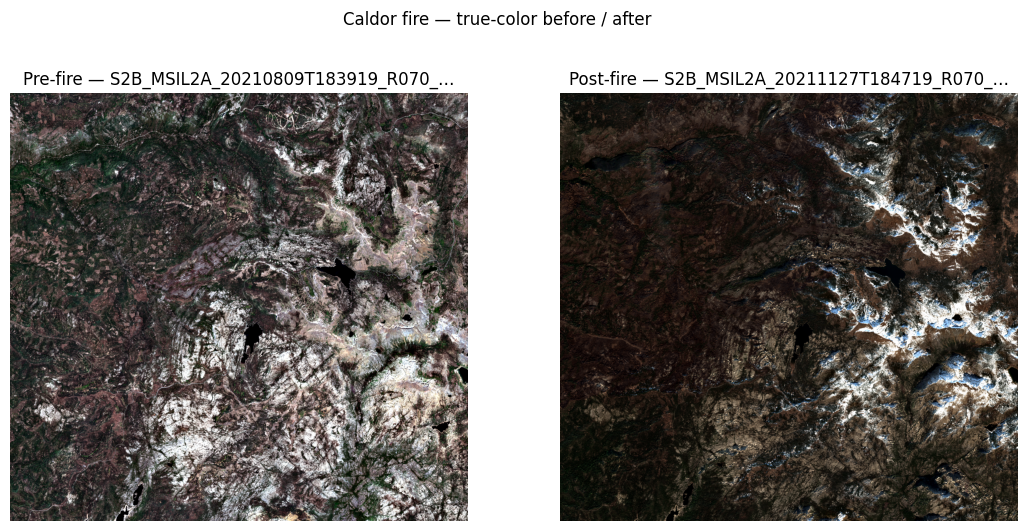
2. Display pipeline — ToFloat32 → DNToReflectance → PercentileClip → Gamma
Build the standard four-stage gz.radiometry chain. ToFloat32
escapes the uint16 DN dtype, DNToReflectance applies the
Sentinel-2 L2A scaling, PercentileClip is a robust per-band 2-98 %
stretch, and Gamma brightens the midtones. All four are stock
gz.radiometry operators — no custom code.
display_pipe = (
    gz.radiometry.ToFloat32()
    | gz.radiometry.DNToReflectance(scale=1e-4)
    | gz.radiometry.PercentileClip(p_min=2.0, p_max=98.0)
    | gz.radiometry.Gamma(g=1.2)
)
print(display_pipe)

pre_display = display_pipe(pre_refl)
post_display = display_pipe(post_refl)


def _rgb(stretched):
    """Pull R, G, B from the BGRN(+SWIR) stack and put channels last."""
    return np.transpose(np.asarray(stretched)[[2, 1, 0]], (1, 2, 0))


fig, ax = plt.subplots(1, 2, figsize=(13, 7))
ax[0].imshow(_rgb(pre_display))
ax[0].set_title(f"Pre-fire — {pre.id[:32]}…")
ax[0].axis("off")
ax[1].imshow(_rgb(post_display))
ax[1].set_title(f"Post-fire — {post.id[:32]}…")
ax[1].axis("off")
fig.suptitle("Caldor fire — true-color before / after", y=0.92)
plt.show()
Sequential([ToFloat32(), DNToReflectance(scale=0.0001, offset=0.0, axis=0), PercentileClip(p_min=2.0, p_max=98.0, axis=(-2, -1)), Gamma(g=1.2)])
3. Cloud masking — MaskFromSCL
gz.cloud.MaskFromSCL returns True where the SCL band’s value is in
the supplied class set. Pair with gz.cloud.SCL_CLOUDS_AND_INVALID
to drop clouds + cirrus + cloud shadows + no-data in one pass.
cloud_op = gz.cloud.MaskFromSCL(band_idx=0, classes=SCL_CLOUDS_AND_INVALID)
pre_mask = cloud_op(pre_scl)
post_mask = cloud_op(post_scl)
print(f"pre  mask: {float(np.mean(np.asarray(pre_mask))):.4f} fraction masked")
print(f"post mask: {float(np.mean(np.asarray(post_mask))):.4f} fraction masked")
pre mask: 0.0007 fraction masked
post mask: 0.0302 fraction masked
4. Indices via Fanout — NDVI + NBR + NDWI from one reflectance carrier
gz.Fanout is sugar over a single-input Graph: one input, many
named outputs. The Graph topologically sorts the nodes, so
DNToReflectance runs exactly once and its output is shared by all
three index ops — no redundant arithmetic.
- NDVI (
(NIR − Red)/(NIR + Red)) — vegetation - NBR (
(NIR − SWIR)/(NIR + SWIR)) — burn severity (drops over scarred ground) - NDWI (
(Green − NIR)/(Green + NIR)) — water / saturation
We also slot gz.mask.ApplyMask per scene to NaN out cloudy pixels.
def indices_pipe(cloud_mask):
    """Reflectance pipeline with cloud masking, computing 3 indices."""
    scale = gz.radiometry.DNToReflectance(scale=1e-4)
    drop_clouds = gz.mask.ApplyMask(mask=cloud_mask, fill_value=float("nan"))
    return scale | gz.Fanout(
        {
            "ndvi": gz.indices.NDVI(red_idx=2, nir_idx=3) | drop_clouds,
            "nbr": gz.indices.NBR(nir_idx=3, swir2_idx=4) | drop_clouds,
            "ndwi": gz.indices.NDWI(green_idx=1, nir_idx=3) | drop_clouds,
        }
    )


pre_idx = indices_pipe(pre_mask)(pre_refl)
post_idx = indices_pipe(post_mask)(post_refl)
print("pre keys :", list(pre_idx.keys()))
print("post keys:", list(post_idx.keys()))
for k in pre_idx:
    arr = np.asarray(pre_idx[k])
    lo, hi = float(np.nanmin(arr)), float(np.nanmax(arr))
    print(f"  pre  {k:5s}: range=[{lo: .3f}, {hi: .3f}]")
pre keys : ['ndvi', 'nbr', 'ndwi']
post keys: ['ndvi', 'nbr', 'ndwi']
pre ndvi : range=[-0.996, 0.999]
pre nbr : range=[-0.999, 0.877]
pre ndwi : range=[-0.999, 0.997]
5. dNBR — the burn-severity signal
Subtract post-fire NBR from pre-fire NBR. Healthy unchanged vegetation cancels out; burned pixels show a strong positive differenced-NBR. USGS uses the threshold table:
| dNBR | Severity |
|---|---|
| < 0.10 | Unburned |
| 0.10 – 0.27 | Low |
| 0.27 – 0.44 | Moderate-low |
| 0.44 – 0.66 | Moderate-high |
| > 0.66 | High |
dnbr = np.asarray(pre_idx["nbr"]) - np.asarray(post_idx["nbr"])
print(
    f"dNBR range: [{np.nanmin(dnbr):.3f}, {np.nanmax(dnbr):.3f}]  "
    f"mean={np.nanmean(dnbr):.3f}"
)

# Severity classification map (USGS / FIRMS conventions).
bounds = np.array([-np.inf, 0.10, 0.27, 0.44, 0.66, np.inf])
labels = ["Unburned", "Low", "Mod-low", "Mod-high", "High"]
colors = ["#2c7bb6", "#abd9e9", "#ffffbf", "#fdae61", "#d7191c"]
class_map = np.digitize(dnbr, bounds[1:-1], right=False).astype(float)
class_map[np.isnan(dnbr)] = np.nan
dNBR range: [-1.949, 1.708] mean=0.010
fig, ax = plt.subplots(1, 3, figsize=(18, 7))

ax[0].imshow(np.asarray(pre_idx["nbr"]), cmap="RdYlGn", vmin=-0.5, vmax=0.9)
ax[0].set_title("NBR — pre-fire")
ax[0].axis("off")

ax[1].imshow(np.asarray(post_idx["nbr"]), cmap="RdYlGn", vmin=-0.5, vmax=0.9)
ax[1].set_title("NBR — post-fire")
ax[1].axis("off")

cmap = ListedColormap(colors)
im = ax[2].imshow(class_map, cmap=cmap, vmin=-0.5, vmax=4.5)
ax[2].set_title("dNBR severity (USGS classes)")
ax[2].axis("off")
cbar = fig.colorbar(im, ax=ax[2], shrink=0.7, ticks=range(5))
cbar.ax.set_yticklabels(labels)

plt.show()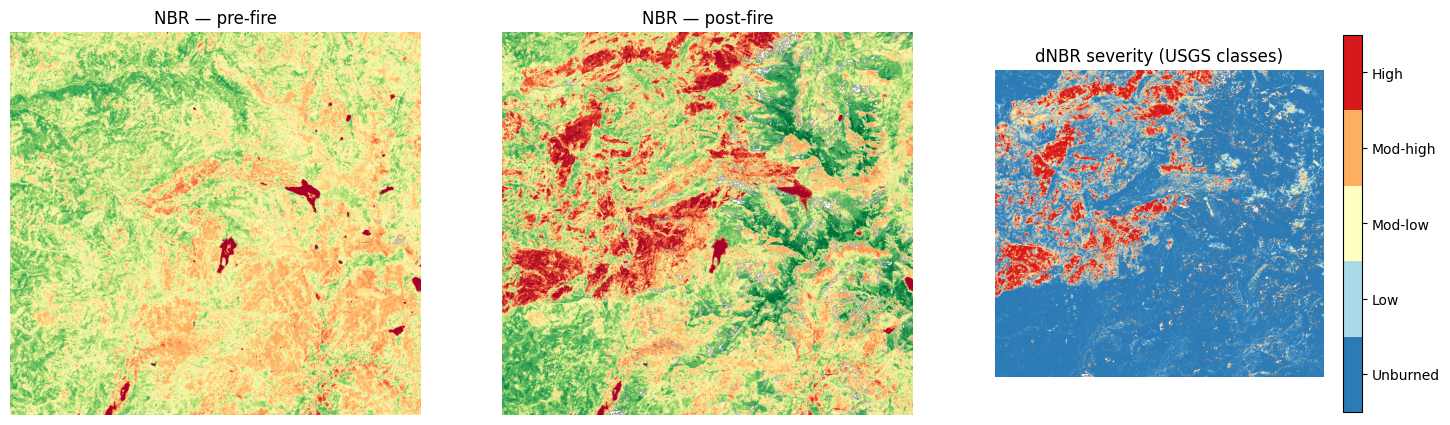
The right-hand panel is the burn footprint: cyan / blue pixels were unchanged forest, orange / red pixels are moderate-to-high burn severity — the Caldor scar.
6. NDVI loss — vegetation impact
The same Fanout shape lets us pull NDVI out of both scenes for
free. Where vegetation burned, NDVI drops sharply; we visualise the
raw post-fire NDVI alongside ΔNDVI.
delta_ndvi = np.asarray(post_idx["ndvi"]) - np.asarray(pre_idx["ndvi"])

fig, ax = plt.subplots(1, 2, figsize=(13, 7))
im0 = ax[0].imshow(np.asarray(post_idx["ndvi"]), cmap="RdYlGn", vmin=-0.4, vmax=0.9)
ax[0].set_title("NDVI — post-fire")
ax[0].axis("off")
fig.colorbar(im0, ax=ax[0], shrink=0.7, label="NDVI")

im1 = ax[1].imshow(delta_ndvi, cmap="RdBu", vmin=-0.6, vmax=0.6)
ax[1].set_title("ΔNDVI = post − pre")
ax[1].axis("off")
fig.colorbar(im1, ax=ax[1], shrink=0.7, label="ΔNDVI")

plt.show()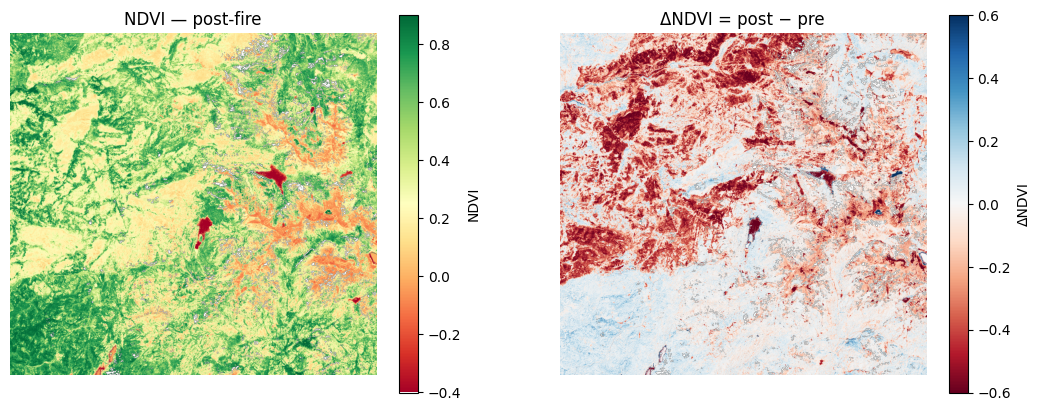
7. Summary
The three operator modules compose cleanly on real data:
gz.radiometry—ToFloat32 | DNToReflectance | PercentileClip | Gammais the canonical display chain;DNToReflectancealone is the index-feed chain.gz.cloud—MaskFromSCL(classes=SCL_CLOUDS_AND_INVALID)produces a True-where-bad mask in one line; pair withgz.mask.ApplyMaskto drop those pixels as NaN.gz.indices— every index (NDVI,NBR,NDWI,EVI,SAVI,MNDWI, …) has the same constructor shape (band indices, axis, epsilon), so they plug intoFanoutinterchangeably.
The composition primitives (|, Fanout) keep the multi-scene + multi-index
logic linear and explicit: one reflectance carrier per scene, one
Fanout per scene, then NumPy for the cross-scene diff. No custom
operator subclasses required.
For the bigger picture — STAC discovery, tiled inference, multi-package
composition — see the canonical multi-repo notebook:
geocatalog/docs/notebooks/end_to_end_lake_tahoe.ipynb.