argminax: optimisation with uncertainty for JAX
argminax is the stack’s optimisation library with uncertainty at the optimum: it finds x̂ = argmin J(x), and then says how sharp that minimum is (posterior covariance, averaging kernel, degrees of freedom) and how x̂ depends on what went in. It sits at Core tier 1 on gaussx, extends optimistix with the stack’s solvers and adjoints, and takes over the curvature code now rebuilt in seven places. Status: proposed, at design-sketch depth.
At a glance
| Layer, tier | Core, tier 1 |
| Imports | gaussx; extends optimistix; JAX, Equinox, lineax |
| Imported by | radtrax, plumax, vardax, pyrox-gp, pyrox-lgm, pyrox-nn |
| Takes over | vardax’s adjoint strategies and posterior adapters; radtrax’s retrieval diagnostics; the Newton loops of gaussx, pyrox-gp and pyrox-lgm; plumax’s 4D-Var posterior |
| Does not own | training over batches (optax, optax_bayes); sampling (NumPyro, pyrox); adjoints through time (integrix) |
| Status | proposed; no repository yet |
| Tracked in | the layer map; the companion functax and integrix designs |
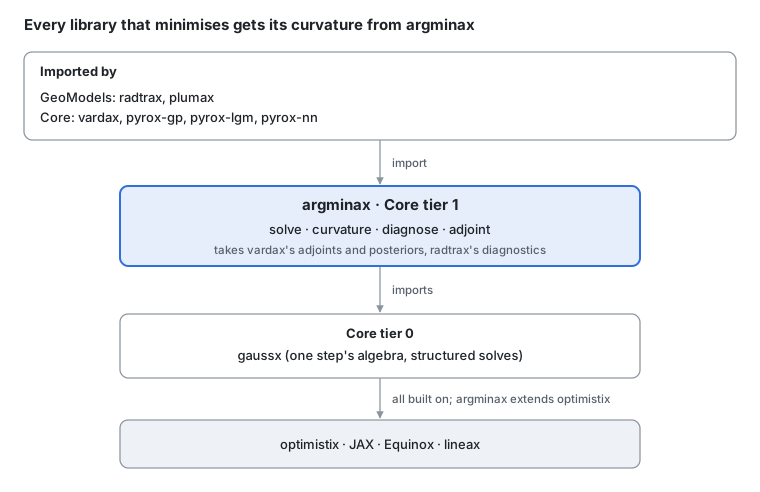
Where argminax sits · core tier 1.
argminax sits one tier above gaussx, whose single steps it iterates, so every library that minimises can import it. This page is the design; core types, algorithms and the code survey are in argminax: design details.
The problem
A methane retrieval is not finished when the optimiser stops. radtrax’s 3D-Var (retrieval/var3d) finds the column enhancement that best fits a hyperspectral pixel, and then needs three more things at that minimum: how uncertain the answer is, how much of it came from the measurement rather than the prior, and how its gradient flows back to the plume model that called it. Those three are the curvature at the minimum, and every library that optimises rebuilds them:
| Library | Minimises | Rebuilds at the minimum |
|---|---|---|
radtrax retrieval/var3d | 3D-Var by L-BFGS, Gauss–Newton or dual PSAS (optimistix) | degrees_of_freedom_for_signal, posterior_covariance_proxy (the averaging kernel appears only in docstrings) |
plumax les_fvm/fourdvar.py | 4D-Var for an emission field (optimistix) | PosteriorCovariance, _gauss_newton_hessian |
plumax assimilation/solve.py | the same 3D-Var solvers radtrax ported from it | — |
| vardax | 3D-Var, strong, weak and incremental 4D-Var (optimistix) | GaussNewtonHessian, LaplaceCovariance; KStepAdjoint, OneStepAdjoint |
| pyrox-gp | non-Gaussian GP likelihoods | the Newton iterations of LaplaceInference, GaussNewtonInference, QuasiNewtonInference |
| pyrox-lgm | inla(): an inner Newton fit, an outer optax.lbfgs search | the Laplace approximation per hyperparameter |
| gaussx | laplace_mode | its own Newton loop |
| pyrox (main) | last_layer_laplace | GGN precision, evidence, prior-precision search |
The solvers mostly come from optimistix already. What each library rewrites is what optimistix leaves out: Gauss–Newton curvature as a structured operator, its inverse as a posterior covariance, the degrees of freedom of a retrieval, and adjoints for differentiating through a minimiser that stops early. Seven copies of that machinery, across GeoModels and Core, with plumax and radtrax each holding the same 3D-Var solvers.
The cost, its minimum, and the curvature there
A retrieval minimises a cost that balances the measurement against the prior. Here y is the measured radiance, F the forward model, x the state (the methane column), xₐ the prior state, Sε the measurement-error covariance and Sₐ the prior covariance:
Three jobs share the word optimisation, and only one belongs here:
| Job | Question | Home |
|---|---|---|
| Solve | where is the minimum x̂? | optimistix, extended by argminax’s solvers |
| Curvature | how sharp is the minimum, and what does that say about x̂? | argminax |
| Train | how do I fit a network’s weights over many batches? | optax and optax_bayes |
At the minimum x̂, with K = ∂F/∂x the Jacobian there, the Gauss–Newton curvature gives the posterior covariance Ŝ and the averaging kernel A:
A says how much a change in the true state moves the retrieved one: A = I means the measurement decides everything, A = 0 means the prior does. Its trace is the retrieval’s degrees of freedom for signal. The same Ŝ is the inverse Gauss–Newton Hessian of 4D-Var, the Laplace approximation in pyrox and the precision in gaussx; only the names differ.
The last piece is the derivative of x̂ with respect to what went in (the prior, the parameters of F). At an exact minimum it comes from the implicit function theorem; for a solver stopped early, as in learned 4D-Var, it comes from differentiating the last k iterations. Both are adjoint strategies of the minimiser.
Modules and boundaries
Four modules: the solvers optimistix lacks, the curvature at the minimum, the retrieval diagnostics built on it, and the adjoints of a minimiser. argminax extends optimistix as gaussx extends lineax: its solvers are optimistix solvers and its adjoints are optimistix adjoints, so optx.minimise and optx.least_squares keep working.
| Module | Owns | Comes from |
|---|---|---|
argminax.solve | Gauss–Newton and Levenberg–Marquardt with a matrix-free inner CG (incremental 4D-Var), trust regions, the dual (observation-space) solve, positivity and bounds by reparametrisation | radtrax and plumax run_gauss_newton, run_dual_psas; pyrox-gp’s and gaussx’s Newton loops |
argminax.curvature | Gauss–Newton, Fisher and quasi-Newton curvature, Laplace covariance Ŝ, its low-rank and diagonal forms, all as gaussx operators | vardax GaussNewtonHessian, LaplaceCovariance; plumax PosteriorCovariance; pyrox last_layer_laplace’s GGN |
argminax.diagnose | averaging kernel A, degrees of freedom for signal, information content, evidence at the minimum | radtrax var3d/diagnostics.py; pyrox’s evidence and prior-precision search |
argminax.adjoint | adjoints of a minimiser stopped early: k-step and one-step. At a converged minimum optimistix’s own ImplicitAdjoint already does the job, so argminax adds none. | vardax KStepAdjoint, OneStepAdjoint, to_optimistix_adjoint |
What argminax owns, and what it hands off
The test for every name: does it find a minimum, or say something about the curvature at one? Then argminax owns it.
| Neighbour | argminax owns | The neighbour owns | The line |
|---|---|---|---|
| optimistix | the stack’s solvers and adjoints, as optimistix subclasses | minimise, least_squares, root_find, BFGS, its solver and adjoint protocols | argminax extends optimistix |
| gaussx | the iteration to a tolerance | one step’s algebra (newton_update, gauss_newton_precision), structured solves, its Chandrupatla root finder | a single step is gaussx’s; the loop around it is argminax’s |
| integrix | adjoints of a minimiser | adjoints of a march: checkpointed backward sweeps through a forward run | through the iterations of an optimiser is argminax’s; through time is integrix’s |
| optax, optax_bayes | deterministic solves to a tolerance | stochastic training over batches; the Bayesian learning rule | many batches and a learning rate are optax’s |
| pyrox, NumPyro | the Laplace approximation as curvature | sampling, variational inference, priors | a Gaussian at the mode is argminax’s; anything that samples is pyrox’s |
| radtrax, plumax, vardax | the solver, curvature and diagnostics | the cost: forward model, observation operator, B and R | the library passes J (or its residuals) in |
What moves in
| From | What | Its users then import |
|---|---|---|
| vardax | KStepAdjoint, OneStepAdjoint, to_optimistix_adjoint; GaussNewtonHessian, LaplaceCovariance | argminax: vardax, plumax |
radtrax retrieval/var3d | run_gauss_newton, run_dual_psas; degrees_of_freedom_for_signal, posterior_covariance_proxy | argminax: radtrax; plumax drops its copy in assimilation/solve.py |
plumax les_fvm/fourdvar.py | PosteriorCovariance, _gauss_newton_hessian | argminax |
| pyrox-gp | the iterations of LaplaceInference, GaussNewtonInference, QuasiNewtonInference and their Markov forms | argminax; pyrox-gp keeps the likelihoods and the GP algebra |
| pyrox-lgm | the inner Newton fit and the outer search of inla() | argminax |
| gaussx | laplace_mode, the loop and its entry point; gaussx keeps one step’s algebra and its root finder | argminax (amx.solve.laplace_mode); gaussx’s copy is deprecated without forwarding |
| pyrox (after pyrox#332, via pyrox-nn) | last_layer_laplace’s curvature, evidence and prior-precision search | argminax; pyrox-nn keeps the last-layer wrapper |
In use
The methane retrieval end to end: solve for the column, then read the uncertainty, the averaging kernel and the degrees of freedom off the curvature at the minimum, and differentiate the answer with respect to the prior. Every argminax name is proposed; the solve itself is ordinary optimistix.
# Shapes: W spectral channels; L layers in the state; Sε is (W, W), Sₐ is (L, L)

import argminax as amx
import jax
import optimistix as optx


# user
# r(x) = (Sε^(-1/2) (y − F(x)), Sₐ^(-1/2) (x − xₐ)), so J(x) = ½ ‖r(x)‖²
def residuals(state, args): ...  # (L,) → (W + L,)


# proposed (argminax)
# Gauss–Newton with an inner CG on (KᵀSε⁻¹K + Sₐ⁻¹) δ = −∇J
solver = amx.solve.GaussNewtonCG(rtol=1e-6, atol=1e-6)
# not pinned (optimistix)
# d x̂ / d(xₐ, θ) by the implicit function theorem at x̂
adjoint = optx.ImplicitAdjoint()
# not pinned (optimistix)
# x̂ = argmin J(x)
solution = optx.least_squares(  # (L,) → (L,)
    residuals, solver, prior_state, args=problem, adjoint=adjoint
)
retrieved = solution.value  # → (L,)

# --- curvature at the minimum ---
# proposed (argminax)
# Ŝ = (KᵀSε⁻¹K + Sₐ⁻¹)⁻¹, a gaussx operator, never formed densely
posterior = amx.curvature.gauss_newton(residuals, retrieved, problem)  # → (L, L) op
# proposed (argminax)
# A = I − Ŝ Sₐ⁻¹
kernel = amx.diagnose.averaging_kernel(posterior, prior_covariance)  # → (L, L) op
# proposed (argminax)
# d_s = tr(A), the degrees of freedom for signal
dofs = amx.diagnose.degrees_of_freedom(kernel)  # → ()

# --- the retrieval inside a larger model ---
# user: retrieve(xₐ) wraps the least_squares call above
# x̂ is differentiable: ∂x̂/∂xₐ flows through the implicit adjoint
sensitivity = jax.jacrev(retrieve)(prior_state)  # (L,) → (L, L)
A plume inversion calls retrieve per pixel and differentiates through it; the implicit adjoint costs one more linear solve with the same curvature, not a pass through every iteration. A learned 4D-Var that stops after a fixed number of steps swaps in amx.adjoint.KStep(k=3).
Integration across the stack
Six libraries would import argminax. For radtrax, plumax and vardax the solve call barely changes, because they already use optimistix: what changes is that the curvature, diagnostics and adjoints come from one place.
| Consumer | Uses today | With argminax |
|---|---|---|
| radtrax | retrieval/var3d: run_lbfgs, run_gauss_newton, run_dual_psas on optimistix, but each returns NumPy arrays, so no retrieval is differentiable today; its own degrees of freedom and posterior proxy, with no averaging-kernel function | amx.solve for Gauss–Newton and the dual solve; amx.curvature and amx.diagnose for Ŝ, A and d_s; keeps the cost and the control transforms |
| plumax | les_fvm/fourdvar.py with its own PosteriorCovariance; assimilation/solve.py, a copy of radtrax’s solvers | amx.curvature for the 4D-Var posterior; drops assimilation/solve.py in favour of argminax (or radtrax) |
| vardax | optimistix BFGS and Gauss–Newton; its own adjoint strategies and posterior adapters | imports them from argminax; keeps the 3D-Var and 4D-Var costs and models |
| pyrox-gp | Newton, Gauss–Newton and quasi-Newton loops inside its non-Gaussian inference | amx.solve for the loop; keeps likelihoods, sites and GP algebra |
| pyrox-lgm | inla(): an inner Newton fit and an outer optax.lbfgs search | amx.solve for both; keeps the GMRF components and PC priors |
| pyrox-nn | last_layer_laplace (after pyrox#332) | amx.curvature and amx.diagnose for the GGN posterior and evidence; keeps the last-layer selection |
vardax’s adjoint strategies are the clearest move: they are already optimistix.AbstractAdjoint subclasses, so for vardax only the import changes. They are not yet usable elsewhere: their apply() raises NotImplementedError, and they work only inside vardax’s own unrolled solver. Wave 1 implements apply, so they work under any optimistix solve.
# Today:
# today (vardax)
from vardax.adjoints import KStepAdjoint

# After:
# proposed (argminax)
from argminax.adjoint import KStep
vardax keeps a deprecated alias for one release, and FourDVarNet1D(solver_adjoint=...) call sites do not change.
Decisions and open questions
Five decided, three open. Each entry gives the position first, then the trade-off.
1. Name: argminax
Decided (5 Nov 2026). argminax, free on PyPI when checked. It extends optimistix, as gaussx extends lineax.
2. Scope: solve and curvature, not training
Decided (5 Nov 2026). argminax owns deterministic solves to a tolerance and what the curvature at the minimum says. Stochastic training over batches stays with optax and optax_bayes; sampling and variational inference stay with NumPyro and pyrox.
3. Layer: Core tier 1
Decided (5 Nov 2026, on the layer map). argminax imports gaussx (Core tier 0) and extends optimistix. vardax, pyrox-gp, pyrox-lgm, pyrox-nn, radtrax and plumax sit above it.
4. gaussx keeps one step; argminax owns the loop
Decided (5 Nov 2026; revised 6 Nov 2026). gaussx keeps newton_update, gauss_newton_precision and its Chandrupatla root finder, because they are single-step algebra a tier below. laplace_mode, the loop that iterates them, moves to argminax whole, entry point included, and its callers (pyrox-gp, pyrox-lgm) import it from there. gaussx never calls argminax: a laplace_mode left in gaussx that forwarded to argminax would be an edge from Core tier 0 up to tier 1, and the repository fixes such an edge by moving code, never by a re-export (AGENTS.md, “Boundaries”). gaussx’s own laplace_mode keeps its current loop for one release behind a DeprecationWarning that names argminax.solve.laplace_mode, then goes.
5. vardax’s adjoint strategies move here
Decided (5 Nov 2026). KStepAdjoint and OneStepAdjoint are optimistix.AbstractAdjoint subclasses: they differentiate through a minimiser, so they are argminax’s. Today their apply() raises NotImplementedError and they work only inside vardax’s unrolled solver; the move implements apply, so they work under any optx.minimise or optx.least_squares call. Backward sweeps through a forward run stay integrix’s (integrix decision 7).
6. Where radtrax’s 3D-Var solvers live
Open. run_gauss_newton and run_dual_psas are general (any sum of squared residuals; any linear observation operator), so they fit amx.solve. run_lbfgs is a thin wrapper over optimistix and may simply go. The cost, control transforms and whitening stay in radtrax. Either way, plumax’s copy in assimilation/solve.py goes.
7. Positivity and bounds
Leaning: by reparametrisation. Methane enhancements and emission rates are positive. A log or softplus transform keeps the solve unconstrained and the curvature well defined; the posterior is then reported in the transformed space, with a note on how to map it back. Projected methods stay out until a case needs them.
8. Diagnostics: argminax or radtrax?
Open. The averaging kernel, degrees of freedom and information content come from atmospheric retrieval Rodgers, 2000, but they are properties of any linear-Gaussian posterior: the same A describes a 4D-Var analysis or a GP posterior. Leaning: argminax, with the retrieval vocabulary in its docstrings.
Roadmap
Five waves, each a GitHub issue epic in the argminax repository once it exists. The adjoints and curvature come first: they already exist in vardax and need a home, plus the apply method they lack, and every later wave uses them.
| Wave | Delivers | Ends | Needs |
|---|---|---|---|
| 0. Scaffold | the repository from the library template; CI, capability index; optimistix and SciPy reference tests | — | — |
| 1. Adjoints and curvature move in | KStep, OneStep, the optimistix mapping; Gauss–Newton and Laplace curvature as gaussx operators | vardax’s copies, with deprecation aliases there | 0 |
| 2. Retrieval diagnostics | averaging kernel, degrees of freedom, information content, evidence | radtrax’s var3d/diagnostics.py; pyrox’s evidence code | 1 |
| 3. Solvers | Gauss–Newton and Levenberg–Marquardt with inner CG, the dual solve, trust regions, reparametrised bounds | radtrax’s and plumax’s 3D-Var solvers (decision 6); gaussx’s Newton loop | 1 |
| 4. Consumers switch | radtrax, plumax, vardax, pyrox-gp, pyrox-lgm and pyrox-nn onto argminax | the remaining Newton loops and posterior adapters | 1–3 |
Wave 4 is one issue per consumer, filed in that consumer’s repository and linked to the argminax epic. pyrox-nn’s issue follows pyrox#332, which moves last_layer_laplace out of the pyrox core.
Sources
Optimistix documentation: the solver and adjoint protocols argminax extends.
Rodgers (2000): the averaging kernel, degrees of freedom and information content.
Bolte et al. (2023): one-step differentiation of iterative algorithms, the basis of vardax’s k-step adjoint, as its docstring cites.
The GeoStack layer map: argminax’s layer, tier, imports and moves.
integrix: the adjoint boundary between the two.
pyrox#332:
last_layer_laplaceout of the pyrox core.Code read on 5 Nov 2026 at geostack’s submodule pins: radtrax
retrieval/var3d/solve.pyanddiagnostics.py; plumaxles_fvm/fourdvar.pyandassimilation/solve.py; vardaxadjoints/andposterior/; pyrox-gp_inference_nongauss.py; pyrox-lgm_inla.py; gaussx_inference/.pyrox
last_layer_laplaceread on pyroxmainat 2ac68a5; geostack’s pyrox pin (94eef13) does not have it yet.
- Rodgers, C. D. (2000). Inverse Methods for Atmospheric Sounding: Theory and Practice. World Scientific.
- Bolte, J., Pauwels, E., & Vaiter, S. (2023). One-step differentiation of iterative algorithms. Advances in Neural Information Processing Systems, 36.