Sister libraries on pipekit
Report 3 · Arrays, GeoTensor and xarray, checked against what geotoolz, xrtoolz and pipekit-array ship
Abstract¶
pipekit is carrier-agnostic, so the real work happens in libraries that pick a carrier. This report proposed three: pipekit-array for any Array API array, geotoolz for GeoTensor, and xrtoolz for xarray. All three now exist, although they are not layered the way the proposal drew them: geotoolz and xrtoolz are large and depend on pipekit directly, whereas pipekit-array has shipped only its first phase (four names) and nothing uses it yet. Each part below records what was proposed, what shipped, and the gap, and the gaps become open questions and follow-ups at the end.
About this report
| Status | Shipped surface; originally a surface proposal for the libraries layered on pipekit |
| Reading time | about 25 minutes |
| Audience | anyone scoping the library ecosystem on top of pipekit, or deciding where a new operator belongs |
| Companions | Report 1 (background); Report 2 (pipekit core); Report 9 (use cases revisited); Report 16 (the geo data stack) |
| Checked against | pipekit and pipekit-array 0.0.2 (ef3c17f); geotoolz 0.10.2 (088475e); xrtoolz 0.0.5 (308c7f2): the revisions pinned in references/. pipekit-array and xrtoolz examples are from real runs; geotoolz claims come from reading its source, since its raster stack (rasterio) is not installed here |
The layers above pipekit¶
The proposal drew a strict stack, with geotoolz and xrtoolz on top delegating their array maths down to pipekit-array, which sits on pipekit core. What shipped has the same three carriers but different wiring (Figure 1). geotoolz sits directly on pipekit core, and xrtoolz sits on a small package of its own, xrcore, which subclasses pipekit’s Operator. pipekit-array also sits on pipekit core, but neither domain library imports it, and a fourth sibling, pipekit-jax, has shipped too. Table 1 sets each proposed layer against what it became, and the stack-wide layering and its ownership rules are in Report 16.
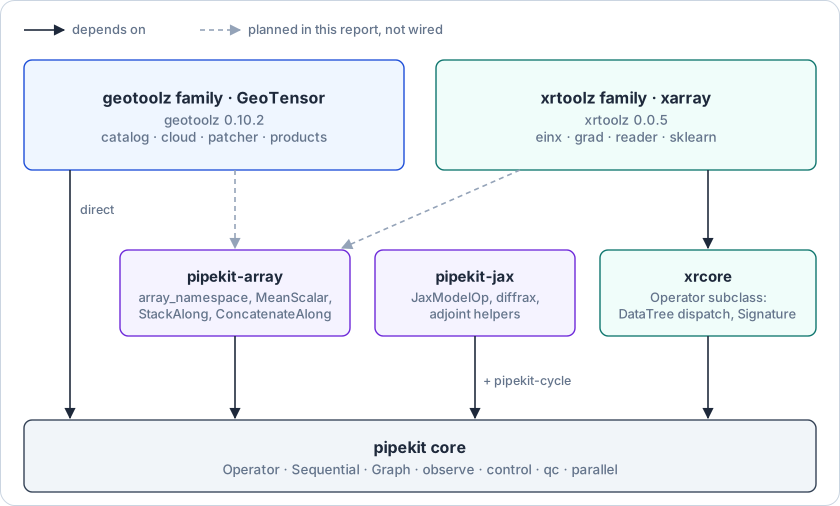
Figure 1:The shipped dependencies. The dashed links to pipekit-array were planned and are not wired.
Table 1:The proposed layers, and what each became.
| Layer | Proposed | Shipped | Source lines |
|---|---|---|---|
| Array | pipekit-array: 12 Array API operators, about 400 lines | pipekit-array 0.0.2: phase A of four, 4 names | 281 |
| Geo | geotoolz: GeoTensor operators, with framework code reduced to a shim | geotoolz 0.10.2 plus four packages: geocatalog, geocloud, geopatcher, geoproducts | 35,044 (+ 49,425 in the four) |
| xarray | xr_toolz: xarray operators, with framework code reduced to a shim | xrtoolz 0.0.5 plus five packages: xrcore, xreinx, xrgrad, xrreader, xrsklearn | 31,729 (+ 16,588 in the five) |
| JAX | pipekit-jax: deferred until a project needs it | pipekit-jax 0.0.2: model wrapping, not tracing (Section ??) | 493 |
The proposal’s sizes were estimates, and the shipped line counts include docstrings and exclude tests.
Part 1 · pipekit-array: arrays through the Array API¶
What the Array API gives us¶
The Python Array API standard specifies a common array interface. A conforming array implements __array_namespace__(), which returns a module-like namespace with mean, sum, where, reshape and the rest, so one function works on any conforming backend:
1 2 3 4 5from pipekit_array import array_namespace def channel_mean(x): # x: (..., C) xp = array_namespace(x) # numpy, jax.numpy, cupy, … return xp.mean(x, axis=-1, keepdims=True) # x̄ = (1/C) ∑ᶜ xᶜ → (..., 1)
The duck-array idea, formalised.
The proposal’s conformance table was out of date in three places, so we corrected it from the NumPy and array-api-compat documentation (Table 2):
Table 2:Array API support by backend, corrected.
| Library | How it conforms | The proposal said |
|---|---|---|
| NumPy ≥ 2.0 | the main numpy namespace (standard 2022.12, working toward 2023.12) | “via numpy.array_api”: that experimental module was removed in NumPy 2.0 |
| JAX | jax.numpy itself, from JAX 0.4.32 (jax.experimental.array_api before) | “since JAX 0.4.20” |
| CuPy | through array-api-compat | full |
| PyTorch | through array-api-compat; tensors do not expose __array_namespace__ themselves | “via torch.array_api”: there is no such module |
| Dask | through array-api-compat; lazy | partial |
| sparse | native support | partial |
pipekit-array’s dispatch handles that wrinkle correctly. array_namespace tries array-api-compat first (shipped as the optional [compat] extra, and needed for PyTorch) and then falls back to x.__array_namespace__(). Either way it fails with the same message when no input conforms or the inputs mix backends.
What ships¶
pipekit-array is planned in four phases (its docs/design/boundaries.md, §4), and phase A has shipped:
1 2 3 4 5 6 7 8 9 10 11 12 13 14 15 16 17import numpy as np from pipekit_ops import Signature from pipekit_array import ConcatenateAlong, MeanScalar, StackAlong, array_namespace x = np.arange(24.0).reshape(2, 3, 4) # (band, y, x) array_namespace(x).__name__ # → 'numpy' MeanScalar()(x) # → 11.5 full mean, scalar MeanScalar(axis=(-2, -1))(x) # → [ 5.5 17.5] per band, (band,) StackAlong(axis=0)([x[0], x[1]]).shape # → (2, 3, 4) ConcatenateAlong(axis=0)([x, x]).shape # → (4, 3, 4) pipe = StackAlong(axis=0) | MeanScalar(axis=(-2, -1)) pipe([x[0], x[1]]) # → [ 5.5 17.5] sig = Signature(dims=(("band", 2), ("y", 3), ("x", 4)), dtype="float64") MeanScalar(axis=(-2, -1)).compute_output_signature(sig) # → Signature((band=2) float64) the reduced dims are dropped
pipekit-array 0.0.2, from a real run on NumPy.
MeanScalar is the first operator on pipekit’s Signature that does real shape inference, as it drops the reduced dimensions, which is the payoff Report 2 said core leaves to the sister libraries. xrtoolz’s operators (in geo, interpolate, metrics and xreinx) infer shapes too, but on xrcore’s separate Signature (Section ??). Table 3 lists the whole planned catalogue by phase, of which only phase A ships.
Table 3:The proposed pipekit-array catalogue, by phase, at 0.0.2.
| Operator | Purpose | Phase | Status |
|---|---|---|---|
array_namespace | Array API dispatch | A | ships |
MeanScalar | reduce with xp.mean; the proposal’s field= argument shipped as axis= and keepdims= | A | ships |
StackAlong(axis) | stack a list of arrays along a new axis | A | ships |
ConcatenateAlong(axis) | concatenate along an existing axis | A | ships |
Subsample(stride) | stride-decimate the last two axes | B | planned |
ApplyToBands(inner, axis=0) | split, apply, stack over an axis | B | planned |
BatchedMap(op, batch_size) | split along axis 0, apply, concatenate | B | planned |
Histogram(bins) | capture distributions per tap site | B | planned |
Diff(reference, atol) | raise on drift from a stored reference | C | planned |
AssertValueRange(min, max, on_fail) | raise or warn when out of range | C | planned |
AssertNoNaN() | raise on any NaN | C | planned |
AssertValidFraction(min_valid) | raise when too few values are valid | C | planned |
ModelOp(model, method, batch_size) | framework-agnostic inference | D | planned |
The trade-offs¶
These held up as written, and they are the reason we think pipekit-array is worth its own package.
What works:
NumPy code is bog-standard.
JAX array maths works, and so do
jax.jit,jax.vmapandjax.gradthrough a pipeline of JAX operators: a tracer is not aNode, so dispatch runs_apply(Report 5). Gradients with respect to parameters held by operators do not reach them (Section ??).CuPy arrays stay on the GPU through the pipeline.
PyTorch keeps gradient tracking, so a pipeline can be differentiated inside an autograd context.
The same operator runs on NumPy or JAX unchanged; the input’s namespace picks the backend. Inputs that mix backends in one call are rejected.
What doesn’t:
NaN handling differs between backends at the edges, so operators that use NaN as a fill value need per-backend tests.
In-place operations break on JAX, whose arrays are immutable. pipekit-array operators are therefore pure.
Operations missing from the standard, such as some FFTs and advanced linear algebra, need backend-specific fallbacks. This is pipekit-array’s own open question Q1.
Dask is lazy: a pipeline needs an explicit
.compute()at the end (open question Q5).
Dependency surface¶
This shipped as proposed: dependencies = ["pipekit"], with one extra per backend (numpy, jax, torch, cupy, dask), plus a compat extra the proposal did not have (array-api-compat, needed for PyTorch). With no backend installed, array_namespace raises a TypeError naming the extras to install, rather than an ImportError.
Migrating the NumPy operators¶
The proposal moved the NumPy-flavoured operators out of geotoolz and xrtoolz into pipekit-array and then re-exported them with carrier-specific defaults:
1 2 3 4 5# geotoolz/qc.py (proposed) from pipekit_array.qc import AssertValueRange as _AssertValueRange class AssertValueRange(_AssertValueRange): """Read GeoTensor's fill_value as the default bounds when none are given."""
The proposed pattern: one implementation, re-exported with GeoTensor defaults.
None of this has happened, because the pipekit-array side (phase C) does not exist yet. The geotoolz side does not exist either, since geotoolz has no value-range, NaN or valid-fraction assertions at all (its assert_* functions in _src/contract.py are test-contract helpers, not operators).
Part 2 · geotoolz: GeoTensor operators¶
Scope¶
The proposal made geotoolz a thinner library focused on remote sensing over georeader.GeoTensor, with its old framework code (geotoolz.core) reduced to a shim that re-exports pipekit. However, the shipped geotoolz has no core at all: it depends on pipekit (pipekit>=0.0.2) and its top-level __init__ re-exports 16 pipekit names directly (Table 4), so gz.Operator is pipekit_ops.Operator.
Table 4:The pipekit names geotoolz re-exports at 0.10.2, all the same objects.
| Re-exported | Not re-exported |
|---|---|
Operator, Carrier, Sequential, Graph, Input, Node, Identity, Const, Lambda, Sink, Tap, Snapshot, ShapeTrace, Branch, Switch, Fanout | Cache, Memoize, Try, Coalesce, Retry, Profile, Histogram, Quarantine, the Assert* classes, the parallel maps, pipe, compose, juxt, complement |
geotoolz defines no class with the same name as a pipekit public name. It deliberately keeps augment.Compose, io.SinkOperator and io.SourceOperator out of its top level, so they cannot be confused with pipekit’s compose and Sink. Its operators accept either a GeoTensor or a plain np.ndarray and return the same kind, which makes the carrier wider than the proposal assumed.
Layout¶
Table 5 maps geotoolz’s subpackages onto the proposed layout.
Table 5:geotoolz’s subpackages at 0.10.2, against the proposed layout.
| Subpackage | What it holds | In the proposal |
|---|---|---|
io | ReadBounds, WriteCOG (the [cloud] extra) | as io |
geom | BowtieCorrection, GeostationaryParallaxCorrect, Tile, Stitch, SlidingWindow, co-registration | as geom |
radiometry | RadianceToReflectance, BTFromRadiance, DOS1, SimpleAtmosphericCorrection | as radiometry |
indices | NDVI, NDWI, EVI, …, with generic band-name resolution (DEFAULT_BAND_KEYS) | as indices |
spectral | spectral operators | as spectral |
matched_filter | MatchedFilter, ColumnEnhancement and 31 more | as matched_filter |
qa | QA-bit decoding and cloud masks: DecodeBitmask, MaskClouds, S2SCL, MODISStateQA, mask_from_qa_bits, mask_from_scl | the proposal’s cloud; its qa meant assertions |
mask | ApplyMask, PolygonMask, BBoxMask, CountryMask, LandMask | as mask |
viz | TrueColor, FalseColor, StretchToUint8, ApplyColormap, ApplyDiscreteColormap | as viz |
compositing | MedianComposite, MaxNDVIComposite, CloudFreeComposite, BAPComposite, MinCloud, … | as compositing |
augment | RandomFlip, RandomRotate90, … | as augment |
normalize | stateful scalers with fit (StandardScaler, RobustScaler, MinMaxScaler), Normalize, PerBandStats | as normalize |
restore | despeckling (Lee, RefinedLee, Frost) and gap-filling (IDW, Laplacian, biharmonic, nearest) | as restore |
plume | PlumeMask, PlumeFootprint, IMEEstimate, CrossSectionalFlux, WindAdvectionCone, SBMP, … | as plume |
learn | ModelOp, SklearnOp | the proposal’s pipekit_array.inference |
einx, feature, measure, segment | einx notation over carriers; edges, blobs, Hough, HOG; region properties and contours; segmentation | new |
patch_ops | bridge to geopatcher: GridSampler, ApplyToChips, MergePatches, StratifiedSample, BalancedSampler, TriangularWindow | the proposal’s patch |
Three proposed subpackages moved into packages of their own, and two did not ship:
patchbecame geopatcher (geotoolz-patcher). It depends on pipekit only through an optional[pipekit]extra, and geotoolz bridges to it throughpatch_ops.ExtractPatchesandStitchPatchesdo not exist under those names.catalogbecame geocatalog (geotoolz-catalog), whereGeoCatalogis a Protocol.CatalogPipelinedoes not exist anywhere.presetsandreadersmoved downstream into geoproducts (Section ??).geocloud (
geotoolz-cloud) is not the proposal’scloud(masks). It is cloud-storage I/O: stores, filesystems, COG and HDF access, caching, credentials.coredoes not exist, and noqaassertions shipped (see below).
What geotoolz owns, and what has not shipped¶
Table 6 lists the named symbols that did not ship under their proposed name.
Table 6:The proposal’s named geotoolz symbols that did not ship under that name.
| Proposed | At 0.10.2 |
|---|---|
TOAToBOA | not shipped; the nearest is SimpleAtmosphericCorrection |
DarkObjectSubtraction | shipped as DOS1 |
ACE, LinearUnmixing | not shipped |
MaskFromQABits, MaskFromSCL | functions mask_from_qa_bits, mask_from_scl; operators DecodeBitmask, S2SCL |
Colormap | ApplyColormap, ApplyDiscreteColormap |
AssertCRSEquals, AssertResolutionWithin, AssertSchema | not shipped |
ExtractPatches, StitchPatches | not shipped; geopatcher’s GridSampler / MergePatches, and geom.Tile / Stitch |
GeoCatalog, CatalogPipeline | GeoCatalog is a Protocol in geocatalog; CatalogPipeline not shipped |
super-resolution (in restore) | not shipped |
point-source attribution (in plume) | no dedicated operator |
| CH4 / NH3 / N2O matched filtering | matched_filter is gas-agnostic: ColumnEnhancement(gas="CH4", sensor="EMIT") records the gas as metadata |
The ownership argument itself held, as geotoolz keeps everything that needs GeoTensor’s crs, transform and bounds, plus the sensor knowledge and the remote-sensing domain operators. However, two of the proposal’s reasons for keeping things there did not turn into code, namely geo-specific QC (AssertCRSEquals, AssertResolutionWithin) and per-sensor calibration tables in geotoolz.
Sensor readers¶
The proposal put eight sensor modules in geotoolz.readers, each bundling a reader, sensor-specific operators and zero-argument presets. There is no geotoolz.readers; readers and presets live in geoproducts, downstream of geotoolz (its [operators] extra pulls geotoolz in), and two of the eight have shipped (Table 7):
Table 7:The eight planned sensor modules at geotoolz 0.10.2.
| Planned | Status | Where |
|---|---|---|
| GOES-R ABI | ships: Reader, L2Reader, Calibration, zero-arg presets | geoproducts.goes |
| Himawari AHI | ships: the same shape | geoproducts.himawari |
| MODIS L1B + L2 | no reader; qa.MODISStateQA and geom.BowtieCorrection exist | geotoolz |
| VIIRS SDR + EDR | no reader | — |
| MSG SEVIRI | no reader | — |
| MTG-FCI | no reader | — |
| TROPOMI L2 | no reader in geotoolz; xrreader has open_tropomi_ch4_l2 | xrtoolz-reader |
| Sentinel-3 OLCI / SLSTR | no reader | — |
The GOES and Himawari presets are NDVI, TrueColor, NaturalColor, DayCloudPhase, FireTemperature, MaskClouds, ParallaxCorrect, a synthetic or hybrid green band, and a Recipe. geoproducts also has a toy sensor for tests and a Carbon Mapper client, whereas georeader keeps its own readers for Sentinel-2 SAFE, EMIT, EnMAP, PRISMA, PROBA-V, SPOT-VGT and Earth Engine.
ModelOp and SklearnOp¶
Both live in geotoolz.learn, not in pipekit-array.
ModelOpwraps any callable or object with.predict. It callsnp.asarrayon the input, supportsbatch_size, and returns the model’s output without re-wrapping it as aGeoTensor.SklearnOpflattens pixels into samples, runs a scikit-learn estimator, and restores the grid. It hasfit,partial_fit,transform,predictandsave_state.
Both set forbid_in_yaml = True, because both hold a model object.
Part 3 · xrtoolz: xarray operators¶
Scope¶
The proposal made xr_toolz a focused xarray library, with its framework code reduced to a shim. It shipped as xrtoolz, and the framework layer became a small package of its own, xrcore (xrtoolz-core, 418 lines), whose Operator subclasses pipekit’s and adds one dispatch mode:
1 2 3 4 5 6 7 8 9 10 11 12 13 14 15 16 17 18import pipekit_ops as pk import xarray as xr import xrtoolz class Double(xrtoolz.Operator): def __init__(self, var: str = "u") -> None: self.var = var def _apply(self, ds: xr.Dataset) -> xr.Dataset: return (2 * ds[self.var]).rename(f"{self.var}2").to_dataset() xrtoolz.Operator is pk.Operator # → False: a subclass, issubclass(xrtoolz.Operator, pk.Operator) # → True so it composes with pipekit xrtoolz.Sequential is pk.Sequential # → True re-exported unchanged ds = xr.Dataset({"u": ("x", [1.0, 2.0]), "v": ("x", [3.0, 4.0])}) tree = xr.DataTree.from_dict({"/a": ds, "/b": ds * 10}) Double("u")(tree)["b"].to_dataset()["u2"].values # → [20. 40.] every node
xrcore’s Operator, from a real run.
A Node argument still builds a graph and plain data still runs _apply, whereas a DataTree argument runs _apply_tree, which by default maps _apply over every node with xr.map_over_datasets. That is the xr.DataTree support the proposal listed, built in at the base class.
xrtoolz re-exports Graph, Input, Node, Sequential and Tap from pipekit, all the same objects, and it defines no Tap, Sequential, Graph, Identity, Fanout or Lambda of its own.
Layout¶
The proposal had sixteen subpackages. xrtoolz folds six of them into one geo subpackage and moves data access out to xrreader (Table 8; the named symbols are in Table 9):
Table 8:xrtoolz’s subpackages at 0.0.5, against the proposed layout.
| Subpackage | What it holds | The proposal’s modules |
|---|---|---|
geo | validation, CRS, subsetting, masks, climatology, regions, wavelets, extremes, vector/raster | validation, crs, subset, masks, detrend |
interpolate | regridding, gap-filling, smoothing, resampling, binning | interpolate |
transforms | Fourier, wavelet and DCT transforms; encoders; decompositions | transforms |
metrics | RMSE, PSDScore, R2Score, … | metrics |
ocn | OkuboWeiss, RelativeVorticity, KineticEnergy, … | kinematics, ocn |
atm | atmospheric quantities, including atm.gas.ch4 | atm |
budgets | budget calculations | new |
inference | ModelOp, SklearnModelOp, JaxModelOp | inference |
viz | plot_* functions; matplotlib *Panel operators in viz.validation | viz |
combinators | Augment, ApplyToEach | core |
rs, ice | empty: a docstring only | rs |
einx, calc | deprecated aliases for xreinx and xrgrad | — |
| (moved to xrreader) | CMEMSSource, CDSSource, AemetSource, CATALOG | data |
Table 9:The proposal’s named xrtoolz symbols, at 0.0.5.
| Proposed | At 0.0.5 |
|---|---|
ValidateCoords, RenameCoords, SubsetBBox, SubsetTime | ship, in geo |
AddLandMask, AddOceanMask, AddCountryMask | ship, in geo, backed by regionmask |
CalculateClimatology, RemoveClimatology | ship, in geo |
RMSE, PSDScore | ship, in metrics |
OkuboWeiss, RelativeVorticity, KineticEnergy | ship, in ocn |
SortCoords | not shipped |
AssignCRS, Reproject, GetCRS | functions assign_crs, reproject, get_crs, plus a ReprojectMatch operator (rioxarray) |
SubsetWhere | the function subset_where |
ComputeAnomaly | the function calculate_anomaly |
Regrid, GapFill, Smooth, Resample | RegridConservative, RegridLike, Coarsen, Refine; the FillNaN* family; GaussianSmooth, MovingAverage, LowpassFilter; ResampleTime |
| one-hot and cyclical encoders | cyclical ships (CyclicalEncode, EncodeTimeCyclical); one-hot does not |
| PSD and wavelet decompositions | PowerSpectrum, CWT; the functions pca, eof, ica, nmf, kmeans |
NashSutcliffe | not shipped; the nearest is R2Score |
The xarray combinators¶
The proposal kept two combinators in xrtoolz because they merge with xarray, and both shipped:
1 2 3 4 5 6 7from xrtoolz import ApplyToEach, Augment sorted(Augment(Double("u"))(ds).data_vars) # → ['u', 'u2', 'v'] each = ApplyToEach(Double(), kwarg="var", values=["u", "v"]) sorted(each(ds).data_vars) # → ['u', 'u2', 'v', 'v2'] # Double(var="u") runs, merges; then Double(var="v") runs, merges
Augment and ApplyToEach at xrtoolz 0.0.5, from a real run.
Augment(inner)runsinner(ds)and merges the result back in withds.merge(result, compat="no_conflicts"): the “compute derived variables and append them” pattern behind chains likeAugment(RelativeVorticity()) | Augment(KineticEnergy()) | Augment(OkuboWeiss()).ApplyToEach(prototype, *, kwarg, values)rebuilds the prototype once per value (cls(**{**config, kwarg: v})) and merges every result. It rejects composite prototypes at construction. Each instance runs on the accumulated dataset, not on the original input, so a later value can see an earlier one’s output.
The proposal asked for a docstring note that this merge differs from pipekit’s framework combinators. The note exists on pipekit’s side (combine.py, which still calls the library xr_toolz) but not in xrtoolz, and pipekit’s Tap replaced xrtoolz’s, as planned.
Inference¶
xrtoolz.inference ships ModelOp, SklearnModelOp and JaxModelOp, all xrcore operators. The proposal’s sample_dim argument became feature_dim, so every dimension except feature_dim is treated as a sample dimension, and output_name and output_dim name the result. JaxModelOp imports JAX lazily and has a jit flag, while xrsklearn separately ships SklearnOp and XarrayEstimator.
The five sibling packages¶
None of these were in the proposal.
xrcore (
xrtoolz-core): theOperatorsubclass andSignatureabove.xreinx (
xrtoolz-einx): einx patterns whose axes are dimension names. It has the functionseinsum,rearrange,reduce,repeat,matmulandpack_dataset, and an operator for each (Einsum,Rearrange,Reduce, …). ItsReduceis a different class fromxrtoolz.geo.Reduce.xrgrad (
xrtoolz-grad): finite-difference calculus on xarray through finitediffx (JAX). It haspartial,gradient,divergence,curlandlaplacian, withgeometry=set to"cartesian","rectilinear"or"spherical". It is plain functions, with no operators and no pipekit dependency.xrreader (
xrtoolz-reader): data access, with no pipekit dependency. It has the sourcesCMEMSSource,CDSSource,AemetSourceandLocalL2Source; request types (BBox,TimeRange,DepthRange,PressureLevels,Station); a CF variable registry withvalidate_dataset; and Level-2 openers for TROPOMI, EMIT and GHGSat CH₄.xrsklearn (
xrtoolz-sklearn):XarrayEstimator, which stacks, delegates to scikit-learn and unstacks for aDataArray,DatasetorDataTree;.sklearnaccessors; andSklearnOp.
The array maths was meant to delegate to pipekit-array (the reduction inside RMSE, for example). However, no xrtoolz package imports pipekit-array, and RMSE reduces through NumPy kernels in metrics/_src/_pixel_kernels.py.
Part 4 · Where each symbol lives¶
The proposal flagged this as the most common confusion, so Table 10 shows where each name lives at the pinned revisions.
Table 10:Where each symbol lives at pipekit 0.0.2, geotoolz 0.10.2 and xrtoolz 0.0.5.
| Symbol | Defined in | Re-exported from | The proposal said |
|---|---|---|---|
Operator | pipekit_ops._base.operator | pipekit, geotoolz; subclassed by xrcore.Operator (re-exported by xrtoolz) | re-exported from both cores |
Sequential, Graph, Input, Node | pipekit_ops._base | pipekit, geotoolz, xrtoolz | as shipped |
Fanout, Identity, Const, Lambda, Sink | pipekit | pipekit, geotoolz | both libraries |
Tap | pipekit_ops.observe | geotoolz, xrtoolz | as shipped |
Branch, Switch | pipekit_ops.control | geotoolz | both libraries |
Try, Coalesce, Retry | pipekit_ops.control | pipekit only | both libraries |
Snapshot, ShapeTrace | pipekit_ops.observe | geotoolz | both libraries |
Profile, Cache, Quarantine, AssertShape, AssertDType, the parallel maps, pipe, compose, juxt, complement | pipekit | pipekit only | both libraries |
Signature | pipekit_ops.signature; a separate one in xrcore | pipekit; xrtoolz (xrcore’s) | one, in pipekit_ops.signature |
Histogram | pipekit_ops.observe | pipekit only | pipekit_array.observe |
BatchedMap | pipekit_ops.parallel | pipekit only | pipekit_array.parallel |
ApplyToBands, Subsample, Diff, AssertValueRange, AssertNoNaN, AssertValidFraction | not shipped | — | pipekit_array |
ModelOp | geotoolz.learn; a separate one in xrtoolz.inference | each library | pipekit_array.inference |
Augment, ApplyToEach | xrtoolz.combinators | xrtoolz | as shipped |
GeoCatalog | geocatalog (a Protocol) | geocatalog | geotoolz.catalog |
CatalogPipeline | not shipped | — | geotoolz.catalog |
| patch extraction and stitching | geopatcher | geotoolz.patch_ops | geotoolz.patch |
| sensor readers and presets | geoproducts.goes, geoproducts.himawari | geoproducts | geotoolz.readers |
| reprojection, CRS | xrtoolz.geo (functions, plus ReprojectMatch) | xrtoolz.geo | xr_toolz.crs |
| climatology, anomalies | xrtoolz.geo | xrtoolz.geo | xr_toolz.detrend |
Part 5 · Other libraries that could fit on top¶
The proposal asked, for each candidate, whether it deserves a library of its own.
pipekit-array, for NumPy, JAX, CuPy and PyTorch: yes, and it exists. The Array API is the right abstraction, and one library covers all four backends.
pipekit-numba: no, and none exists. Numba is a compiler, not a carrier. A numba-jitted operator is still NumPy-flavoured at the carrier level; at most, a few pipekit-array operators could get
@njitinner kernels behind a[fast]extra. That extra does not exist.A JAX-traceable library: still deferred, and pipekit-jax is not it. Differentiating through a pipeline with respect to its operators’ parameters means operators that are PyTrees with static metadata and a pure
_apply; dispatch already lets tracers through. The shipped pipekit-jax does something else:JaxModelOpwraps aneqx.Moduleas an operator, withserialize_weights,with_weightsandfrom_registry, so trained weights round-trip through a pipekit-experiment registry;DiffraxForwardModelis a pipekit-cycle forward model on a diffrax solve;to_diffrax_adjointandtruncated_scaninterpret pipekit-cycle’s adjoint specs.
A pipeline of JAX operators can already be jitted, vmapped and differentiated with respect to its inputs. However, what is missing is differentiating with respect to the operators’ own parameters, because no shipped operator is a PyTree (Report 5).
pipekit-dask: out of scope, and none exists. Distributing work is the orchestrator’s job. Operators that pickle can go inside
dask.bag.mapordask.delayedas they are.pipekit-cuda: covered by pipekit-array with CuPy. That is the
[cupy]extra.pandas, polars, dicts: deferred, and none exists.
Carrier = Any, so a DataFrame operator is just anOperatorsubclass. The methane, MARS and atmospheric-chemistry work has not needed a DataFrame library.
Part 6 · How to decide on a new sister library¶
We apply the proposal’s three questions to the shipped code:
Is there a clearly typed carrier? If not, the operators belong in an existing library or in core.
Are there at least eight operators that would consume it natively? If not, contribute them to the closest existing library.
Does the carrier already have a wide-enough standard? The Array API does for arrays, and
xarray.Datasetis its own de facto standard. If the carrier has no coherent standard, we would be inventing one alongside the operators.
Table 11 applies them to each candidate.
Table 11:The criteria, with the shipped evidence.
| Library | Typed carrier | ≥ 8 native operators | A standard | Verdict |
|---|---|---|---|---|
| pipekit-array | any Array API array | 3 operators and the dispatcher; 12 planned | the Array API | passes on plan; not yet on code |
| geotoolz | GeoTensor (and plain np.ndarray) | hundreds: 272 top-level names | GeoTensor in this stack | passes |
| xrtoolz | xr.DataArray, Dataset, DataTree | hundreds, across a dozen subpackages | xarray | passes |
| JAX-traceable | JAX PyTrees | none yet | JAX | deferred until a project drives it |
| numba, dask, pandas | no new carrier, orchestration, no shared standard | — | — | do not pass |
Two points in the shipped code bear on question 2. The domain libraries grew packages of their own (geopatcher, geocatalog, xrreader, xrgrad), each with a clear job and its own dependencies, which turned out to be how they stay focused. pipekit-array exists ahead of its operators, which is fine for a library planned in phases, but until phase C lands the code does not justify the package.
Summary¶
Table 12 sets each layer’s proposed status against the pinned revisions.
Table 12:The ecosystem as proposed, and at the pinned revisions.
| Layer | Library | What it owns | Proposed status | At the pinned revisions |
|---|---|---|---|---|
| Core | pipekit | the framework: operators, composition, observers, control, QC, parallelism | new | 0.0.2, 52 names (Report 2) |
| Array | pipekit-array | Array API operators | new | 0.0.2, phase A: 4 names; no dependents |
| Geo | geotoolz (+ 4) | GeoTensor operators, patches, catalogs, cloud I/O, sensor products | existing, refactored | 0.10.2; the framework moved to pipekit; readers in geoproducts (2 of 8 sensors) |
| xarray | xrtoolz (+ 5) | xarray operators, readers, calculus, einx, sklearn | existing, refactored | 0.0.5; the framework moved to pipekit, plus xrcore |
| JAX | pipekit-jax | the proposal: JAX-traceable operators | deferred | 0.0.2, but model wrapping and diffrax, not tracing |
| Out of scope | pipekit-dask, pipekit-numba, pipekit-pandas | — | not planned | not built |
The proposal’s takeaway was two new packages (pipekit, pipekit-array) and a refactor of two existing ones. The refactor happened, as neither domain library carries framework code any more, and the ecosystem grew beyond the proposal (pipekit’s workspace has seven packages, geotoolz’s five and xrtoolz’s six). However, the piece that has not landed is the middle layer the proposal was built around, a shared array library the domain libraries delegate to.
Open questions¶
The shipped code raises these decisions:
Is pipekit-array still the middle layer? Both domain libraries grew their own array code instead. Either pipekit-array’s phases B to D land and geotoolz and xrtoolz migrate onto them, or pipekit-array becomes an optional toolkit beside them and we retire the layering in this report.
What do pipekit-array’s
BatchedMapandHistogrambecome? Core already ships both names, so the options are to give the array versions distinct names (BatchedArrayMap, say), to make them subclasses that add axis-0 splitting, or to drop them and extend the core classes.One
Signatureor two? Resolved: one, pipekit’s (Report 16 §A).One
JaxModelOpname or two? Resolved: one model-operator family (Report 16 §B).Where do the numeric QC asserts go?
AssertValueRange,AssertNoNaNandAssertValidFractionwere promised to pipekit-array, and pipekit’sqc.pystill says they live there, but they exist nowhere. Should they wait for phase C, or land in geotoolz and xrtoolz first?Does geotoolz own geo QC?
AssertCRSEquals,AssertResolutionWithinandAssertSchemawere part of the case for geotoolz and did not ship.Which sensors come next in geoproducts? Resolved for TROPOMI: the reader stays on the xarray side (Report 16 §E).
Upcoming work¶
Table 13 lists the follow-ups whose shape is clear.
Table 13:Follow-ups from checking the proposal against the pinned revisions.
| Follow-up | Where | Why |
|---|---|---|
Make require_operator, callable_name and nested_config public, or stop importing them | pipekit _base/operator.py; geotoolz, geopatcher | geotoolz depends on private API |
| Index each library’s public subpackages in the capability index | geostack scripts/capabilities.py (UPSTREAM) | only top-level modules are indexed: the xrtoolz subpackages (geo, metrics, ocn, …) are missing, geocloud has no rows, and the clash check misses JaxModelOp and Reduce |
Ship pipekit-array phases B to D, resolving the BatchedMap / Histogram names first | pipekit-array | 9 of the 13 planned names are missing |
Fix pipekit’s qc.py docstring that says the numeric asserts live in pipekit-array | pipekit qc.py | they don’t exist yet |
Rename xr_toolz to xrtoolz in pipekit’s combine.py docstring, and add the merge-semantics note to xrtoolz’s Augment / ApplyToEach | pipekit, xrtoolz | stale name; a note planned on the xrtoolz side |
Build CatalogPipeline on ProcessMap / ThreadMap | geocatalog | Reports 2 and 3 both assume it; use cases 2 and 12 need it |
Fill or remove the empty xrtoolz.rs and xrtoolz.ice subpackages | xrtoolz | they ship as docstrings only |
Add SortCoords, a one-hot encoder and a Nash–Sutcliffe score, or drop them from the plan | xrtoolz | named in the proposal, not shipped |
References¶
Citations¶
To be added: the Python Array API standard, array-api-compat, NumPy’s Array API compatibility notes, xarray, and georeader, as entries in references.bib. Until then, the Array API standard, array-api-compat and NumPy’s compatibility notes are linked inline.