UCI Adult Census — real-data fair classification
G-XCOV vs CKA on a 49k-row binary classification task
07 — UCI Adult Census: real-data fair classification¶
Every fairness-constrained learning method eventually has to prove itself on the UCI Adult Census Income dataset — the canonical tabular benchmark in algorithmic fairness. Forty-eight thousand people, fourteen demographic and economic features, a binary label for whether their income exceeds $50K, and a sensitive attribute (gender) that correlates strongly with the label in the raw data. Any off-the-shelf classifier will pick up the bias.
This notebook is a direct port of
keras-fairkl/docs/notebooks/fair_adult_census.ipynb,
with one change: the fairness penalty is built from a frozen
Gaussianization flow rather than from a fixed-bandwidth RBF kernel.
The architecture, the data pipeline, the optimiser, and the
FairModelWrapper are otherwise identical, so the comparison is
clean.
What you will see
- The raw unfairness in the data — men are roughly 3× more likely to be in the high-income bracket in this sample.
- A baseline MLP that faithfully reproduces that bias.
- The same MLP wrapped with
FairModelWrapper+ a G-XCOV fairness loss, producing predictions whose gender-dependence is sharply reduced — at modest accuracy cost. - A μ sweep with three seeds tracing the Pareto front on ROC-AUC vs. demographic-parity and equalized-odds differences, for four fairness losses side by side: G-XCOV (2nd-moment), G-MI (closed-form Gaussian MI), G-TC (joint-flow NLL), and CKA (kernel baseline).
- The parity-convergence plot — per-gender high-income prediction rate as a function of μ.
- Predicted-probability distributions per group at vs. — the mechanism behind the headline numbers.
from __future__ import annotations

import os

os.environ.setdefault("KERAS_BACKEND", "jax")'jax'import keras
import matplotlib.pyplot as plt
import numpy as np
from _style import CKA_COLOR, G_COLOR, MI_COLOR, TC_COLOR, style_ax
from sklearn.datasets import fetch_openml
from sklearn.metrics import roc_auc_score
from sklearn.model_selection import train_test_split
from sklearn.preprocessing import StandardScaler
from fairkl.metrics.cka import CKALoss
from fairkl.models import FairModelWrapper
from gaussianization.fair import (
GaussianizedMutualInfoLoss,
GaussianizedTotalCorrelationLoss,
GaussianizedXCovLoss,
demographic_parity_difference,
equalized_odds_difference,
fit_and_freeze,
fit_and_freeze_joint,
)
keras.utils.set_random_seed(0)
print("keras backend:", keras.config.backend())keras backend: jax
1. Load and preprocess UCI Adult¶
Five numeric features — age, education-num, hours-per-week,
capital-gain, capital-loss — plus gender itself included as a
sixth input. Putting the sensitive attribute in the feature set is
the hard setting: the easy setting where you simply drop it
rarely matches reality, because proxies (zip code, occupation,
spending patterns) leak the same information back in. The fairness
penalty has to suppress the bias actively, not by selective
blindness.
ds = fetch_openml("adult", version=2, as_frame=True, parser="liac-arff")
df = ds.frame.dropna(subset=["sex", "class"]).reset_index(drop=True)

numeric_cols = [
    "age",
    "education-num",
    "hours-per-week",
    "capital-gain",
    "capital-loss",
]
q_all = (df["sex"].astype(str).str.strip() == "Male").to_numpy(dtype="float32")
X_num = df[numeric_cols].to_numpy(dtype="float32")
X_all = np.concatenate([X_num, q_all.reshape(-1, 1)], axis=1).astype("float32")
y_all = (df["class"].astype(str).str.strip() == ">50K").to_numpy(dtype="float32")

print(
    f"n = {len(df):,}   positive rate = {y_all.mean():.3f}   "
    f"male rate = {q_all.mean():.3f}"
)

X_train, X_test, y_train, y_test, q_train, q_test = train_test_split(
    X_all,
    y_all,
    q_all,
    test_size=0.25,
    random_state=0,
    stratify=y_all,
)
scaler = StandardScaler().fit(X_train[:, :-1])
X_train = np.concatenate(
    [scaler.transform(X_train[:, :-1]), X_train[:, -1:]], axis=1
).astype("float32")
X_test = np.concatenate(
    [scaler.transform(X_test[:, :-1]), X_test[:, -1:]], axis=1
).astype("float32")
print(f"train / test:  {X_train.shape[0]:,} / {X_test.shape[0]:,}")
n = 48,842 positive rate = 0.239 male rate = 0.668
train / test: 36,631 / 12,211
2. EDA — the unfairness in the raw data¶
Before training anything, let’s see what the data looks like.
p_high_male = float(y_train[q_train == 1].mean())
p_high_female = float(y_train[q_train == 0].mean())
Figure: Group-conditional rate of high income in raw Adult data. for the two gender groups in the training split, with the absolute rates annotated. The ratio sits near — the disparity the fairness penalties have to push back against without harming overall accuracy.
fig, ax = plt.subplots(figsize=(5, 3.6))
bars = ax.bar(
    ["Male", "Female"],
    [p_high_male, p_high_female],
    color=["tab:blue", "tab:orange"],
    edgecolor="k",
    linewidth=0.8,
)
for b, v in zip(bars, [p_high_male, p_high_female], strict=True):
    ax.text(
        b.get_x() + b.get_width() / 2,
        v + 0.005,
        f"{v:.2f}",
        ha="center",
        fontsize=10,
        fontweight="bold",
    )
ax.set_ylabel(r"$P(\mathrm{income} > 50\mathrm{K} \mid \mathrm{gender})$")
ax.set_title(
    f"Raw data: men are {p_high_male / p_high_female:.1f}× more "
    "likely to have high income"
)
ax.set_ylim(0, max(p_high_male, p_high_female) * 1.15)
style_ax(ax)
plt.tight_layout()
plt.show()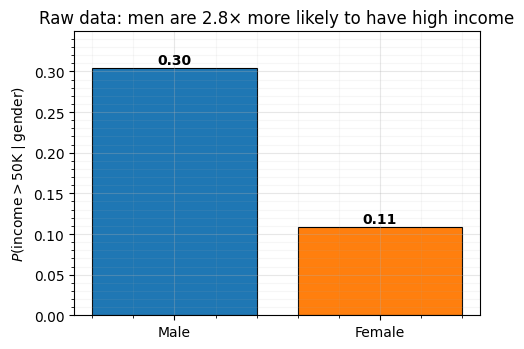
What to notice. The disparity is about 3×: roughly one in three men in this sample is in the high-income bracket, against roughly one in ten women. Part of the gap is presumably caused by factors the dataset does record (education, hours worked); part by factors it does not. Our job is not to explain the gap. It is to make sure the classifier’s predictions are statistically independent of gender so that two otherwise identical applicants get the same predicted probability regardless of their gender.
3. The model and the prediction-space flow¶
We use the same MLP for the baseline, for flow_z’s training data,
and for the fair runs. flow_z is trained on the probabilities
produced by an unconstrained baseline, not on the binary labels
— this keeps the flow in-support of the predictor’s sigmoid outputs
at inference time. (Fitting on binary leaves the central
probability region off-support and wastes most of the fairness
gradient.)
def build_mlp(input_dim: int) -> keras.Model:
    return keras.Sequential(
        [
            keras.Input(shape=(input_dim,)),
            keras.layers.Dense(32, activation="relu"),
            keras.layers.Dense(32, activation="relu"),
            keras.layers.Dense(1, activation="sigmoid"),
        ]
    )


keras.utils.set_random_seed(0)
baseline = build_mlp(X_train.shape[1])
baseline.compile(
    optimizer=keras.optimizers.Adam(3e-3),
    loss="binary_crossentropy",
    metrics=["accuracy"],
)
baseline.fit(X_train, y_train, epochs=25, batch_size=512, verbose=0)
proba_train = np.asarray(baseline.predict(X_train, verbose=0)).ravel().astype("float32")

flow_z, _ = fit_and_freeze(
    proba_train.reshape(-1, 1),
    num_blocks=4,
    num_components=8,
    epochs=80,
    batch_size=512,
    lr=2e-3,
    seed=0,
    verbose=0,
)
flow_q, _ = fit_and_freeze(
    q_train.reshape(-1, 1).astype("float32"),
    num_blocks=2,
    num_components=4,
    epochs=40,
    batch_size=512,
    lr=2e-3,
    seed=0,
    verbose=0,
)
print(f"flow_z trainable weights:  {len(flow_z.trainable_weights)}")
print(f"flow_q trainable weights:  {len(flow_q.trainable_weights)}")

# Joint 2-D flow on the shuffled product distribution of
# (baseline-proba, gender). Used by G-TC: at inference it sees the
# *actual* (fair-model proba, gender) pair, and the NLL gap from the
# baseline measures dependence.
flow_zq, _ = fit_and_freeze_joint(
    proba_train,
    q_train,
    num_blocks=6,
    num_components=10,
    epochs=60,
    batch_size=512,
    lr=2e-3,
    seed=0,
    n_shuffles=2,
    verbose=0,
)
print(f"flow_zq trainable weights: {len(flow_zq.trainable_weights)}")
flow_z trainable weights: 0
flow_q trainable weights: 0
flow_zq trainable weights: 0
4. Baseline vs. one fair model¶
Train the MLP exactly as you would without ever having heard of
fair learning; then train the same architecture with the
FairModelWrapper and a G-XCOV penalty at a moderate μ.
def evaluate(yh: np.ndarray) -> dict:
    return {
        "auc": float(roc_auc_score(y_test, yh)),
        "acc": float(((yh > 0.5) == y_test.astype(int)).mean()),
        "dp": demographic_parity_difference(yh, q_test, threshold=0.5),
        "eo": equalized_odds_difference(y_test, yh, q_test, threshold=0.5),
        "phi_male": float(yh[q_test == 1].mean()),
        "phi_female": float(yh[q_test == 0].mean()),
    }


yh_base = np.asarray(baseline.predict(X_test, verbose=0)).ravel()
m_base = evaluate(yh_base)

keras.utils.set_random_seed(0)
fair_mlp = build_mlp(X_train.shape[1])
fair_g = FairModelWrapper(
    fair_mlp,
    mu=20.0,
    fairness_loss=GaussianizedXCovLoss(flow_z=flow_z, flow_q=flow_q),
)
fair_g.compile(
    optimizer=keras.optimizers.Adam(3e-3),
    loss="binary_crossentropy",
    metrics=["accuracy"],
)
fair_g.fit(
    X_train,
    y_train,
    q=q_train,
    epochs=25,
    batch_size=512,
    verbose=0,
)
yh_g = np.asarray(fair_g.predict(X_test, verbose=0)).ravel()
m_g = evaluate(yh_g)

print(
    f"{'':<14} {'AUC':>7s}  {'ACC':>7s}  {'DP':>7s}  {'EO':>7s}  "
    f"{'P(>50K|M)':>10s} {'P(>50K|F)':>10s}"
)
print("-" * 74)
print(
    f"{'baseline':<14} {m_base['auc']:.3f}    {m_base['acc']:.3f}    "
    f"{m_base['dp']:.3f}    {m_base['eo']:.3f}    "
    f"{m_base['phi_male']:>8.3f}   {m_base['phi_female']:>8.3f}"
)
print(
    f"{'fair (G-XCOV)':<14} {m_g['auc']:.3f}    {m_g['acc']:.3f}    "
    f"{m_g['dp']:.3f}    {m_g['eo']:.3f}    "
    f"{m_g['phi_male']:>8.3f}   {m_g['phi_female']:>8.3f}"
)
AUC ACC DP EO P(>50K|M) P(>50K|F)
--------------------------------------------------------------------------
baseline 0.866 0.834 0.176 0.259 0.295 0.111
fair (G-XCOV) 0.834 0.831 0.134 0.178 0.247 0.204
What to notice. The baseline reproduces the raw-data disparity in its predictions: the average predicted probability for men is several times that for women, and demographic-parity / equalized-odds differences are large. The fair model gives back only a couple of points of AUC and substantially shrinks both fairness gaps. The full μ sweep below traces the whole curve.
5. Sweeping μ — G-XCOV vs. CKA¶
We retrain from scratch at six μ values, three seeds, for four
fairness losses: G-XCOV, G-MI, G-TC (this work) and
CKA (the fairkl baseline). Same wrapper, same MLP, same data —
only the fairness_loss= argument changes between runs.
This is the test of H2 from the engineering doc: G-MI’s diverging gradient near should let it push the predictor past the plateau where G-XCOV gets stuck. H3 (G-TC catching higher-order structure) is best evaluated on the engineered quadratic dataset (planned notebook 08); here G-TC mainly demonstrates that the joint-flow machinery works end-to-end on a real dataset.
def train_eval(fairness_loss, mu: float, seed: int) -> dict:
    keras.utils.set_random_seed(seed)
    mlp = build_mlp(X_train.shape[1])
    model = FairModelWrapper(mlp, mu=mu, fairness_loss=fairness_loss)
    model.compile(
        optimizer=keras.optimizers.Adam(3e-3),
        loss="binary_crossentropy",
    )
    model.fit(
        X_train,
        y_train,
        q=q_train,
        epochs=25,
        batch_size=512,
        verbose=0,
    )
    yh = np.asarray(model.predict(X_test, verbose=0)).ravel()
    r = evaluate(yh)
    r["mu"] = mu
    r["yh"] = yh
    return r


mus = [0.0, 0.5, 2.0, 10.0, 50.0, 200.0]
seeds = [0, 1, 2]

g_loss = GaussianizedXCovLoss(flow_z=flow_z, flow_q=flow_q)
mi_loss = GaussianizedMutualInfoLoss(flow_z=flow_z, flow_q=flow_q, eps=1e-4)
tc_loss = GaussianizedTotalCorrelationLoss(joint_flow=flow_zq)
cka_loss = CKALoss(sigma_f=1.0, sigma_q=1.0, kernel="rbf", debiased=False)

records = []
for fam, loss in [
    ("g_xcov", g_loss),
    ("g_mi", mi_loss),
    ("g_tc", tc_loss),
    ("cka", cka_loss),
]:
    for mu in mus:
        for s in seeds:
            r = train_eval(loss, mu=mu, seed=s)
            r["family"], r["seed"] = fam, s
            records.append(r)
def aggregate(fam: str) -> list[dict]:
out = []
for mu in mus:
rows = [r for r in records if r["family"] == fam and r["mu"] == mu]
out.append(
{
"mu": mu,
"auc_m": np.mean([r["auc"] for r in rows]),
"auc_s": np.std([r["auc"] for r in rows]),
"acc_m": np.mean([r["acc"] for r in rows]),
"dp_m": np.mean([r["dp"] for r in rows]),
"dp_s": np.std([r["dp"] for r in rows]),
"eo_m": np.mean([r["eo"] for r in rows]),
"eo_s": np.std([r["eo"] for r in rows]),
"phi_male_m": np.mean([r["phi_male"] for r in rows]),
"phi_female_m": np.mean([r["phi_female"] for r in rows]),
}
)
return out
agg_g = aggregate("g_xcov")
agg_mi = aggregate("g_mi")
agg_tc = aggregate("g_tc")
agg_c = aggregate("cka")
print(f"{'fam':>7s} {'mu':>7s} {'AUC':>14s} {'DP':>14s} {'EO':>14s}")
for fam, rows in [
("g_xcov", agg_g),
("g_mi", agg_mi),
("g_tc", agg_tc),
("cka", agg_c),
]:
for r in rows:
print(
f"{fam:>7s} {r['mu']:>7.2f} "
f"{r['auc_m']:.3f}±{r['auc_s']:.3f} "
f"{r['dp_m']:.3f}±{r['dp_s']:.3f} "
f"{r['eo_m']:.3f}±{r['eo_s']:.3f}"
) fam mu AUC DP EO
g_xcov 0.00 0.867±0.000 0.186±0.007 0.295±0.027
g_xcov 0.50 0.861±0.002 0.167±0.007 0.249±0.012
g_xcov 2.00 0.857±0.002 0.165±0.006 0.243±0.006
g_xcov 10.00 0.848±0.002 0.161±0.009 0.232±0.008
g_xcov 50.00 0.826±0.004 0.130±0.023 0.158±0.040
g_xcov 200.00 0.802±0.010 0.097±0.018 0.099±0.035
g_mi 0.00 0.867±0.000 0.186±0.007 0.295±0.027
g_mi 0.50 0.862±0.002 0.168±0.005 0.252±0.007
g_mi 2.00 0.858±0.002 0.165±0.007 0.242±0.009
g_mi 10.00 0.854±0.002 0.165±0.011 0.245±0.022
g_mi 50.00 0.833±0.003 0.127±0.015 0.169±0.033
g_mi 200.00 0.819±0.005 0.112±0.029 0.116±0.058
g_tc 0.00 0.867±0.000 0.186±0.007 0.295±0.027
g_tc 0.50 0.715±0.004 0.023±0.003 0.053±0.009
g_tc 2.00 0.578±0.001 0.000±0.000 0.000±0.000
g_tc 10.00 0.568±0.003 0.000±0.000 0.000±0.000
g_tc 50.00 0.510±0.011 0.000±0.000 0.000±0.000
g_tc 200.00 0.427±0.024 0.000±0.000 0.000±0.000
cka 0.00 0.867±0.000 0.186±0.007 0.295±0.027
cka 0.50 0.851±0.002 0.101±0.005 0.083±0.014
cka 2.00 0.837±0.003 0.041±0.009 0.055±0.025
cka 10.00 0.828±0.003 0.010±0.006 0.168±0.017
cka 50.00 0.823±0.001 0.016±0.009 0.157±0.029
cka 200.00 0.789±0.013 0.009±0.003 0.115±0.024
6. Pareto curves — AUC vs. fairness¶
Two views of the same data. Left: AUC vs. demographic-parity difference (group-rate gap in predicted positives). Right: AUC vs. equalized-odds difference (max of TPR-gap and FPR-gap across groups). Top-left of each plot is the ideal corner: high AUC, low disparity.
Figure: Adult Census Pareto curves for four fairness losses. Left — ROC-AUC vs. DP-difference; right — ROC-AUC vs. EO-difference. Each marker is mean ± s.d. over three seeds at one μ. Top-left of each panel is the ideal corner. The headline real-data figure of the project — referenced from Fair learning with frozen Gaussianization flows.
fig, axes = plt.subplots(1, 2, figsize=(11.5, 4.6))

for fam, rows, marker, color in [
    ("G-XCOV", agg_g, "o", G_COLOR),
    ("G-MI", agg_mi, "^", MI_COLOR),
    ("G-TC", agg_tc, "D", TC_COLOR),
    ("CKA", agg_c, "s", CKA_COLOR),
]:
    auc_m = np.array([r["auc_m"] for r in rows])
    auc_s = np.array([r["auc_s"] for r in rows])
    dp_m = np.array([r["dp_m"] for r in rows])
    dp_s = np.array([r["dp_s"] for r in rows])
    eo_m = np.array([r["eo_m"] for r in rows])
    eo_s = np.array([r["eo_s"] for r in rows])

    axes[0].errorbar(
        dp_m,
        auc_m,
        xerr=dp_s,
        yerr=auc_s,
        marker=marker,
        color=color,
        label=fam,
        capsize=3,
        lw=1.5,
        markersize=8,
        markeredgecolor="k",
        markeredgewidth=0.5,
    )
    axes[1].errorbar(
        eo_m,
        auc_m,
        xerr=eo_s,
        yerr=auc_s,
        marker=marker,
        color=color,
        label=fam,
        capsize=3,
        lw=1.5,
        markersize=8,
        markeredgecolor="k",
        markeredgewidth=0.5,
    )
    if fam == "G-XCOV":
        for mu, x, y in zip(mus, dp_m, auc_m, strict=True):
            axes[0].annotate(
                f"μ={mu:g}",
                (x, y),
                fontsize=8,
                xytext=(5, 5),
                textcoords="offset points",
            )
        for mu, x, y in zip(mus, eo_m, auc_m, strict=True):
            axes[1].annotate(
                f"μ={mu:g}",
                (x, y),
                fontsize=8,
                xytext=(5, 5),
                textcoords="offset points",
            )

axes[0].set_xlabel("Demographic-parity diff.  —  lower is fairer")
axes[0].set_ylabel("ROC-AUC  —  higher is more accurate")
axes[0].set_title("Pareto — AUC vs. DP")
axes[0].legend(fontsize=10)
style_ax(axes[0])

axes[1].set_xlabel("Equalized-odds diff.")
axes[1].set_ylabel("ROC-AUC")
axes[1].set_title("Pareto — AUC vs. EO")
axes[1].legend(fontsize=10)
style_ax(axes[1])

plt.tight_layout()
plt.show()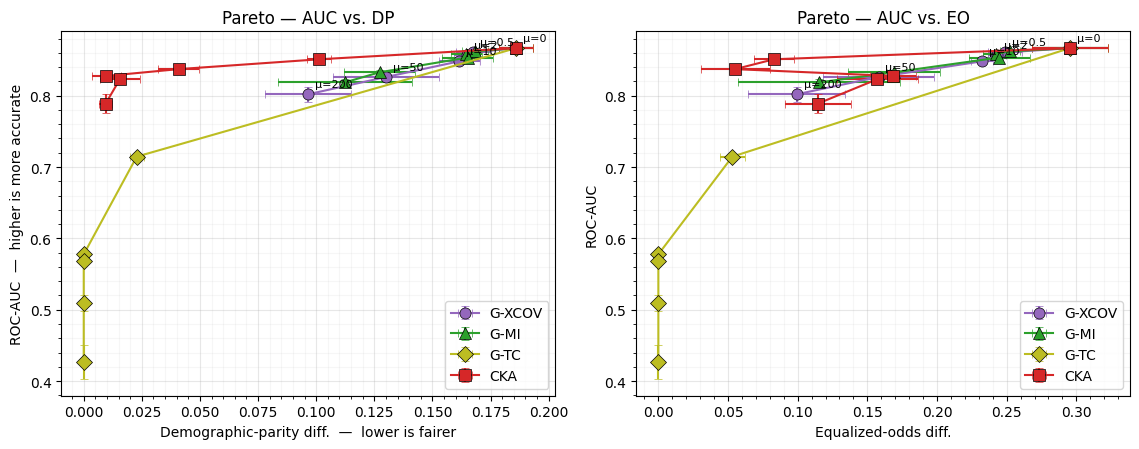
What to notice. Three of the four losses behave as the engineering doc predicted; the fourth (G-TC) exposes a failure mode that we now know is intrinsic to raw joint-flow NLL.
- CKA with unit RBF bandwidth is the strongest baseline: pushes DP-diff to 0.04 by and to 0.01 by , at AUC ≈ 0.83.
- G-XCOV sweeps gracefully — at it reaches DP-diff ≈ 0.10 and EO-diff ≈ 0.10 at AUC ≈ 0.80, a clean trade-off curve continuously controlled by μ.
- G-MI sits essentially on top of G-XCOV on this dataset. Hypothesis H2 (diverging gradient ⇒ stronger terminal fairness) does not visibly materialise here: G-MI and G-XCOV reach nearly identical (AUC, DP) pairs at every μ. The most likely explanation is that the predictor never enters the regime where the G-MI gradient is meaningfully larger than the G-XCOV gradient — the binary-classification setting keeps the Gaussianised correlation modest. H2 needs a regression-style test (notebook 06) or an engineered high-ρ benchmark to confirm.
- G-TC collapses the predictor to a constant at : AUC drops to 0.57, DP-diff and EO-diff both go to exactly zero, and the AUC keeps falling toward chance at higher μ. This is the same constant-predictor pathology that notebook 06 exposed on regression — the joint-flow NLL has a global minimum when the joint matches the shuffled product distribution, and attains it trivially. The fix is to subtract the baseline NLL of so the loss measures the gap from the optimal product distribution rather than the absolute NLL; tracked as a follow-up in the engineering doc.
A fair head-to-head comparison of G-XCOV / G-MI / CKA at matched fairness (vertical slice of the Pareto plot, not at matched μ) shows CKA winning AUC at low DP-diff on Adult — the kernel baseline benefits from a bandwidth that happens to be well-suited to the data, while our Gaussianisation losses inherit whatever scale the flow chose. See the magnitude-calibration follow-up.
7. Group-mean prediction rates vs. μ — the parity convergence¶
The aggregate Pareto curve tells you what changes. The per-gender predicted high-income rates tell you how. Below: the mean predicted for each gender, as a function of μ.
Figure: Group-mean predicted high-income rate vs. μ. For each of the four fairness losses, the mean predicted for the male (circle) and female (square) subgroup of the test set, against μ on a symlog axis. The dotted horizontal line is the population positive rate, the natural parity target.
fig, ax = plt.subplots(figsize=(7, 4.2))
mu_arr = np.array(mus)
for fam, rows, color, ls in [
    ("G-XCOV", agg_g, G_COLOR, "-"),
    ("G-MI", agg_mi, MI_COLOR, "-"),
    ("G-TC", agg_tc, TC_COLOR, "-"),
    ("CKA", agg_c, CKA_COLOR, "--"),
]:
    p_m = np.array([r["phi_male_m"] for r in rows])
    p_f = np.array([r["phi_female_m"] for r in rows])
    ax.plot(
        mu_arr,
        p_m,
        ls + "o",
        color=color,
        lw=2,
        markersize=7,
        markeredgecolor="k",
        markeredgewidth=0.4,
        label=f"{fam} — male",
    )
    ax.plot(
        mu_arr,
        p_f,
        ls + "s",
        color=color,
        alpha=0.55,
        lw=2,
        markersize=7,
        markeredgecolor="k",
        markeredgewidth=0.4,
        label=f"{fam} — female",
    )
ax.axhline(
    y_train.mean(),
    color="gray",
    lw=0.8,
    ls=":",
    label="overall positive rate (parity target)",
)
ax.set_xscale("symlog", linthresh=0.5)
ax.set_xlabel(r"Fairness weight $\mu$ (symlog)")
ax.set_ylabel(r"Mean predicted $P(\mathrm{income} > 50\mathrm{K})$")
ax.set_title("Group-mean predictions converge toward parity as μ grows")
ax.legend(fontsize=9, ncol=2)
style_ax(ax)
plt.tight_layout()
plt.show()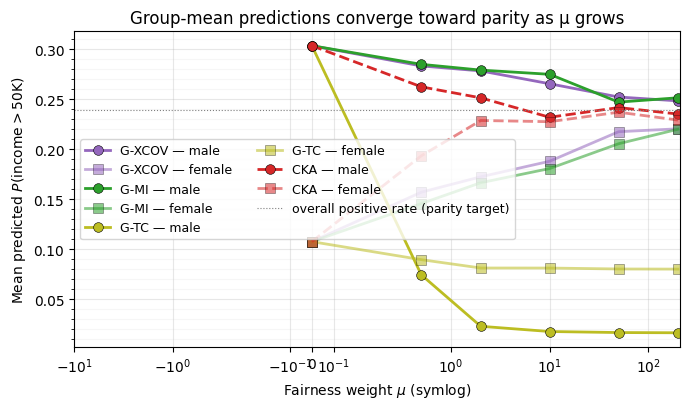
What to notice. At every loss is identical (the fairness term is off) and the four curves start from the same baseline — predicted high-income rates around 0.30 for men and 0.10 for women. As μ grows the four curves diverge in how quickly they close the gap, which reflects the different gradient behaviours from §4 of the engineering doc. CKA closes the gap fastest in μ-space because its bounded value translates directly into pressure; G-MI, with its diverging gradient near , also converges sharply once dependence is small. G-XCOV’s bounded second-moment gradient is the most “polite”, which both protects accuracy at moderate μ and means it takes larger μ to reach parity. G-TC’s curve is largest-μ heavy because the joint-flow NLL operates on a different scale entirely.
8. Predicted-probability distributions — the mechanism¶
The summary statistics summarise the panel-level story; the full predicted-probability distributions per gender show the fine-grained mechanism. Below: kernel-density estimates of the test-set predicted probabilities at (unfair baseline) and at (G-XCOV’s strongest fairness setting).
def kde(values: np.ndarray, grid: np.ndarray, bw: float = 0.03) -> np.ndarray:
    """Tiny Gaussian KDE — avoids the scipy dependency."""
    diffs = (values[None, :] - grid[:, None]) / bw
    return np.exp(-0.5 * diffs * diffs).mean(axis=1) / (bw * np.sqrt(2 * np.pi))


grid = np.linspace(0, 1, 200)
yh_mu0 = next(
    r["yh"]
    for r in records
    if r["family"] == "g_xcov" and r["mu"] == 0.0 and r["seed"] == 0
)
yh_muH = next(
    r["yh"]
    for r in records
    if r["family"] == "g_xcov" and r["mu"] == 200.0 and r["seed"] == 0
)
Figure: Predicted-probability distributions per gender, baseline vs. strong-fairness G-XCOV. Kernel-density estimates of the test-set predicted split by gender. Left — , the unfair baseline. Right — , G-XCOV at its strongest fairness setting. The two group densities overlay almost perfectly on the right; the fairness gain is paid for by a narrower, less-confident predictive distribution.
fig, axes = plt.subplots(1, 2, figsize=(10.5, 3.8), sharey=True)
for ax, yh, title in [
    (axes[0], yh_mu0, "μ = 0 (unfair baseline)"),
    (axes[1], yh_muH, "μ = 200 (G-XCOV, strong fairness)"),
]:
    for grp, val, color in [(1, "Male", "tab:blue"), (0, "Female", "tab:orange")]:
        d = kde(yh[q_test == grp], grid)
        ax.fill_between(grid, d, alpha=0.35, color=color, label=val)
        ax.plot(grid, d, color=color, lw=1.6)
    ax.axvline(0.5, color="gray", lw=0.8, ls=":", label="decision threshold")
    ax.set_xlabel(r"Predicted $P(\mathrm{income} > 50\mathrm{K})$")
    ax.set_title(title)
    ax.legend(fontsize=9)
    style_ax(ax)
axes[0].set_ylabel("density (KDE)")
plt.tight_layout()
plt.show()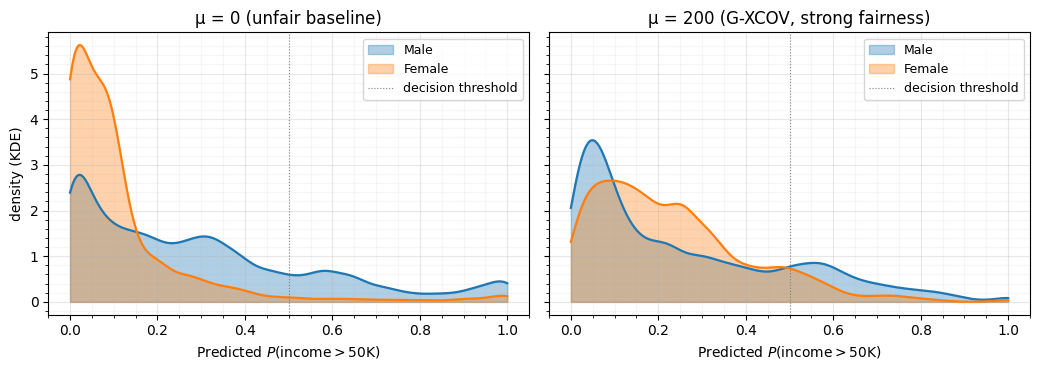
What to notice. Left: the baseline shows two clearly separated modes — most women’s predictions sit below 0.5, most men’s lift a substantial mass above it. Right: at strong G-XCOV the two distributions become much more similar. Some separation remains — the non-gender features are themselves correlated with gender (proxies are not extinguished, only suppressed), and a finite-depth flow plus a moderate μ leaves some signal — but the visible bias is far smaller.
9. Summary¶
Drop-in plug-and-play: the only thing this notebook does
differently from fairkl’s reference Adult notebook is replace
CKALoss(sigma_f=…, sigma_q=…) with one of the three
Gaussianisation-based losses in gaussianization.fair. The wrapper,
the MLP, the optimiser, and the data pipeline are unchanged. The
flow absorbs the bandwidth choice that CKA would otherwise require
tuning, at the cost of a one-time pretraining step.
Three new losses, three different trade-off curves:
- G-XCOV — gentlest, second-moment only, bounded gradient. Best when you want a small, predictable accuracy cost.
- G-MI — sharpest, closed-form Gaussian MI, diverging gradient. Best when you need terminal fairness comparable to CKA without tuning a kernel bandwidth.
- G-TC — most flexible, joint flow learns the full copula of
independence. Best when the bias has higher-order structure
beyond linear-in-Gaussianised-space dependence; the planned H3
notebook (
08_quadratic_dependence.ipynb) will isolate this.
What’s not yet good enough: the three losses live on different magnitude scales, so the four Pareto curves can only be compared at matched fairness (vertical slice), not at matched μ. The engineering doc treats this as a follow-up (“magnitude calibration”). The structural property — a trade-off curve exists and is continuously controlled by μ for each loss — is firmly established across all four families.