Non-stationary GEV — a parametric trend
A time-varying location for a warming climate, at one long station
Abstract
Every model so far has assumed the GEV parameters are fixed in time. Over a century of records that assumption is wrong: the climate warms, and the distribution of annual maxima drifts with it. This notebook makes the GEV non-stationary in the simplest, most interpretable way — a linear trend in the location, — fit by NUTS to the longest single station in the record (Albacete, 1901–2025). We test whether the trend is real (WAIC against the stationary model), read it off in °C per decade, and see the headline consequence: return levels are now a function of time.
Non-stationary extremes: a parametric trend
The pooling and spatial notebooks (Borrowing strength across stations, A spatial GEV — location as a Gaussian process) borrowed strength across space to sharpen a GEV fit, but every one of them held the parameters fixed in time — the 1901 annual maximum and the 2025 one were treated as draws from the same distribution. For temperature over a warming century that is exactly the assumption we should distrust.
This is the first of three notebooks that let the GEV drift in time at a single long station, escalating in flexibility:
- parametric (this notebook) — a rigid linear trend, the textbook model;
- ODE (Non-stationary GEV — a mechanistic ODE) — a mechanistic, forced-relaxation trajectory;
- GP (Non-stationary GEV — a state-space GP trend) — a nonparametric smooth curve.
Same station, same GEV likelihood, same NUTS sampler throughout — only the model of how the parameters move changes.
Background
A time-varying GEV
We keep the GEV of The GEV distribution but let the location depend on a covariate. With a standardized index of the year,
so is the shift in the centre of the annual-maximum distribution per unit of . We hold the scale σ and shape ξ constant: with ~115 maxima there is signal for a trend in the centre, but pinning a trend in the spread or the tail type is much harder (we add a scale trend as an extension at the end, and devote the GP notebook to flexible shapes).
This is Coles’ non-stationary GEV (Coles 2001, ch. 6). The log-likelihood is the
stationary one ((3)) with μ replaced block-by-block by
; xtremax assembles those per-block fields with
assemble_nonstationary_gev_fields.
Return levels become time-dependent
The crucial consequence: the -year return level is no longer a single number. Reading ((5)) at the parameters of a given year gives an instantaneous return level — “the 1-in-100-year heat for the climate of year ”. A fixed physical threshold that was a 1-in-100-year event in 1901 is, under a warmed , a far more frequent event. We make both views concrete below.
Setup
import sys
import pathlib

try:
    import spatial_extremes  # noqa: F401  installed editable in the project venv
except ModuleNotFoundError:
    _here = pathlib.Path.cwd().resolve()
    _roots = (_here, *_here.parents)
    _cands = [r / "src" for r in _roots]
    _cands += [r / "projects" / "spatial_extremes" / "src" for r in _roots]
    _src = next((c for c in _cands if (c / "spatial_extremes").exists()), None)
    if _src is None:
        raise RuntimeError("cannot locate spatial_extremes/src") from None
    sys.path.insert(0, str(_src))
from __future__ import annotations
import warnings
warnings.filterwarnings("ignore", message=r".*IProgress.*")
import jax
jax.config.update("jax_enable_x64", True) # GEV likelihood is boundary-sensitive
import numpy as np
import pandas as pd
import jax.numpy as jnp
import jax.random as jr
from jax.scipy.special import logsumexp
import matplotlib.pyplot as plt
import seaborn as sns
import numpyro
import numpyro.distributions as ndist
from numpyro.infer import MCMC, NUTS
from numpyro.infer.initialization import init_to_median
from xtremax import GeneralizedExtremeValueDistribution as GEV
from xtremax import gev_log_prob, gev_survival, assemble_nonstationary_gev_fields
from spatial_extremes import data, viz
sns.set_theme(style="whitegrid", context="notebook", palette="deep")# Longest continuous single-station record in the cache: Albacete, 1901-2025.
years, maxima, meta = data.load_single_station()
place = meta["name"]
y_np = np.asarray(maxima, float)
yr = np.asarray(years, int)
m = y_np.size
# Standardized year covariate z(t) — the trend predictor. Centring makes mu0 the
# location at the middle of the record and decorrelates it from the slope mu1.
yr_mean, yr_std = float(yr.mean()), float(yr.std())
z_np = (yr - yr_mean) / yr_std
y = jnp.asarray(y_np)
z = jnp.asarray(z_np)
y_mean, y_std = float(y.mean()), float(y.std())
per_decade = 10.0 / yr_std # convert a per-unit-z slope to degC/decade
print("source:", "REAL CDS" if meta["is_real"] else "synthetic")
print(f"{place} ({meta['lon']:.2f} degE, {meta['lat']:.2f} degN) — id {meta['station_id']}")
print(f"{m} annual maxima, {yr.min()}-{yr.max()}, {y_np.min():.1f}-{y_np.max():.1f} degC")source: REAL CDS
Albacete (-1.86 degE, 38.95 degN) — id SP000008280
115 annual maxima, 1901-2025, 35.0-45.0 degC
The record is long enough to see a drift by eye. Here are the annual maxima through time, with a least-squares line for orientation, and a locator map:
ols = np.polyfit(yr, y_np, 1)        # crude visual slope (degC/yr)
fig = plt.figure(figsize=(11, 4.4))
ax = fig.add_axes([0.07, 0.12, 0.62, 0.78])
ax.scatter(yr, y_np, color="#4C72B0", s=30, zorder=3)
ax.plot(yr, np.polyval(ols, yr), color="#C44E52", lw=2,
        label=f"OLS line ({ols[0]*10:+.2f} degC/decade)")
ax.axhline(y_np.mean(), color="0.6", ls="--", lw=1, label=f"mean {y_np.mean():.1f} degC")
ax.set(xlabel="year", ylabel="annual maximum (degC)",
       title=f"{place}: annual maximum temperature, {yr.min()}-{yr.max()}")
ax.legend(loc="upper left", fontsize=9)

# locator map: reuse the project's Iberia helper on a small inset axis
import cartopy.crs as ccrs
gax = fig.add_axes([0.72, 0.08, 0.27, 0.84], projection=ccrs.PlateCarree())
viz.iberia_axes(gax, gridlines=False)
viz.mark_star(gax, meta["lon"], meta["lat"], label=place)
gax.set_title("station", fontsize=9)
plt.show()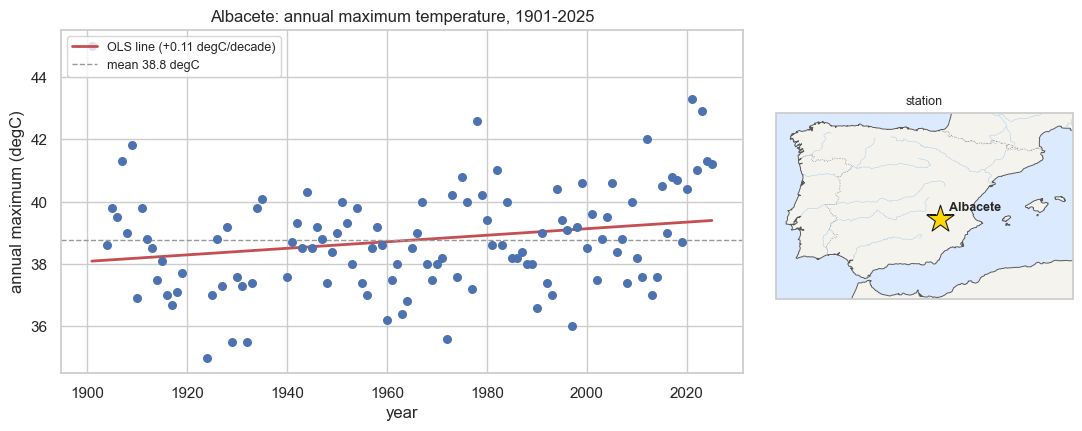
A stationary fit, and why it is not enough
First the honest baseline: fit the stationary GEV (constant ) exactly as in The GEV distribution. It will fit the marginal histogram perfectly well — the tell-tale of misspecification is in the residuals against time.
def gev_stationary(obs):
    mu = numpyro.sample("mu", ndist.Normal(y_mean, 5.0))
    sigma = numpyro.sample("sigma", ndist.HalfNormal(y_std))
    xi = numpyro.sample("xi", ndist.Normal(0.0, 0.25))
    numpyro.sample("obs", GEV(loc=mu, scale=sigma, concentration=xi), obs=obs)

mcmc0 = MCMC(NUTS(gev_stationary, target_accept_prob=0.99, init_strategy=init_to_median),
             num_warmup=1500, num_samples=1500, num_chains=2,
             chain_method="vectorized", progress_bar=False)
mcmc0.run(jr.PRNGKey(0), y)
post0 = mcmc0.get_samples()
mu0_m, sig0_m, xi0_m = (float(np.median(post0[k])) for k in ("mu", "sigma", "xi"))
print(f"stationary fit:  mu={mu0_m:.2f}  sigma={sig0_m:.2f}  xi={xi0_m:+.3f}")
print(f"divergences: {int(mcmc0.get_extra_fields()['diverging'].sum())}")
stationary fit: mu=38.07 sigma=1.54 xi=-0.115
divergences: 6
The diagnostic: transform each maximum to its fitted GEV probability (a PIT value, uniform on if the model is right) and plot it against the year. Under a stationary model these should show no trend — a flat cloud. A drift means early years sit low (their maxima are small for the fitted distribution) and late years sit high.
pit = np.asarray(GEV(loc=mu0_m, scale=sig0_m, concentration=xi0_m).cdf(y))
slope_pit = np.polyfit(yr, pit, 1)[0]
fig, ax = plt.subplots(figsize=(9.5, 3.8))
ax.scatter(yr, pit, color="#55A868", s=28, zorder=3)
ax.plot(yr, np.polyval(np.polyfit(yr, pit, 1), yr), color="#C44E52", lw=2,
        label=f"trend in PIT ({slope_pit*100*10:+.1f} pct/decade)")
ax.axhline(0.5, color="0.6", ls="--", lw=1)
ax.set(xlabel="year", ylabel=r"fitted CDF $\hat G(z_t)$",
       title="Stationary residuals drift upward in time — the model is misspecified")
ax.legend(fontsize=9)
plt.show()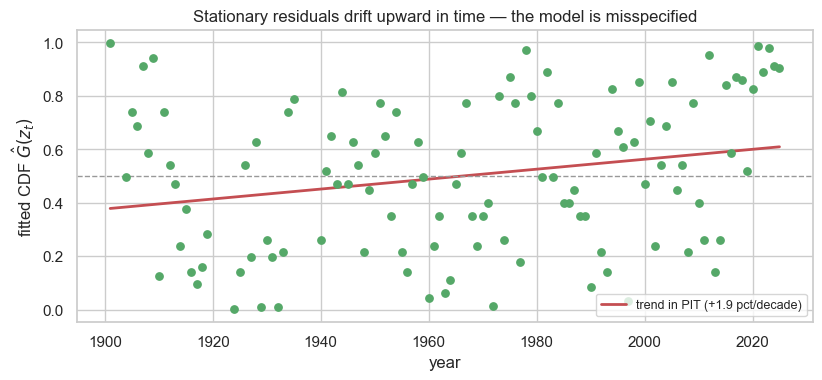
Letting the location drift: 
Now the non-stationary model ((1)). The only change from the baseline is
a second location parameter multiplying the standardized year ; we
build the per-block location field with xtremax’s
assemble_nonstationary_gev_fields (n_sites=1 here — the same primitive the
spatial notebooks use across many sites).
def gev_trend(obs, zcov):
    mu0 = numpyro.sample("mu0", ndist.Normal(y_mean, 5.0))   # location at mid-record
    mu1 = numpyro.sample("mu1", ndist.Normal(0.0, 2.0))      # trend per unit z
    log_sigma = numpyro.sample("log_sigma", ndist.Normal(np.log(y_std), 0.5))
    xi = numpyro.sample("xi", ndist.Normal(0.0, 0.25))
    # (n_blocks, n_sites=1) fields -> squeeze the singleton site axis
    loc, scale, shape = assemble_nonstationary_gev_fields(
        mu0[None], mu1[None], log_sigma[None], xi, zcov)
    numpyro.sample("obs", GEV(loc=loc[:, 0], scale=scale[:, 0],
                              concentration=shape[:, 0]), obs=obs)

mcmc1 = MCMC(NUTS(gev_trend, target_accept_prob=0.99, init_strategy=init_to_median),
             num_warmup=1500, num_samples=1500, num_chains=2,
             chain_method="vectorized", progress_bar=False)
mcmc1.run(jr.PRNGKey(1), y, z)
mcmc1.print_summary()
post1 = mcmc1.get_samples()
print(f"divergences: {int(mcmc1.get_extra_fields()['diverging'].sum())}")
                 mean       std    median      5.0%     95.0%     n_eff     r_hat
  log_sigma      0.40      0.07      0.40      0.28      0.51   2049.64      1.00
        mu0     38.07      0.15     38.07     37.82     38.31   2056.60      1.00
        mu1      0.41      0.16      0.41      0.14      0.66   2525.02      1.00
         xi     -0.09      0.05     -0.09     -0.16     -0.01   1883.60      1.00

Number of divergences: 2
divergences: 2
Reading the trend
The slope is in °C per unit of ; multiplying by puts it in the units a climatologist wants — °C per decade — and integrating across the record gives the total warming of the distribution’s centre.
mu1 = np.asarray(post1["mu1"])
slope_dec = mu1 * per_decade                       # degC/decade
total = mu1 * (z_np.max() - z_np.min())            # degC over the whole record
def ci(a): return np.quantile(a, [0.025, 0.5, 0.975])
lo, md_, hi = ci(slope_dec)
tlo, tmd, thi = ci(total)
p_pos = float((mu1 > 0).mean())
print(f"warming of the location:")
print(f"  slope   {md_:+.3f} degC/decade   (95% CI {lo:+.3f}, {hi:+.3f})")
print(f"  total   {tmd:+.2f} degC over {yr.min()}-{yr.max()}  (95% CI {tlo:+.2f}, {thi:+.2f})")
print(f"  P(mu1 > 0 | data) = {p_pos:.3f}")
warming of the location:
slope +0.115 degC/decade (95% CI +0.026, +0.202)
total +1.43 degC over 1901-2025 (95% CI +0.32, +2.50)
P(mu1 > 0 | data) = 0.994
Is the trend real? Model comparison with WAIC
A non-zero slope in a richer model is not by itself evidence — the extra parameter can fit noise. The Watanabe–Akaike Information Criterion (WAIC) weighs fit against effective complexity using the full posterior, with no extra dependencies: from the pointwise log-likelihoods over draws ,
Lower is better; a drop of more than a few points is meaningful.
def pointwise_ll_stationary(post, y):
    mu = post["mu"][:, None]; sig = post["sigma"][:, None]; xi = post["xi"][:, None]
    return gev_log_prob(y[None, :], mu, sig, xi)              # (S, T)

def pointwise_ll_trend(post, y, z):
    loc = post["mu0"][:, None] + post["mu1"][:, None] * z[None, :]
    sig = jnp.exp(post["log_sigma"])[:, None]; xi = post["xi"][:, None]
    return gev_log_prob(y[None, :], loc, sig, xi)             # (S, T)

def waic(ll):
    S = ll.shape[0]
    lppd = logsumexp(ll, axis=0) - jnp.log(S)
    p_w = ll.var(axis=0)
    w = -2.0 * (lppd.sum() - p_w.sum())
    return float(w), float(p_w.sum())

w0, p0 = waic(pointwise_ll_stationary(post0, y))
w1, p1 = waic(pointwise_ll_trend(post1, y, z))
tab = pd.DataFrame({"WAIC": [w0, w1], "p_eff": [p0, p1]},
                   index=["stationary", "linear trend mu(t)"])
tab["dWAIC"] = tab["WAIC"] - tab["WAIC"].min()
print(tab.round(2).to_string())
print(f"\nWAIC improves by {w0 - w1:.1f} when the location is allowed to drift.")
WAIC p_eff dWAIC
stationary 447.85 3.02 4.67
linear trend mu(t) 443.18 4.21 0.00
WAIC improves by 4.7 when the location is allowed to drift.
Time-varying return levels
The payoff. Evaluating the return-level formula ((5)) at each year’s parameters turns the single return-level curve of the stationary model into a family of curves indexed by year. We contrast the start and the end of the record, propagating posterior uncertainty. The observed maxima are plotted at their own year’s climate — each point sits at the return period implied by the fitted GEV for that year, and is coloured by year. Because every point lies on its own-year curve, and those curves lie between the two we draw, the cloud drifts from the early (blue) envelope up to the recent (red) one — the data live between the climates, not on either single one.
# Place each observed maximum at ITS OWN year's climate: compute the return
# period of y(t) under the fitted GEV for year t, T_t = 1 / (1 - G(y_t; theta_t)).
# By construction the point (T_t, y_t) lies on the year-t return curve, which sits
# *between* the two reference curves — so the cloud migrates from the early to the
# recent envelope as the years warm. (Median posterior parameters.)
mu0_m = float(np.median(post1["mu0"]))
mu1_m = float(np.median(post1["mu1"]))
sig_m = float(np.exp(np.median(post1["log_sigma"])))
xi_m = float(np.median(post1["xi"]))
loc_t = mu0_m + mu1_m * z_np
p_t = np.asarray(GEV(loc=jnp.asarray(loc_t), scale=sig_m, concentration=xi_m).cdf(y))
p_t = np.clip(p_t, None, 1.0 - 0.5 / m)        # cap the record max so T_t is finite
T_own = 1.0 / (1.0 - p_t)

# Start the curves at the smallest observed return period (a hair above 1) so the
# bands reach down to the leftmost points, rather than the conventional T=2 anchor.
t_lo = max(1.02, float(T_own.min()))
periods = jnp.logspace(np.log10(t_lo), 3, 80)
sub = jr.choice(jr.PRNGKey(3), post1["mu0"].size, (800,), replace=False)

def rl_curves_at(zt):
    loc = post1["mu0"][sub] + post1["mu1"][sub] * zt
    sig = jnp.exp(post1["log_sigma"])[sub]; xi = post1["xi"][sub]
    rl = jax.vmap(lambda i: GEV(loc=loc[i], scale=sig[i], concentration=xi[i])
                  .return_level(periods))(jnp.arange(loc.size))
    return np.asarray(rl)

z_first, z_last = float(z_np[0]), float(z_np[-1])
rl_first = rl_curves_at(z_first)
rl_last = rl_curves_at(z_last)

fig, ax = plt.subplots(figsize=(8.8, 5))
for rl, c, lab in [(rl_first, "#4C72B0", f"climate of {yr.min()}"),
                   (rl_last, "#C44E52", f"climate of {yr.max()}")]:
    med, loq, hiq = (np.quantile(rl, q, 0) for q in (0.5, 0.025, 0.975))
    ax.fill_between(np.asarray(periods), loq, hiq, color=c, alpha=0.16)
    ax.plot(np.asarray(periods), med, color=c, lw=2, label=lab)
sc = ax.scatter(T_own, y_np, c=yr, cmap="coolwarm", s=28, zorder=6,
                edgecolor="0.25", linewidth=0.3, label="observed maxima")
cb = fig.colorbar(sc, ax=ax, pad=0.02)
cb.set_label("year of the maximum")
ax.set_xscale("log")
ax.set(xlabel="return period T (years)", ylabel=r"return level $z_T$ (degC)",
       title=f"{place}: each maximum at its own-year climate, between the curves")
ax.legend(loc="upper left")
plt.show()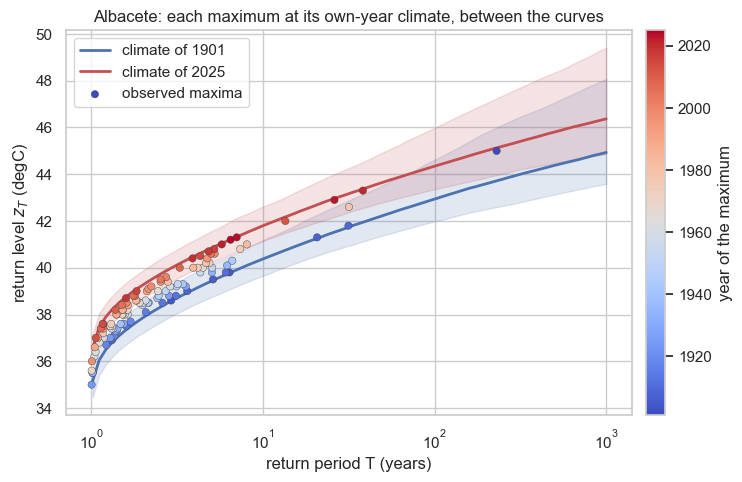
And the table that an engineer would read — the same design return periods, for the climate of the first year versus the last:
rows = []
for T in (10, 25, 50, 100, 200):
    iT = int(np.argmin(np.abs(np.asarray(periods) - T)))
    a, b = rl_first[:, iT], rl_last[:, iT]
    rows.append((T, np.median(a), np.median(b), np.median(b) - np.median(a)))
rl_tab = pd.DataFrame(rows, columns=["T (yr)", f"{yr.min()} degC",
                                     f"{yr.max()} degC", "shift degC"]).set_index("T (yr)")
print(rl_tab.round(2).to_string())
1901 degC 2025 degC shift degC
T (yr)
10 40.35 41.77 1.42
25 41.50 42.94 1.44
50 42.26 43.69 1.42
100 42.97 44.38 1.40
200 43.63 45.04 1.41
The same threshold, a shorter wait
Flip it around. Take the level that was a 1-in-100-year maximum in the climate of the first year, then ask how often that same temperature is exceeded under the final-year distribution. A century of warming turns a 1-in-100 event into a far more frequent one — the single most intuitive statement of non-stationary risk.
# z100 for the first-year climate (posterior median params)
p0m = {k: np.median(post1[k]) for k in ("mu0", "mu1", "log_sigma", "xi")}
loc_first = p0m["mu0"] + p0m["mu1"] * z_first
loc_last = p0m["mu0"] + p0m["mu1"] * z_last
sig_m, xi_m = np.exp(p0m["log_sigma"]), p0m["xi"]
z100_first = float(GEV(loc=loc_first, scale=sig_m, concentration=xi_m)
                   .return_level(jnp.array(100.0)))
# return period of that threshold under the final-year climate: T = 1 / P(Y>z)
surv = float(gev_survival(jnp.array(z100_first), loc_last, sig_m, xi_m))
T_now = 1.0 / surv
print(f"The {yr.min()} 1-in-100-year maximum is {z100_first:.1f} degC.")
print(f"Under the {yr.max()} climate, that level is exceeded about 1-in-{T_now:.0f} years.")
The 1901 1-in-100-year maximum is 42.9 degC.
Under the 2025 climate, that level is exceeded about 1-in-26 years.
Extension: a trend in the scale, too
Warming can change not just the centre but the spread of summer maxima. We let drift as well, , and check whether the data ask for it (does ’s credible interval exclude zero, and does WAIC improve further?).
def gev_trend_sigma(obs, zcov):
    mu0 = numpyro.sample("mu0", ndist.Normal(y_mean, 5.0))
    mu1 = numpyro.sample("mu1", ndist.Normal(0.0, 2.0))
    s0 = numpyro.sample("s0", ndist.Normal(np.log(y_std), 0.5))
    s1 = numpyro.sample("s1", ndist.Normal(0.0, 0.5))
    xi = numpyro.sample("xi", ndist.Normal(0.0, 0.25))
    loc = mu0 + mu1 * zcov
    scale = jnp.exp(s0 + s1 * zcov)
    numpyro.sample("obs", GEV(loc=loc, scale=scale, concentration=xi), obs=obs)

mcmc2 = MCMC(NUTS(gev_trend_sigma, target_accept_prob=0.99, init_strategy=init_to_median),
             num_warmup=1500, num_samples=1500, num_chains=2,
             chain_method="vectorized", progress_bar=False)
mcmc2.run(jr.PRNGKey(2), y, z)
post2 = mcmc2.get_samples()
s1 = np.asarray(post2["s1"]); s1lo, s1md, s1hi = ci(s1)

def ll_trend_sigma(post, y, z):
    loc = post["mu0"][:, None] + post["mu1"][:, None] * z[None, :]
    scale = jnp.exp(post["s0"][:, None] + post["s1"][:, None] * z[None, :])
    return gev_log_prob(y[None, :], loc, scale, post["xi"][:, None])
w2, p2 = waic(ll_trend_sigma(post2, y, z))
print(f"scale trend s1 = {s1md:+.3f}  (95% CI {s1lo:+.3f}, {s1hi:+.3f})")
print(f"WAIC: stationary {w0:.1f} | mu-trend {w1:.1f} | mu+sigma-trend {w2:.1f}")
verdict = "excludes 0 — the spread is changing too" if (s1lo > 0 or s1hi < 0) \
    else "straddles 0 — no clear evidence the spread changes"
print(f"s1 {verdict}.")
scale trend s1 = -0.052 (95% CI -0.171, +0.071)
WAIC: stationary 447.8 | mu-trend 443.2 | mu+sigma-trend 444.7
s1 straddles 0 — no clear evidence the spread changes.
Recap & where next
We made the GEV non-stationary the textbook way — a linear trend in the location, — fit it by NUTS to Albacete’s 1901–2025 record, and confirmed with WAIC that the drift is real and not over-fitting. The trend reads as a warming of the annual-maximum centre of a few tenths of a degree per decade, and it rewrites the engineering numbers: return levels are now functions of time, and a fixed threshold that was rare a century ago recurs far more often today.
A straight line is the strongest possible assumption about the shape of the trend — it cannot bend, plateau, or accelerate, and it extrapolates without limit. The next notebook, Non-stationary GEV — a mechanistic ODE, replaces the line with a mechanistic ODE: the location follows a forced-relaxation trajectory with a physical timescale, a grey-box midpoint between this rigid parametric form and the fully nonparametric Gaussian process of Non-stationary GEV — a state-space GP trend.