Elliptic Solvers Guide
Practical guide for solving Helmholtz, Poisson, and Laplace equations with SpectralDiffX.
The Problem
You need to solve an equation of the form:
where nabla^2 is the 2-D Laplacian, lambda >= 0 is a constant, f is a
known source term, and psi is the unknown.
Special cases:
| Name | lambda | Equation | Arises in |
|---|---|---|---|
| Poisson | 0 | nabla^2 psi = f | Streamfunction inversion, pressure correction |
| Helmholtz | > 0 | (nabla^2 - lambda) psi = f | QG PV inversion, implicit diffusion steps |
| Laplace | 0, f = 0 | nabla^2 psi = 0 | Steady-state problems, harmonic functions |
Choosing a Solver
Do you have a rectangular domain (no mask)?
|
+-- YES: Use a spectral solver (Layer 0 functions)
|   |
|   What boundary conditions?
|   |
|   +-- Dirichlet (psi = 0 on boundary)
|   |   |
|   |   +-- Regular grid (vertices on boundary)?
|   |   |   --> solve_helmholtz_dst / solve_poisson_dst   (DST-I)
|   |   |
|   |   +-- Staggered grid (cell centres, boundary outside)?
|   |       --> solve_helmholtz_dst2 / solve_poisson_dst2 (DST-II)
|   |
|   +-- Neumann (dpsi/dn = 0 on boundary)
|   |   |
|   |   +-- Staggered grid (cell centres)?
|   |   |   --> solve_helmholtz_dct / solve_poisson_dct   (DCT-II)
|   |   |
|   |   +-- Regular grid (vertices on boundary)?
|   |       --> solve_helmholtz_dct1 / solve_poisson_dct1 (DCT-I)
|   |
|   +-- Periodic (domain wraps)
|   |   --> solve_helmholtz_fft / solve_poisson_fft
|   |
|   +-- Different BCs on different axes?
|   |   --> solve_helmholtz_2d / solve_helmholtz_3d
|   |       (e.g., periodic x + Dirichlet y)
|   |
|   +-- Non-zero boundary values (inhomogeneous)?
|       --> For mixed/axis-specific BCs, pass bc_x_values / bc_y_values to
|           solve_helmholtz_2d / solve_helmholtz_3d. For same BCs on all
|           axes, use modify_rhs_* to incorporate BCs, then call the matching
|           homogeneous spectral solver above.
|
+-- NO: You have a mask (irregular domain)
    |
    +-- Perimeter < ~1000 points?
    |   --> Use capacitance solver (see Capacitance Guide)
    |
    +-- Perimeter too large?
        --> Consider iterative solvers (CG in finitevolX)
Regular vs staggered grids
On a regular (vertex-centred) grid, the first and last grid points sit on the domain boundary. On a staggered (cell-centred) grid, all grid points are at cell centres — the boundary is half a grid spacing outside the first and last points. The staggered Dirichlet solver (DST-II) is critical for incompressible flow solvers using the projection method, where pressure lives on a cell-centred grid.
Poisson vs Helmholtz
The solve_poisson_* functions are convenience wrappers that call
solve_helmholtz_* with lambda_=0.0. If you need a nonzero lambda,
use the Helmholtz functions directly.
Layer 0: Functional API
The functional API takes arrays and grid spacings directly. These functions are pure, JIT-compatible, and vmap-friendly.
Dirichlet BCs (DST)
The input rhs lives on the interior grid. Boundary values are
implicitly zero (psi = 0 on all four edges).
import jax
import jax.numpy as jnp
from spectraldiffx import solve_poisson_dst, solve_helmholtz_dst

jax.config.update("jax_enable_x64", True)

Ny, Nx = 64, 64
dx, dy = 1.0, 1.0

# Create a source term on the interior grid
j = jnp.arange(Ny)[:, None]
i = jnp.arange(Nx)[None, :]
rhs = jnp.sin(jnp.pi * (j + 1) / (Ny + 1)) * jnp.sin(jnp.pi * (i + 1) / (Nx + 1))

# Poisson: nabla^2 psi = rhs
psi = solve_poisson_dst(rhs, dx, dy)

# Helmholtz: (nabla^2 - 1.0) psi = rhs
psi_helm = solve_helmholtz_dst(rhs, dx, dy, lambda_=1.0)
Neumann BCs (DCT)
The grid includes boundary points. The normal derivative is implicitly zero on all four edges.
from spectraldiffx import solve_poisson_dct, solve_helmholtz_dct

# Poisson with Neumann BCs (zero-mean gauge applied automatically)
psi = solve_poisson_dct(rhs, dx, dy)

# Helmholtz with Neumann BCs
psi_helm = solve_helmholtz_dct(rhs, dx, dy, lambda_=1.0)
Periodic BCs (FFT)
The domain wraps in both x and y. Uses JAX's built-in FFT for maximum speed.
from spectraldiffx import solve_poisson_fft, solve_helmholtz_fft

# Poisson with periodic BCs (zero-mean gauge applied automatically)
psi = solve_poisson_fft(rhs, dx, dy)

# Helmholtz with periodic BCs
psi_helm = solve_helmholtz_fft(rhs, dx, dy, lambda_=1.0)
Dirichlet BCs, Staggered Grid (DST-II)
For cell-centred grids where the Dirichlet boundary (\(\psi = 0\)) is half a grid spacing outside the first and last points:
from spectraldiffx import solve_poisson_dst2, solve_helmholtz_dst2

# Poisson: nabla^2 psi = rhs (staggered Dirichlet)
psi = solve_poisson_dst2(rhs, dx, dy)

# Helmholtz: (nabla^2 - 1.0) psi = rhs
psi_helm = solve_helmholtz_dst2(rhs, dx, dy, lambda_=1.0)
Neumann BCs, Regular Grid (DCT-I)
For vertex-centred grids where the boundary points are included and \(\partial\psi/\partial n = 0\) is enforced at the first and last points:
from spectraldiffx import solve_poisson_dct1, solve_helmholtz_dct1

# Poisson with regular Neumann BCs
psi = solve_poisson_dct1(rhs, dx, dy)

# Helmholtz with regular Neumann BCs
psi_helm = solve_helmholtz_dct1(rhs, dx, dy, lambda_=1.0)
1-D Solvers
All BC types have 1-D variants:
from spectraldiffx import (
    solve_helmholtz_dst1_1d,  # Dirichlet, regular
    solve_helmholtz_dst2_1d,  # Dirichlet, staggered
    solve_helmholtz_dct1_1d,  # Neumann, regular
    solve_helmholtz_dct2_1d,  # Neumann, staggered
    solve_helmholtz_fft_1d,   # Periodic
)
3-D Solvers
All BC types also have 3-D variants:
from spectraldiffx import (
    solve_helmholtz_dst1_3d,  # Dirichlet, regular
    solve_helmholtz_dst2_3d,  # Dirichlet, staggered
    solve_helmholtz_dct1_3d,  # Neumann, regular
    solve_helmholtz_dct2_3d,  # Neumann, staggered
    solve_helmholtz_fft_3d,   # Periodic
    solve_poisson_fft_3d,
)

# Example: 3-D periodic Poisson solve on a (Nz, Ny, Nx) grid
Nz, dz = 8, 1.0
rhs_3d = jnp.broadcast_to(rhs, (Nz, Ny, Nx))  # the 2-D source, stacked in z
psi_3d = solve_poisson_fft_3d(rhs_3d, dx, dy, dz)
1-D Periodic Solvers
For 1-D problems on periodic domains:
from spectraldiffx import solve_poisson_fft_1d, solve_helmholtz_fft_1d

x = jnp.sin(jnp.linspace(0, 2 * jnp.pi, 64, endpoint=False))
psi_1d = solve_poisson_fft_1d(x, dx=2 * jnp.pi / 64)
Mixed Per-Axis BCs (2D/3D)
When different axes need different boundary conditions, use solve_helmholtz_2d
or solve_helmholtz_3d. These accept any combination of BC types per axis:
from spectraldiffx import solve_helmholtz_2d, solve_helmholtz_3d

# Channel flow: periodic in x, Dirichlet walls in y
psi = solve_helmholtz_2d(rhs, dx, dy, bc_x="periodic", bc_y="dirichlet")

# Atmospheric BL: periodic x/y, Neumann staggered z
psi_3d = solve_helmholtz_3d(
    rhs_3d, dx, dy, dz,
    bc_x="periodic", bc_y="periodic", bc_z="neumann_stag",
)
Supported BC types per axis: "periodic", "dirichlet", "dirichlet_stag",
"neumann", "neumann_stag", and mixed left/right tuples like
("dirichlet_stag", "neumann_stag").
JIT with mixed BCs
BC arguments are Python objects used for dispatch, so mark them static:
Inhomogeneous Boundary Conditions
By default, all solvers enforce homogeneous BCs (zero Dirichlet values,
zero Neumann flux). For non-zero boundary values, pass bc_x_values and/or
bc_y_values:
from spectraldiffx import solve_helmholtz_2d

Ny, Nx = 64, 64
dx, dy = 1.0 / (Nx + 1), 1.0 / (Ny + 1)

# Non-zero Dirichlet: psi = sin(pi*y) on left wall, psi = 0 elsewhere
y_arr = jnp.arange(1, Ny + 1) * dy
left_wall = jnp.sin(jnp.pi * y_arr)

psi = solve_helmholtz_2d(
    rhs, dx, dy,
    bc_x="dirichlet", bc_y="dirichlet",
    bc_x_values=(left_wall, None),  # (left, right); None = zero
    bc_y_values=(None, None),
)
For Neumann BCs, the values are the outward normal derivative \(\partial\psi/\partial n\):
# Non-zero Neumann flux on the right wall
right_flux = 2.0 * jnp.ones(Ny)  # dpsi/dn = 2 at x = Lx

psi = solve_helmholtz_2d(
    rhs, dx, dy,
    bc_x="neumann_stag", bc_y="neumann_stag",
    lambda_=1.0,  # Helmholtz to avoid null mode
    bc_x_values=(None, right_flux),
    bc_y_values=(None, None),
)
The 3D solver supports face arrays for each axis:
# 3D with non-zero Dirichlet on the z-faces
bottom_face = jnp.ones((Ny, Nx))  # shape (Ny, Nx)
psi_3d = solve_helmholtz_3d(
    rhs_3d, dx, dy, dz,
    bc_x="periodic", bc_y="periodic", bc_z="dirichlet",
    bc_z_values=(bottom_face, None),
)
FD2 eigenvalues only
Inhomogeneous BC support exploits the finite-difference stencil structure,
so it only works with FD2 eigenvalues (the default approximation="fd2").
It does not work with approximation="spectral".
For advanced usage, the Layer 0 helpers modify_rhs_1d, modify_rhs_2d, and
modify_rhs_3d let you apply the RHS modification manually before calling
the homogeneous solver.
Layer 1: Module Classes
Module classes (eqx.Module) store solver configuration and provide a
callable interface. Use them when you solve the same equation type
repeatedly with the same grid parameters.
DirichletHelmholtzSolver2D
from spectraldiffx import DirichletHelmholtzSolver2D

# Create solver (stores dx, dy, alpha)
solver = DirichletHelmholtzSolver2D(dx=1.0, dy=1.0, alpha=0.0)

# Call it like a function
psi = solver(rhs)  # solves nabla^2 psi = rhs with Dirichlet BCs
StaggeredDirichletHelmholtzSolver2D
from spectraldiffx import StaggeredDirichletHelmholtzSolver2D

solver = StaggeredDirichletHelmholtzSolver2D(dx=1.0, dy=1.0, alpha=0.0)
psi = solver(rhs)  # Dirichlet BCs on staggered grid (DST-II)
NeumannHelmholtzSolver2D
from spectraldiffx import NeumannHelmholtzSolver2D

solver = NeumannHelmholtzSolver2D(dx=1.0, dy=1.0, alpha=0.0)
psi = solver(rhs)  # solves nabla^2 psi = rhs with Neumann BCs (staggered)
RegularNeumannHelmholtzSolver2D
from spectraldiffx import RegularNeumannHelmholtzSolver2D

solver = RegularNeumannHelmholtzSolver2D(dx=1.0, dy=1.0, alpha=0.0)
psi = solver(rhs)  # Neumann BCs on regular grid (DCT-I)
MixedBCHelmholtzSolver2D / 3D
For mixed per-axis BCs, the module classes accept BC types at construction time and boundary values at call time:
from spectraldiffx import MixedBCHelmholtzSolver2D, MixedBCHelmholtzSolver3D

# 2D: channel flow (periodic x, Dirichlet y)
solver_2d = MixedBCHelmholtzSolver2D(
    dx=0.1, dy=0.1, bc_x="periodic", bc_y="dirichlet",
)
psi = solver_2d(rhs)

# With inhomogeneous BCs (values passed at call time), one value per x column:
bottom_vals = jnp.zeros(Nx)
top_vals = jnp.ones(Nx)
psi = solver_2d(rhs, bc_y_values=(bottom_vals, top_vals))

# 3D: atmospheric BL (periodic x/y, Neumann z)
solver_3d = MixedBCHelmholtzSolver3D(
    dx=1000.0, dy=1000.0, dz=50.0,
    bc_x="periodic", bc_y="periodic", bc_z="neumann_stag",
)
psi_3d = solver_3d(rhs_3d)
SpectralHelmholtzSolver2D (Periodic)
The periodic solver classes use continuous Fourier wavenumbers (not
finite-difference eigenvalues). They require a FourierGrid2D object:
import jax.numpy as jnp
from spectraldiffx import SpectralHelmholtzSolver2D, FourierGrid2D

grid = FourierGrid2D.from_N_L(Nx=64, Ny=64, Lx=2 * jnp.pi, Ly=2 * jnp.pi)
solver = SpectralHelmholtzSolver2D(grid=grid)

# .solve() method (not __call__)
psi = solver.solve(rhs, alpha=0.0, zero_mean=True)
FD2 vs spectral eigenvalues
All Layer 0 functions accept approximation="fd2" (default) or
approximation="spectral":
"fd2": Discrete finite-difference eigenvalues — exact inverse of the 5-point stencil. \(O(h^2)\) convergence."spectral": Continuous Laplacian eigenvalues — spectral accuracy for smooth solutions.
# FD2 (default) — correct for finite-difference codes
psi = solve_helmholtz_dst(rhs, dx, dy)

# Spectral — best for smooth solutions
psi = solve_helmholtz_dst(rhs, dx, dy, approximation="spectral")
The Layer 1 classes (SpectralHelmholtzSolver2D) always use
continuous Fourier wavenumbers (-k^2), equivalent to "spectral".
Batched Solves with vmap
All Layer 0 solvers are pure functions, so they work with jax.vmap for
batched solves:
import jax
from spectraldiffx import solve_helmholtz_dst

dx, dy = 1.0, 1.0
lambda_ = 0.0

# Batch of 10 right-hand sides: shape [10, Ny, Nx]
rhs_batch = jnp.ones((10, 64, 64))

# vmap over the batch dimension
solve_batch = jax.vmap(lambda rhs: solve_helmholtz_dst(rhs, dx, dy, lambda_))
psi_batch = solve_batch(rhs_batch)  # [10, 64, 64]
This compiles to a single fused kernel -- much faster than a Python loop.
The Layer 1 module classes also work with vmap since they are equinox Modules (pure pytrees):
from spectraldiffx import DirichletHelmholtzSolver2D

solver = DirichletHelmholtzSolver2D(dx=1.0, dy=1.0, alpha=0.0)
solve_batch = jax.vmap(solver)
psi_batch = solve_batch(rhs_batch)  # [10, 64, 64]
Solver Comparison Table
2-D Solvers
| Function | BC type | Grid | Null mode? | Best for |
|---|---|---|---|---|
solve_helmholtz_dst |
Dirichlet | Regular | No | Streamfunction, bounded domains |
solve_helmholtz_dst2 |
Dirichlet | Staggered | No | Pressure Poisson (projection method) |
solve_helmholtz_dct1 |
Neumann | Regular | Yes (k=0) | Vertex-centred Neumann problems |
solve_helmholtz_dct |
Neumann | Staggered | Yes (k=0) | Free-surface, no-flux boundaries |
solve_helmholtz_fft |
Periodic | Either | Yes (k=0) | Doubly-periodic domains |
solve_helmholtz_2d |
Mixed/axis | Any | Depends | Channel flow, mixed physics |
3-D Solvers
| Function | BC type | Grid |
|---|---|---|
solve_helmholtz_dst1_3d |
Dirichlet | Regular |
solve_helmholtz_dst2_3d |
Dirichlet | Staggered |
solve_helmholtz_dct1_3d |
Neumann | Regular |
solve_helmholtz_dct2_3d |
Neumann | Staggered |
solve_helmholtz_fft_3d |
Periodic | Either |
solve_helmholtz_3d |
Mixed/axis | Any |
1-D Solvers
| Function | BC type | Grid |
|---|---|---|
solve_helmholtz_dst1_1d |
Dirichlet | Regular |
solve_helmholtz_dst2_1d |
Dirichlet | Staggered |
solve_helmholtz_dct1_1d |
Neumann | Regular |
solve_helmholtz_dct2_1d |
Neumann | Staggered |
solve_helmholtz_fft_1d |
Periodic | Either |
Naming convention
The original names (solve_helmholtz_dst, solve_helmholtz_dct) are preserved
as backwards-compatible aliases for solve_helmholtz_dst1 (Dirichlet, regular)
and solve_helmholtz_dct2 (Neumann, staggered) respectively.
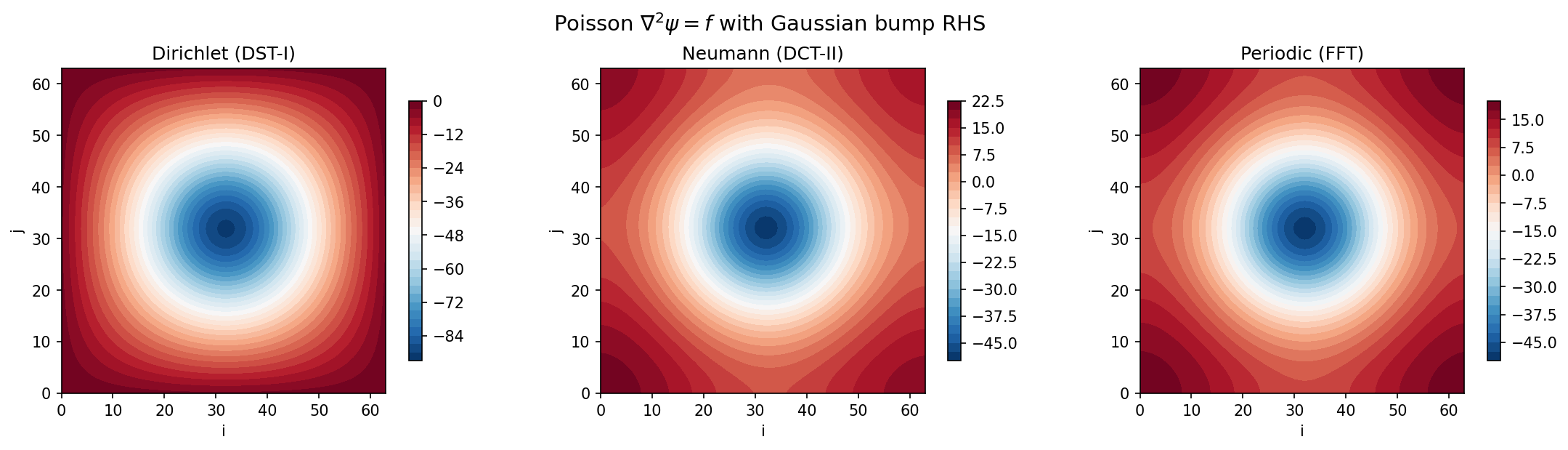
Common Pitfalls
lambda must be >= 0 for DST well-posedness
The DST solver eigenvalues are all strictly negative. The denominator
eigenvalue - lambda is always nonzero when lambda >= 0, ensuring a
unique solution. Negative lambda could push a denominator toward zero,
causing numerical instability.
Zero-mean gauge for Poisson with Neumann/Periodic BCs
When lambda = 0, the Neumann and periodic Laplacians have a null mode
(constant function). The Poisson equation only has a solution if the
source term f has zero mean. The solvers handle this by setting the
(0,0) spectral coefficient to zero, which implicitly enforces zero-mean
on the solution. If your f does not have zero mean, the solver still
runs but the solution may not satisfy the PDE at the mean level.
Interior grid vs full grid
The DST solver (solve_helmholtz_dst) expects the right-hand side at
interior grid points only. Boundary values (psi = 0) are implicit.
Do not include boundary rows/columns in the input array.
Layer 1 API differences
The Dirichlet and Neumann module classes use __call__ (callable), while
the periodic SpectralHelmholtzSolver2D uses a .solve() method. The
periodic solvers also take alpha (not lambda_) as the Helmholtz
parameter, and the sign convention is (nabla^2 - alpha) with
phi_hat = -f_hat / (k^2 + alpha).