Pseudo-Spectral vs Finite-Difference Eigenvalues
SpectralDiffX provides two families of eigenvalues for its spectral elliptic solvers:
| Type | Parameter | Formula (Dirichlet) | Accuracy | Use case |
|---|---|---|---|---|
| FD2 | approximation="fd2" |
$-\frac{4}{\Delta x^2}\sin^2\!\bigl(\frac{\pi(k+1)}{2(N+1)}\bigr)$ | $O(h^2)$ | Finite-difference / finite-volume codes |
| Spectral | approximation="spectral" |
$-\bigl(\frac{\pi(k+1)}{L}\bigr)^2$ | Spectral | Pseudo-spectral methods, smooth solutions |
The FD2 eigenvalues are the exact inverse of the 3-point finite-difference Laplacian stencil. The pseudo-spectral (PS) eigenvalues are the eigenvalues of the continuous Laplacian $\partial^2/\partial x^2$. They agree for low wavenumbers but diverge near the Nyquist frequency.
This notebook visualises the differences and demonstrates when each matters.
from pathlib import Path

import jax
import jax.numpy as jnp
import matplotlib
import matplotlib.pyplot as plt
import numpy as np

matplotlib.use("Agg")
jax.config.update("jax_enable_x64", True)

from spectraldiffx import (
    dct1_eigenvalues,
    dct1_eigenvalues_ps,
    dct2_eigenvalues,
    dct2_eigenvalues_ps,
    dst1_eigenvalues,
    dst1_eigenvalues_ps,
    dst2_eigenvalues,
    dst2_eigenvalues_ps,
    fft_eigenvalues,
    fft_eigenvalues_ps,
    solve_helmholtz_dst1_1d,
    solve_helmholtz_dst2_1d,
    solve_helmholtz_fft_1d,
)

IMG_DIR = (
    Path(__file__).resolve().parent.parent / "docs" / "images" / "ps_vs_fd2_eigenvalues"
)
IMG_DIR.mkdir(parents=True, exist_ok=True)
1. Eigenvalue Curves
For a fixed grid with $N = 32$ points, we plot $|\lambda_k|$ for both FD2 and PS eigenvalues across all five same-BC types. The key observation: they agree at low $k$ and diverge at high $k$.
N = 32
dx = 1.0
k = np.arange(N)

configs = [
    ("DST-I (Dirichlet, regular)", dst1_eigenvalues, dst1_eigenvalues_ps, (N + 1) * dx),
    ("DST-II (Dirichlet, staggered)", dst2_eigenvalues, dst2_eigenvalues_ps, N * dx),
    ("DCT-I (Neumann, regular)", dct1_eigenvalues, dct1_eigenvalues_ps, (N - 1) * dx),
    ("DCT-II (Neumann, staggered)", dct2_eigenvalues, dct2_eigenvalues_ps, N * dx),
    ("FFT (periodic)", fft_eigenvalues, fft_eigenvalues_ps, N * dx),
]

fig, axes = plt.subplots(1, 5, figsize=(18, 3.5), constrained_layout=True)

for ax, (title, fd2_fn, ps_fn, L) in zip(axes, configs, strict=False):
    fd2 = np.abs(np.array(fd2_fn(N, dx)))
    ps = np.abs(np.array(ps_fn(N, L)))

    ax.plot(k, fd2, "o-", ms=3, lw=1.2, label="FD2", color="#2196F3")
    ax.plot(k, ps, "s--", ms=3, lw=1.2, label="PS", color="#F44336")
    ax.set_title(title, fontsize=9)
    ax.set_xlabel("Mode $k$", fontsize=9)
    ax.tick_params(labelsize=8)
    if ax == axes[0]:
        ax.set_ylabel("$|\\lambda_k|$", fontsize=10)
    ax.legend(fontsize=8)

fig.suptitle(
    "FD2 vs PS eigenvalues ($N = 32$): agree at low $k$, diverge near Nyquist",
    fontsize=11,
    y=1.02,
)
fig.savefig(IMG_DIR / "eigenvalue_curves.png", dpi=150, bbox_inches="tight")
plt.close(fig)
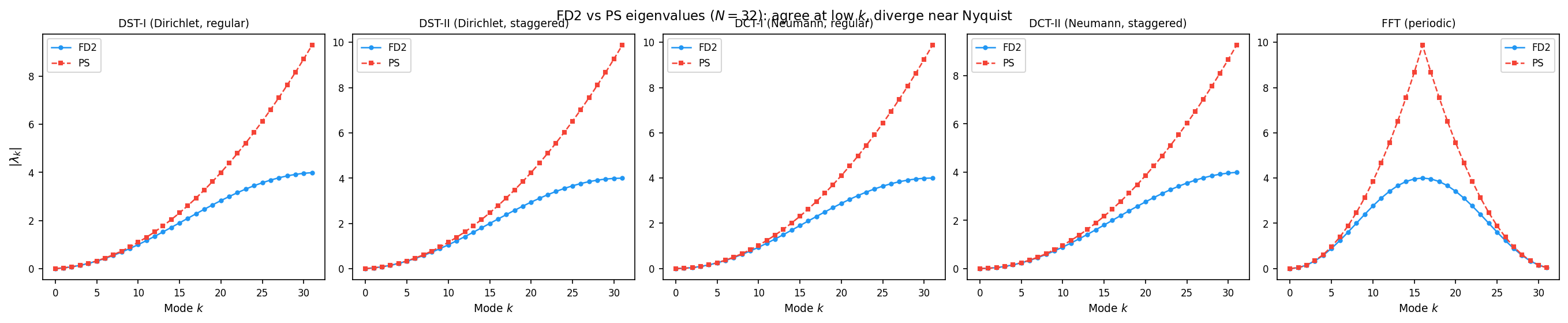
At low wavenumbers ($k \ll N$), the small-angle approximation $\sin(\theta) \approx \theta$ makes the FD2 eigenvalues match the PS ones. Near Nyquist ($k \approx N/2$), the FD2 eigenvalues plateau at $4/\Delta x^2$ while the PS eigenvalues keep growing as $k^2$.
2. Relative Difference
The relative error $|\lambda_k^{\text{FD2}} - \lambda_k^{\text{PS}}| / |\lambda_k^{\text{PS}}|$ quantifies when the two families diverge.
fig, ax = plt.subplots(figsize=(7, 4), constrained_layout=True)

colours = ["#2196F3", "#4CAF50", "#FF9800", "#9C27B0", "#F44336"]

for (title, fd2_fn, ps_fn, L), colour in zip(configs, colours, strict=False):
    fd2 = np.array(fd2_fn(N, dx))
    ps = np.array(ps_fn(N, L))
    # Skip k=0 where both may be zero (Neumann/periodic null mode)
    mask = np.abs(ps) > 1e-14
    ps_safe = np.where(mask, np.abs(ps), 1.0)
    rel_err = np.where(mask, np.abs(fd2 - ps) / ps_safe, 0.0)
    ax.semilogy(k, rel_err, "o-", ms=3, lw=1.2, label=title, color=colour)

ax.set_xlabel("Mode $k$", fontsize=10)
ax.set_ylabel("Relative difference", fontsize=10)
ax.set_title("FD2 vs PS relative difference ($N = 32$)")
ax.legend(fontsize=8, loc="upper left")
ax.set_ylim(1e-8, 10)
ax.grid(True, alpha=0.3)
fig.savefig(IMG_DIR / "relative_difference.png", dpi=150, bbox_inches="tight")
plt.close(fig)
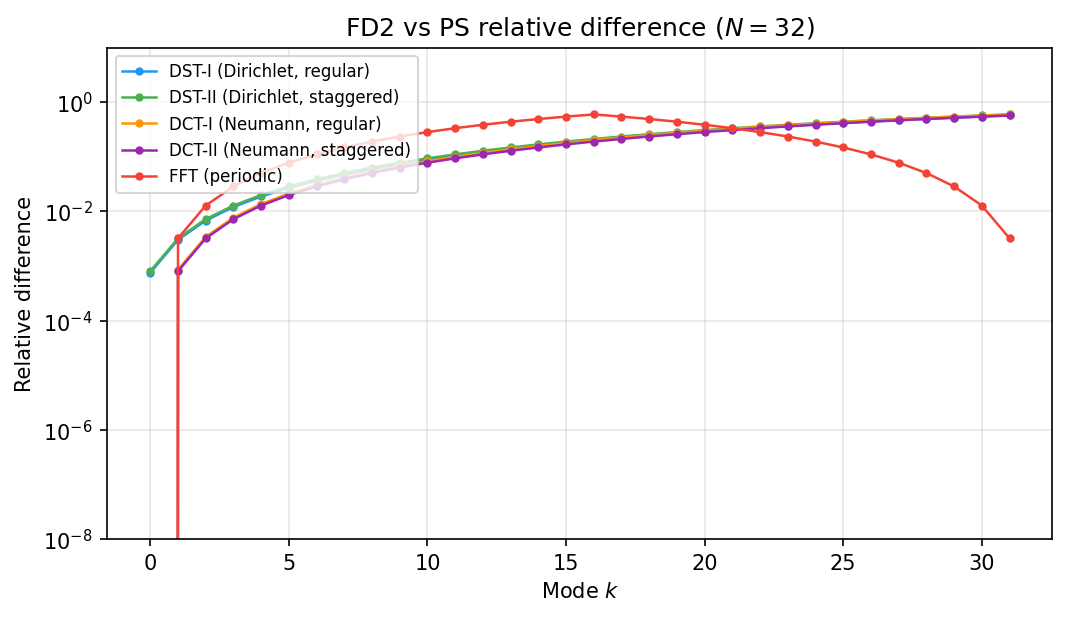
For the first few modes the difference is $< 10^{-3}$. By mode $k = N/2$ (Nyquist), the relative difference exceeds 20%. This means FD2 and PS solvers give essentially the same answer for well-resolved, smooth solutions — the difference only matters at under-resolved scales.
3. Convergence: Spectral vs Second-Order
The real payoff of PS eigenvalues is spectral convergence: for smooth test functions, the error drops exponentially with $N$. FD2 eigenvalues give $O(h^2)$ convergence regardless of smoothness.
We solve $\psi''(x) = f(x)$ on $[0, 1]$ with Dirichlet BCs, where $\psi(x) = \sin(4\pi x)$ so that $f(x) = -(4\pi)^2 \sin(4\pi x)$.
resolutions = [8, 12, 16, 24, 32, 48, 64, 96, 128]
errors_fd2_dst1 = []
errors_ps_dst1 = []
errors_fd2_dst2 = []
errors_ps_dst2 = []

for N in resolutions:
    # DST-I: regular grid, L = (N+1)*dx
    dx = 1.0 / (N + 1)
    x = jnp.linspace(dx, 1.0 - dx, N)
    psi_exact = jnp.sin(4 * jnp.pi * x)
    rhs = -((4 * jnp.pi) ** 2) * psi_exact

    psi_fd2 = solve_helmholtz_dst1_1d(rhs, dx, approximation="fd2")
    psi_ps = solve_helmholtz_dst1_1d(rhs, dx, approximation="spectral")
    errors_fd2_dst1.append(float(jnp.max(jnp.abs(psi_fd2 - psi_exact))))
    errors_ps_dst1.append(float(jnp.max(jnp.abs(psi_ps - psi_exact))))

    # DST-II: staggered grid, L = N*dx
    dx2 = 1.0 / N
    x2 = (jnp.arange(N) + 0.5) * dx2
    psi_exact2 = jnp.sin(4 * jnp.pi * x2)
    rhs2 = -((4 * jnp.pi) ** 2) * psi_exact2

    psi_fd2_2 = solve_helmholtz_dst2_1d(rhs2, dx2, approximation="fd2")
    psi_ps_2 = solve_helmholtz_dst2_1d(rhs2, dx2, approximation="spectral")
    errors_fd2_dst2.append(float(jnp.max(jnp.abs(psi_fd2_2 - psi_exact2))))
    errors_ps_dst2.append(float(jnp.max(jnp.abs(psi_ps_2 - psi_exact2))))

N_arr = np.array(resolutions)

fig, axes = plt.subplots(1, 2, figsize=(12, 5), constrained_layout=True)

# DST-I panel
ax = axes[0]
ax.loglog(N_arr, errors_fd2_dst1, "o-", lw=2, ms=5, label="FD2", color="#2196F3")
ax.loglog(
    N_arr, errors_ps_dst1, "s-", lw=2, ms=5, label="PS (spectral)", color="#F44336"
)
# Reference O(h^2) line
ref = errors_fd2_dst1[0] * (N_arr[0] / N_arr) ** 2
ax.loglog(N_arr, ref, "k--", lw=1, alpha=0.5, label="$O(N^{-2})$ reference")
ax.set_xlabel("$N$ (grid points)", fontsize=11)
ax.set_ylabel("Max absolute error", fontsize=11)
ax.set_title("DST-I (Dirichlet, regular grid)")
ax.legend(fontsize=9)
ax.grid(True, alpha=0.3, which="both")
ax.set_ylim(1e-16, 1)

# DST-II panel
ax = axes[1]
ax.loglog(N_arr, errors_fd2_dst2, "o-", lw=2, ms=5, label="FD2", color="#2196F3")
ax.loglog(
    N_arr, errors_ps_dst2, "s-", lw=2, ms=5, label="PS (spectral)", color="#F44336"
)
ref2 = errors_fd2_dst2[0] * (N_arr[0] / N_arr) ** 2
ax.loglog(N_arr, ref2, "k--", lw=1, alpha=0.5, label="$O(N^{-2})$ reference")
ax.set_xlabel("$N$ (grid points)", fontsize=11)
ax.set_title("DST-II (Dirichlet, staggered grid)")
ax.legend(fontsize=9)
ax.grid(True, alpha=0.3, which="both")
ax.set_ylim(1e-16, 1)

fig.suptitle(
    "Convergence: $\\psi(x) = \\sin(4\\pi x)$, Dirichlet BCs",
    fontsize=12,
    y=1.02,
)
fig.savefig(IMG_DIR / "convergence_dirichlet.png", dpi=150, bbox_inches="tight")
plt.close(fig)
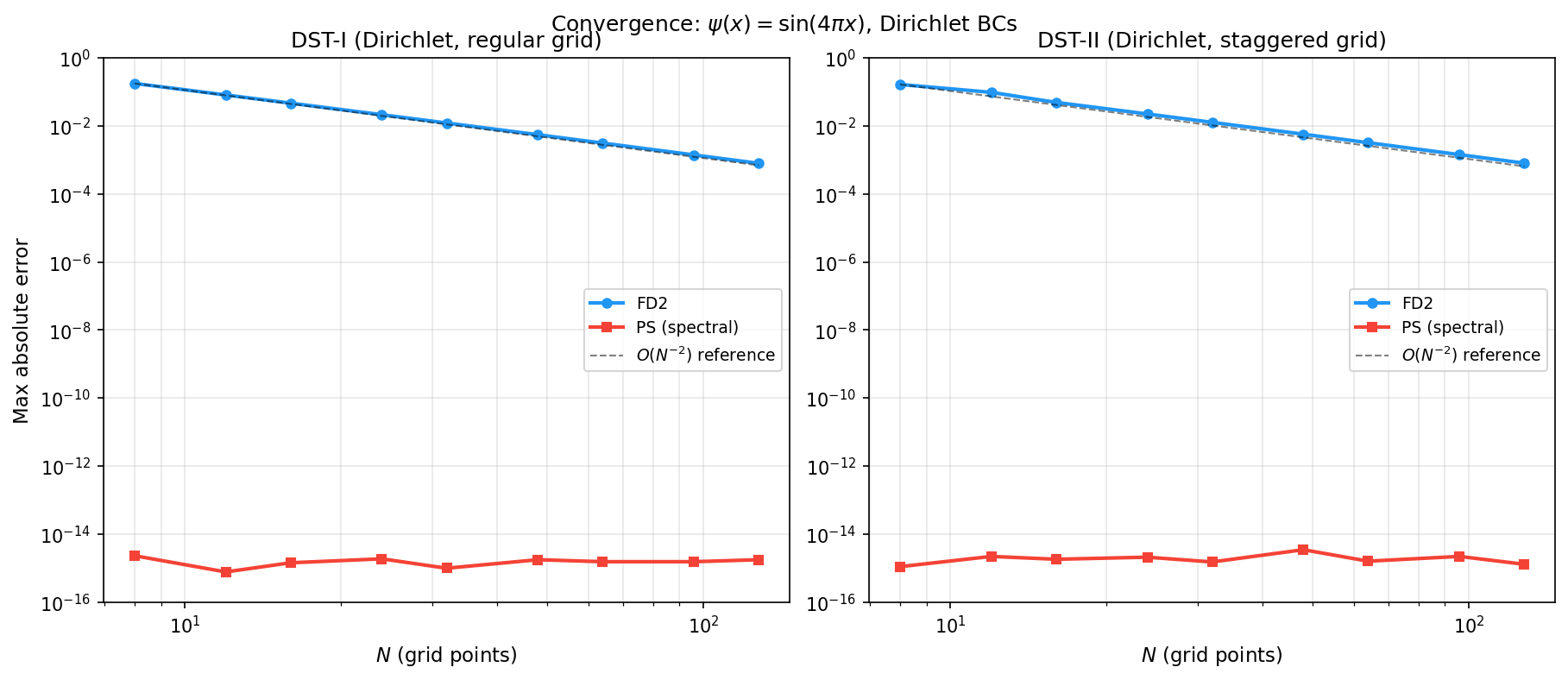
FD2 (blue circles) converges at exactly $O(N^{-2})$ — the dashed reference line confirms second-order. PS (red squares) reaches machine precision ($\sim 10^{-14}$) by $N \approx 32$ for this smooth test function.
The takeaway: if your solution is smooth and you want maximum accuracy per
grid point, use approximation="spectral". If you're inverting a
finite-difference Laplacian (e.g., in a CFD code), stick with "fd2".
4. Periodic Domain: FFT Convergence
The same comparison for periodic BCs.
errors_fd2_fft = []
errors_ps_fft = []

for N in resolutions:
    dx = 1.0 / N
    x = jnp.arange(N) * dx
    psi_exact = jnp.sin(4 * jnp.pi * x)
    rhs = -((4 * jnp.pi) ** 2) * psi_exact

    psi_fd2 = solve_helmholtz_fft_1d(rhs, dx, approximation="fd2")
    psi_ps = solve_helmholtz_fft_1d(rhs, dx, approximation="spectral")
    errors_fd2_fft.append(float(jnp.max(jnp.abs(psi_fd2 - psi_exact))))
    errors_ps_fft.append(float(jnp.max(jnp.abs(psi_ps - psi_exact))))

fig, ax = plt.subplots(figsize=(7, 5), constrained_layout=True)
ax.loglog(N_arr, errors_fd2_fft, "o-", lw=2, ms=5, label="FD2", color="#2196F3")
ax.loglog(
    N_arr, errors_ps_fft, "s-", lw=2, ms=5, label="PS (spectral)", color="#F44336"
)
ref = errors_fd2_fft[0] * (N_arr[0] / N_arr) ** 2
ax.loglog(N_arr, ref, "k--", lw=1, alpha=0.5, label="$O(N^{-2})$ reference")
ax.set_xlabel("$N$ (grid points)", fontsize=11)
ax.set_ylabel("Max absolute error", fontsize=11)
ax.set_title("FFT Periodic: $\\psi(x) = \\sin(4\\pi x)$")
ax.legend(fontsize=10)
ax.grid(True, alpha=0.3, which="both")
ax.set_ylim(1e-16, 1)
fig.savefig(IMG_DIR / "convergence_periodic.png", dpi=150, bbox_inches="tight")
plt.close(fig)
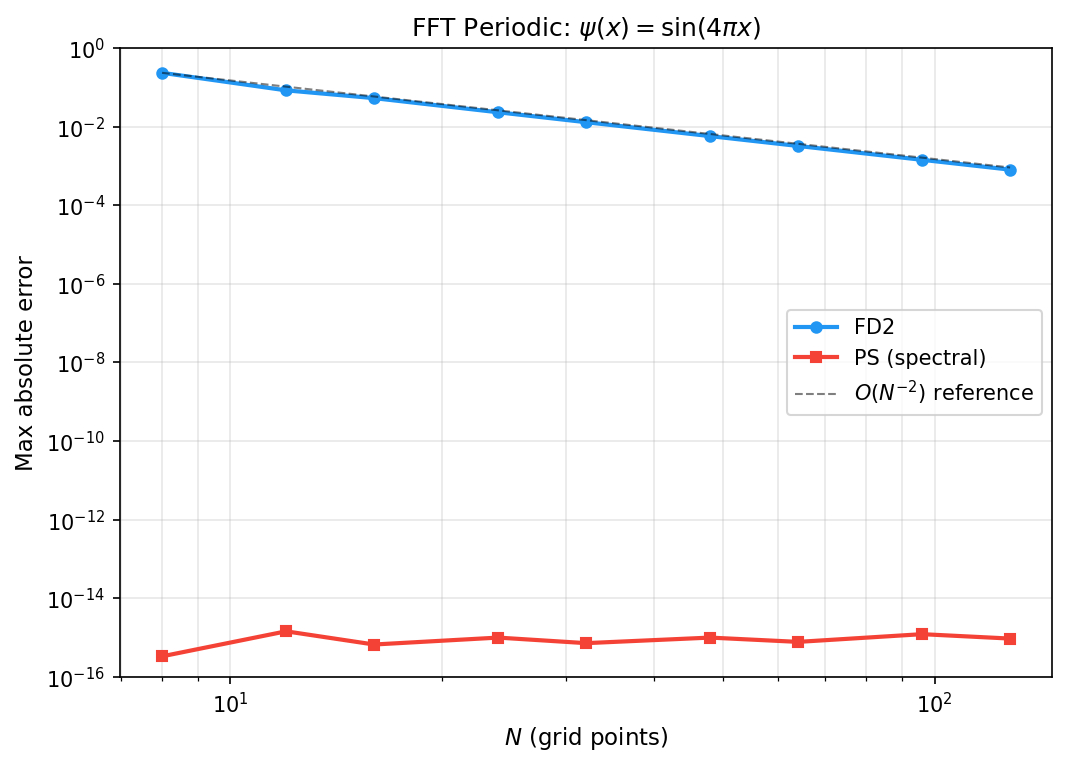
Same story: PS eigenvalues give spectral convergence while FD2 gives
$O(h^2)$. For the periodic case, SpectralHelmholtzSolver1D from
Layer 1 already uses continuous wavenumbers (equivalent to PS), so
approximation="spectral" in the Layer 0 solve_helmholtz_fft_1d
now gives the same behaviour.
5. Solution Comparison at Low Resolution
At coarse resolution ($N = 16$), the difference between FD2 and PS is visible in the solution itself. Here we solve the same Dirichlet problem and overlay both solutions against the exact answer.
N = 16
dx = 1.0 / (N + 1)
x = np.array(jnp.linspace(dx, 1.0 - dx, N))
psi_exact = np.array(jnp.sin(4 * jnp.pi * jnp.array(x)))

rhs = jnp.array(
    -((4 * jnp.pi) ** 2) * jnp.sin(4 * jnp.pi * jnp.linspace(dx, 1.0 - dx, N))
)
psi_fd2 = np.array(solve_helmholtz_dst1_1d(rhs, dx, approximation="fd2"))
psi_ps = np.array(solve_helmholtz_dst1_1d(rhs, dx, approximation="spectral"))

fig, axes = plt.subplots(1, 2, figsize=(12, 4.5), constrained_layout=True)

# Solutions
ax = axes[0]
x_fine = np.linspace(0, 1, 500)
ax.plot(x_fine, np.sin(4 * np.pi * x_fine), "k-", lw=1.5, label="Exact", alpha=0.4)
ax.plot(x, psi_fd2, "o-", ms=6, lw=1.5, label="FD2", color="#2196F3")
ax.plot(x, psi_ps, "s--", ms=5, lw=1.5, label="PS", color="#F44336")
ax.set_xlabel("$x$", fontsize=11)
ax.set_ylabel("$\\psi(x)$", fontsize=11)
ax.set_title(f"Solution ($N = {N}$)")
ax.legend(fontsize=9)
ax.grid(True, alpha=0.3)

# Errors
ax = axes[1]
ax.plot(
    x,
    np.abs(psi_fd2 - psi_exact),
    "o-",
    ms=5,
    lw=1.5,
    label="FD2 error",
    color="#2196F3",
)
ax.plot(
    x, np.abs(psi_ps - psi_exact), "s-", ms=5, lw=1.5, label="PS error", color="#F44336"
)
ax.set_xlabel("$x$", fontsize=11)
ax.set_ylabel("$|\\psi - \\psi_{\\text{exact}}|$", fontsize=11)
ax.set_title(f"Pointwise error ($N = {N}$)")
ax.set_yscale("log")
ax.legend(fontsize=9)
ax.grid(True, alpha=0.3)

fig.savefig(IMG_DIR / "solution_comparison.png", dpi=150, bbox_inches="tight")
plt.close(fig)
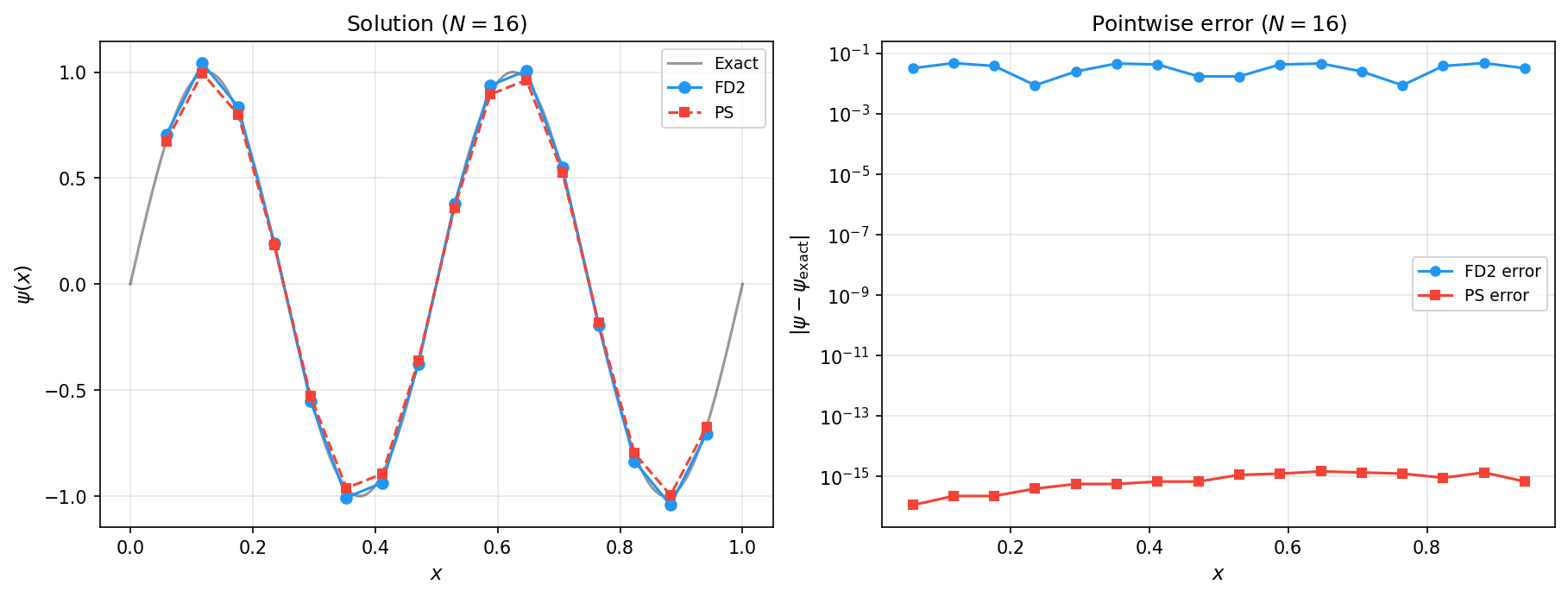
At $N = 16$, FD2 shows visible deviation from the exact solution (left panel), with pointwise errors of $O(10^{-2})$ (right panel). The PS solution is accurate to $\sim 10^{-13}$ — essentially machine precision.
Summary
FD2 ("fd2") |
PS ("spectral") |
|
|---|---|---|
| Formula | $-4/\Delta x^2 \cdot \sin^2(\ldots)$ | $-(\pi k / L)^2$ |
| Convergence | $O(h^2)$ | Spectral (exponential) |
| Exact inverse of | 3-point FD stencil | Continuous Laplacian |
| Best for | FD/FV codes, operator splitting | Pseudo-spectral methods |
| Default | Yes | No |
# Use FD2 (default) for finite-difference codes
psi = solve_helmholtz_dst(rhs, dx, dy)

# Use spectral for maximum accuracy with smooth data
psi = solve_helmholtz_dst(rhs, dx, dy, approximation="spectral")