pipekit-train
Report 11 · Training pipelines for emulators and amortized inference, as shipped and as still needed
Abstract¶
pipekit-train turns a dataset, a model and a loss into a trained pipekit Operator without anyone writing a fourth training loop, because it hands the loop over to an existing tool. Version 0.0.2 ships the core of the scoping report (datasets, losses, TrainingLoop, callbacks, sweeps, a training artifact) and more than it asked for, namely three Bayesian backends (NumPyro SVI, NumPyro MCMC, BlackJAX) and a windowed Zarr dataset for training on stored model states. However, it is also further from finished than pipekit-cycle. Equinox is the only gradient backend that runs, CatalogDataset does not exist, and the running example hits eight defects, which go from a trajectory path that crashes to a cache that serves the wrong simulator’s data. Every unshipped idea from the scoping report stays on the table as a proposal with a gate. An emulator of Report 10’s transport model trains to of the true operator and drops into a cycle unchanged.
About this report
| Status | Partly built. Originally a scoping proposal (“committed”); pipekit-train 0.0.2 is the design of record where it has decided, and the scoping report’s unshipped ideas are kept as proposals |
| Reading time | about 35 minutes |
| Audience | anyone training an emulator, a retrieval network or a posterior estimator with the stack, or extending the backends |
| Companions | Report 10 (the forward models and cycles an emulator replaces); Report 13 (the stored states a dataset reads); Report 9 (use cases); Report 12 (pipekit-experiment); Report 17 (the five-band sensor); Report 16 (the stack rules and the one model-operator family) |
| Code checked against | pipekit-train 0.0.2 at ef3c17f, with pipekit, pipekit-cycle, pipekit-experiment and pipekit-jax from the same revision and geopatcher from geotoolz 088475e. JAX on CPU with Equinox, Optax, Grain, Orbax, NumPyro and BlackJAX; torch, Lightning and Keras were not installed (their adapters are scaffolds that never import them). Read on 13 October 2026 |
| Running example | every number below is from one run of notebooks/reports/report11_pipekit_train.py, which seeds every draw and asserts each number the page shows (wall times are printed, not asserted) |
| Design docs | the package’s docs/design/ (vision, architecture, boundaries, 14 ADRs, API pages, examples) were read alongside the code |
Summary¶
Decision. pipekit-train stays a thin layer over existing training tools, as both the scoping report and ADR D1 say, and we keep its 0.0.2 design: step-based loops (D10), run() returning (model_op, TrainingArtifact) (D6), Equinox with Grain and Orbax (D8), and the Bayesian backends (D13, D14). Five workstreams finish it.
A. Datasets.
CatalogDatasetis missing (A1).SimulationDatasetcrashes on itscycle=path and hides prior errors (A2), and its content hash ignores the simulator, so a cache can serve stale data (A3).CachedDatasetreads one zarr item at 8.2 ms and only supports zarr (A4).XarrayWindowDatasetimports a geopatcher module that no longer exists (A5).B. The trained model’s handoff. The Equinox backend returns an
EquinoxModelOpwhich cannot be stored with its weights or reloaded fromLocalModelRegistry, whereas wrapping it in pipekit-jax’sJaxModelOpworks (B1). We also fill the artifact’s model hash without requiring a registry (B2).C. Loop components.
Checkpointignoressave_dirand does not save the final step (C1),HyperSweepranks trials on the last training batch instead of on validation (C2),ValidationStepis never used by the loop (C3), and NumPyro SVI runs an un-jitted update at 76 ms per step (C4).D. Amortized inference. The data path and
NLLwork, but every user writes their own distribution head and dataset flip. So we ship a recipe and a Gaussian head, and we decide where conditional density estimators live (D1).E. The other two backends. We build the Lightning (E1) and Keras 3 (E2) adapters that ADR D5 schedules for v0.2 and v0.3.
End state. The scoping report’s three training shapes all run from pipekit-train: 1) supervised training from a catalog, 2) emulator training from a pipekit-cycle forward model, and 3) amortized inference. Each one produces an operator that drops into an inference pipeline or a cycle, reloads from the registry with its weights, and carries an artifact whose hashes identify its data and its weights.
Ownership rules¶
pipekit-train owns the glue between the data, a model and a training tool, whereas the tools own the training maths and the model libraries own the models (Figure 1).
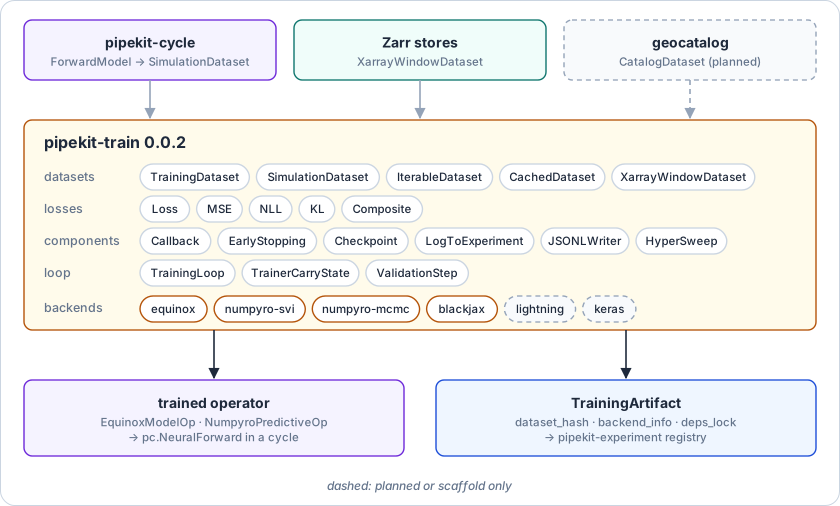
Figure 1:pipekit-train 0.0.2: its layers, its backends and its two handoffs. Dashed boxes and chips are planned or scaffold only.
pipekit-train owns the datasets, losses, the loop, callbacks, sweeps, writers and the adapters to training tools. Its core only imports pipekit. JAX, torch and Keras arrive through extras, and pipekit_experiment is only imported by LogToExperiment and the artifact. It never reimplements an optimizer step or a sampler, it never defines its own artifact type, and it has no model-definition DSL (see its boundaries.md).
The neighbours (the training tools, pipekit-cycle, pipekit-experiment and the model libraries) follow the stack rules.
What ships¶
Table 1 lists the public surface by layer.
Table 1:pipekit-train 0.0.2’s public surface. Rows in italics go beyond the scoping report.
| Layer | Names | Module | State |
|---|---|---|---|
| Datasets | TrainingDataset, SimulationDataset, CachedDataset | dataset | shipped; CachedDataset is zarr only |
| Datasets | IterableDataset(source, content_hash), XarrayWindowDataset (lazy), hash_config | dataset, xarray_window | shipped |
| Datasets | CatalogDataset | not built | |
| Losses | Loss (Protocol), MSE, NLL, KL, Composite | loss | shipped; duck-typed, return (scalar, metrics) |
| Loop | TrainingLoop, TrainerCarryState, ValidationStep | loop | shipped; ValidationStep standalone |
| Components | Callback, EarlyStopping, Checkpoint, LogToExperiment | callbacks | shipped |
| Components | MetricWriter, JSONLWriter; HyperSweep, ParameterGrid, SweepResult, SweepCarryState | writer, sweep | shipped; sweeps are sequential |
| Backends | equinox | adapters.equinox | shipped: EquinoxModelOp, TrainTask, TrainState, train_step, save_state, restore_state, ShardingSpec |
| Backends | lightning, keras | adapters.lightning, adapters.keras | scaffolds: run() raises NotImplementedError (“v0.2”, “v0.3”) |
| Backends | numpyro-svi, numpyro-mcmc, blackjax | adapters.numpyro_svi, .numpyro_mcmc, .blackjax, .bayes | shipped: NumpyroTask, NumpyroPredictiveOp, BlackjaxTask (NUTS only) |
The package’s tests pass: 228 tests in 76 s with geopatcher shimmed (see stage 8), plus the BlackJAX (9 of 9) and NumPyro suites, which are marked slow.
The running example: an emulator, a retrieval and a stored archive¶
The stages reuse the two problems of Report 10, so that we can check a trained model against the exact operator it replaces. In the six-step cycle, stage 2 is step 3 of a forecast (and stage 3 runs that emulator forward), and stages 6 and 7 are steps 5 and 2 of a retrieval. Report 17 runs all six steps on the same retrieval.
The transport model is the upwind advection of Report 10 on a periodic 40-cell transect, with . Here is the state at step with , is the linear transport model, is the periodic one-cell shift and is the identity (the code keeps the array name M for ). An emulator is a learned , and the target is .
The retrieval uses the five-band sensor of Report 17 unchanged, for the bands , with the absorption coefficients , the noise standard deviation and the column enhancement , a scalar. We stack the bands into the spectrum and write the noise-free spectrum as . An amortized retrieval learns once, for every , whereas a per-scene retrieval (Report 10’s Gauss–Newton, or MCMC) solves for one at a time.
The archive. Fifty hourly states of the transect, written to a Zarr store, stand in for the stored model states of Report 13.
Stage 1 · Training data from a forward model (pipekit-cycle → pipekit-train)¶
TL;DR. We turn the transport model of Report 10 into 2,000 input-output pairs with fixed seeds and with train, validation and test splits.
Problem. A SimulationDataset draws each input from a prior with the seed , where is the base seed, is the split’s offset and indexes the samples, and it returns the pair . The splits are 80, 10 and 10 % of the seed range, so they never share a draw.
1 2 3 4 5 6 7 8 9 10 11 12 13 14 15 16# Shapes: D_x = 40 (the code's N); N = 2,000 pairs; train 1,600 · val 200 · test 200 import pipekit_cycle as pc import pipekit_train as pt fwd = pc.CallableForward(lambda x, dt: M @ x, dt=1.0) # F x: (D_x,) → (D_x,) today class WhitePrior(pk.Operator): # x ~ 𝒩(0, I) user def _apply(self, seed=0): return np.random.default_rng(seed).normal(size=N) train = pt.SimulationDataset(fwd, WhitePrior(), n_samples=2000, seed=0) # today val = train.with_split("val") # disjoint seeds today len(train), len(val) # → 1600, 200 today train.content_hash() # sha256 of the recipe pt.SimulationDataset(fwd, WhitePrior(), 2000, cycle=pc.Cycle(fwd, 24))[0] # → TypeError: Cycle._apply() missing 1 required positional argument: 'state'
An emulator’s training data is a SimulationDataset over a pipekit-cycle forward model.
The one-step path works. However, the trajectory path, cycle=, calls self.cycle(params) without a carry state, so every pipekit-cycle cycle raises (dataset.py:284). A second defect sits just above it. The prior is called as prior(seed=...) inside try … except TypeError, and any TypeError raised inside the prior silently falls back to prior() with no seed, which means every sample comes out identical. Workstream A2 fixes both.
Stage 2 · Train the emulator (pipekit-train → Equinox)¶
TL;DR. We fit a linear emulator by least squares on the pairs and see how the choice of prior decides what it learns.
Problem. We take pairs and a linear model , whose parameters are the entries of the weight matrix , so . The mean-squared error (1),
is zero at , and the minimiser is only unique when the inputs span , that is when the stacked inputs (one per row) have full rank. The loop minimises it with Adam at a step size on batches of pairs, where counts the optimiser iterations.
1 2 3 4 5 6 7 8 9 10 11 12 13 14 15# Shapes: W (D_x, D_x); batch 64; 25 steps per epoch import equinox as eqx from pipekit_train.adapters.equinox import EquinoxModelOp loop = pt.TrainingLoop( model_op=EquinoxModelOp(eqx.nn.Linear(N, N, use_bias=False, key=key)), dataset=train, val_dataset=val, loss=pt.MSE(), optimizer_config={"name": "adam", "lr": 1e-2}, max_steps=6000, steps_per_epoch=25, batch_size=64, eval_every_n_steps=50, callbacks=(pt.EarlyStopping(metric="mse", patience=5),), seed=0, ) # today trained, artifact = loop.run() # (EquinoxModelOp, TrainingArtifact) # white prior: stops at step 500; val MSE 5.3e-14; max |W − F| = 3.8e-7 # smooth prior: stops at step 2200; val MSE 3.4e-5; max |W − F| = 0.343
The emulator trained with the Equinox backend, early stopping and validation, from a real run.
Table 2:The same loop on two priors. The smooth prior draws three Gaussian bumps per sample.
| Prior | Stopped at | Validation MSE | of | Wall time | |
|---|---|---|---|---|---|
| white, | step 500 (20 epochs) | well conditioned | 12.3 s | ||
| smooth bumps | step 2,200 (88 epochs) | 0.343 | 45.4 s |
Both runs fit their data (Table 2), where is the ratio of the smallest to the largest singular value of . However, the inputs of the smooth prior nearly lie in a low-dimensional subspace, so is only fixed on that subspace and is arbitrary off it. In other words, a low training loss is not a correct emulator. This is a property of the data and not of the code, and it is the reason a SimulationDataset’s prior is part of its hash.
Stage 3 · Drop the emulator into a cycle (pipekit-train → pipekit-cycle)¶
TL;DR. We replace the forward model of a six-hour forecast with the emulator, and we test it on states that the prior did and did not cover.
Problem. The emulated forecast is , where is the initial state. Its error is only small when lies where was fixed.
1 2 3 4 5# Shapes: x₀ (D_x,) emulator = pc.NeuralForward(trained, dt=1.0) # today x6, _ = pc.Cycle(emulator, n_steps=6)(x0, None) # today # white-prior W: max |x̂₆ − F⁶ x₀| = 1.1e-6 (smooth x₀), 1.3e-6 (white x₀) # smooth-prior W: max |x̂₆ − F⁶ x₀| = 0.017 (smooth x₀), 0.533 (white x₀)
The trained operator is a forward model with no glue.
The handoff that the scoping report promised works as written, since NeuralForward wraps the trained EquinoxModelOp directly and the cycles of Report 10 accept it. The smooth-prior emulator is accurate on smooth states but wrong by half the signal on white ones. So an emulator is only as general as its prior.
Stage 4 · Callbacks, checkpoints and the artifact (pipekit-train)¶
TL;DR. We watch the smooth-prior run through its callbacks and see what it records about itself.
Problem. A training run must be stoppable, resumable and traceable, which asks for an early-stopping rule, periodic checkpoints, a metric log, a tracker, and an artifact that names the data and the code.
1 2 3 4 5 6 7 8 9 10 11 12 13 14 15 16 17# Shapes: as stage 2 loop = pt.TrainingLoop( ..., callbacks=( pt.EarlyStopping(metric="mse", patience=5, min_delta=1e-9), pt.Checkpoint(every_n_steps=250, keep_last=2, save_dir="unused", registry=px.LocalModelRegistry("registry")), pt.LogToExperiment(tracker, run_name="emu"), ), metric_writer=pt.JSONLWriter("metrics.jsonl"), checkpoint_dir="ckpt", ) # today trained, art = loop.run() # early stop at step 2200; ckpt/ holds 1750 and 2000 (not 2200) # metrics.jsonl: 44 lines; tracker: start, step and 44 eval/* events, end art.dataset_hash, art.model_registry_uri # set today art.backend_info["final_step"], art.deps_lock # 2200, uv pip freeze loop.run() # resumes at step 2000
The stage-2 run with every component attached, from a real run.
Early stopping, the metric log, the tracker and auto-resume all work. However, Checkpoint has two defects. It writes to the loop’s checkpoint_dir and ignores its own save_dir (the adapter only reads every_n_steps and keep_last). In addition, the final step is only saved if it is a multiple of every_n_steps, so a run that stops early loses its last 200 steps on resume. Workstream C1 fixes both.
Stage 5 · Store and reload the emulator (pipekit-train → pipekit-experiment)¶
TL;DR. We put the trained emulator in the registry and load it back with its weights.
Problem. A registered model must reload to the same outputs, so after a store and a load, should equal the trained .
1 2 3 4 5 6 7 8 9 10 11 12# Shapes: W (D_x, D_x) reg = px.LocalModelRegistry("registry") # Today, through Checkpoint(registry=reg): reg.load_weights(art.trained_model_hash) # → None: no weights.bin reg.load(art.trained_model_hash) # → RuntimeError: from_state cannot reconstruct EquinoxModelOp … forbid_in_yaml # What works today: re-wrap as pipekit-jax's JaxModelOp j = JaxModelOp(trained.module) # today h = reg.store(j, weights=j.serialize_weights()) # today loaded = skeleton.from_registry(reg, h) # skeleton: a JaxModelOp today # → max |W_loaded − F| = 3.8e-7; a 6-step NeuralForward cycle agrees too
The registry round trip, as it fails today and as it works through pipekit-jax.
The loop always returns an EquinoxModelOp, even when it was given a JaxModelOp, and EquinoxModelOp has no serialize_weights. So Checkpoint’s registry.store writes the operator’s config and metadata but no weights. The design docs (ADR D7) say that the Equinox adapter returns a JaxModelOp, which the code does not do. Workstream B1 closes the gap.
Stage 6 · An amortized retrieval (pipekit-train → Equinox)¶
TL;DR. We train a network that returns a mean and an uncertainty for the column enhancement for any measured spectrum, and we check its calibration.
Problem. For and the spectra it produces, a network outputs a Gaussian , with the mean and the standard deviation . Its weights are variational parameters (they parameterise an approximate posterior), and they are trained on the negative log-likelihood (2),
A calibrated has for the standardised residual , and about 95 % of its intervals cover the truth. No unbiased estimator can beat the Cramér–Rao bound , where is the Jacobian of the noise-free spectrum, with entries . An RMSE averages squared errors, so its floor is the root-mean-square bound over the prior, , whereas the mean bound, , is the comparator for a mean posterior width. On the 200 test draws below, the two are 0.253 and 0.227.
1 2 3 4 5 6 7 8 9 10 11 12 13 14 15 16 17 18# Shapes: params = (α, ε₁…ε₅): (6,); y (5,); network 5 → 64 → 64 → 64 → 2 sim = pt.SimulationDataset(pc.CallableForward(beer_lambert, dt=1.0), AlphaNoisePrior(), n_samples=20_000) # today train = Flip(sim) # (params, y) → (y, α): a TrainingDataset subclass user class GaussianHead(eqx.Module): # user mean: jax.Array log_var: jax.Array # log q(α | y) = −½ (log 2π + log σ_α² + (α − μ_α)² / σ_α²) def log_prob(self, a): ... loop = pt.TrainingLoop(model_op=EquinoxModelOp(Net(key)), # y → GaussianHead dataset=train, val_dataset=train.with_split("val"), loss=pt.NLL(), optimizer_config={"name": "adam", "lr": 2e-3}, max_steps=8000, batch_size=256) # today q, _ = loop.run() # 425 s on CPU # 200 test draws: RMSE 0.303 (RMS Cramér–Rao floor 0.253); bias −0.15 # ±2σ_α coverage 99.5 %; E[r²] = 0.43: σ_α is about 1.5× too wide
The amortized retrieval: the simulator is the dataset, the loss is NLL, and two pieces of glue are user code.
The network is useful and honest in shape, as its grows from 0.33 for to 0.74 for just as the bound does. However, it is under-confident, since means its intervals are about 1.5 times too wide. NLL only needs predicted.log_prob(target), which is the right seam, but there is no Gaussian head to plug into it, and the noise has to be drawn inside the prior so that it is seeded. Workstream D1 turns this into a recipe.
Stage 7 · The same retrieval with the Bayesian backends (pipekit-train → NumPyro, BlackJAX)¶
TL;DR. We solve one retrieval exactly with MCMC, as the reference that the amortized network should match.
Problem. For one measured spectrum (with the true ), the posterior is (3),
which is nearly Gaussian here, with the Laplace standard deviation .
1 2 3 4 5 6 7 8 9 10 11 12 13 14 15 16# Shapes: x = k (5, 1); y (5,); α scalar def model(x, y=None): # user a = numpyro.sample("alpha", dist.Uniform(0.0, 300.0)) numpyro.sample("obs", dist.Normal(jnp.exp(-x[..., 0] * a), 1e-3), obs=y) data = pt.IterableDataset(source=list(zip(k[:, None], y)), content_hash="beer-lambert-y3") # today task = NumpyroTask(model, num_warmup=1000, num_samples=4000) # today for backend, t in [("numpyro-mcmc", task), ("blackjax", BlackjaxTask(numpyro_task=task)), ("numpyro-svi", task)]: op, art = pt.TrainingLoop(model_op=Dummy(), dataset=data, task=t, backend=backend, max_steps=4000).run() # today # numpyro-mcmc: α = 120.143 ± 0.167, 0 divergences, 5.6 s # blackjax: α = 120.152 ± 0.168, 0 divergences, 10.4 s # numpyro-svi: α ≈ 119.96 ± 0.65 after 4,000 steps, 305 s
One NumPyro model, three backends, from a real run.
Both samplers agree with each other and with the Laplace width to the third decimal, so they are the oracle that we can score the amortized network of stage 6 against (its mean over the prior, 0.46, is close to three times this width). However, SVI, which minimises (the negative evidence lower bound), is far from converged after 4,000 steps, and it is slow. This is because the adapter calls svi.update in a Python loop without jax.jit, at 76 ms per step on five data points. Workstream C4 jits the step. The Bayesian backends are not in the scoping report. They come from ADRs D13 and D14 (“inference is training too”), where NUTS is the oracle rung of the benchmark ladder.
Stage 8 · Train on stored states, and cache what you simulate (pipekit-train)¶
TL;DR. We read input and target windows from a Zarr archive of model states, and we cache the simulated pairs so that later runs skip the simulator.
Problem. For an archive of hourly states , a window dataset with an input stencil of the last three hours and a target one hour ahead yields the pairs for every valid origin . A cache keyed by the dataset’s content hash must return exactly what the source would.
1 2 3 4 5 6 7 8 9 10 11 12 13 14# Shapes: archive (T = 50, D_x = 40); input (1, 3, D_x); target (1, 1, D_x) stencils = {"input": TimeStencil("-2h", "0h", "1h", closed="both"), "target": TimeStencil("1h", "1h", "0h", closed="both")} ds = pt.XarrayWindowDataset(source={"input": store, "target": store}, stencils=stencils, store_version="adv-v1") # today # → ImportError unless geopatcher.time is shimmed: geopatcher ships # geopatcher.temporal.stencils len(ds), len(ds.with_split("val")), len(ds.with_split("test")) # → 35, 1, 3 x, y = ds[0] # y = F x[0, −1] exactly today cached = pt.CachedDataset(sim_M, cache_dir="cache") # today list(cached) # 400 items: 3.70 s, then 0.68 s pt.CachedDataset(sim_2M, cache_dir="cache")[0] # simulator now 2F … # → returns the cached F pairs: the hash does not include the simulator
XarrayWindowDataset over an archive of states, and CachedDataset over a simulation.
The window dataset is the training reader for the archives of Report 13. Its content_hash covers store_version, the stencils and the origins, and a linear last-step model trained on it reached an MSE of . However, two defects stand out. It imports geopatcher.time, which the pinned geopatcher no longer has (xarray_window.py:35), and its error message wrongly says that geopatcher is not installed (A5). In addition, the 80/10/10 contiguous split with a guard band left one validation window out of 47 origins, which is the expected cost of guard bands on a short archive. The cache is correct when the source is, but SimulationDataset.content_hash hashes the forward model’s class name, dt and state signature and not its function, so swapping for serves stale data (A3). It is also slow, because each __getitem__ reopens the zarr store, at 8.2 ms against 0.05 ms to recompute this simulator (A4).
The scoping report’s names, checked¶
Table 3 checks the stack names that the scoping report’s examples use.
Table 3:The stack names the scoping report’s examples use, at the pinned revisions.
| Name in the report | At the pinned revisions |
|---|---|
pt.TrainingLoop, pt.SimulationDataset, pt.CachedDataset, pt.MSE, pt.NLL, pt.EarlyStopping, pt.Checkpoint, pt.LogToExperiment | exist; signatures differ as the boxes above say |
pt.CatalogDataset, dataset.with_split("val") on it | CatalogDataset does not exist; with_split exists on every TrainingDataset |
pa.ModelOp(UNet(...)) | does not exist: pipekit-array has no ModelOp. Trained models are EquinoxModelOp; pipekit-jax has JaxModelOp |
loop.run() returning the model | returns (model_op, TrainingArtifact) |
optimizer_config={"name": "adam", "lr": 1e-3}, n_epochs, backend="lightning" | the optimizer dict works (adam, adamw, sgd, rmsprop); n_epochs is max_steps; "lightning" raises NotImplementedError |
gz.radiometry.ToFloat32, gz.radiometry.PercentileClip | exist in geotoolz |
gz.cloud.LoadLabel | does not exist: geotoolz has no cloud module |
gp.SpatialRegularStride((256, 256)) | geopatcher’s sampler is RegularStride |
ChemistryForward, PlumeForward, ColumnObs (plumax adapters), pyrox.adapters.pipekit_train.ConditionalNormalizingFlow | not checked: plumax and pyrox are not pinned here |
AtmosphericPrior, SourcePrior, EmulatorNet, UNet | user code in the examples |
Current-state audit¶
Of the twenty pieces we checked, ten ship and work, eight ship with defects, and two are missing (Table 4), and Figure 2 counts the page’s calls by marker. The audit read references/geostack/pipekit at ef3c17f on 13 October 2026.
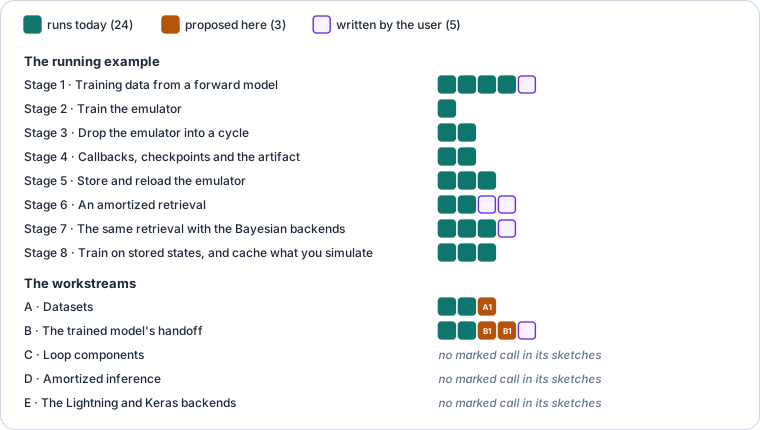
Figure 2:What this page’s sketches call: of 32 stack calls, 24 run today, 3 are proposed by this report’s workstreams and 5 are code the reader writes (how to read it).
Table 4:pipekit-train 0.0.2, piece by piece.
| Symbols | Defined in | Used by | Verdict |
|---|---|---|---|
TrainingDataset(seed, split), with_split, content_hash | dataset.py:46 | every dataset | Healthy. Default hash is the config |
SimulationDataset(forward_model, prior, n_samples, cycle, obs_op, seed, split) | dataset.py:185 | stage 1, 6 | Split ownership. One-step path works; cycle= raises; prior TypeErrors are swallowed; the hash omits the simulator |
IterableDataset(source, content_hash) | dataset.py:113 | Bayesian backends | Healthy. Hash is user-supplied |
CachedDataset(source, cache_dir, format="zarr") | dataset.py:345 | stage 8 | Split ownership. Correct but 8.2 ms per item; parquet and tfrecord raise |
CatalogDataset | the scoping report, datasets.md, examples/direct.md | Missing. | |
XarrayWindowDataset | xarray_window.py:134 | stage 8 | Split ownership. Works with a shim; imports geopatcher.time |
Loss, MSE, NLL, KL, Composite | loss.py | every gradient backend | Healthy. NLL needs .log_prob; KL needs .kl_divergence |
TrainingLoop, TrainerCarryState | loop.py:213, :34 | all stages | Healthy. Step-based; returns (op, artifact) |
ValidationStep(model_op, dataset, metrics) | loop.py:91 | Split ownership. Standalone; the loop evaluates with the task’s loss instead | |
EarlyStopping(metric, patience, mode, min_delta) | callbacks.py:80 | stage 2, 4 | Healthy. |
Checkpoint(every_n_steps, keep_last, save_dir, registry) | callbacks.py:175 | stage 4 | Split ownership. save_dir ignored; final step not saved; registry gets no weights |
LogToExperiment(tracker, run_name, config), JSONLWriter | callbacks.py:280, writer.py:35 | stage 4 | Healthy. |
HyperSweep, ParameterGrid | sweep.py:179, :39 | Split ownership. Sequential; ranks on final_metrics, the last training batch | |
Equinox adapter, EquinoxModelOp | adapters/equinox.py:66, run at :728 | stage 2–6 | Healthy as a trainer; split ownership at the registry (stage 5) |
ShardingSpec | adapters/equinox.py:113 | scripts/multihost_sharding_smoke.py | Healthy. Not exercised here |
| NumPyro MCMC, BlackJAX NUTS | adapters/numpyro_mcmc.py, blackjax.py | stage 7 | Healthy. BlackJAX samplers other than NUTS raise; MCMC’s final_metrics is empty, so a sweep over it fails |
| NumPyro SVI | adapters/numpyro_svi.py | stage 7 | Split ownership. Un-jitted update, full batch only |
| Lightning, Keras adapters | adapters/lightning.py, keras.py | Missing. Scaffolds (ADR D5) | |
TrainingArtifact handoff | loop.py:404 | stage 4 | Healthy. trained_model_hash and model_registry_uri set only with a registry |
| docs | README.md, docs/design/ | Split ownership. Stale in 14 places (below) |
There are also smaller findings from the design docs:
The README says the package is “planning only” and that “the source directory currently contains no operators”, and the
__init__docstring still says “v0.0 ships the carrier-agnostic Protocols”.The ADRs are ahead of their status lines. D13 and D14 say “implementation planned”,
blackjax_adapter.mdsays “Design only — no code yet”, andadapters.mdheads BlackJAX “(planned)”, yet all three backends ship.decisions.mdsays “Eleven ADRs total” and lists 14.Hyperparameter search contradicts itself, as it is out of scope in
vision.md, a non-goal inboundaries.md§12, and resolved and shipped inboundaries.mdQ5.Checkpoints are described three ways: a Composite Orbax handler in
adapters.md,PyGrainCheckpointHandlerin D8, and the JSON side-car that the code actually writes (data_iter.json).IterableDatasetand the sweep classes are undocumented in the API index, and the layout inarchitecture.mdomitsxarray_window.py,_xreader.pyand the Bayesian adapters.Seed ranges overlap across datasets. The splits within one
SimulationDatasetare disjoint, but two datasets withseed=0andseed=1share all but one sample seed.
Workstream A · Datasets¶
Decision. Each of the three training shapes gets a dataset that is correct, hashed by everything that determines its contents, and fast enough to feed Grain (Table 5).
Table 5:Workstream A’s moves.
| Symbol | Destination | Reason |
|---|---|---|
CatalogDataset(catalog, preprocess, target_op, sampler=None) | pipekit_train.dataset, behind a [catalog] extra on geocatalog | the scoping report’s direct-supervised shape; datasets.md and examples/direct.md already specify it |
| state-aware cycle call, error-transparent prior call | SimulationDataset.__getitem__ | cycle= raises today; a TypeError inside the prior is swallowed |
simulator identity in content_hash | SimulationDataset.content_hash | swapping for keeps the hash and serves a stale cache |
| one open store per worker; parquet and tfrecord | CachedDataset | 8.2 ms per item today; the two formats raise |
geopatcher.temporal.stencils | xarray_window.py:35 | the module it imports was renamed |
A1 · CatalogDataset¶
Read from a catalog. It iterates the rows that a
GeoSlicequery returns, or the patches that a geopatcherSampler(such asRegularStride) cuts from them, through geocatalog’sCatalogDomainbridge.Reuse the inference preprocess.
preprocessis the same operator that the inference pipeline runs, so training and serving cannot drift apart.Hash the recipe.
content_hashcovers the catalog’s own hash (aCatalogBundleor the GeoParquet file’s checksum), the query, the sampler config, the preprocess config, the split and the seed.Accept states too. With the state profile of Report 13, the same class reads a state catalog through
load_states, so there is no separateStateCatalogtype to support.
1 2 3 4 5 6 7 8# Shapes: chips (N_batch = 4, 256, 256) → labels (2, 256, 256) dataset = pt.CatalogDataset( # proposed (A1) catalog=gc.open_catalog("s3://imeo/labeled-scenes.parquet"), # today preprocess=gz.radiometry.ToFloat32() | gz.radiometry.PercentileClip( p_min=2, p_max=98), # today target_op=load_label, # arguments sketched sampler=gp.RegularStride((256, 256)), # arguments sketched )
The scoping report’s direct-supervised example, as it would read with A1.
A2 · A correct simulation path¶
SimulationDataset calls cycle(params, state0) with a state that the user supplies (cycle_state=). It checks once, by signature, that the prior accepts seed, rather than catching TypeError on every call, and it documents that the observation noise is drawn inside the prior so that it is seeded.
A3 · Hash the simulator¶
content_hash includes the forward model’s get_config() and, for a CallableForward, a user-supplied version string, since a Python function cannot be hashed reliably. Without either, it warns that the cache cannot tell two simulators apart.
A4 · A cache that keeps up¶
CachedDataset opens the zarr group once per process and reads in chunks. Parquet lands for tabular pairs, whereas tfrecord stays deferred unless a Lightning or Keras user needs it.
A5 · The window dataset’s import¶
We import TimeStencil from geopatcher.temporal.stencils (or from the geopatcher root, if it re-exports it), and we make the error message say which module is missing.
Workstream B · The trained model’s handoff¶
Decision. Every trained operator can be stored with its weights and reloaded to the same outputs, and the artifact always names it (Table 6). B1 is absorbed by Report 16 B1, which makes JaxModelOp the one Equinox wrapper and aliases EquinoxModelOp to it.
Table 6:Workstream B’s moves.
| Symbol | Destination | Reason |
|---|---|---|
return the input’s operator type, or JaxModelOp | adapters.equinox.run | ADR D7 says the adapter returns a JaxModelOp; it returns EquinoxModelOp, which has no serialize_weights |
serialize_weights, from_registry | EquinoxModelOp, if it stays | so Checkpoint(registry=...) writes weights.bin |
trained_model_hash without a registry | TrainingLoop.run | a content hash of the weights needs no registry |
1 2 3 4 5 6 7 8 9# Shapes: W (D_x, D_x) # Today: trained, art = loop.run() # EquinoxModelOp today j = JaxModelOp(trained.module) # manual re-wrap user h = reg.store(j, weights=j.serialize_weights()) # today # After: trained, art = loop.run() # JaxModelOp proposed (B1) loaded = reg.load(art.trained_model_hash) # with weights proposed (B1, B2)
Stage 5, before and after workstream B.
Workstream C · Loop components¶
Decision. Checkpoints, sweeps, validation and the SVI backend do what their names promise (Table 7).
Table 7:Workstream C’s moves.
| Symbol | Destination | Reason |
|---|---|---|
honour save_dir; save the final step | Checkpoint, adapters/equinox.py:800-816 | stage 4: files go to checkpoint_dir; step 2,200 was not saved |
select_metric read from validation | HyperSweep | trials are ranked on final_metrics, the last training batch |
ValidationStep as the loop’s evaluator | TrainingLoop(validation=...) | the class exists and the loop never calls it |
jax.jit(svi.update) | adapters/numpyro_svi.py | 76 ms per step on five points; NumPyro’s own svi.run jits |
Workstream D · Amortized inference¶
Decision. pipekit-train documents one recipe for amortized inference and ships the smallest piece that every user rewrote, whereas the density estimators stay in the model libraries (Table 8).
Table 8:Workstream D’s moves.
| Symbol | Destination | Reason |
|---|---|---|
invert=True (yield (output, params)) | SimulationDataset | stage 6’s Flip subclass is boilerplate every SBI user writes |
GaussianHead(mean, log_var) with log_prob | a model library (pyrox), or pipekit_train.recipes if none takes it | NLL needs .log_prob; a model-definition helper in pipekit-train core would breach boundaries.md |
| the SBI recipe page | pipekit-train docs | simulator, flipped dataset, head, NLL, calibration check against an MCMC oracle (stages 6 and 7) |
Workstream E · The Lightning and Keras backends¶
Decision. We build the two backends that ADR D5 already scheduled, on the same run(loop) -> (op, backend_info) seam as Equinox (Table 9).
Table 9:Workstream E’s moves.
| Symbol | Destination | Reason |
|---|---|---|
adapters.lightning.run with _build_lightning_module | pipekit-train, v0.2 | the scoping report’s default backend; a scaffold today |
adapters.keras.run | pipekit-train, v0.3 | multi-backend Keras 3; a scaffold today |
a ModelOp for torch and Keras models | pipekit-array or the adapters | there is no pipekit-array ModelOp to return |
Testing gates¶
Each workstream only merges when its gates pass, and the existing gates are checks that the code passes today (Table 10).
Table 10:Gates for the proposals and for what ships.
| Gate | Workstream | Passes when |
|---|---|---|
| A1 Catalog parity | A1 | a CatalogDataset over a 10-scene catalog with RegularStride((256, 256)) yields the same chips, to 0, as running the sampler and preprocess by hand; its hash changes when any of query, sampler, preprocess, split or seed changes |
| A2 Trajectories | A2 | SimulationDataset(cycle=Cycle(fwd, 24))[i] equals 24 manual steps to 0; a prior that raises TypeError internally raises it |
| A3 Simulator hash | A3 | swapping for changes the hash, and CachedDataset misses (today it serves the cache) |
| A4 Cache speed | A4 | reading 16,000 cached items takes at most 2× the time to simulate them for stage 1’s model (today about 160×) |
| A5 Window import | A5 | XarrayWindowDataset imports with the pinned geopatcher and no shim; stage 8’s pairs satisfy to 1e-5 |
| B1 Registry round trip | B1 | Checkpoint(registry=reg) writes weights, and reg.load(hash) reloads to , the trained value |
| B2 Model hash | B2 | art.trained_model_hash is set without a registry and changes when any weight changes |
| C1 Final checkpoint | C1 | an early stop at step 2,200 leaves ckpt/2200 in save_dir, and a resume starts there |
| C2 Sweep selection | C2 | on a two-trial sweep whose training and validation rankings disagree, HyperSweep returns the validation winner |
| C3 Validation | C3 | the loop’s eval/* metrics equal ValidationStep’s on the same model to 1e-12 |
| C4 SVI speed | C4 | stage 7’s 4,000 SVI steps run in under 10 s (today 305 s) with the same final ELBO to 1e-6 |
| D1 Amortized recipe | D1 | the recipe reproduces stage 6 with invert=True and no Flip; is reported, and coverage of is in [0.90, 0.99] after the recipe’s calibration step |
| E1, E2 Backends | E1, E2 | stage 2’s white-prior emulator, as a torch or Keras linear layer, reaches through backend="lightning" and "keras" |
| T1 Emulator (existing) | — | stage 2: white-prior and stage 3’s six-step cycle within 10-5. Passes today: and |
| T2 MCMC oracle (existing) | — | stage 7: NumPyro and BlackJAX NUTS posterior standard deviations within 5 % of the Laplace width. Passes today: 0.167 and 0.168 against 0.168 |
| T3 Window pairs (existing) | — | stage 8’s targets equal applied to the last input to 1e-5. Passes today, with the shim |
Sequencing and risks¶
The fixes come first, because the running example hit them. The missing features follow, and the two new backends come last, as ADR D5 already orders them (Figure 3).
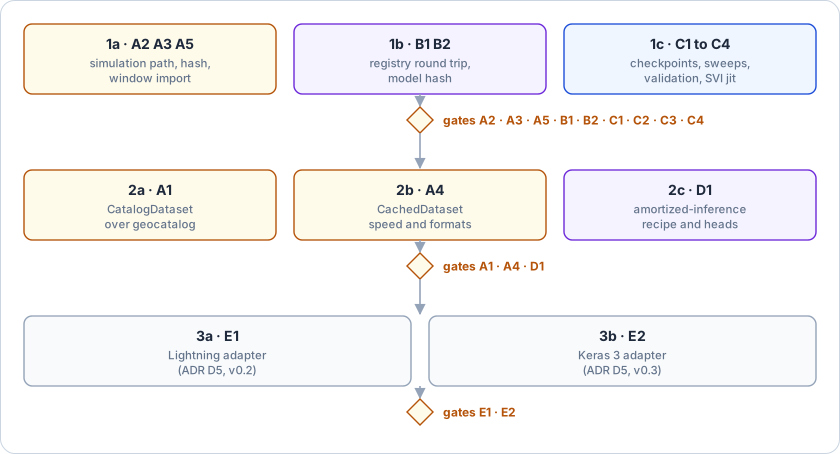
Figure 3:Fixes first, then the missing features, then the backends.
CatalogDataset waits on packaging. The
[catalog]extra is held back until geocatalog is on PyPI. Fallback: we shipCatalogDatasetwithout an extra and import geocatalog lazily with an install hint, asXarrayWindowDatasetdoes for geopatcher.A simulator hash cannot see inside a function. Hashing the code of a
CallableForwardis fragile across Python versions. Fallback: a requiredversionstring for callables, with a warning when it is absent.Changing the returned operator type breaks callers. Scripts that use
trained.moduleon anEquinoxModelOpmust keep working. Fallback: we keepEquinoxModelOpand give itserialize_weightsandfrom_registryinstead of returningJaxModelOp.Two more backends to maintain. Lightning and Keras double the test matrix. Fallback: we mark both as experimental and gate them only on the emulator gate E1/E2, as the scoping report itself suggested.
Under-confident posteriors look safe. The intervals of stage 6 cover 99.5 %, so they would pass a naive coverage check. Fallback: the recipe reports and compares against an MCMC oracle on a few scenes, as stage 7 does.
Open questions¶
Where do distribution heads and density estimators live? The design docs name pyrox for
ConditionalNormalizingFlow, but it is not pinned here. Is aGaussianHeada pyrox object, or a smallpipekit_train.recipeshelper?Should a trained model’s prior travel with it? The emulator of stage 3 is only accurate inside its training prior. Should the artifact record the prior’s hash, and should
NeuralForwardwarn on inputs outside it?Seeds across datasets. Two
SimulationDatasets with seeds 0 and 1 share all but one sample seed. Should the seeds be hashed into the sample seed rather than added?One validation path or two? The Equinox loop evaluates with the task’s loss, whereas
ValidationStepevaluates with arbitrary metrics. C3 makes the loop useValidationStep, so is the task-loss path still needed?Sweeps in parallel.
HyperSweepruns the trials one after another, and parallel trials and Optuna or Ray Tune samplers are deferred. Ispipekit_ops.parallel.ProcessMapenough for the first parallel version?Online training.
OnlineTraineris deferred to v0.3 (boundaries Q6), and the scoping report ruled online training out. Is it still wanted?
Upcoming work¶
Table 11 lists the follow-ups.
Table 11:Follow-ups from checking the scoping report and the design docs against the code.
| Follow-up | Where | Why |
|---|---|---|
Rewrite the README and the __init__ docstring for 0.0.2 | pipekit-train | they say “planning only” and “v0.0” |
| Update ADR D13, D14 and the adapter pages to “implemented” | docs/design/decisions.md, adapters.md, blackjax_adapter.md | the backends ship |
| Settle hyperparameter search’s status in one place | vision.md, boundaries.md | out of scope in one, shipped in another |
| Describe the checkpoint format the code writes | D8, adapters.md, primitives.md | three descriptions, one implementation |
Add IterableDataset and the sweep classes to the API index | docs/design/api/README.md | exported but undocumented |
Give numpyro-mcmc final metrics | adapters/numpyro_mcmc.py | final_metrics is {}, so a sweep over it fails |
| Run the slow NumPyro test in CI with a timeout | pipekit-train tests | test_same_task_runs_under_both_backends ran past 500 s here |
References¶
Sources¶
The scoping report, “Report 11 —
pipekit-train: training pipelines for emulators and amortized inference” (supplied by the author).pipekit-train 0.0.2 in
references/geostack/pipekit/packages/pipekit-train, with its source, tests, README, CHANGELOG anddocs/design/(vision, architecture, boundaries, decisions D1 to D14, API pages and examples).The running example’s scripts and outputs, described in Section ??.