Matrix-exponential neural flow
The linear special case of a continuous flow: dx/dt = Wx has the closed-form solution exp(Wt)x and the closed-form log-det t·tr(W) — no ODE solver, no Hutchinson, but only affine, so it Gaussianizes a Gaussian exactly and needs nonlinear partners for the rest
02 — Matrix-exponential neural flow
Notebooks 00 and 01 paid two prices for a free-form continuous flow: an ODE solve in both directions, and a stochastic estimate of the log-det trace. Both prices vanish the moment the vector field is linear. Take
the matrix exponential. The instantaneous change-of-variables trace is now constant in — — so the log-det integral collapses to a closed form:
gauss_flows.MatrixExponential adds a time-gated bias, ,
and is a neural flow Biloš et al. (2021), Kidger (2021): the
closed-form solution of an ODE rather than something a solver integrates. It is the
continuous-time face of Part 2’s linear mixers — a trainable, exactly-invertible
rotation-plus-scale with a free, analytic log-det. The catch is the flip side of the
gift: a linear map is affine, so on its own it can only Gaussianize a Gaussian.
What you will see
- A single layer morphing a ring as — the identity at since .
- The log-det is exactly — checked against autodiff
slogdet. - It Gaussianizes an anisotropic Gaussian exactly (latent ).
- It cannot Gaussianize two moons — the affine ceiling, and why you compose it with nonlinear blocks (Parts 4-5) or use FFJORD.
- The -indexed family of distributions a single trained model encodes for free.
import warnings

warnings.filterwarnings("ignore")

import equinox as eqx
import jax
import jax.numpy as jnp
import jax.random as jr
import matplotlib.pyplot as plt
import numpy as np
import optax
from flowjax.bijections import Chain
from flowjax.distributions import Normal, Transformed
from flowjax.train import fit_to_data
from scipy import stats
from sklearn.datasets import make_moons

from gauss_flows import MatrixExponential, TimeTanh, pack_time_control
from _style import DATA_COLOR, GAUSS_KW, LATENT_COLOR, SCATTER_KW, style_ax

jax.config.update("jax_enable_x64", True)
1. A single layer morphing a ring
Push the unit circle through for . At the map is the identity (, ), and as grows it becomes a rotated, scaled, shifted ellipse — a continuum of affine maps indexed by .
single = MatrixExponential(jr.key(0), shape=(2,), w_init_scale=0.6)
th = jnp.linspace(0.0, 2 * jnp.pi, 200)
ring = jnp.stack([jnp.cos(th), jnp.sin(th)], axis=-1)

times = jnp.linspace(0.0, 1.0, 5)
fig, axes = plt.subplots(1, 5, figsize=(16, 3.6), sharex=True, sharey=True)
for ax, t in zip(axes, times):
    pushed = jax.vmap(lambda p: single.transform_and_log_det(p, pack_time_control(float(t)))[0])(ring)
    ax.plot(np.asarray(ring[:, 0]), np.asarray(ring[:, 1]), color="0.6", lw=1.0)
    ax.plot(np.asarray(pushed[:, 0]), np.asarray(pushed[:, 1]), color=DATA_COLOR, lw=2.0)
    ax.set(title=rf"$t={float(t):.2f}$", xlabel="$x_1$", xlim=(-2.5, 2.5), ylim=(-2.5, 2.5))
    ax.set_aspect("equal")
    style_ax(ax)
axes[0].set_ylabel("$x_2$")
fig.suptitle(r"A single $\exp(Wt)$ layer: identity at $t=0$, affine warp by $t=1$", y=1.04)
fig.tight_layout()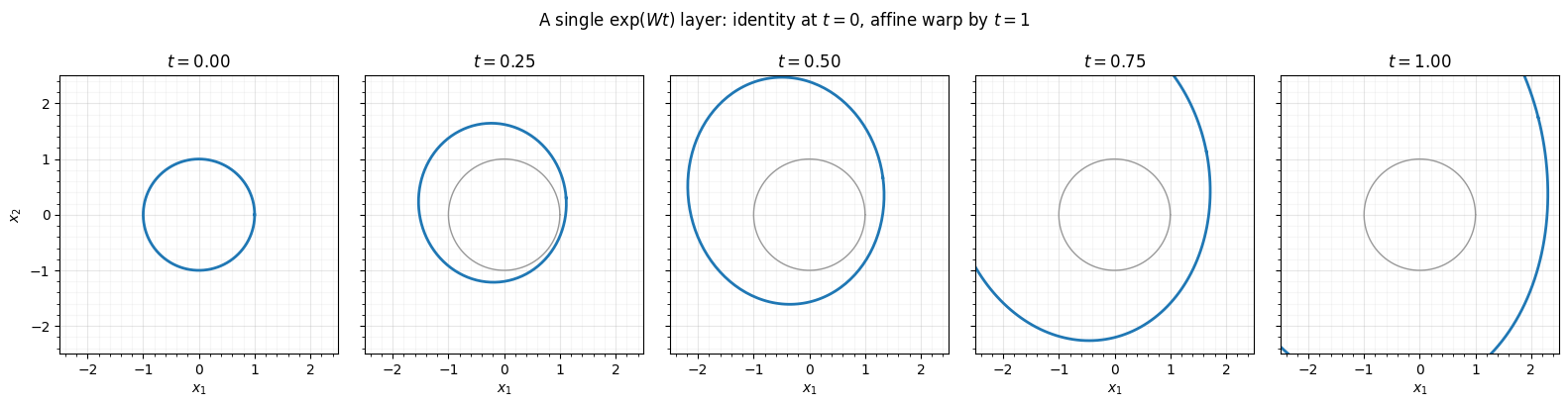
2. The log-det is exactly 
This is the whole appeal: no trace integral to estimate, no solver — the log-det is
the analytic , independent of the bias gate (a shift
never scales volume). We check it against an autodiff slogdet of the Jacobian on a
4-D layer with a learned time gate, across a range of query times.
gate_key, w_key = jr.split(jr.key(1))
checked = MatrixExponential(w_key, shape=(4,), time_bias_net=TimeTanh(gate_key, embedding_dim=8),
                            w_init_scale=0.2)
x_eval = jr.normal(jr.key(2), (4,))
ts = jnp.linspace(-1.0, 1.0, 21)


def forward(x, t):
    return checked.transform_and_log_det(x, pack_time_control(t))[0]


closed = jax.vmap(lambda t: t * jnp.trace(checked.W))(ts)
ad = jax.vmap(lambda t: jnp.linalg.slogdet(jax.jacrev(forward)(x_eval, t))[1])(ts)

fig, ax = plt.subplots(figsize=(6.2, 4.2))
ax.plot(np.asarray(ts), np.asarray(ad), "o", color=LATENT_COLOR, ms=8,
        label=r"autodiff $\log|\det\,\partial y/\partial x|$")
ax.plot(np.asarray(ts), np.asarray(closed), "-", color=DATA_COLOR, lw=2,
        label=r"closed-form $t\,\mathrm{tr}(W)$")
ax.set(xlabel="$t$", ylabel=r"$\log|\det\,\partial y/\partial x|$",
       title="Closed-form log-det matches autodiff")
ax.legend()
style_ax(ax)
fig.tight_layout()
print(f"max |closed-form - autodiff| over 21 times: {float(jnp.max(jnp.abs(closed - ad))):.2e}")
max |closed-form - autodiff| over 21 times: 4.72e-16
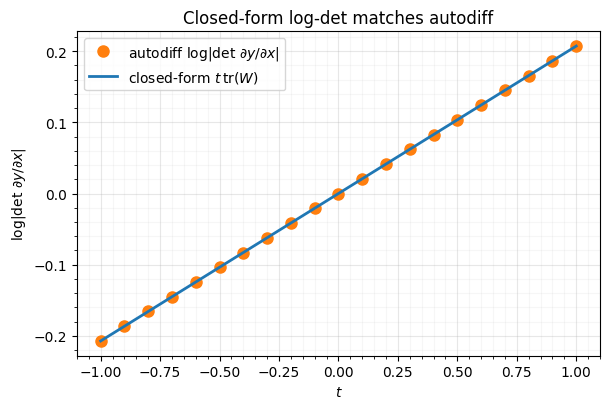
Agreement to machine precision. The log-det never touches the Jacobian — it reads straight off the weight matrix.
3. Gaussianizing an anisotropic Gaussian — exactly
A linear flow is exactly the right tool when the data is Gaussian: whitening a
correlated, tilted Gaussian to is a linear map, and
MatrixExponential represents it with a closed-form log-det. We fit a short chain
(each block its own , , gate) to a tilted anisotropic Gaussian, querying the
time at so the chain acts as a fixed composition.
angle = jnp.pi / 6
R = jnp.array([[jnp.cos(angle), -jnp.sin(angle)], [jnp.sin(angle), jnp.cos(angle)]])
gauss = (jr.normal(jr.key(7), (2000, 2)) * jnp.array([1.7, 0.7])) @ R.T + jnp.array([0.5, -0.5])


def make_chain(key, n_layers=3):
    keys = jr.split(key, n_layers)
    return Chain([
        MatrixExponential(k, shape=(2,), time_bias_net=TimeTanh(jr.fold_in(k, 99), embedding_dim=8),
                          w_init_scale=0.3)
        for k in keys
    ])


def fit_chain(key, data, n_layers=3, max_epochs=250):
    # Closed-form flow => training is cheap; run a cosine-decayed schedule to
    # convergence (no early stopping) so the linear whitening actually settles.
    dist = Transformed(Normal(jnp.zeros(2)), make_chain(key, n_layers))
    t_one = jnp.broadcast_to(pack_time_control(1.0), (data.shape[0], 1))
    steps = -(-int(data.shape[0] * 0.9) // 256)
    sched = optax.cosine_decay_schedule(5e-3, decay_steps=max_epochs * steps, alpha=0.01)
    opt = optax.chain(optax.clip_by_global_norm(5.0), optax.adam(sched))
    trained, losses = fit_to_data(key, dist, (data, t_one), optimizer=opt,
                                  max_epochs=max_epochs, max_patience=max_epochs,
                                  batch_size=256, val_prop=0.1, show_progress=False)
    return trained, losses


gauss_dist, gauss_losses = fit_chain(jr.key(0), gauss)
print(f"anisotropic-Gaussian fit: stopped at {len(gauss_losses['train'])} epochs, "
      f"val NLL = {float(min(gauss_losses['val'])):.4f}")
anisotropic-Gaussian fit: stopped at 250 epochs, val NLL = 3.0454
def gaussianize(chain, data):
    c1 = pack_time_control(1.0)
    return np.asarray(jax.vmap(lambda x: chain.inverse_and_log_det(x, c1)[0])(data))


def density_grid(dist, lim=3.5, n=80):
    xs = jnp.linspace(-lim, lim, n)
    gx, gy = jnp.meshgrid(xs, xs)
    pts = jnp.stack([gx.ravel(), gy.ravel()], -1)
    cond = jnp.broadcast_to(pack_time_control(1.0), (pts.shape[0], 1))
    lp = eqx.filter_jit(lambda p, c: jax.vmap(dist.log_prob)(p, c))(pts, cond)
    return gx, gy, jnp.exp(lp).reshape(n, n)


gx, gy, dens = density_grid(gauss_dist)
samp = gauss_dist.sample(jr.key(5), (2000,), condition=pack_time_control(1.0))

fig, (ax_d, ax_s) = plt.subplots(1, 2, figsize=(11.5, 5))
ax_d.contourf(np.asarray(gx), np.asarray(gy), np.asarray(dens), levels=20, cmap="viridis")
ax_d.set(title=r"learned density $p_\theta(x)$ (closed-form, $t=1$)", xlabel="$x_1$", ylabel="$x_2$")
ax_d.set_aspect("equal"); style_ax(ax_d)
ax_s.scatter(np.asarray(gauss[:, 0]), np.asarray(gauss[:, 1]), color=DATA_COLOR, label="data", **SCATTER_KW)
ax_s.scatter(np.asarray(samp[:, 0]), np.asarray(samp[:, 1]), color="tab:red", marker="x",
             s=10, alpha=0.4, linewidths=0.7, label="flow samples")
ax_s.set(title="data vs. flow samples", xlabel="$x_1$", ylabel="$x_2$", xlim=(-3.5, 3.5), ylim=(-3.5, 3.5))
ax_s.set_aspect("equal"); ax_s.legend(loc="upper right", framealpha=0.9); style_ax(ax_s)
fig.tight_layout()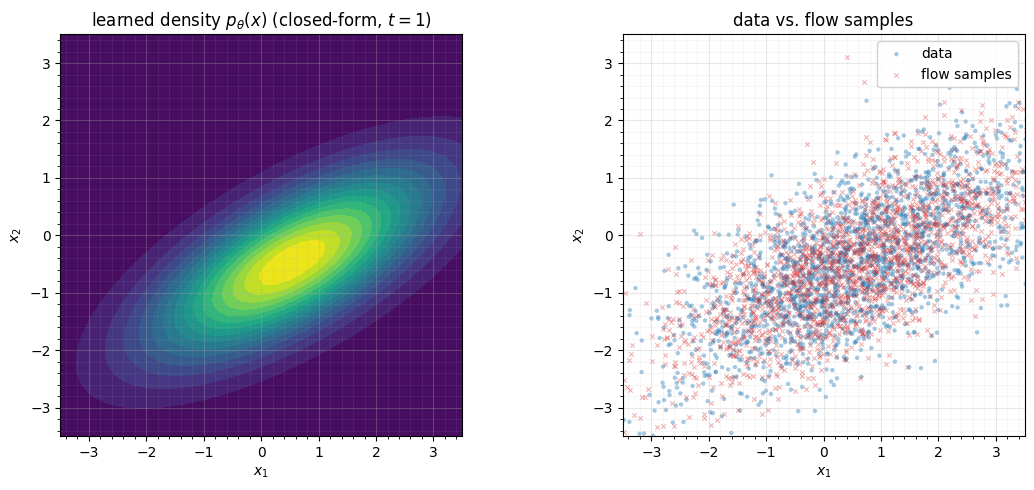
Now the Gaussianization direction: push the data through the inverse map and check the pushforward is standard normal.
Z = gaussianize(gauss_dist.bijection, gauss)
fig, axes = plt.subplots(1, 3, figsize=(15, 4.6))
ax = axes[0]
ax.scatter(Z[:, 0], Z[:, 1], color=LATENT_COLOR, **SCATTER_KW)
for r in (1.0, 2.0):
    ax.plot(r * np.cos(th), r * np.sin(th), **GAUSS_KW)
ax.set(title=r"Gaussianized data $z=T^{-1}(x)$", xlabel="$z_1$", ylabel="$z_2$",
       xlim=(-3.6, 3.6), ylim=(-3.6, 3.6))
ax.set_aspect("equal"); style_ax(ax)
for j, ax in enumerate(axes[1:]):
    osm, osr = stats.probplot(Z[:, j], dist="norm", fit=False)
    ax.scatter(osm, osr, color=LATENT_COLOR, s=8, alpha=0.5, edgecolors="none")
    ax.plot([-3.5, 3.5], [-3.5, 3.5], **GAUSS_KW)
    ax.set(title=f"QQ plot — $z_{j + 1}$", xlabel="theoretical", ylabel="empirical",
           xlim=(-3.5, 3.5), ylim=(-3.5, 3.5))
    ax.set_aspect("equal"); style_ax(ax)
fig.tight_layout()
print("Gaussianized moments (target 0, 1, 0, 0):")
for j in range(2):
    z = Z[:, j]
    print(f"  z_{j + 1}: mean={z.mean():+.3f}  std={z.std():.3f}  "
          f"skew={stats.skew(z):+.3f}  exc-kurt={stats.kurtosis(z):+.3f}")
Gaussianized moments (target 0, 1, 0, 0):
z_1: mean=+0.021 std=1.083 skew=+0.031 exc-kurt=-0.122
z_2: mean=-0.156 std=0.890 skew=-0.026 exc-kurt=-0.182
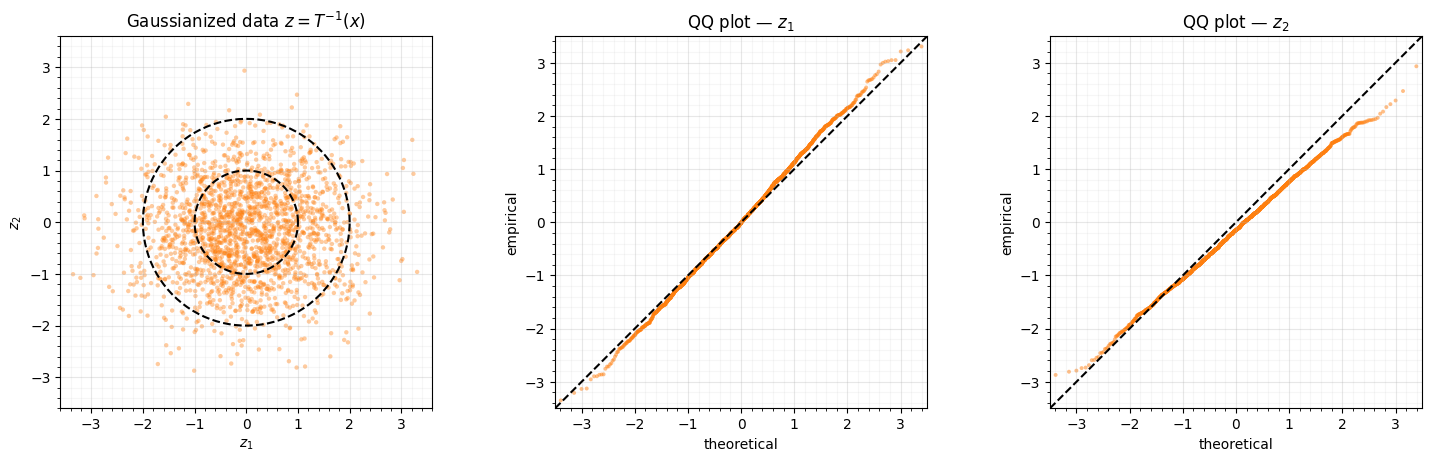
Clean: the latent fills the rings, the QQ plots sit on the diagonal, the skew is ~0 and there are no residual modes — the map that whitens a Gaussian is the affine family this flow spans, so the fit lands at the optimum (the log-det being exact helps the optimiser get there). Contrast the next section, where the target is not Gaussian.
4. The affine ceiling — two moons
Stacking matrix exponentials does not escape affine: a composition of linear maps
is linear. So the moment the data is genuinely non-Gaussian, a MatrixExponential
chain hits a wall. We fit the same chain to standardised two moons and look at the
Gaussianized latent — it keeps the bimodal crescent structure that no affine map can
remove.
Xm = make_moons(n_samples=2000, noise=0.06, random_state=0)[0]
Xm = jnp.asarray((Xm - Xm.mean(0)) / Xm.std(0))
moons_dist, _ = fit_chain(jr.key(1), Xm)
gxm, gym, densm = density_grid(moons_dist, lim=2.6)
Zm = gaussianize(moons_dist.bijection, Xm)

fig, (ax_d, ax_z) = plt.subplots(1, 2, figsize=(11.5, 5))
ax_d.contourf(np.asarray(gxm), np.asarray(gym), np.asarray(densm), levels=20, cmap="viridis")
ax_d.scatter(np.asarray(Xm[:, 0]), np.asarray(Xm[:, 1]), s=5, alpha=0.25, color="white", edgecolors="none")
ax_d.set(title="best affine fit to two moons\n(one Gaussian blob — misses both crescents)",
         xlabel="$x_1$", ylabel="$x_2$")
ax_d.set_aspect("equal"); style_ax(ax_d)
ax_z.scatter(Zm[:, 0], Zm[:, 1], color=LATENT_COLOR, **SCATTER_KW)
for r in (1.0, 2.0):
    ax_z.plot(r * np.cos(th), r * np.sin(th), **GAUSS_KW)
ax_z.set(title=r"Gaussianized latent $z=T^{-1}(x)$" + "\n(still two crescents — not $\\mathcal{N}(0,I)$)",
         xlabel="$z_1$", ylabel="$z_2$", xlim=(-3.6, 3.6), ylim=(-3.6, 3.6))
ax_z.set_aspect("equal"); style_ax(ax_z)
fig.tight_layout()
print(f"two-moons latent excess-kurtosis: z_1={stats.kurtosis(Zm[:, 0]):+.3f}, "
      f"z_2={stats.kurtosis(Zm[:, 1]):+.3f}  (non-zero => not Gaussianized)")
two-moons latent excess-kurtosis: z_1=-0.408, z_2=-1.273 (non-zero => not Gaussianized)
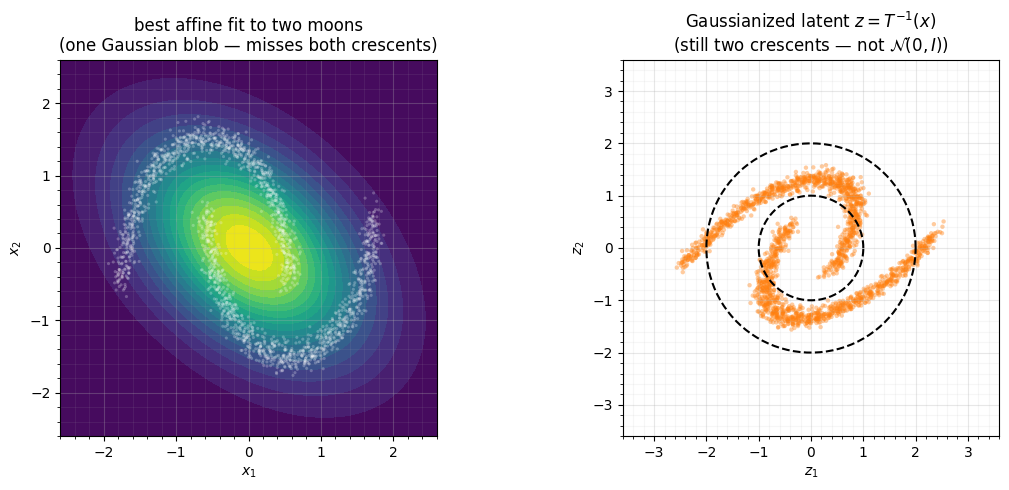
The density is a single tilted blob and the latent is still two crescents: an affine
map cannot separate the modes. This is exactly why MatrixExponential earns its
keep as a mixing block between nonlinear layers — the continuous-time analogue
of a learned rotation in Part 2 — rather than as a stand-alone Gaussianizer. Slot a
coupling or mixture-CDF layer (Parts 4-5) between two matrix-exponential blocks, or
reach for FFJORD, and the modes come apart.
5. The -indexed family, for free
Because the bijection carries an explicit time, training at hands us the whole one-parameter family — a smooth, exact interpolation from the base Gaussian at to the fitted target at , queryable at any with no retraining and no solver.
chain = gauss_dist.bijection
base = jr.normal(jr.key(17), (800, 2))
sweep = jnp.linspace(0.0, 1.0, 5)
fig, axes = plt.subplots(1, 5, figsize=(16, 3.6), sharex=True, sharey=True)
for ax, t in zip(axes, sweep):
    ct = pack_time_control(float(t))
    pushed = jax.vmap(lambda z: chain.transform_and_log_det(z, ct)[0])(base)
    ax.scatter(np.asarray(pushed[:, 0]), np.asarray(pushed[:, 1]), color=DATA_COLOR, **SCATTER_KW)
    ax.set(title=rf"$t={float(t):.2f}$", xlabel="$x_1$", xlim=(-3.5, 3.5), ylim=(-3.5, 3.5))
    ax.set_aspect("equal"); style_ax(ax)
axes[0].set_ylabel("$x_2$")
fig.suptitle(r"$p_t$: base $\mathcal{N}(0,I)$ at $t=0$ $\to$ anisotropic target at $t=1$ (exact, no ODE)", y=1.04)
fig.tight_layout()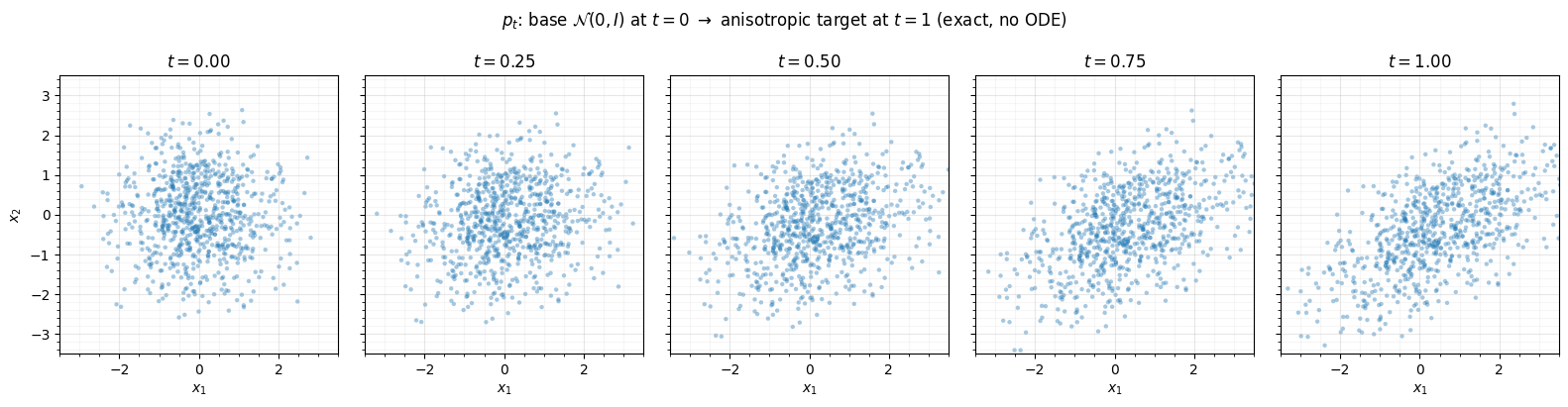
At the cloud is the base Gaussian; as it tilts and stretches into the target — the matrix exponential delivers this interpolation in closed form.
Recap
| matrix-exponential flow | FFJORD (00–01) | |
|---|---|---|
| flow map | (closed form) | numerical ODE solve |
| log-det | exact | trace integral, Hutchinson-estimated |
| per layer | affine in | universal |
| Gaussianizes | a Gaussian, exactly | non-Gaussian data too |
| cost | dense matrix-exp, | many ODE steps × probes |
The matrix-exponential flow is the linear corner of the continuous-time family: everything is closed-form and exact, the log-det is a one-liner, and it whitens a Gaussian perfectly — but it is affine, so it Gaussianizes only what a linear map can. Treat it as Part 2’s mixer made continuous, to be composed with the nonlinear blocks of Parts 4-5.
Next up. 03 — Latent ODE on spirals closes Part 6 by moving the dynamics into a latent space: encode, run an ODE on the latent state, decode — Gaussianization on the latent — which is also the bridge to irregular time-series in Part 11.
- Biloš, M., Sommer, J., Rangapuram, S. S., Januschowski, T., & Günnemann, S. (2021). Neural Flows: Efficient Alternative to Neural ODEs. Advances in Neural Information Processing Systems (NeurIPS).
- Kidger, P. (2021). On Neural Differential Equations [Phdthesis]. University of Oxford.