Density destructors
Naming the object: an invertible map that destroys structure, built by iterating whitening + a nonlinearity
04 — Density destructors¶
Notebooks 00–03 assembled all the parts: an invertible map carries a density (change of variables), maps compose with additive log-dets, the two directions trade off, and is the natural target. Now we name the object those parts describe — a density destructor — and build one explicitly.
What you will see
- The density-destructor definition (Inouye & Ravikumar, 2018) and how it unifies “normalizing flow”, “Gaussianization”, and “density destructor”.
- The canonical recipe: alternate a marginal Gaussianization (elementwise nonlinearity) with a rotation, because neither move alone suffices.
- Two-moons morphing into across
rbig’s iterations — the “intuition picture” for the whole method. - Running the destructor backward to generate moon-shaped samples from Gaussian noise.
import warnings

warnings.filterwarnings("ignore")

import matplotlib.pyplot as plt
import numpy as np
from sklearn.datasets import make_moons

import rbig
from _style import style_ax

rng = np.random.default_rng(4)

X, _ = make_moons(6000, noise=0.05, random_state=0)
X = (X - X.mean(0)) / X.std(0)  # standardise so the base is N(0, I)
1. What is a density destructor?¶
Inouye & Ravikumar Inouye & Ravikumar (2018) define a density destructor as an invertible map that turns the data distribution into a fixed, structureless base — here the standard Gaussian:
It “destroys” the density: everything that made structured — skew, heavy tails, multi-modality, dependence between coordinates — is removed, leaving isotropic Gaussian noise. This is the same object the rest of the field calls by other names, and each earlier notebook is one of its capabilities:
| once you have a destructor | you get… | from notebook |
|---|---|---|
| exact density | 00, 01 | |
| a generator | 02 | |
| , negentropy | independent, IT-friendly coords | 03 |
“Normalizing flow” (ML), “Gaussianization” (signal processing), and “density destructor” (Inouye–Ravikumar) are three names for this one map. The whole curriculum is about building good ones.
2. The canonical recipe: nonlinearity + rotation¶
How do we construct for a tangled distribution like two-moons? The classic answer — Gaussianization Chen & Gopinath (2000) via Rotation-Based Iterative Gaussianization (RBIG) Laparra et al. (2011) — alternates two moves that each fix what the other cannot:
- Marginal Gaussianization — apply to each coordinate independently. This makes every axis standard normal, but being elementwise it cannot touch the dependence between axes.
- Rotation — apply an orthogonal . This is free (, notebook 01) and mixes the axes, exposing new non-Gaussian structure along fresh directions for the next marginal step.
Neither alone works: marginals-only leaves the moons’ dependence intact; rotations-only never fixes the marginal shapes. Watch one iteration.
mg = rbig.MarginalGaussianize().fit(X)
X_marg = mg.transform(X)                      # step 1: elementwise nonlinearity
rot = rbig.RandomRotation(random_state=0).fit(X_marg)
X_rot = rot.transform(X_marg)                 # step 2: rotation

fig, axes = plt.subplots(1, 3, figsize=(12, 4))
for ax, data, title in [
    (axes[0], X, "data $x$ (two-moons)"),
    (axes[1], X_marg, "after marginal Gaussianization\n(axes ~N(0,1), shape remains)"),
    (axes[2], X_rot, "after rotation\n(structure remixed across axes)"),
]:
    ax.scatter(data[:3000, 0], data[:3000, 1], s=5, alpha=0.22, edgecolors="none")
    ax.set(title=title, xlim=(-4, 4), ylim=(-4, 4), xlabel="$z_1$", ylabel="$z_2$")
    ax.set_aspect("equal")
    style_ax(ax)
fig.tight_layout()

print("per-axis std after marginal step:", X_marg.std(0).round(3),
      "(each axis standardised)")
print("the moon shape survives the marginal step — only the rotation can remix it")
per-axis std after marginal step: [1. 1.] (each axis standardised)
the moon shape survives the marginal step — only the rotation can remix it
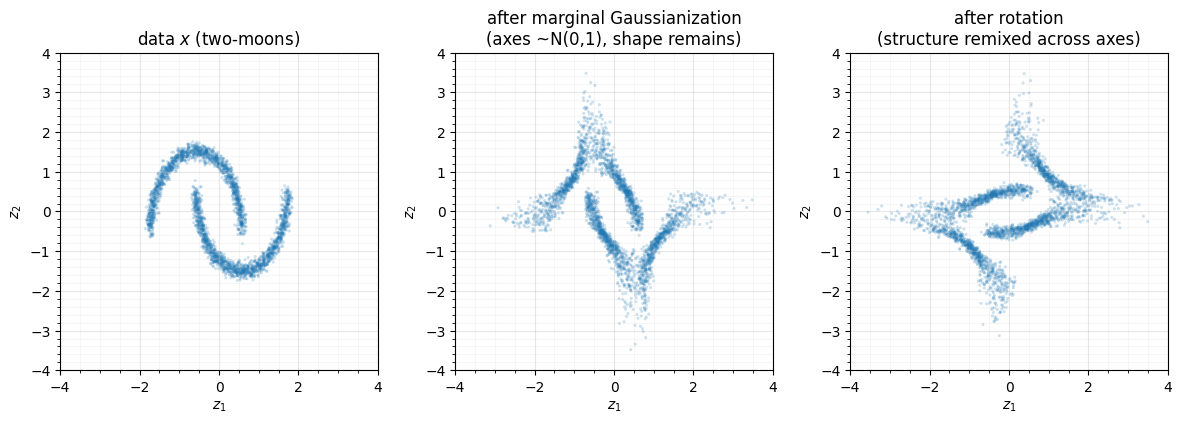
After step 1 each axis is individually standard-normal, yet the crescent shape
is clearly still there — proof that elementwise maps cannot remove dependence.
Step 2 rotates that structure onto new axes, where it again looks non-Gaussian
per coordinate — so the next marginal step has something to bite on. One
RBIGLayer in rbig is exactly this (marginal, rotation) pair.
3. Iterate to convergence — the intuition picture¶
Stack many (marginal, rotation) layers and the distribution is ground down
toward . rbig.AnnealedRBIG is precisely this iterated
destructor; we fit it and snapshot the data after and all layers.
model = rbig.AnnealedRBIG(n_layers=100, rotation="random", random_state=0)
model.fit(X)


def through_layers(k):
    state = X
    for layer in model.layers_[:k]:
        state = layer.transform(state)
    return state


n_total = len(model.layers_)
fig, axes = plt.subplots(1, 4, figsize=(13, 3.6))
for ax, k in zip(axes, [0, 3, 12, n_total]):
    d = through_layers(k)
    ax.scatter(d[:3000, 0], d[:3000, 1], s=4, alpha=0.2, edgecolors="none")
    label = "data" if k == 0 else f"{k} layers"
    ax.set(title=label, xlim=(-4, 4), ylim=(-4, 4))
    ax.set_aspect("equal")
    style_ax(ax)
fig.suptitle(f"Two-moons → N(0, I): a density destructor at work "
             f"({n_total} RBIG layers)", y=1.02)
fig.tight_layout()
print(f"fitted {n_total} layers; final pushforward std = "
      f"{through_layers(n_total).std(0).round(3)}")
fitted 100 layers; final pushforward std = [1. 1.]
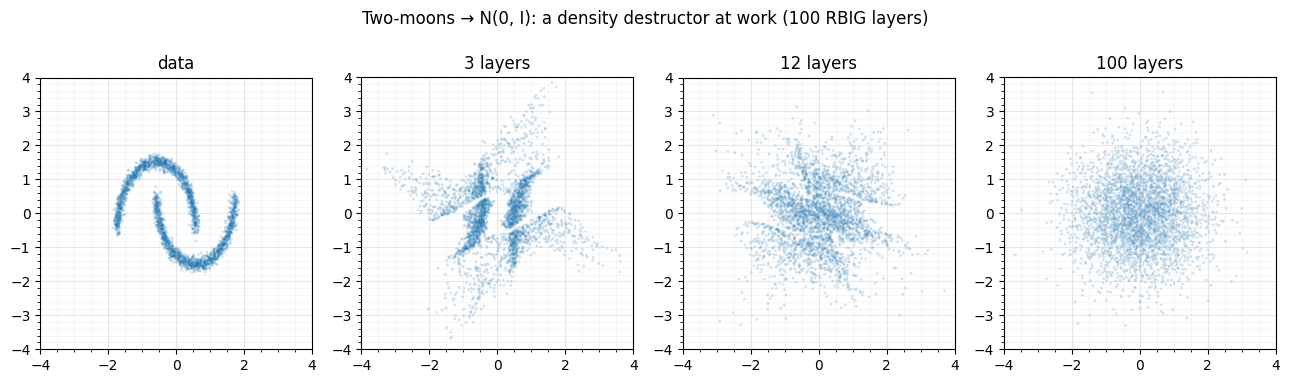
The crescents are progressively destroyed: by the last layer the data is an isotropic Gaussian blob with unit per-axis variance. That sequence is Gaussianization — iterated whitening-plus-nonlinearity grinding structure away. (How many layers are “enough” is a convergence question we quantify with diagnostics in notebook 06.)
4. Run it backward to generate¶
Because a density destructor is invertible, is a generator: draw
and push it back through the inverted layers to get
data-shaped samples. rbig does this with model.sample, which internally
inverts each marginal layer (the bisection/root-find of
notebook 02) and transposes each rotation.
samples = np.asarray(model.sample(4000, random_state=1))

fig, axes = plt.subplots(1, 2, figsize=(9.5, 4.6), sharex=True, sharey=True)
axes[0].scatter(X[:3000, 0], X[:3000, 1], s=5, alpha=0.25, edgecolors="none")
axes[0].set(title="real data $x \\sim p_X$")
axes[1].scatter(samples[:3000, 0], samples[:3000, 1], s=5, alpha=0.25,
                edgecolors="none", color="tab:green")
axes[1].set(title=r"samples $x = T^{-1}(z),\ z\sim\mathcal{N}(0,I)$")
for ax in axes:
    ax.set(xlim=(-3, 3), ylim=(-3, 3), xlabel="$x_1$", ylabel="$x_2$")
    ax.set_aspect("equal")
    style_ax(ax)
fig.tight_layout()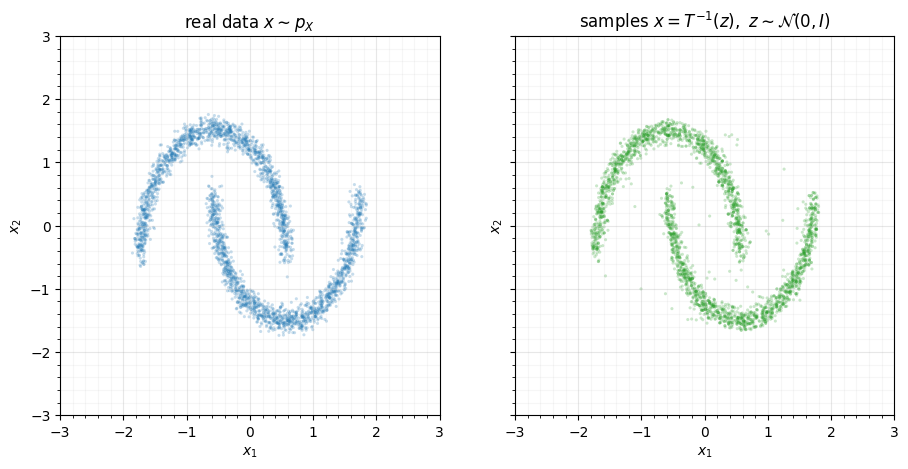
The same map, read in reverse, turns Gaussian noise back into two moons. A good density destructor is therefore simultaneously a density estimator (forward) and a generative model (inverse) — one object, both jobs.
Recap¶
| concept | statement | in code |
|---|---|---|
| density destructor | invertible with | rbig.AnnealedRBIG |
| one RBIG layer | marginal Gaussianization ∘ rotation | MarginalGaussianize + RandomRotation |
| why both moves | marginals fix axes; rotations remix dependence | §2 three-panel |
| iterate | structure ground down to | model.layers_ snapshots |
| generate | run on Gaussian draws | model.sample |
Next up. Iterating hundreds of times is a numerical minefield — CDFs hit 0 and 1, blows up, log-dets must not drift. 05 — Numerical mechanics covers the jitter, clamping, and float64 bookkeeping that keep a deep destructor stable.
- Inouye, D. I., & Ravikumar, P. (2018). Deep Density Destructors. International Conference on Machine Learning (ICML).
- Chen, S. S., & Gopinath, R. A. (2000). Gaussianization. Advances in Neural Information Processing Systems (NeurIPS).
- Laparra, V., Camps-Valls, G., & Malo, J. (2011). Iterative Gaussianization: From ICA to Random Rotations. IEEE Transactions on Neural Networks, 22(4), 537–549. 10.1109/TNN.2011.2106511
- Meng, C., Song, Y., Song, J., & Ermon, S. (2020). Gaussianization Flows. International Conference on Artificial Intelligence and Statistics (AISTATS).