Forward vs. inverse parameterisation
One bijection, two directions — and which one you make cheap decides what the flow is good at
02 — Forward vs. inverse parameterisation¶
A normalizing flow is a bijection , so it can be run in either direction. That sounds symmetric, but it almost never is: one direction is a closed-form expression and the other needs an iterative solve. Which direction you make cheap decides whether your flow is good at density estimation or at sampling.
What you will see
- The two operations a flow supports —
log_prob(forward) andsample(inverse) — and which direction each needs. - A mixture-CDF whose forward is one closed-form line but whose
inverse we solve with
optimistix.root_find(bisection). - A real
gauss_flowsflow wherelog_probis ~39× faster thansample, and theflowjax.Invertparameterisation choice (the MAF ↔ IAF duality).
import warnings

warnings.filterwarnings("ignore")

import time

import equinox as eqx
import jax
import jax.numpy as jnp
import jax.random as jr
import jax.scipy.stats as jstats
import matplotlib.pyplot as plt
import numpy as np
import optimistix as optx

from _style import style_ax

jax.config.update("jax_enable_x64", True)
rng = np.random.default_rng(2)
1. A flow runs both ways¶
Let map data to a standard-Gaussian latent. The two things we ever ask of a flow use opposite directions:
| operation | direction | needs | used for |
|---|---|---|---|
log_prob(x) | forward | and | density estimation, MLE training |
sample() | inverse | , | generation, simulation |
Both are always possible (that’s what “bijection” means), but their cost and their differentiability can differ sharply. The culprit is the marginal transform.
2. Analytic forward, iterative inverse — with optimistix¶
The atom of Gaussianization is the per-coordinate map , where is a mixture-of-Gaussians CDF,
Forward () is one closed-form sum. Inverse () has no closed form, so we frame it as a root-find: solve
. We hand that to
optimistix
Kidger (2021) — the same solver library gauss_flows depends on —
using its bracketing Bisection solver, which is bullet-proof because is
monotone.
w = jnp.array([0.4, 0.35, 0.25])
mu = jnp.array([-1.5, 0.3, 2.0])
sd = jnp.array([0.4, 0.6, 0.5])


def F(x):  # mixture-of-Gaussians CDF (forward), closed form
    return jnp.sum(w * jstats.norm.cdf(x, mu, sd))


F_v = jax.vmap(F)

_solver = optx.Bisection(rtol=1e-10, atol=1e-12)


def invF(u, max_steps=200):
    """x = F^{-1}(u) via optimistix bisection on g(x) = F(x) - u."""
    sol = optx.root_find(
        lambda x, args: F(x) - args, _solver, 0.0, args=u,
        options=dict(lower=-12.0, upper=12.0), max_steps=max_steps, throw=False,
    )
    return sol.value


# Round-trip: push real samples forward, then recover them with the solver.
x_true = jnp.asarray(rng.normal(0.3, 1.2, size=400))
u_targets = F_v(x_true)
x_rec = jax.vmap(invF)(u_targets)
print("forward F(x): closed form, one evaluation")
print(f"inverse F^-1(u) via optimistix: max|x - x_rec| = "
      f"{float(jnp.max(jnp.abs(x_true - x_rec))):.2e}")

# Accuracy vs. solver budget: bisection error falls geometrically (~2^-n).
steps = np.arange(1, 46)
u0 = 0.7
err_vs_steps = np.array(
    [abs(float(F(invF(u0, max_steps=int(k))) - u0)) for k in steps]
)
forward F(x): closed form, one evaluation
inverse F^-1(u) via optimistix: max|x - x_rec| = 1.63e-10
fig, axes = plt.subplots(1, 2, figsize=(11, 4.2))

xg = jnp.linspace(-4, 4, 500)
axes[0].plot(xg, F_v(xg), color="tab:blue", lw=2, label="$F(x)$ (forward, analytic)")
for u in [0.2, 0.5, 0.8]:
    xr = float(invF(jnp.asarray(u)))
    axes[0].hlines(u, -4, xr, color="tab:orange", lw=1, ls=":")
    axes[0].vlines(xr, 0, u, color="tab:orange", lw=1, ls=":")
    axes[0].plot(xr, u, "o", color="tab:orange", ms=6)
axes[0].set(title="forward is a lookup; inverse is a root-find",
            xlabel="x", ylabel="$u = F(x)$")
axes[0].legend(loc="upper left")
style_ax(axes[0])

axes[1].semilogy(steps, err_vs_steps, "-o", color="tab:red", ms=3)
axes[1].axhline(1e-12, color="k", lw=0.8, ls="--", label=r"$\approx$ float64 floor")
axes[1].set(title=r"optimistix bisection: error $\sim 2^{-n}$",
            xlabel="solver max_steps", ylabel=r"residual $|F(x_\star) - u|$")
axes[1].legend()
style_ax(axes[1])
fig.tight_layout()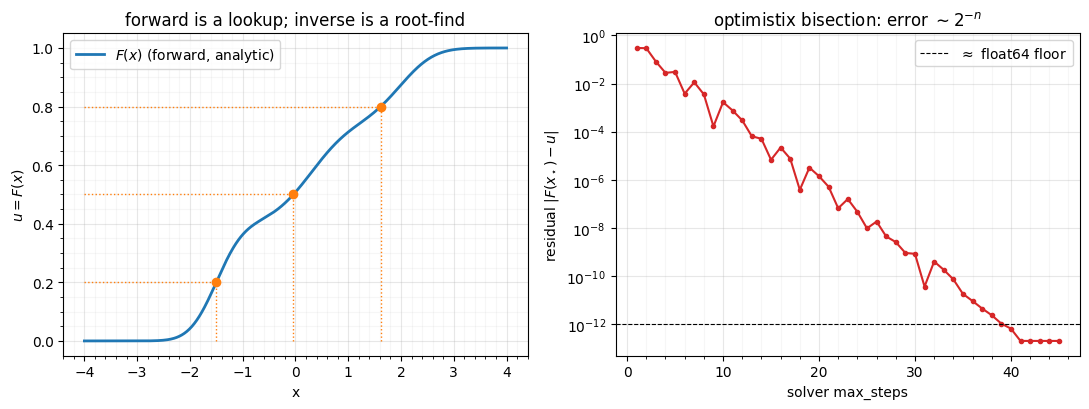
Left: inverting means reading the curve right-to-left — there is no formula,
so optimistix hunts for the that lands on each target . Right: the
residual falls geometrically with the solver budget, hitting the float64 floor
in ~40 steps. Accurate and robust — but it is a loop. How to differentiate
that loop (and why naively unrolling it fails) is its own story, told in
Part 1, notebook 03
when we train a mixture-CDF.
3. The asymmetry on a real flow¶
gauss_flows builds its marginal layers from exactly this mixture-CDF, so a
whole flow inherits the asymmetry: log_prob runs the analytic forward maps,
while sample runs the bisection inverse inside every marginal layer. We time
both on the same flow (JIT-compiled and warmed up for a fair race).
import gauss_flows as gf

key = jr.key(0)
flow = gf.gaussianization_flow(key, n_dims=2, n_layers=6, n_components=8)
X = jnp.asarray(rng.standard_normal((5000, 2)))


@eqx.filter_jit
def logp(f, x):
    return f.log_prob(x)


@eqx.filter_jit
def samp(f, k):
    return f.sample(k, (5000,))


logp(flow, X).block_until_ready()           # warmup (compile)
samp(flow, key).block_until_ready()

t = time.perf_counter()
for _ in range(5):
    logp(flow, X).block_until_ready()
t_lp = (time.perf_counter() - t) / 5

t = time.perf_counter()
for i in range(5):
    samp(flow, jr.fold_in(key, i)).block_until_ready()
t_s = (time.perf_counter() - t) / 5

print(f"log_prob (forward, analytic)  : {t_lp * 1e3:6.2f} ms / 5000 pts")
print(f"sample   (inverse, bisection) : {t_s * 1e3:6.2f} ms / 5000 pts")
print(f"sample is {t_s / t_lp:.0f}x more expensive than log_prob")
log_prob (forward, analytic) : 19.54 ms / 5000 pts
sample (inverse, bisection) : 764.82 ms / 5000 pts
sample is 39x more expensive than log_prob
fig, ax = plt.subplots(figsize=(6.2, 4))
bars = ax.bar(["log_prob\n(forward)", "sample\n(inverse)"],
              [t_lp * 1e3, t_s * 1e3], color=["tab:blue", "tab:orange"])
ax.bar_label(bars, fmt="%.1f ms", padding=3)
ax.set(ylabel="wall-clock (ms / 5000 points)",
       title=f"Same flow, opposite directions: {t_s / t_lp:.0f}x gap")
style_ax(ax)
fig.tight_layout()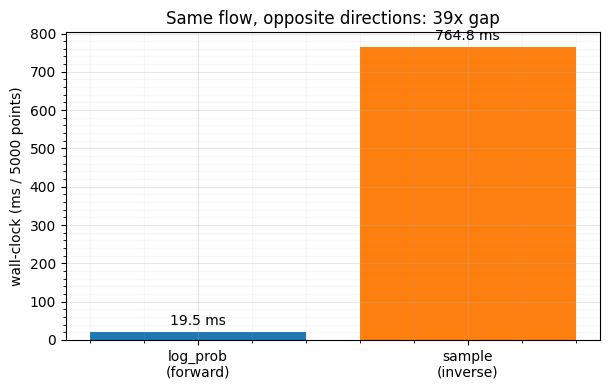
4. The parameterisation choice¶
The map and its inverse describe the same flow — but we choose which one to store as the cheap, closed-form direction. Whatever we store cheaply, the other direction pays the iterative price.
- Density-estimation flows call
log_probconstantly. Store the forward map cheaply → fast training, slow sampling. This is whatgauss_flowsGaussianization flows do, hence §3. - Sampling / variational flows call
sampleconstantly. Store the inverse cheaply → fast sampling, slow density.
In flowjax the switch is one wrapper, Invert, which swaps a bijector’s
forward and inverse.
from flowjax.bijections import Invert

b = gf.MixtureGaussianCDF(n_components=8, shape=(2,))
x = jnp.array([0.4, -0.7])
bi = Invert(b)  # forward and inverse swapped
print("Invert(b).transform == b.inverse :",
      bool(jnp.allclose(bi.transform(x), b.inverse(x))))
print("=> 'forward' and 'inverse' are a labelling choice, not a fixed property.")
Invert(b).transform == b.inverse : True
=> 'forward' and 'inverse' are a labelling choice, not a fixed property.
Recap¶
| concept | takeaway | in code |
|---|---|---|
| two directions | forward for density, inverse for sampling | flow.log_prob / flow.sample |
| mixture-CDF inverse | a monotone root-find | optimistix.root_find + Bisection |
| measured asymmetry | sample ≈ 39× log_prob for Gaussianization | timed, JIT-warmed |
| parameterisation | store the cheap direction; Invert swaps it | flowjax.bijections.Invert |
| differentiating the inverse | unrolling / one-step / adjoint | Part 1, nb 03 |
Next up. We have been mapping to a standard Gaussian without asking why that target. 03 — Why a standard Gaussian? shows the three properties — maximum entropy, separability, trivial primitives — that make the natural destination.
- Kidger, P. (2021). On Neural Differential Equations [Phdthesis]. University of Oxford.
- Papamakarios, G., Pavlakou, T., & Murray, I. (2017). Masked Autoregressive Flow for Density Estimation. Advances in Neural Information Processing Systems (NeurIPS).
- Kingma, D. P., Salimans, T., Jozefowicz, R., Chen, X., Sutskever, I., & Welling, M. (2016). Improving Variational Inference with Inverse Autoregressive Flow. Advances in Neural Information Processing Systems (NeurIPS).
- Dinh, L., Sohl-Dickstein, J., & Bengio, S. (2017). Density Estimation using Real NVP. International Conference on Learning Representations (ICLR).