Inversion strategies
Bisection vs. Newton for monotone CDFs, the safeguarded hybrid, differentiating the inverse, and vectorising it
04 — Inversion strategies
Notebooks 01–03 all reduced “invert the marginal” to the same problem: solve the monotone equation for . This closing notebook of Part 1 is about how to solve it well — the trade-off between bisection and Newton, the safeguarded hybrid that production solvers use, and how to run the solve on a whole batch at once.
What you will see
- Bisection: bracketing, derivative-free, linearly convergent (one bit per step → ~50 steps for float64), and bullet-proof for monotone .
- Newton: uses (the density), quadratically convergent (~5 steps), but can overshoot or diverge in flat tails.
- The safeguarded Newton hybrid — Newton when it stays in the bracket, else bisect — fast and robust.
- Differentiating the inverse four ways (unroll-bisection, unroll-Newton,
one-step, adjoint) — the gradient depends on the solver, and
gauss_flows’ unrolled bisection returns zero. - Vectorising the root-find across a batch with
jax.vmap.
import warnings

warnings.filterwarnings("ignore")

import time

import gauss_flows as gf
import jax
import jax.numpy as jnp
import jax.scipy.stats as jstats
import matplotlib.pyplot as plt
import numpy as np
import optimistix as optx

from _style import style_ax

jax.config.update("jax_enable_x64", True)
rng = np.random.default_rng(14)

# A 3-component mixture CDF F and its density F' (= forward derivative).
w = jnp.array([0.4, 0.35, 0.25])
mu = jnp.array([-1.5, 0.3, 2.0])
sd = jnp.array([0.4, 0.6, 0.5])


def F(x):
    return jnp.sum(w * jstats.norm.cdf(x, mu, sd))


def Fp(x):  # F'(x): the mixture density, Newton's slope
    return jnp.sum(w * jstats.norm.pdf(x, mu, sd))
1. Bisection vs. Newton
Both solve for a monotone , but they trade robustness against speed.
- Bisection keeps a bracket straddling the root and halves it each step. The error falls like — linear convergence — so reaching float64 takes ~50 steps. It needs no derivative and cannot fail for a monotone .
- Newton iterates . Near the root the error roughly squares each step — quadratic convergence, ~5 steps — but it needs and, with no bracket, can overshoot into a flat tail where and diverge. We record the per-iteration error of each.
def bisection(u, n_iter=55):
    lo, hi, errs = -12.0, 12.0, []
    for _ in range(n_iter):
        mid = 0.5 * (lo + hi)
        errs.append(abs(float(F(mid) - u)))
        if F(mid) < u:
            lo = mid
        else:
            hi = mid
    return np.array(errs)


def newton(u, x0=0.0, n_iter=12):
    x, errs = x0, []
    for _ in range(n_iter):
        errs.append(abs(float(F(x) - u)))
        x = x - (F(x) - u) / Fp(x)
    return np.array(errs)


u = 0.7
err_bis, err_newt = bisection(u), newton(u)
print(f"bisection: {len(err_bis)} steps to {err_bis[-1]:.1e}  (linear)")
print(f"newton:    reaches {err_newt[5]:.1e} in 5 steps        (quadratic)")

# Newton's fragility: from a far-tail start aiming at an extreme quantile.
err_newt_bad = newton(0.999, x0=-8.0, n_iter=8)
print(f"newton from a bad tail start: errors = "
      f"{[f'{e:.0e}' for e in err_newt_bad[:6]]}  -> diverges (nan)")
bisection: 55 steps to 1.1e-16 (linear)
newton: reaches 1.1e-16 in 5 steps (quadratic)
newton from a bad tail start: errors = ['1e+00', '1e-03', '1e+00', 'nan', 'nan', 'nan'] -> diverges (nan)
fig, axes = plt.subplots(1, 2, figsize=(11, 4.2))
axes[0].semilogy(range(1, len(err_bis) + 1), np.maximum(err_bis, 1e-17), "-o",
                 ms=3, color="tab:blue", label="bisection (linear)")
axes[0].semilogy(range(1, len(err_newt) + 1), np.maximum(err_newt, 1e-17), "-s",
                 ms=4, color="tab:green", label="Newton (quadratic)")
axes[0].set(title="convergence: Newton is far faster",
            xlabel="iteration", ylabel=r"residual $|F(x_n) - u|$")
axes[0].legend(); style_ax(axes[0])

steps_bad = np.arange(1, len(err_newt_bad) + 1)
finite = np.isfinite(err_newt_bad)
axes[1].semilogy(steps_bad[finite], np.maximum(err_newt_bad[finite], 1e-17), "-s",
                 ms=5, color="tab:red", label="plain Newton (diverges → nan)")
axes[1].axvspan(steps_bad[finite][-1], len(err_newt_bad), color="tab:red", alpha=0.08)
axes[1].set(title="...but Newton alone is fragile in the tails",
            xlabel="iteration", ylabel="residual")
axes[1].legend(); style_ax(axes[1])
fig.tight_layout()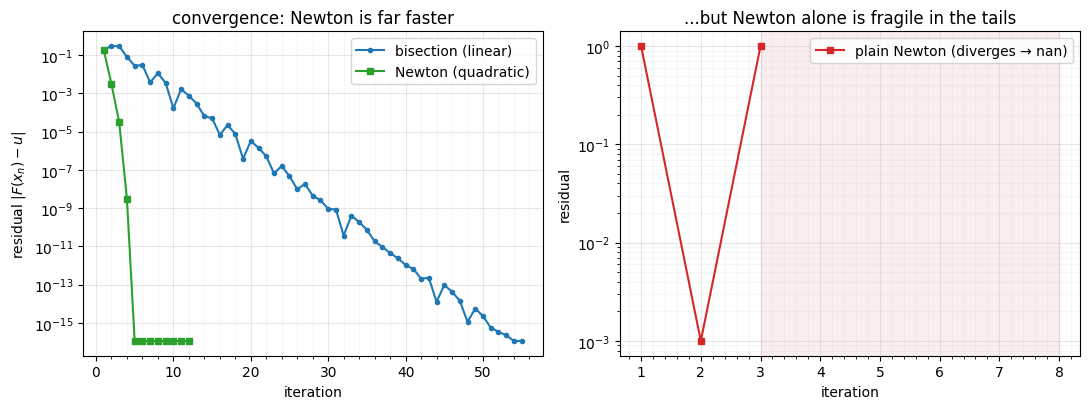
Left: Newton (green) reaches machine precision in ~5 steps where bisection
(blue) needs ~50 — quadratic vs. linear. Right: starting Newton far out in the
tail, the tiny throws the iterate even further out and it blows up to
nan. Bisection would simply have kept halving. We want Newton’s speed without
its fragility.
2. The safeguarded hybrid
The standard fix (Brent-style Brent (1973)) keeps a bracket like bisection but tries a Newton step each iteration, accepting it only if it lands inside the bracket; otherwise it falls back to the bisection midpoint. This keeps the guaranteed convergence of bisection and the speed of Newton near the root — and it is essentially what robust library solvers do.
def safeguarded_newton(u, n_iter=60):
    lo, hi, x, errs = -12.0, 12.0, 0.0, []
    for _ in range(n_iter):
        errs.append(abs(float(F(x) - u)))
        lo, hi = (x, hi) if F(x) < u else (lo, x)   # tighten bracket
        step = x - (F(x) - u) / Fp(x)               # Newton proposal
        x = step if lo < step < hi else 0.5 * (lo + hi)  # accept or bisect
    return np.array(errs)


err_safe = safeguarded_newton(0.999)  # the same hard target that broke Newton
print(f"safeguarded Newton on the hard tail target: {err_safe[-1]:.1e}, "
      f"all finite = {bool(np.all(np.isfinite(err_safe)))}")

fig, ax = plt.subplots(figsize=(7, 4))
ax.semilogy(range(1, len(err_safe) + 1), np.maximum(err_safe, 1e-17), "-o", ms=3,
            color="tab:purple", label="safeguarded Newton")
ax.semilogy(range(1, len(err_bis) + 1), np.maximum(err_bis, 1e-17), "--", lw=1,
            color="tab:blue", label="bisection (for reference)")
ax.set(title="Safeguarded Newton: fast and robust (hard tail target)",
       xlabel="iteration", ylabel=r"residual $|F(x_n) - u|$")
ax.legend(); style_ax(ax)
fig.tight_layout()
safeguarded Newton on the hard tail target: 1.1e-16, all finite = True
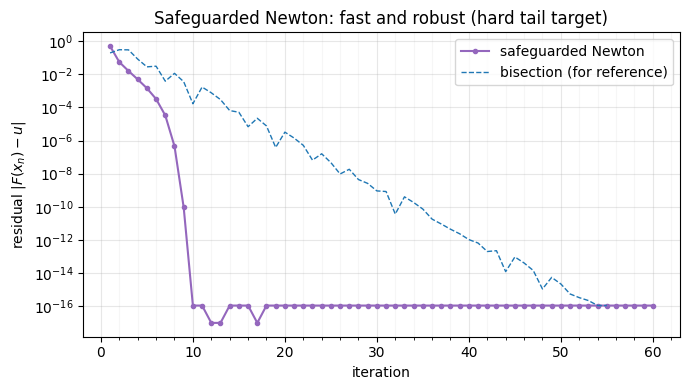
On the very target that sent plain Newton to nan, the safeguarded version
stays finite and converges quickly — the bracket catches every bad Newton step.
optimistix Kidger (2021) ships both primitives (optx.Bisection,
optx.Newton) and composes them; gauss_flows uses the robust bracketing
bisection by default
(we saw its internals in notebook 03).
3. Differentiating the inverse
To train a flow through its sampling path we need to differentiate the inverse — and . Crucially, whether you get the right gradient depends on the solver. There are four options:
| strategy | idea | pros | cons |
|---|---|---|---|
| unroll bisection | backprop the bracketing loop | trivial | wrong (zero) — the where(F<u) comparisons are piecewise constant |
| unroll Newton | backprop the smooth update | correct gradient; trivial | memory — stores every iterate |
| one-step | detach the root, add one Newton step | exact; memory; ~3 lines | needs at |
| adjoint (implicit-fn thm) | differentiate directly | exact; ; automatic in optimistix; scales to vector roots | a linear solve |
The last three all compute the implicit-function gradient Blondel et al. (2022), which depends only on the solution:
Unrolling instead differentiates the path to — which is why it is correct for smooth Newton but useless for comparison-based bisection.
_isolver = optx.Bisection(rtol=1e-12, atol=1e-14)


def _solve(u):  # the converged root (used by one-step and adjoint)
    return optx.root_find(lambda x, a: F(x) - a, _isolver, 0.0, args=u,
                          options=dict(lower=-12.0, upper=12.0), max_steps=200,
                          throw=False).value


def inv_unroll_bisect(u, n=60):          # (1) unroll bisection -> zero grad
    lo, hi = -12.0, 12.0
    for _ in range(n):
        mid = 0.5 * (lo + hi)
        below = F(mid) < u
        lo = jnp.where(below, mid, lo)
        hi = jnp.where(below, hi, mid)
    return 0.5 * (lo + hi)


def inv_unroll_newton(u, n=30):          # (2) unroll Newton -> correct, O(n) memory
    x = 0.0
    for _ in range(n):
        x = x - (F(x) - u) / Fp(x)
    return x


def inv_onestep(u):                      # (3) detach + one Newton step -> exact, O(1)
    x_star = jax.lax.stop_gradient(_solve(u))
    return x_star - (F(x_star) - u) / Fp(x_star)


def inv_adjoint(u):                      # (4) optimistix ImplicitAdjoint -> exact, O(1)
    return _solve(u)


uu = jnp.linspace(0.03, 0.97, 40)
g_analytic = jax.vmap(lambda u: 1.0 / Fp(_solve(u)))(uu)
g_unroll_b = jax.vmap(jax.grad(inv_unroll_bisect))(uu)
g_unroll_n = jax.vmap(jax.grad(inv_unroll_newton))(uu)
g_onestep = jax.vmap(jax.grad(inv_onestep))(uu)
g_adjoint = jax.vmap(jax.grad(inv_adjoint))(uu)

amax = lambda g: float(jnp.max(jnp.abs(g - g_analytic)))
print(f"max |unroll-Newton - analytic| = {amax(g_unroll_n):.2e}   (correct)")
print(f"max |one-step     - analytic| = {amax(g_onestep):.2e}   (correct)")
print(f"max |adjoint      - analytic| = {amax(g_adjoint):.2e}   (correct)")
print(f"unroll-bisection grad range   = [{float(g_unroll_b.min()):.0e}, "
      f"{float(g_unroll_b.max()):.0e}]   <- zero (wrong)")
max |unroll-Newton - analytic| = 6.00e-12 (correct)
max |one-step - analytic| = 0.00e+00 (correct)
max |adjoint - analytic| = 3.55e-15 (correct)
unroll-bisection grad range = [0e+00, 0e+00] <- zero (wrong)
fig, ax = plt.subplots(figsize=(8, 4.4))
ax.plot(uu, g_analytic, "-", color="k", lw=2.5, label=r"analytic $1/F'(x_\star)$")
ax.plot(uu, g_adjoint, "o", color="tab:green", ms=6, label="adjoint (optimistix)")
ax.plot(uu, g_onestep, "s", color="tab:orange", ms=5, mfc="none", label="one-step Newton")
ax.plot(uu, g_unroll_n, "^", color="tab:purple", ms=5, mfc="none",
        label="unrolled Newton (O(n) mem)")
ax.plot(uu, g_unroll_b, "--", color="tab:red", lw=1.5, label="unrolled bisection (wrong: 0)")
ax.set(title=r"gradient of the inverse, $\partial x_\star/\partial u$, by strategy",
       xlabel="u", ylabel=r"$\partial x_\star / \partial u$")
ax.legend(fontsize=8); style_ax(ax)
fig.tight_layout()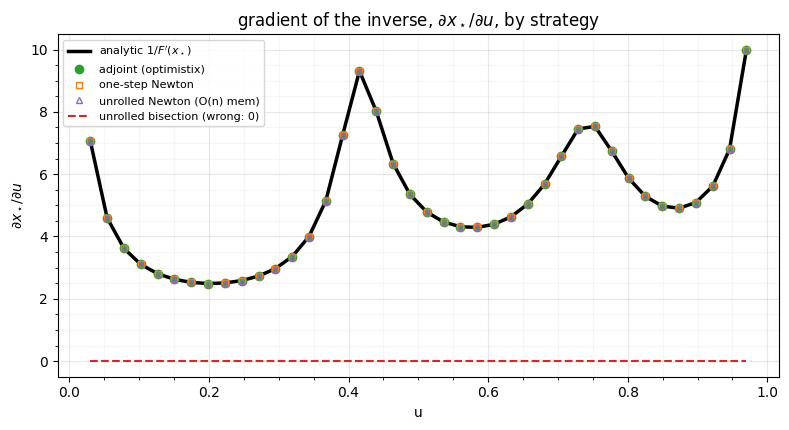
Three of the four land on the analytic curve; only unrolled bisection is
flat at zero, because its iterates depend on the inputs solely through <
comparisons. Unrolled Newton is correct — its update is smooth — but pays
memory, so the one-step and adjoint methods
win for deep flows. This trap is live: gauss_flows’ MixtureGaussianCDF.inverse
is an unrolled bisection, so differentiating it returns zero
(gauss_flows#111):
b = gf.MixtureGaussianCDF.from_data(jnp.asarray(rng.normal(0, 1.5, (2000, 1))), 6)
y = jnp.array([0.7])
g_lib = float(jax.grad(lambda yy: b.inverse(yy).sum())(y)[0])
g_fwd = float(jax.grad(lambda xx: b.transform(xx).sum())(b.inverse(y))[0])
print(f"grad through gauss_flows .inverse = {g_lib:.4f}   <- 0 (unrolled bisection)")
print(f"correct implicit value 1/F'(x*)   = {1.0 / g_fwd:.4f}")
print("=> fine for density/log_prob (forward); wrap with optimistix or one-step "
      "to train through sampling")
grad through gauss_flows .inverse = 0.0000 <- 0 (unrolled bisection)
correct implicit value 1/F'(x*) = 1.1619
=> fine for density/log_prob (forward); wrap with optimistix or one-step to train through sampling
4. Vectorising across a batch
A flow inverts a whole array of values at once (every sample, every
dimension). We never write a Python loop over elements — we write the scalar
solve once and jax.vmap it, which fuses the batch into a single compiled
kernel. (Bisection vectorises especially naturally: the bracket updates are
jnp.where over arrays — exactly what gauss_flows’ bisection_inverse does.)
solver = optx.Bisection(rtol=1e-10, atol=1e-12)


def solve_one(u):
    return optx.root_find(lambda x, a: F(x) - a, solver, 0.0, args=u,
                          options=dict(lower=-12.0, upper=12.0), max_steps=200,
                          throw=False).value


batched = jax.jit(jax.vmap(solve_one))     # vectorised over the leading axis
solve_jit = jax.jit(solve_one)             # same solve, jitted but called per-element
U = jnp.asarray(rng.uniform(0.01, 0.99, 4000))
batched(U).block_until_ready()             # warmup / compile
solve_jit(U[0]).block_until_ready()

t = time.perf_counter()
for _ in range(5):
    batched(U).block_until_ready()
t_vmap = (time.perf_counter() - t) / 5

# Python loop over a subset, calling the *compiled* scalar solve per element —
# a fair contrast (dispatch-per-element vs. one fused batch, not recompilation).
sub = U[:400]
t = time.perf_counter()
for uu in sub:
    solve_jit(uu).block_until_ready()
t_loop = time.perf_counter() - t

per_vmap = t_vmap / len(U) * 1e6
per_loop = t_loop / len(sub) * 1e6
print(f"vmap : {t_vmap * 1e3:6.2f} ms for {len(U)} inversions  ({per_vmap:.2f} µs each)")
print(f"loop : {t_loop * 1e3:6.2f} ms for {len(sub)} inversions ({per_loop:.1f} µs each)")
print(f"=> vmap is ~{per_loop / per_vmap:.0f}x faster per inversion")

# correctness: F(x*) recovers u
err = float(jnp.max(jnp.abs(jax.vmap(F)(batched(U)) - U)))
print(f"batched inversion accuracy: max|F(x*) - u| = {err:.1e}")
vmap : 5.19 ms for 4000 inversions (1.30 µs each)
loop : 119.17 ms for 400 inversions (297.9 µs each)
=> vmap is ~229x faster per inversion
batched inversion accuracy: max|F(x*) - u| = 2.6e-11
fig, ax = plt.subplots(figsize=(6.2, 4))
bars = ax.bar(["vmap\n(fused)", "Python loop\n(per element)"],
              [per_vmap, per_loop], color=["tab:green", "tab:red"])
ax.bar_label(bars, fmt="%.1f µs", padding=3)
ax.set(ylabel="time per inversion (µs)", yscale="log",
       title="One vmap'd kernel vs. a Python loop")
style_ax(ax)
fig.tight_layout()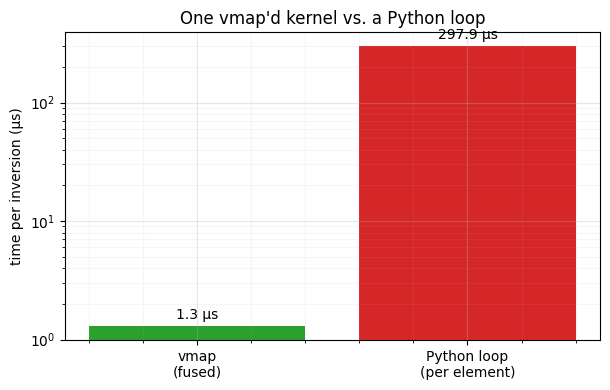
Same solver, but vmap amortises tracing and dispatch across the whole batch —
orders of magnitude faster per element than looping, and it composes with
jax.jit/grad. For a -dimensional marginal layer you simply vmap over the
leading (batch) axes and apply the scalar solve per coordinate.
Recap
Solving :
| method | convergence | needs ? | robust? | use |
|---|---|---|---|---|
| bisection | linear () | no | always (monotone) | default; gauss_flows inverse |
| Newton | quadratic | yes | no (tails) | when bracketed & well-scaled |
| safeguarded Newton | quadratic + safe | yes | yes | best of both (Brent-style) |
Differentiating the inverse, and scaling it:
| technique | gradient | memory | note |
|---|---|---|---|
| unroll bisection | wrong (0) | comparisons kill the gradient | |
| unroll Newton | correct | smooth update; memory-heavy | |
| one-step | correct | detach + 1 Newton step | |
| adjoint | correct | optimistix ImplicitAdjoint; automatic | |
jax.vmap | — | — | batch the scalar solve into one kernel |
Next up — end of Part 1. We can now build, fit, train, and invert a single 1D marginal transform every way that matters. Part 2 stacks them with rotations (PCA, Householder, random) so that marginal Gaussianization can attack multivariate dependence — the second half of the RBIG loop from Part 0 notebook 04.
- Brent, R. P. (1973). Algorithms for Minimization Without Derivatives. Prentice-Hall.
- Kidger, P. (2021). On Neural Differential Equations [Phdthesis]. University of Oxford.
- Blondel, M., Berthet, Q., Cuturi, M., Frostig, R., Hoyer, S., Llinares-López, F., Pedregosa, F., & Vert, J.-P. (2022). Efficient and Modular Implicit Differentiation. Advances in Neural Information Processing Systems (NeurIPS).