The rotation zoo, and why rotation matters
PCA / ICA / random / Picard orthogonal mixers, and the demo that shows why a marginal pass needs one
00 — The rotation zoo, and why rotation matters
Part 1 built the atomic operation of Gaussianization: turn one coordinate into a standard normal via . But a stack of independent 1D maps can only ever fix the marginals. It cannot touch the dependence between coordinates — a product of per-axis maps is, by construction, separable. So if the data is correlated, marginal Gaussianization makes each axis look and then stalls, with the joint still far from .
The cure is the other half of Gaussianization: an orthogonal rotation between marginal passes, which mixes information across coordinates so the next marginal pass has something to do. Iterating (marginal → rotate → marginal → rotate …) is exactly RBIG Laparra et al. (2011). This notebook is the conceptual anchor for Part 2.
What you will see
- The rotation zoo in
rbig— PCA, ICA, random, Picard — and how they differ as orthogonal maps. - Why a pure rotation is free: (the Part 0 composition thread), while a whitening rotation pays a scaling log-det.
- The headline demo: marginal-only Gaussianization stalls at high total correlation; inserting a rotation drives it to zero.
- Rotation choice sets the convergence speed — PCA in one step, a random rotation in a few (previewing Part 3’s rotation studies).
import warnings

warnings.filterwarnings("ignore")

import jax
import matplotlib.pyplot as plt
import numpy as np

import rbig
from _style import SCATTER_KW, style_ax

jax.config.update("jax_enable_x64", True)
rng = np.random.default_rng(0)
1. The rotation zoo
A rotation here is an orthogonal linear map with .
Orthogonality buys two things at once: it is exactly invertible
(), and — because — it is volume-preserving, so
it contributes nothing to the change-of-variables log-determinant. rbig
ships a whole zoo, differing only in how they pick :
| rotation | how is chosen | when it shines |
|---|---|---|
| PCA | eigenvectors of | scales differ across axes; decorrelates in one shot |
| ICA Hyvärinen & Oja (2000) | maximise non-Gaussianity of the axes | heavy-tailed / non-Gaussian structure |
| random | Haar-uniform via QR of a Gaussian | no fitting cost; the RBIG default guarantee |
| Picard Ablin et al. (2018) | quasi-Newton ICA on the orthogonal manifold | fast, robust ICA |
Let’s fit each on a correlated, slightly non-Gaussian 2D cloud and look at the axes they choose.
# Correlated, mildly heavy-tailed 2D data: a shared latent + per-axis noise,
# stretched along a diagonal.
n = 4000
s = rng.standard_normal(n)
X = np.stack([2.0 * s + 0.6 * rng.standard_normal(n),
              1.2 * s + 0.6 * rng.standard_normal(n)], axis=1)

rotations = {
    "PCA": rbig.PCARotation(whiten=False),
    "ICA": rbig.ICARotation(random_state=0),
    "random": rbig.RandomRotation(random_state=0),
    "Picard": rbig.PicardRotation(random_state=0),
}

fig, axes = plt.subplots(1, 4, figsize=(15, 3.9), sharex=True, sharey=True)
for ax, (name, rot) in zip(axes, rotations.items()):
    rot.fit(X)
    Z = rot.transform(X)
    ax.scatter(Z[:, 0], Z[:, 1], color="tab:orange", **SCATTER_KW)
    ld = float(np.mean(rot.log_det_jacobian(X)))
    ax.set(title=f"{name}\nmean log|det J| = {ld:+.3f}", xlabel="$z_0$")
    ax.axhline(0, color="k", lw=0.6); ax.axvline(0, color="k", lw=0.6)
    style_ax(ax)
axes[0].set_ylabel("$z_1$")
fig.suptitle("The rotation zoo: same data, four orthogonal frames", y=1.02)
fig.tight_layout()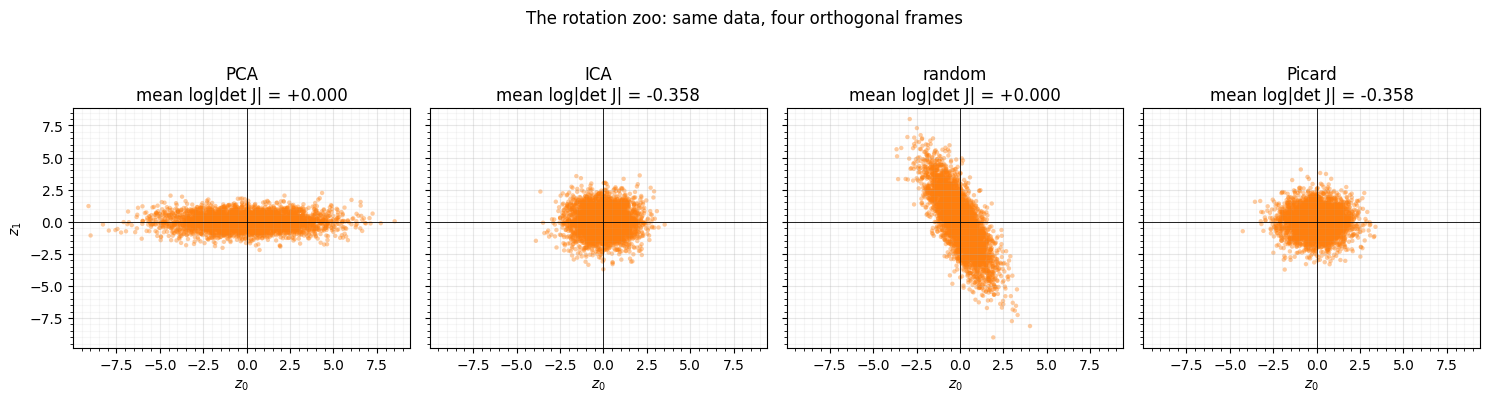
Each rotation re-expresses the same cloud in a different orthogonal frame. PCA aligns the axes with the directions of maximum variance (here the diagonal), so the cloud comes out axis-aligned. ICA and Picard instead hunt for the most non-Gaussian projections. Random just picks some Haar frame — no fitting at all. Crucially, all four are pure rotations: their mean log-determinant is 0.
2. A pure rotation is free; whitening is not
The log-det printed above was 0 because for an orthogonal . That is the same fact Part 0 used to call rotations “free” inside a composed flow (composition log-det): a rotation re-frames the data without stretching volume, so it adds nothing to . But beware — PCA-whitening is a rotation and a per-axis rescale (), and that scaling is not free:
rot_only = rbig.PCARotation(whiten=False).fit(X)
whiten = rbig.PCARotation(whiten=True).fit(X)
print(f"PCA rotation only (whiten=False): mean log|det J| = "
      f"{np.mean(rot_only.log_det_jacobian(X)):+.4f}   <- free")
print(f"PCA whitening   (whiten=True):    mean log|det J| = "
      f"{np.mean(whiten.log_det_jacobian(X)):+.4f}   <- pays for the rescale")
print(f"  (the rescale contributes -sum(0.5*log(eigvals)) of Cov(X))")
PCA rotation only (whiten=False): mean log|det J| = +0.0000 <- free
PCA whitening (whiten=True): mean log|det J| = -0.3585 <- pays for the rescale
(the rescale contributes -sum(0.5*log(eigvals)) of Cov(X))
So when Part 2 talks about “rotations are free”, it means the orthogonal part. A whitening step folds in a diagonal scaling whose log-det is — cheap to compute, but not zero. Most RBIG variants keep the rotation pure and let the marginal step do the rescaling, which keeps the bookkeeping clean.
3. Why rotation matters: the stuck-vs-unstuck demo
Here is the whole reason Part 2 exists. Take strongly correlated data and run
the marginal-Gaussianization step on its own, repeatedly. Then run it again
with a rotation inserted between passes. We measure progress with the total
correlation Watanabe (1960) —
the multi-information that is 0 iff the coordinates are independent, and
which rbig.total_correlation estimates directly.
def marginal_gaussianize(A):
    """One per-coordinate Gaussianization pass (the Part 1 atom)."""
    return rbig.MarginalGaussianize().fit(A).transform(A)

def total_corr(A):
    return float(rbig.total_correlation(A))

# Highly correlated, near-Gaussian data so that ONLY the dependence is the
# obstacle — marginals are already easy, the joint is not.
s = rng.standard_normal(n)
Xc = np.stack([s + 0.3 * rng.standard_normal(n),
               s + 0.3 * rng.standard_normal(n)], axis=1)

n_iter = 8
schemes = {
    "marginal only": None,
    "marginal + PCA rotation": lambda k: rbig.PCARotation(whiten=False),
    "marginal + random rotation": lambda k: rbig.RandomRotation(random_state=k),
}
histories = {}
for label, make_rot in schemes.items():
    A = Xc.copy()
    tc = [total_corr(A)]
    for k in range(n_iter):
        A = marginal_gaussianize(A)
        if make_rot is not None:
            A = make_rot(k).fit(A).transform(A)
        tc.append(total_corr(A))
    histories[label] = tc
    print(f"{label:28s} TC: " + " ".join(f"{v:5.3f}" for v in tc))
marginal only TC: 0.922 0.925 0.925 0.925 0.925 0.925 0.925 0.925 0.925
marginal + PCA rotation TC: 0.922 -0.003 0.000 -0.004 -0.000 0.000 0.000 0.000 0.000
marginal + random rotation TC: 0.922 0.859 0.002 -0.002 0.001 -0.001 -0.000 -0.001 0.001
fig, (axL, axR) = plt.subplots(1, 2, figsize=(12, 4.4))

colors = {"marginal only": "tab:red",
          "marginal + PCA rotation": "tab:green",
          "marginal + random rotation": "tab:blue"}
for label, tc in histories.items():
    axL.plot(range(len(tc)), tc, "o-", color=colors[label], lw=2, ms=5, label=label)
axL.axhline(0, **{"color": "k", "lw": 1.5, "ls": "--"}, label="independent (TC = 0)")
axL.set(title="Marginal-only stalls; a rotation unsticks it",
        xlabel="iteration", ylabel="total correlation (nats)")
axL.legend(fontsize=8); style_ax(axL)

# Right: the geometry — marginal-only leaves a tilted Gaussian-on-the-diagonal.
A_marg = Xc.copy()
for _ in range(n_iter):
    A_marg = marginal_gaussianize(A_marg)
axR.scatter(A_marg[:, 0], A_marg[:, 1], color="tab:red", **SCATTER_KW,
            label="marginal-only (still correlated)")
A_rot = Xc.copy()
for k in range(n_iter):
    A_rot = marginal_gaussianize(A_rot)
    A_rot = rbig.PCARotation(whiten=False).fit(A_rot).transform(A_rot)
axR.scatter(A_rot[:, 0], A_rot[:, 1], color="tab:green", **SCATTER_KW,
            label="marginal + rotation (isotropic)")
axR.set(title="The joint after 8 passes", xlabel="$z_0$", ylabel="$z_1$",
        xlim=(-4, 4), ylim=(-4, 4))
axR.axhline(0, color="k", lw=0.6); axR.axvline(0, color="k", lw=0.6)
axR.legend(fontsize=8, loc="upper left"); style_ax(axR)
fig.tight_layout()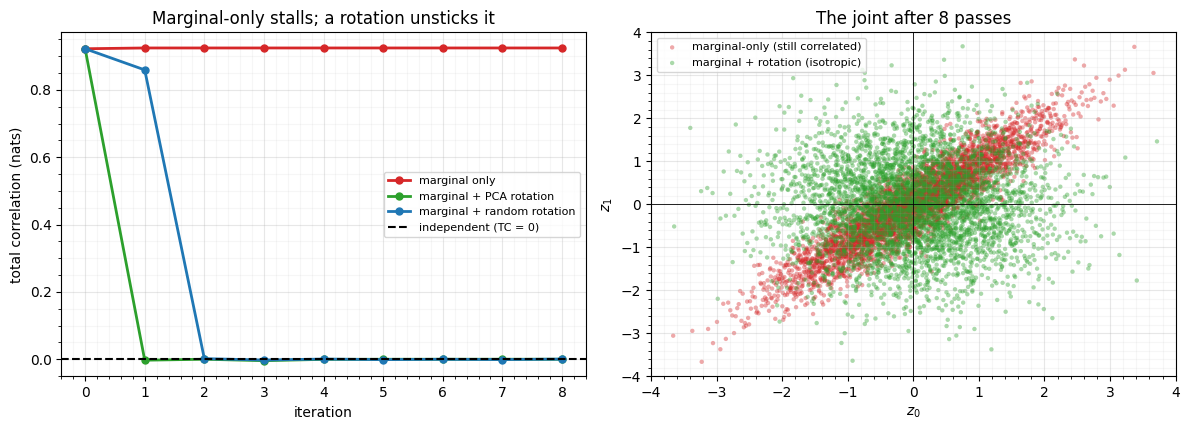
Marginal-only (red) is stuck. Each pass dutifully makes both axes , but a separable map can never remove the diagonal correlation, so the total correlation plateaus around 0.9 nats forever — the scatter stays a tilted ellipse pinned to the diagonal. A separable transform has a separable image; you cannot reach this way.
Insert a rotation and the obstacle dissolves. The rotation mixes the two coordinates, so the next marginal pass sees fresh non-Gaussian structure to remove. With PCA the data is near-Gaussian, so a single decorrelating rotation collapses TC to 0 in one step. A random rotation has no idea where the correlation lives, so it takes a couple of passes — but it does converge. That robustness is the theoretical heart of RBIG Laparra et al. (2011): for near-Gaussian targets almost any rotation works, because each marginal pass can only reduce the total correlation and a generic rotation keeps exposing reducible structure.
4. Rotation choice sets the convergence speed
The demo already hints at it: PCA reached independence in one step, random in two. That difference — same destination, different speed — is what makes rotation choice a real design knob. We make it explicit by counting passes to drive TC below a tolerance.
tol = 1e-2
print(f"passes to reach TC < {tol}:")
for label, tc in histories.items():
    if label == "marginal only":
        print(f"  {label:28s} never (plateau at {tc[-1]:.3f})")
        continue
    hit = next((i for i, v in enumerate(tc) if abs(v) < tol), None)
    print(f"  {label:28s} {hit} passes")
passes to reach TC < 0.01:
marginal only never (plateau at 0.925)
marginal + PCA rotation 1 passes
marginal + random rotation 2 passes
PCA wins here because the data is Gaussian and correlated — exactly the case its eigenvector frame is built for. On heavy-tailed or multimodal data, ICA and Picard can win instead by aligning to the non-Gaussian directions, while random is the safe, fit-free default whose only cost is a few extra passes. Part 3 turns this into a proper rotation-choice convergence study; here the point is simply that the between-coordinate step is not an afterthought — it is half the algorithm.
Recap
| idea | takeaway |
|---|---|
| rotation = orthogonal map | exactly invertible, volume-preserving ($\log |
| marginal-only Gaussianization | fixes marginals, cannot remove dependence — stalls |
| rotation between passes | mixes coordinates so the next marginal pass progresses → TC |
| rotation choice | sets convergence speed: PCA (variance), ICA/Picard (non-Gaussianity), random (free, robust) |
| whitening ≠ pure rotation | the rescale costs a log-det |
Next up. A random or PCA rotation is fixed once fit. To learn the rotation end-to-end inside a flow we need an orthogonal matrix that stays orthogonal under gradient descent. 01 — Householder & trainable orthogonals builds two such parameterisations from scratch — products of Householder reflections and the Cayley map — both exactly orthogonal, both with log-det 0.
- Laparra, V., Camps-Valls, G., & Malo, J. (2011). Iterative Gaussianization: From ICA to Random Rotations. IEEE Transactions on Neural Networks, 22(4), 537–549. 10.1109/TNN.2011.2106511
- Hyvärinen, A., & Oja, E. (2000). Independent Component Analysis: Algorithms and Applications. Neural Networks, 13(4–5), 411–430.
- Ablin, P., Cardoso, J.-F., & Gramfort, A. (2018). Faster Independent Component Analysis by Preconditioning with Hessian Approximations. IEEE Transactions on Signal Processing, 66(15), 4040–4049.
- Watanabe, S. (1960). Information Theoretical Analysis of Multivariate Correlation. IBM Journal of Research and Development, 4(1), 66–82. 10.1147/rd.41.0066