The canonical RBIG loop
Alternating marginal Gaussianization and rotation to drive a distribution to N(0, I) — forward for density, inverse for generation
00 — The canonical RBIG loop
We now have both halves of Gaussianization. Part 1 turns one coordinate into a standard normal; Part 2 mixes coordinates with a rotation so the next marginal pass has something to do. Rotation-Based Iterative Gaussianization Laparra et al. (2011) is the algorithm that stacks them:
where is the per-coordinate marginal Gaussianization and is an orthogonal rotation. Iterate, and the distribution flows to — a density destructor in the sense of Inouye & Ravikumar Inouye & Ravikumar (2018) (Part 0 04). Because every block is invertible, the whole stack is invertible: run it forward to evaluate density, backward to generate.
What you will see
- One RBIG layer = marginal Gaussianization + rotation, built from
rbig. - The morph: two-moons → , snapshot layer by layer.
- Forward vs inverse: Gaussianize the data, then sample and run the layers in reverse to generate two-moons back.
- Confirming against
rbig.AnnealedRBIGand the smoothgauss_flowsRBIG, whose exact log-det gives a trustworthy density.
import warnings

warnings.filterwarnings("ignore")

import jax
import jax.numpy as jnp
import jax.random as jr
import matplotlib.pyplot as plt
import numpy as np
from sklearn.datasets import make_moons

import gauss_flows as gf
import rbig
from _style import SCATTER_KW, style_ax

jax.config.update("jax_enable_x64", True)
rng = np.random.default_rng(0)

X, _ = make_moons(n_samples=4000, noise=0.07, random_state=0)
X = (X - X.mean(0)) / X.std(0)
1. One RBIG layer
A single layer does two things in sequence. First, marginal Gaussianization
(Ψ): map each coordinate through so every axis
becomes standard normal — but the joint stays dependent (Part 2
00 showed this alone stalls). Then a
rotation (): re-frame the coordinates so the next marginal pass sees fresh
non-Gaussian structure. rbig.MarginalGaussianize and rbig.PCARotation are the
two pieces.
mg = rbig.MarginalGaussianize().fit(X)
X_marg = mg.transform(X)
rot = rbig.PCARotation(whiten=False).fit(X_marg)
X_rot = rot.transform(X_marg)

fig, axes = plt.subplots(1, 3, figsize=(13.5, 4.2), sharex=True, sharey=True)
for ax, D, t in zip(axes, [X, X_marg, X_rot],
                    ["input (two-moons)", "after marginal $\\Psi$ (axes ~N(0,1))",
                     "after rotation $Q$ (re-framed)"]):
    ax.scatter(D[:, 0], D[:, 1], color="tab:blue", **SCATTER_KW)
    ax.set(title=t, xlabel="$x_0$")
    ax.axhline(0, color="k", lw=0.6); ax.axvline(0, color="k", lw=0.6)
    style_ax(ax)
axes[0].set_ylabel("$x_1$")
fig.suptitle("One RBIG layer = marginal Gaussianization, then rotation", y=1.02)
fig.tight_layout()
print(f"after marginal: per-axis std = {X_marg.std(0).round(3)}  (each ~1, but joint still moon-shaped)")
after marginal: per-axis std = [1. 1.] (each ~1, but joint still moon-shaped)
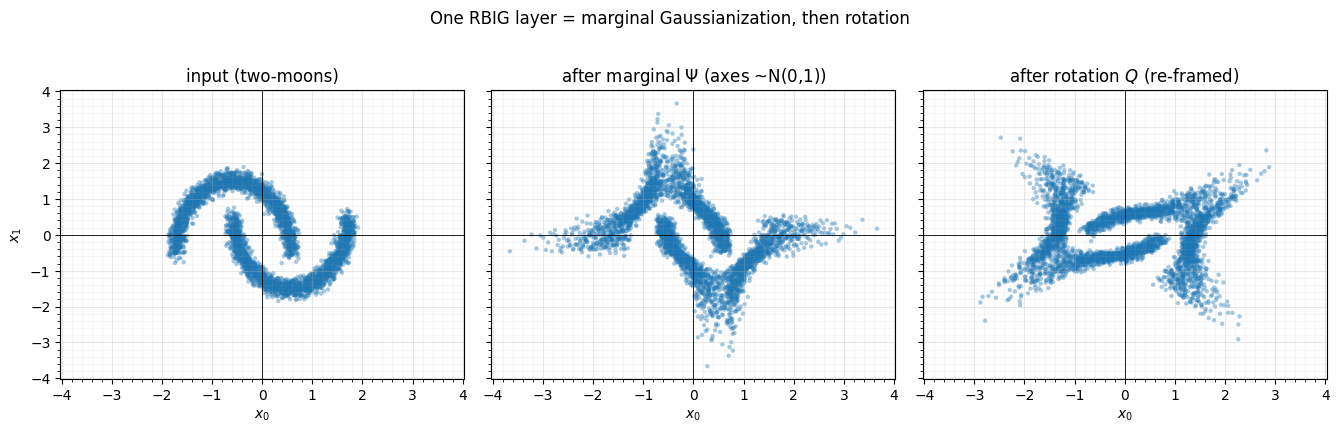
The marginal step makes each axis standard normal, but the cloud is still clearly two crescents — a separable map cannot remove that. The rotation mixes the axes; now the next layer’s marginal step has new structure to attack. Stacking this block is the whole algorithm.
2. The morph: two-moons → 
We build the loop from scratch — fit a layer, transform, repeat — keeping each intermediate state and the total correlation (Part 2’s dependence measure, 0 iff independent). Watch the crescents dissolve into an isotropic Gaussian blob.
def rbig_fit(X, n_layers, seed=0):
    """Fit an RBIG stack; return per-layer snapshots, TC trace, and the layers."""
    A = X.copy()
    snaps, tc, layers = [A.copy()], [float(rbig.total_correlation(A))], []
    for _ in range(n_layers):
        mg = rbig.MarginalGaussianize().fit(A); A = mg.transform(A)
        rot = rbig.PCARotation(whiten=False).fit(A); A = rot.transform(A)
        layers.append((mg, rot))
        snaps.append(A.copy()); tc.append(float(rbig.total_correlation(A)))
    return snaps, tc, layers

n_layers = 12
snaps, tc, layers = rbig_fit(X, n_layers)
Z = snaps[-1]
print(f"final latent: mean = {Z.mean():+.3f}, std = {Z.std():.3f}, "
      f"|TC| = {abs(tc[-1]):.4f}  (independent)")

# Our hand-rolled loop matches the maintained rbig.AnnealedRBIG implementation.
Z_ann = rbig.AnnealedRBIG(n_layers=50, rotation="pca", random_state=0).fit_transform(X)
print(f"rbig.AnnealedRBIG latent: mean = {Z_ann.mean():+.3f}, std = {Z_ann.std():.3f}, "
      f"|TC| = {abs(float(rbig.total_correlation(Z_ann))):.4f}")

show = [0, 1, 2, 4, 8, 12]
fig, axes = plt.subplots(1, len(show), figsize=(16, 3.0), sharex=True, sharey=True)
for ax, k in zip(axes, show):
    ax.scatter(snaps[k][:, 0], snaps[k][:, 1], color="tab:blue", **SCATTER_KW)
    ax.set(title=f"layer {k}", xlabel="$x_0$" if k else "input")
    ax.axhline(0, color="k", lw=0.5); ax.axvline(0, color="k", lw=0.5)
    ax.set_aspect("equal"); style_ax(ax)
fig.suptitle("RBIG morph: two-moons dissolves into N(0, I)", y=1.05)
fig.tight_layout()
final latent: mean = -0.000, std = 1.000, |TC| = 0.0002 (independent)
rbig.AnnealedRBIG latent: mean = -0.000, std = 1.000, |TC| = 0.0002
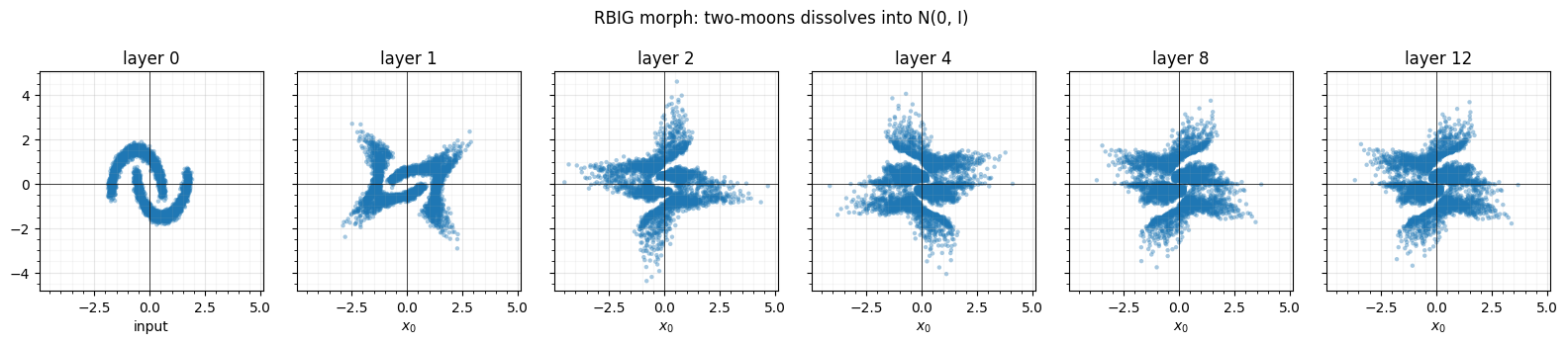
By a dozen layers the moons are an isotropic Gaussian and the total correlation has collapsed to (estimator) zero. Each layer chips away a little more non-Gaussianity — the formal monotone-decrease guarantee is the subject of notebook 01. Note the latent reaches in distribution; individual points are not preserved across the morph (it is a transport, not a labelling).
3. Forward for density, inverse for generation
Every block is invertible, so the stack runs both ways. Forward () is what we just did — Gaussianize the data. Inverse () runs the layers in reverse, each undoing its rotation then its marginal map; feed it and it generates new two-moons.
def rbig_inverse(Z, layers):
    A = Z.copy()
    for mg, rot in reversed(layers):
        A = rot.inverse_transform(A)
        A = mg.inverse_transform(A)
    return A

X_round = rbig_inverse(Z, layers)
err = np.abs(X - X_round).max(1)
print(f"round-trip error: median = {np.median(err):.2e}, max = {err.max():.2e} "
      f"(tails are worst — see notebook 04)")
round-trip error: median = 2.83e-03, max = 2.09e-01 (tails are worst — see notebook 04)
The round-trip is near machine precision in the bulk and degrades only in the
tails (max ), the boundary effect notebook 04 is devoted to. So the
inverse mechanism is correct. Generation quality, though, depends on how
smooth the marginal map is. Our from-scratch loop uses histogram marginals
(Part 1 00): their inverse
is piecewise-flat, so sampling and inverting yields a
diffuse cloud — the moons are there but smeared. Swap in the smooth
mixture-CDF marginals of gauss_flows’ RBIG (Part 1
01) and the same procedure
generates crisp crescents. We sample both and compare.
Z_samp = rng.standard_normal((3000, 2))
X_gen_hist = rbig_inverse(Z_samp, layers)                    # histogram marginals (blocky)

res = gf.fit_rbig(jnp.asarray(X), n_layers=40, n_components=12, random_state=0)
X_gen_smooth = np.asarray(jax.vmap(res.sample)(jr.split(jr.key(0), 3000)))  # smooth mixture-CDF

fig, axes = plt.subplots(1, 3, figsize=(13.5, 4.6), sharex=True, sharey=True)
axes[0].scatter(X[:, 0], X[:, 1], color="tab:blue", **SCATTER_KW)
axes[0].set(title="data (two-moons)", xlabel="$x_0$", ylabel="$x_1$")
axes[1].scatter(X_gen_hist[:, 0], X_gen_hist[:, 1], color="tab:red", **SCATTER_KW)
axes[1].set(title="generated — histogram marginals (diffuse)", xlabel="$x_0$")
axes[2].scatter(X_gen_smooth[:, 0], X_gen_smooth[:, 1], color="tab:green", **SCATTER_KW)
axes[2].set(title="generated — smooth mixture-CDF (crisp)", xlabel="$x_0$")
for ax in axes:
    ax.set_aspect("equal"); ax.set(xlim=(-2.5, 2.5), ylim=(-2.5, 2.5)); style_ax(ax)
fig.suptitle(r"RBIG runs backwards to generate: $z\sim\mathcal{N}(0,I)\to T^{-1}(z)$", y=1.02)
fig.tight_layout()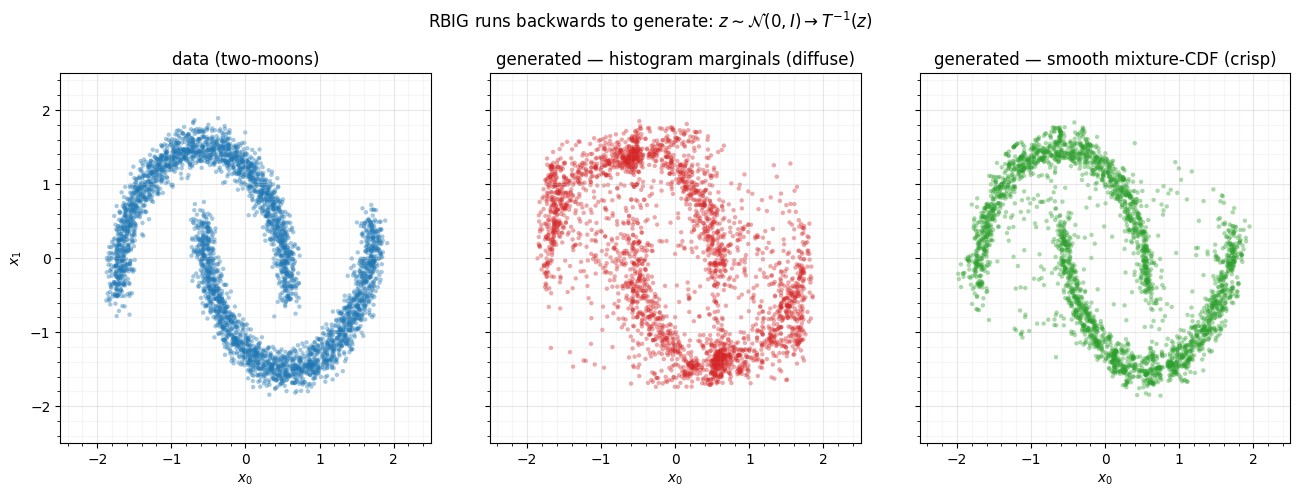
Same algorithm, same number of effective passes — the only difference is the
marginal estimator. The histogram inverse scatters samples because its quantile
function is a staircase; the smooth mixture-CDF inverse traces the manifold
cleanly. The lesson generalises: for generation, use a smooth marginal;
histograms are fine for a quick Gaussianization but blocky to sample from. This is
also why the next notebooks lean on gauss_flows whenever sample/density quality
matters.
4. The density
The same smooth gauss_flows RBIG gives a trustworthy density: with
mixture-CDF marginals and an exact autodiff log-det, is well-defined
(unlike the histogram version, whose pointwise Jacobian is rough). On
data its mean log-density matches the analytic value to two
decimals; on two-moons its density concentrates on the crescents the generator
samples.
# Sanity-check the density on N(0, I): mean log p should be the analytic -2.838.
G = jnp.asarray(rng.standard_normal((4000, 2)))
res_G = gf.fit_rbig(G, n_layers=12, n_components=12, random_state=0)
print(f"gf.fit_rbig log p on N(0,I): mean = {float(jax.vmap(res_G.log_prob)(G).mean()):.3f} "
      f"(analytic -2.838)")

# Density of the two-moons RBIG -> contour over the data.
gx, gy = np.meshgrid(np.linspace(-2.5, 2.5, 140), np.linspace(-2.5, 2.5, 140))
grid = jnp.asarray(np.column_stack([gx.ravel(), gy.ravel()]))
logp = np.asarray(jax.vmap(res.log_prob)(grid)).reshape(gx.shape)

fig, ax = plt.subplots(figsize=(5.6, 5.0))
ax.contourf(gx, gy, np.exp(logp), levels=18, cmap="viridis")
ax.scatter(X[:, 0], X[:, 1], s=4, color="white", alpha=0.25)
ax.set(title="gauss_flows RBIG density $p(x)$ (exact log-det)",
       xlabel="$x_0$", ylabel="$x_1$")
ax.set_aspect("equal")
fig.tight_layout()
gf.fit_rbig log p on N(0,I): mean = -2.849 (analytic -2.838)
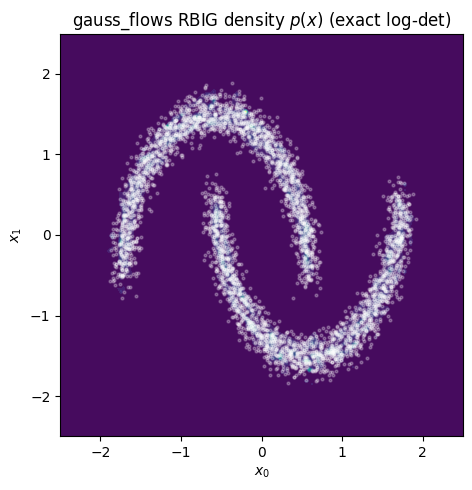
The learned density concentrates on the two crescents — the same object the
generator samples from. Two takeaways for the rest of Part 3: rbig gives the
canonical iterative algorithm and the information-theoretic measures (used next
for convergence), while gauss_flows gives the smooth differentiable version
whose exact log-det we trust for likelihoods and which Part 4 (parametric
Gaussianization flows) fine-tunes end-to-end.
Recap
| piece | role |
|---|---|
| marginal Ψ (Part 1) | makes each axis ; alone it stalls |
| rotation (Part 2) | mixes axes so the next marginal pass progresses |
| stack | drives the joint to — a density destructor |
| forward | density / Gaussianization |
| inverse | generation (sample , invert) |
Next up. We morphed for a fixed 12 layers. How many do we actually need, and how do we know we are done? 01 — Convergence & stopping shows that each layer provably reduces a non-Gaussianity measure (negentropy / total correlation), turning that into a principled stopping criterion.
- Laparra, V., Camps-Valls, G., & Malo, J. (2011). Iterative Gaussianization: From ICA to Random Rotations. IEEE Transactions on Neural Networks, 22(4), 537–549. 10.1109/TNN.2011.2106511
- Inouye, D. I., & Ravikumar, P. (2018). Deep Density Destructors. International Conference on Machine Learning (ICML).