Skip to article frontmatterSkip to article content
Site not loading correctly?

This may be due to an incorrect BASE_URL configuration. See the MyST Documentation for reference.

Zero-kernel ≡ diagonal

Zero-kernel coupling ≡ diagonal Gaussianization

A coupling flow with mixture-CDF blocks normally captures cross-dim dependence via the conditioner. But when the conditioner is zero-initialised — specifically, when the final Dense of the conditioner has kernel W=0W = 0 — something interesting happens: the flow collapses into a plain diagonal Gaussianization flow.

This notebook:

  1. Recaps the four objects at play (the mixture-CDF primitive, the diagonal Gaussianization flow, iterative vs parametric training, the coupling flow).
  2. Works through the math showing the equivalence (Lemmas 1–3 → Theorem → Corollary).
  3. Verifies it empirically: build matched diagonal and coupling flows, IG-initialise both, compare pushforwards element-wise.
  4. Shows that a single gradient step is enough for the coupling flow to break the equivalence — its conditioner starts modulating on xax_a and the flow becomes strictly more expressive.

The upshot: IG init on a coupling flow gives you the best of both worlds — a well-understood RBIG starting point and a conditioner waiting to do cross-dim work once training begins.

1. Mathematical recap

Self-contained summary of the pieces so this notebook stands on its own.

Notation and shapes

  • dd — data dimensionality, KK — mixture components per marginal, NN — batch size, LL — number of blocks in the flow.
  • Random vector XpXX \sim p_X on Rd\mathbb{R}^d (what we have data from). Latent ZpZ=N(0,Id)Z \sim p_Z = \mathcal{N}(0, I_d) (what we want the flow to land on).
  • Bijective map f:RdRdf: \mathbb{R}^d \to \mathbb{R}^d with Jacobian Jf(x)Rd×dJ_f(x) \in \mathbb{R}^{d \times d}.

Change of variables (the one identity behind everything)

For a bijection z=f(x)z = f(x) and any base density pZp_Z,

logpX(x)  =  logpZ ⁣(f(x))  +  logdetJf(x).\log p_X(x) \;=\; \log p_Z\!\big(f(x)\big) \;+\; \log\lvert\det J_f(x)\rvert.

Training minimises the negative of this averaged over data — the NLL.

1-D mixture-CDF Gaussianization (the primitive)

Classical probability integral transform: if XX has strictly increasing CDF FF, then F(X)Uniform[0,1]F(X) \sim \text{Uniform}[0, 1], so Φ1(F(X))N(0,1)\Phi^{-1}(F(X)) \sim \mathcal{N}(0, 1). We approximate FF with a mixture of KK normals,

F(x;π,μ,σ)  =  k=1KπkΦ ⁣((xμk)/σk),f(x;π,μ,σ)  =  k=1Kπkσk1φ ⁣((xμk)/σk).F(x;\,\pi, \mu, \sigma) \;=\; \sum_{k=1}^{K} \pi_k \,\Phi\!\big((x - \mu_k)/\sigma_k\big), \qquad f(x;\,\pi, \mu, \sigma) \;=\; \sum_{k=1}^{K} \pi_k\,\sigma_k^{-1}\,\varphi\!\big((x - \mu_k)/\sigma_k\big).

Parameter shapes: πΔK1\pi \in \Delta^{K-1} (weights on the simplex), μRK\mu \in \mathbb{R}^K, σR>0K\sigma \in \mathbb{R}_{>0}^K. The forward map and its log-derivative are

z  =  Φ1 ⁣(F(x)),logz/x  =  logf(x)logφ(z).z \;=\; \Phi^{-1}\!\big(F(x)\big), \qquad \log\lvert \partial z / \partial x \rvert \;=\; \log f(x) - \log \varphi(z).

Inverse uses monotone bisection on F(x)=Φ(z)F(x) = \Phi(z).

Diagonal marginal Gaussianization layer (MixtureCDFGaussianization)

Lift the 1-D primitive to dd dims by applying it independently per dim. Parameters are tensors of shape (d,K)(d, K):

πRd×K,μRd×K,logσRd×K.\pi \in \mathbb{R}^{d \times K}, \qquad \mu \in \mathbb{R}^{d \times K}, \qquad \log\sigma \in \mathbb{R}^{d \times K}.

Forward: zi=Φ1 ⁣(F(xi;πi,μi,σi))z_i = \Phi^{-1}\!\big(F(x_i;\, \pi_i, \mu_i, \sigma_i)\big) for each i=1,,di = 1, \dots, d. Jacobian is diagonal, so

logdetJdiag(x)  =  i=1d[logf(xi;πi,μi,σi)logφ(zi)].\log\lvert\det J_{\text{diag}}(x)\rvert \;=\; \sum_{i=1}^{d} \big[\log f(x_i;\, \pi_i, \mu_i, \sigma_i) \,-\, \log\varphi(z_i)\big].

Rotation layer

Orthogonal QO(d)Q \in O(d) — either a Householder product Q=HK1H0Q = H_{K-1}\cdots H_0 with Hj=I2vjvj/vj2H_j = I - 2\,v_j v_j^\top / \lVert v_j \rVert^2, or a fixed (frozen) matrix. detQ=1\lvert\det Q\rvert = 1, so rotations contribute zero to the flow’s log-det. Their role is to redistribute non-Gaussianity across dims between marginal blocks — a marginal layer can only Gaussianize dim-by-dim, so the rotation “mixes” structure that’s otherwise stuck in single dims.

A full Gaussianization flow: LL blocks of (rotation, marginal)

f(x)  =  (margLQL)(marg1Q1)(x)f(x) \;=\; \big(\text{marg}_L \circ Q_L\big) \circ \cdots \circ \big(\text{marg}_1 \circ Q_1\big)(x)

with total log-det logdetJmarg\sum_{\ell} \log\lvert\det J_{\text{marg}_\ell}\rvert (rotations drop out).

Iterative Gaussianization — RBIG (Laparra & Malo 2011)

Greedy, non-gradient fit. Walk through the flow one block at a time. Starting with Y(0)=XY^{(0)} = X:

  1. Fit Q=Q_\ell = PCA(Y(1))(Y^{(\ell-1)}), rotate: Y=Y(1)QY'_\ell = Y^{(\ell-1)} Q_\ell.
  2. Fit per-dim GMM via EM on each column of YY'_\ell(π,μ,σ)(\pi_\ell, \mu_\ell, \sigma_\ell) of shape (d,K)(d, K).
  3. Apply the marginal transform: Y()=Y^{(\ell)} = marg(Y;π,μ,σ)(Y'_\ell;\, \pi_\ell, \mu_\ell, \sigma_\ell).
  4. Increment \ell and repeat.

Laparra & Malo show the negentropy J(Y())=DKL ⁣(Y()N(0,I))J(Y^{(\ell)}) = D_\text{KL}\!\big(Y^{(\ell)} \,\Vert\, \mathcal{N}(0, I)\big) decreases at a geometric rate under mild conditions. Remarkably, this already gives a decent density estimator — before any gradient descent.

Parametric Gaussianization

Same architecture as above. All parameters {(π,μ,σ,Q)}=1L\{(\pi_\ell, \mu_\ell, \sigma_\ell, Q_\ell)\}_{\ell=1}^{L} are learned jointly by gradient descent on the NLL. Gradient flows through the whole composition, so later blocks can compensate for finite-KK approximation errors in earlier blocks — something RBIG fundamentally cannot do.

Coupling flow (the MixtureCDFCoupling layer)

Swap the diagonal marginal for a conditional transform. Pick a mask m{0,1}dm \in \{0, 1\}^d. It splits xx into an “identity” half xax_a (indices where mi=1m_i = 1, size dad_a) and a “transformed” half xbx_b (indices where mi=0m_i = 0, size db=ddad_b = d - d_a).

A conditioner θ:RdaR3dbK\theta: \mathbb{R}^{d_a} \to \mathbb{R}^{3 \cdot d_b \cdot K} maps xax_a to the mixture parameters that will Gaussianize xbx_b. Decompose it through its final Dense as

θ(xa)  =  Wϕ(xa)+c,\theta(x_a) \;=\; W\,\phi(x_a) + c,

where ϕ(xa)Rh\phi(x_a) \in \mathbb{R}^{h} is the output of the MLP body, WRh×3dbKW \in \mathbb{R}^{h \times 3 d_b K}, cR3dbKc \in \mathbb{R}^{3 d_b K}. The output is reshaped to (3,db,K)(3, d_b, K) and split into (πi(xa),μi(xa),logσi(xa))ib(\pi_i(x_a), \mu_i(x_a), \log\sigma_i(x_a))_{i \in b} — one mixture per bb-dim, depending on xax_a.

The forward map:

za  =  xa,zb,i  =  Φ1 ⁣(F(xb,i;πi(xa),μi(xa),σi(xa)))    for ib.z_a \;=\; x_a, \qquad z_{b,i} \;=\; \Phi^{-1}\!\big(F(x_{b,i};\, \pi_i(x_a), \mu_i(x_a), \sigma_i(x_a))\big) \;\; \text{for } i \in b.

Jacobian is block-triangular (top half is the identity on xax_a, bottom-left carries zb/xa\partial z_b / \partial x_a, bottom-right is diagonal). Only the bottom-right diagonal enters the determinant:

logdetJcoupling(x)  =  iblogzb,i/xb,i  =  ib[logf(xb,i;θi(xa))logφ(zb,i)].\log\lvert\det J_\text{coupling}(x)\rvert \;=\; \sum_{i \in b} \log\lvert \partial z_{b,i} / \partial x_{b,i} \rvert \;=\; \sum_{i \in b} \big[\log f(x_{b,i};\, \theta_i(x_a)) - \log\varphi(z_{b,i})\big].

Same form as the diagonal marginal’s log-det — only difference is that the mixture params are functions of xax_a instead of fixed.

make_coupling_flow stacks blocks of [rotation,couple(m),couple(¬m)][\text{rotation},\, \text{couple}(m),\, \text{couple}(\neg m)]: the mask swap ensures that both halves get transformed within each block.

The equivalence we’re going to prove

A diagonal Gaussianization flow is strictly less expressive than a coupling flow — the coupling has the freedom to modulate its mixture on xax_a (through θ); the diagonal cannot. But when the conditioner’s final Dense has W=0W = 0, the function collapses: θ(xa)=c\theta(x_a) = c is the same for every xax_a, and the coupling layer reduces exactly to a diagonal marginal with params unpacked from cc. This is the regime IG init puts the coupling flow into.

2. The setup — coupling layer, decomposed

With the recap in hand, zoom in on a single coupling layer. Input xRN×dx \in \mathbb{R}^{N \times d} (batch NN, dim dd). Mask mm picks the dad_a “identity” dims and db=ddad_b = d - d_a “transformed” dims. Write xaRN×dax_a \in \mathbb{R}^{N \times d_a} and xbRN×dbx_b \in \mathbb{R}^{N \times d_b} for the two halves.

The conditioner final-Dense decomposition repeated here for convenience:

θ(xa)  =  Wϕ(xa)+c.\theta(x_a) \;=\; W\,\phi(x_a) + c.

IG init sets W=0W = 0 and cc to the RBIG fit.

Lemma 1 — the conditioner becomes a constant

With W=0W = 0,

θ(xa)  =  0ϕ(xa)+c  =  cfor every xa.\theta(x_a) \;=\; 0 \cdot \phi(x_a) + c \;=\; c \quad \text{for every } x_a.

Every example sees the same mixture parameters. The forward pass on xbx_b is therefore

zb  =  Φ1 ⁣(F(xb;c)),z_b \;=\; \Phi^{-1}\!\big(F(x_b;\,c)\big),

a function of xbx_b alone.

Lemma 2 — the log-det collapses to a diagonal

The coupling Jacobian is block-triangular:

Jcoupling  =  (Ida0diag(zb,i/xb,i)).J_{\text{coupling}} \;=\; \begin{pmatrix} I_{d_a} & 0 \\ \ast & \mathrm{diag}(\partial z_{b,i}/\partial x_{b,i}) \end{pmatrix}.

The off-diagonal block \ast carries θ(xa)/xa\partial \theta(x_a)/\partial x_a through the chain rule, but with W=0W = 0 we get θ/xa=0\partial \theta / \partial x_a = 0, so =0\ast = 0 too. The matrix is now block-diagonal, and

logdetJcoupling  =  iblogzb,i/xb,i.\log\lvert\det J_\text{coupling} \rvert \;=\; \sum_{i \in b} \log\lvert \partial z_{b,i}/\partial x_{b,i} \rvert.

Which is exactly what a diagonal MixtureCDFGaussianization layer would produce on the same bb-indices with the same mixture params.

Lemma 3 — two complementary-mask layers pair into one full-dd marginal (pedantic)

A single coupling layer only transforms the bb-dim half. make_coupling_flow uses pairs [couple(m), couple(~m)] inside each block. Claim: with zero-kernel init, one such pair equals one full-dd diagonal marginal layer. Proof by index chase.

Let the first layer use mask mm with index set a1={i:mi=1}a_1 = \{i : m_i = 1\}, b1={i:mi=0}b_1 = \{i : m_i = 0\}, da1=a1d_{a_1} = \lvert a_1 \rvert, db1=b1d_{b_1} = \lvert b_1 \rvert. Its zero-kernel parameters pack into a bias c(1)R3db1Kc^{(1)} \in \mathbb{R}^{3 d_{b_1} K} encoding per-b-dim params θi(1)=(πi(1),μi(1),σi(1))\theta^{(1)}_i = (\pi^{(1)}_i, \mu^{(1)}_i, \sigma^{(1)}_i) for ib1i \in b_1. Forward:

yi  =  xiia1,yi  =  Φ1(F(xi;θi(1)))ib1.y_i \;=\; x_i \quad \forall i \in a_1, \qquad y_i \;=\; \Phi^{-1}(F(x_i;\,\theta^{(1)}_i)) \quad \forall i \in b_1.

The second layer uses ¬m\neg m. Its index sets are swapped: a2=b1a_2 = b_1, b2=a1b_2 = a_1. With its zero-kernel bias c(2)c^{(2)} encoding params θi(2)\theta^{(2)}_i for ia1i \in a_1, forward:

zi  =  yiia2=b1,zi  =  Φ1(F(yi;θi(2)))ib2=a1.z_i \;=\; y_i \quad \forall i \in a_2 = b_1, \qquad z_i \;=\; \Phi^{-1}(F(y_i;\,\theta^{(2)}_i)) \quad \forall i \in b_2 = a_1.

Now substitute yy in terms of xx. For ib1i \in b_1 we have zi=yi=Φ1(F(xi;θi(1)))z_i = y_i = \Phi^{-1}(F(x_i;\,\theta^{(1)}_i)) (unchanged by layer 2). For ia1i \in a_1 we have yi=xiy_i = x_i (untouched by layer 1), so zi=Φ1(F(xi;θi(2)))z_i = \Phi^{-1}(F(x_i;\,\theta^{(2)}_i)). Combining:

zi  =  {Φ1(F(xi;θi(2))),ia1,Φ1(F(xi;θi(1))),ib1.z_i \;=\; \begin{cases} \Phi^{-1}(F(x_i;\,\theta^{(2)}_i)), & i \in a_1, \\ \Phi^{-1}(F(x_i;\,\theta^{(1)}_i)), & i \in b_1. \end{cases}

Each dimension is Gaussianized independently by its own mixture, with no cross-dim interaction — the definition of a full-dd diagonal marginal layer. Take its parameters to be

θi  =  {θi(2),ia1,θi(1),ib1,\theta_i \;=\; \begin{cases} \theta^{(2)}_i, & i \in a_1, \\ \theta^{(1)}_i, & i \in b_1, \end{cases}

and the coupling pair equals MixtureCDFGaussianization with those parameters. Log-dets add the same way:

logdetJ  =  ia1logzi/yi+ib1logyi/xi  =  i=1dlogzi/xi.\log|\det J| \;=\; \sum_{i \in a_1} \log\lvert\partial z_i / \partial y_i \rvert + \sum_{i \in b_1} \log\lvert\partial y_i/\partial x_i\rvert \;=\; \sum_{i = 1}^{d} \log\lvert\partial z_i / \partial x_i\rvert. \qquad\square

Theorem — full-flow equivalence at zero-kernel init

A coupling flow

fcpl  =  [rotL,couple(m),couple(¬m)][rot1,couple(m),couple(¬m)]f_\text{cpl} \;=\; \big[\text{rot}_L,\,\text{couple}(m),\,\text{couple}(\neg m)\big] \circ \cdots \circ \big[\text{rot}_1,\,\text{couple}(m),\,\text{couple}(\neg m)\big]

with zero-kernel init on every coupling layer reduces, by Lemma 3 applied block-by-block, to

fdiag  =  [rotL,marginalL][rot1,marginal1],f_\text{diag} \;=\; \big[\text{rot}_L,\,\text{marginal}_L\big] \circ \cdots \circ \big[\text{rot}_1,\,\text{marginal}_1\big],

provided the rotations and marginal parameters are matched. initialize_flow_from_ig walks both kinds of flow with the same per-block PCA and per-dim GMM fits (seeded by (block_idx, dim_idx)), so the matching holds automatically.

Corollary — both flows equal RBIG

Classical RBIG produces exactly the sequence of (rotation,marginal)(\text{rotation}, \text{marginal}) transforms that initialize_flow_from_ig assigns, so

fcplIG-init(x)  =  fdiagIG-init(x)  =  fRBIG(x)for every x.f^{\,\text{IG-init}}_\text{cpl}(x) \;=\; f^{\,\text{IG-init}}_\text{diag}(x) \;=\; f_\text{RBIG}(x) \quad \text{for every } x.

Time for a numerical check.

import os

os.environ["KERAS_BACKEND"] = "tensorflow"

import keras
import matplotlib.pyplot as plt
import numpy as np
import seaborn as sns
from keras import ops
from sklearn.datasets import make_moons

from gaussianization.gauss_keras import (
    base_nll_loss,
    initialize_flow_from_ig,
    make_coupling_flow,
    make_gaussianization_flow,
)

# --- global plot styling ------------------------------------------------------
sns.set_theme(context="poster", style="whitegrid", palette="deep", font_scale=0.85)
plt.rcParams.update(
    {
        "figure.dpi": 110,
        "savefig.dpi": 110,
        "savefig.bbox": "tight",
        "savefig.pad_inches": 0.2,
        "figure.constrained_layout.use": True,
        "figure.constrained_layout.h_pad": 0.1,
        "figure.constrained_layout.w_pad": 0.1,
        "axes.grid.which": "both",
        "grid.linewidth": 0.7,
        "grid.alpha": 0.5,
        "axes.edgecolor": "0.25",
        "axes.linewidth": 1.1,
        "axes.titleweight": "semibold",
        "axes.labelpad": 6,
    }
)


def style_axes(ax, *, aspect=None, grid=True):
    if grid:
        ax.minorticks_on()
        ax.grid(True, which="major", linewidth=0.8, alpha=0.6)
        ax.grid(True, which="minor", linewidth=0.4, alpha=0.3)
    if aspect is not None:
        ax.set_aspect(aspect)
    return ax


def style_jointgrid(g, aspect="equal"):
    style_axes(g.ax_joint, aspect=aspect)
    style_axes(g.ax_marg_x, grid=False)
    style_axes(g.ax_marg_y, grid=False)
    for spine in ("top", "right"):
        g.ax_marg_x.spines[spine].set_visible(False)
        g.ax_marg_y.spines[spine].set_visible(False)


palette = sns.color_palette("deep")
COLOR_CPL = palette[0]
COLOR_DIAG = palette[2]
COLOR_DELTA = palette[3]

keras.utils.set_random_seed(0)
np.random.seed(0)
WARNING: All log messages before absl::InitializeLog() is called are written to STDERR
I0000 00:00:1776870379.761267  442045 cpu_feature_guard.cc:227] This TensorFlow binary is optimized to use available CPU instructions in performance-critical operations.
To enable the following instructions: AVX2 AVX512F FMA, in other operations, rebuild TensorFlow with the appropriate compiler flags.

3. Matched flows on two moons

Same dataset as elsewhere. Build a diagonal flow and a coupling flow, both with num_blocks=4 and num_components=8, then IG-init both on the training data. Both flows see identical PCA and GMM fits by construction of initialize_flow_from_ig.

X_raw, _ = make_moons(n_samples=5000, noise=0.05, random_state=0)
X = (X_raw - X_raw.mean(axis=0)) / X_raw.std(axis=0)
X = X.astype("float32")

NUM_BLOCKS = 4
NUM_COMPONENTS = 8

keras.utils.set_random_seed(11)
flow_diag = make_gaussianization_flow(
    input_dim=2,
    num_blocks=NUM_BLOCKS,
    num_reflectors=2,
    num_components=NUM_COMPONENTS,
)
_ = flow_diag(ops.convert_to_tensor(X[:4]))
initialize_flow_from_ig(flow_diag, X)

keras.utils.set_random_seed(11)
flow_cpl = make_coupling_flow(
    input_dim=2,
    num_blocks=NUM_BLOCKS,
    num_components=NUM_COMPONENTS,
    hidden=(32, 32),
)
_ = flow_cpl(ops.convert_to_tensor(X[:4]))
initialize_flow_from_ig(flow_cpl, X)

print(f"diagonal flow bijectors : {len(flow_diag.bijector_layers)}")
print(f"coupling flow bijectors : {len(flow_cpl.bijector_layers)}")
print(f"diagonal flow trainable params : "
      f"{int(sum(np.prod(w.shape) for w in flow_diag.trainable_weights))}")
print(f"coupling flow trainable params : "
      f"{int(sum(np.prod(w.shape) for w in flow_cpl.trainable_weights))}")
E0000 00:00:1776870386.599572  442045 cuda_platform.cc:52] failed call to cuInit: INTERNAL: CUDA error: Failed call to cuInit: CUDA_ERROR_NO_DEVICE: no CUDA-capable device is detected
diagonal flow bijectors : 8
coupling flow bijectors : 12
diagonal flow trainable params : 208
coupling flow trainable params : 15312

4. Element-wise equality check

Theorem says fcpl(x)=fdiag(x)f_\text{cpl}(x) = f_\text{diag}(x) for every xx. Evaluate both on the whole training set and compute:

  • per-sample L2L_2 error zcplzdiag2\| z_\text{cpl} - z_\text{diag} \|_2
  • per-sample log-prob difference logpcpl(x)logpdiag(x)|\log p_\text{cpl}(x) - \log p_\text{diag}(x)|

Expected: float32 precision on the bulk (106\lesssim 10^{-6}). A handful of tail points drift up to 103\sim 10^{-3} from accumulated float error through the multi-block composition.

z_diag = ops.convert_to_numpy(flow_diag(ops.convert_to_tensor(X)))
z_cpl = ops.convert_to_numpy(flow_cpl(ops.convert_to_tensor(X)))
err = np.linalg.norm(z_cpl - z_diag, axis=-1)

lp_diag = ops.convert_to_numpy(flow_diag.log_prob(ops.convert_to_tensor(X)))
lp_cpl = ops.convert_to_numpy(flow_cpl.log_prob(ops.convert_to_tensor(X)))
lp_err = np.abs(lp_cpl - lp_diag)

print("pushforward difference  ||z_cpl - z_diag||_2")
print(f"  median : {np.median(err):.2e}")
print(f"  95th%  : {np.percentile(err, 95):.2e}")
print(f"  max    : {err.max():.2e}")
print()
print("log-prob difference     |log p_cpl(x) - log p_diag(x)|")
print(f"  median : {np.median(lp_err):.2e}")
print(f"  95th%  : {np.percentile(lp_err, 95):.2e}")
print(f"  max    : {lp_err.max():.2e}")
pushforward difference  ||z_cpl - z_diag||_2
  median : 3.63e-07
  95th%  : 2.48e-06
  max    : 1.26e-02

log-prob difference     |log p_cpl(x) - log p_diag(x)|
  median : 7.15e-07
  95th%  : 5.72e-06
  max    : 1.31e-03

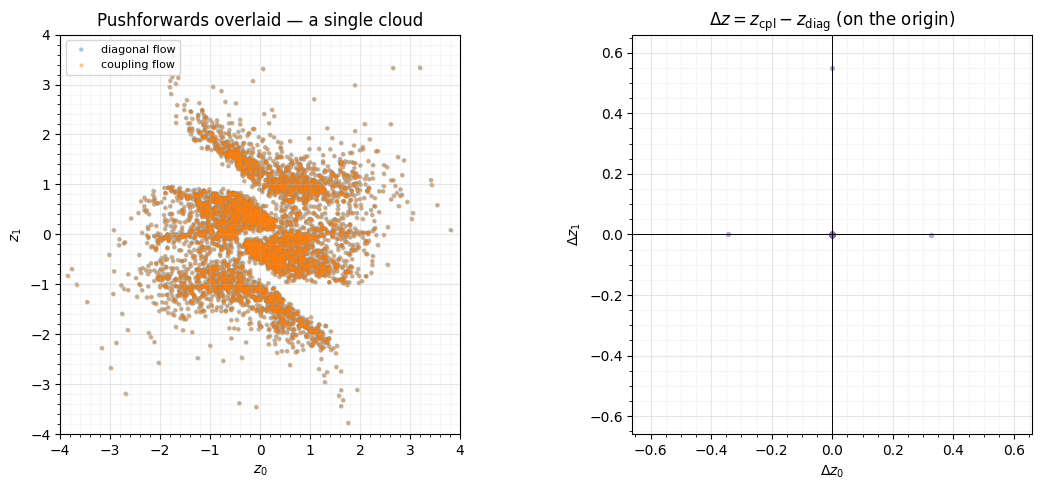
Visualise the pushforwards overlaid

If the two flows are equivalent, plotting both pushforwards in the same axes should show a single indistinguishable point cloud. The right panel is the scatter of the pointwise error vectors Δz=zcplzdiag\Delta z = z_\text{cpl} - z_\text{diag} — should sit on the origin to within float precision.

fig, axes = plt.subplots(1, 2, figsize=(14, 7))

ax = axes[0]
ax.scatter(z_diag[:, 0], z_diag[:, 1], s=12, alpha=0.55,
           color=COLOR_DIAG, label="diagonal flow")
ax.scatter(z_cpl[:, 0], z_cpl[:, 1], s=5, alpha=0.35,
           color=COLOR_CPL, label="coupling flow")
ax.set_xlabel("$z_1$")
ax.set_ylabel("$z_2$")
ax.set_title("Pushforwards  overlaid")
ax.set_xlim(-4, 4)
ax.set_ylim(-4, 4)
ax.legend(loc="upper left", frameon=True)
style_axes(ax, aspect="equal")

ax = axes[1]
delta = z_cpl - z_diag
lim = max(1e-5, np.max(np.abs(delta)) * 1.2)
ax.scatter(delta[:, 0], delta[:, 1], s=10, alpha=0.6, color=COLOR_DELTA)
ax.axhline(0, color="black", linewidth=0.8, alpha=0.6)
ax.axvline(0, color="black", linewidth=0.8, alpha=0.6)
ax.set_xlim(-lim, lim)
ax.set_ylim(-lim, lim)
ax.set_xlabel("$\\Delta z_1$")
ax.set_ylabel("$\\Delta z_2$")
ax.set_title("$\\Delta z = z_{\\mathrm{cpl}} - z_{\\mathrm{diag}}$")
style_axes(ax, aspect="equal")

plt.show()
<Figure size 1540x770 with 2 Axes>

5. Training breaks the equivalence

One gradient step of the coupling flow sets its final-Dense kernels WW to nonzero values. The conditioner stops being constant-in-xax_a, and the layer becomes a genuinely conditional transform. From that point on, fcplf_\text{cpl} diverges from fdiagf_\text{diag}.

Train only the coupling flow (the diagonal flow stays frozen as the reference). Re-check the pointwise error after a handful of epochs.

flow_cpl.compile(optimizer=keras.optimizers.Adam(3e-3), loss=base_nll_loss)
hist = flow_cpl.fit(X, X, batch_size=512, epochs=20, verbose=0)

z_cpl_trained = ops.convert_to_numpy(flow_cpl(ops.convert_to_tensor(X)))
err_trained = np.linalg.norm(z_cpl_trained - z_diag, axis=-1)
lp_cpl_trained = ops.convert_to_numpy(flow_cpl.log_prob(ops.convert_to_tensor(X)))
lp_err_trained = np.abs(lp_cpl_trained - lp_diag)

print("after 20 epochs of coupling-flow training:")
print()
print("pushforward difference  ||z_cpl - z_diag||_2")
print(f"  median : {np.median(err_trained):.2e}")
print(f"  95th%  : {np.percentile(err_trained, 95):.2e}")
print(f"  max    : {err_trained.max():.2e}")
print()
print("log-prob difference     |log p_cpl(x) - log p_diag(x)|")
print(f"  median : {np.median(lp_err_trained):.2e}")
print(f"  95th%  : {np.percentile(lp_err_trained, 95):.2e}")
print(f"  max    : {lp_err_trained.max():.2e}")
print()
print(f"mean log-likelihood  diagonal (frozen) = {lp_diag.mean():+.3f} nats/sample")
print(f"mean log-likelihood  coupling (trained) = {lp_cpl_trained.mean():+.3f} nats/sample")
after 20 epochs of coupling-flow training:

pushforward difference  ||z_cpl - z_diag||_2
  median : 1.99e-01
  95th%  : 6.11e-01
  max    : 2.41e+00

log-prob difference     |log p_cpl(x) - log p_diag(x)|
  median : 8.34e-01
  95th%  : 2.11e+00
  max    : 7.66e+00

mean log-likelihood  diagonal (frozen) = -1.827 nats/sample
mean log-likelihood  coupling (trained) = -1.122 nats/sample

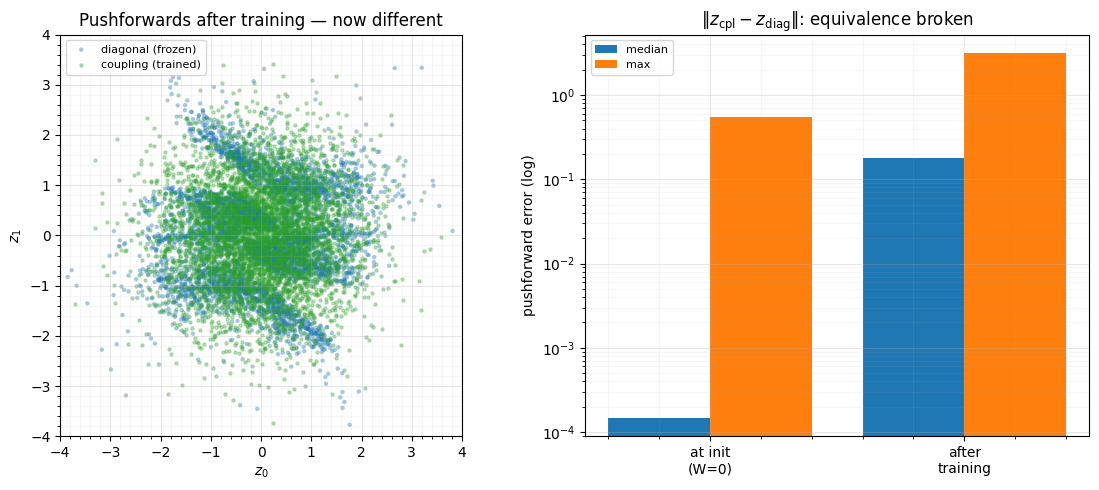
Visualise the divergence

Same two panels, after training. Now the overlay shows two visibly different point clouds, and Δz\Delta z fills a non-trivial region of the plane — the conditioner has learnt cross-dim structure the diagonal flow cannot express.

fig, axes = plt.subplots(1, 2, figsize=(14, 7))

ax = axes[0]
ax.scatter(z_diag[:, 0], z_diag[:, 1], s=12, alpha=0.55,
           color=COLOR_DIAG, label="diagonal flow (frozen)")
ax.scatter(z_cpl_trained[:, 0], z_cpl_trained[:, 1], s=5, alpha=0.35,
           color=COLOR_CPL, label="coupling flow (trained)")
ax.set_xlabel("$z_1$")
ax.set_ylabel("$z_2$")
ax.set_title("Pushforwards  overlaid  (after training)")
ax.set_xlim(-4, 4)
ax.set_ylim(-4, 4)
ax.legend(loc="upper left", frameon=True)
style_axes(ax, aspect="equal")

ax = axes[1]
delta_trained = z_cpl_trained - z_diag
lim = max(0.05, np.max(np.abs(delta_trained)) * 1.1)
ax.scatter(delta_trained[:, 0], delta_trained[:, 1], s=10, alpha=0.6, color=COLOR_DELTA)
ax.axhline(0, color="black", linewidth=0.8, alpha=0.6)
ax.axvline(0, color="black", linewidth=0.8, alpha=0.6)
ax.set_xlim(-lim, lim)
ax.set_ylim(-lim, lim)
ax.set_xlabel("$\\Delta z_1$")
ax.set_ylabel("$\\Delta z_2$")
ax.set_title("$\\Delta z$  after training — equivalence is broken")
style_axes(ax, aspect="equal")

plt.show()
<Figure size 1540x770 with 2 Axes>

Error magnitudes side-by-side

One bar chart comparing the pointwise L2L_2 error and log-prob difference, before vs after training. Log scale on the y-axis because the two regimes differ by 6+ orders of magnitude.

stats = {
    "at init (W=0)":   (err, lp_err),
    "after 20 epochs": (err_trained, lp_err_trained),
}
labels = list(stats.keys())
err_medians = [np.median(stats[k][0]) for k in labels]
err_maxs    = [stats[k][0].max()       for k in labels]
lp_medians  = [np.median(stats[k][1]) for k in labels]
lp_maxs     = [stats[k][1].max()       for k in labels]

fig, axes = plt.subplots(1, 2, figsize=(14, 5.5))
width = 0.35
x = np.arange(len(labels))

ax = axes[0]
ax.bar(x - width/2, err_medians, width, label="median", color=palette[0])
ax.bar(x + width/2, err_maxs,    width, label="max",    color=palette[1])
ax.set_yscale("log")
ax.set_xticks(x)
ax.set_xticklabels(labels)
ax.set_ylabel("$\\|z_\\mathrm{cpl} - z_\\mathrm{diag}\\|_2$")
ax.set_title("Pushforward error")
ax.legend(loc="upper left", frameon=True)
style_axes(ax)

ax = axes[1]
ax.bar(x - width/2, lp_medians, width, label="median", color=palette[0])
ax.bar(x + width/2, lp_maxs,    width, label="max",    color=palette[1])
ax.set_yscale("log")
ax.set_xticks(x)
ax.set_xticklabels(labels)
ax.set_ylabel("$|\\log p_\\mathrm{cpl}(x) - \\log p_\\mathrm{diag}(x)|$")
ax.set_title("Log-prob error")
ax.legend(loc="upper left", frameon=True)
style_axes(ax)

plt.show()
<Figure size 1540x605 with 2 Axes>

Takeaways

  • At zero-kernel init the coupling flow is a reparameterisation of a diagonal Gaussianization flow, which itself is the parametric form of RBIG. Three different architectures, one function — empirically equal to float precision.
  • The only freedom unused at init is the conditioner’s final kernel WW. Training lets that kernel grow, which is exactly what turns a diagonal Gaussianization into a genuinely conditional coupling flow.
  • Practical implication: when using make_coupling_flow + initialize_flow_from_ig, you can think of the first forward pass as “here is RBIG” and of training as “now refine RBIG with cross-dim modulation”. The warm-start doesn’t constrain the eventual model — only the starting point.