The coupling pattern
Split, condition, transform — why a coupling layer has a triangular Jacobian, a free log-det, and an analytic inverse with no network inversion
00 — The coupling pattern
Part 4 used coupling flows as a black box and saw they are more expressive per parameter than diagonal marginals. Part 5 opens the box. The coupling layer (Dinh et al., RealNVP Dinh et al. (2017)) is a deceptively simple idea with three remarkable properties. Split the coordinates into two halves via a mask, then
where is any 1-D bijector and its parameters come from a conditioner network reading the unchanged half. The passive half is copied through; only is transformed, and its transform is conditioned on . From this one move follow:
- a triangular Jacobian, so the log-determinant is a cheap sum;
- an analytic inverse that never inverts the conditioner network;
- arbitrary expressiveness — can be any network, any bijector.
What you will see
- A coupling layer (
gf.AffineCoupling) splitting, conditioning, and transforming. - The triangular Jacobian and why over the active half is free.
- The inverse round-tripping at machine precision with no network inversion.
- Swapping the bijector (affine → mixture-CDF) — same pattern, more power.
import warnings

warnings.filterwarnings("ignore")

import jax
import jax.numpy as jnp
import jax.random as jr
import matplotlib.pyplot as plt
import numpy as np

import gauss_flows as gf
from _style import GAUSS_KW, style_ax

jax.config.update("jax_enable_x64", True)
The coupling layer at a glance
The whole mechanism in one picture: the mask splits the input into a passive half and an active half . The passive half is copied straight to the output () and fed to a conditioner network that emits the bijector’s parameters . The active half is then transformed by the bijector (). Because the conditioner only sees the copied half, the Jacobian is triangular and the log-det is the cheap sum over the active half — everything below makes this concrete.
from matplotlib.patches import FancyArrowPatch, FancyBboxPatch


def _box(ax, x, y, w, h, text, fc, fs=12):
    ax.add_patch(FancyBboxPatch((x, y), w, h, boxstyle="round,pad=0.02,rounding_size=0.08",
                                fc=fc, ec="0.3", lw=1.6))
    ax.text(x + w / 2, y + h / 2, text, ha="center", va="center", fontsize=fs)


def _arrow(ax, p0, p1, color="0.3", lw=1.8, ls="-"):
    ax.add_patch(FancyArrowPatch(p0, p1, arrowstyle="-|>", mutation_scale=16,
                                 lw=lw, color=color, ls=ls))


fig, ax = plt.subplots(figsize=(10, 4.8))
ax.set_xlim(0, 10); ax.set_ylim(0, 6); ax.axis("off")
_box(ax, 0.2, 3.75, 1.5, 0.95, r"$x_A$" + "\n(passive)", "#cfe3f7")
_box(ax, 0.2, 1.0, 1.5, 0.95, r"$x_B$" + "\n(active)", "#fde2c4")
_box(ax, 3.4, 2.5, 2.1, 1.0, r"conditioner $c_\phi$" + "\n(neural net)", "#e8e8e8")
_box(ax, 6.5, 1.0, 2.0, 0.95, r"bijector $T_\theta$", "#ffd9a8")
_box(ax, 8.9, 3.75, 1.0, 0.95, r"$z_A$", "#cfe3f7")
_box(ax, 8.9, 1.0, 1.0, 0.95, r"$z_B$", "#fde2c4")
ax.text(0.95, 5.1, "split (mask)", ha="center", fontsize=10, style="italic", color="0.45")
_arrow(ax, (1.7, 4.5), (8.9, 4.5), color="#1f6fb2", ls=(0, (5, 2)))         # copy
ax.text(5.2, 4.72, "copy (identity)", ha="center", fontsize=9, color="#1f6fb2")
_arrow(ax, (1.7, 3.95), (3.4, 3.15))                                       # x_A -> conditioner
_arrow(ax, (4.45, 2.5), (7.1, 1.95), color="0.45")                         # theta -> bijector
ax.text(6.3, 2.5, r"$\theta=c_\phi(x_A)$", fontsize=10, color="0.35")
_arrow(ax, (1.7, 1.47), (6.5, 1.47), color="#d4820a")                      # x_B -> bijector
_arrow(ax, (8.5, 1.47), (8.9, 1.47), color="#d4820a")                      # bijector -> z_B
ax.text(7.5, 0.5, r"$\log|\det|=\sum_{B}\log|s|$  (free)", ha="center", fontsize=10, color="0.35")
ax.set_title(r"Coupling layer: copy $x_A$, transform $x_B$ conditioned on $x_A$", fontsize=13)
fig.tight_layout()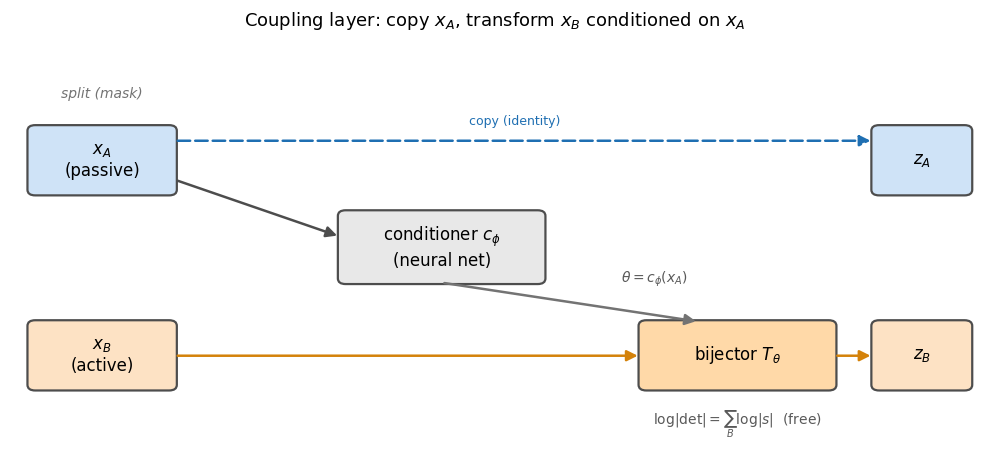
1. Split, condition, transform
gf.AffineCoupling is the canonical example: the active half is transformed by an
affine map , with the log-scale and shift
predicted by an MLP from the passive half. We build one on a 4-D event and see
exactly which coordinates it touches.
d = 4
coupling = gf.AffineCoupling(jr.key(0), shape=(d,), nn_width=32, nn_depth=2)

x = jr.normal(jr.key(1), (d,))
z, log_det = coupling.transform_and_log_det(x)
unchanged = [int(i) for i in np.where(np.abs(np.asarray(z - x)) < 1e-9)[0]]
print(f"input  x = {np.round(np.asarray(x), 3)}")
print(f"output z = {np.round(np.asarray(z), 3)}")
print(f"passive half (unchanged): coords {unchanged}")
print(f"active half (transformed): coords {[i for i in range(d) if i not in unchanged]}")
input x = [-1.184 -0.116 0.173 0.957]
output z = [-1.184 -0.116 0.363 0.679]
passive half (unchanged): coords [0, 1]
active half (transformed): coords [2, 3]
The first two coordinates pass straight through; the last two are rescaled and shifted by amounts the conditioner computed from the first two. That conditioning is what lets a coupling model dependence — the transform of bends with — while keeping everything else exactly invertible.
2. The triangular Jacobian → a free log-det
Here is the magic. Because does not depend on , and depends on only through the (elementwise) bijector , the Jacobian is block-triangular:
A triangular matrix’s determinant is the product of its diagonal, so — just the active half’s log-scales, with no Jacobian ever formed. We confirm against an autodiff Jacobian.
J = jax.jacfwd(coupling.transform)(x)
print("Jacobian:")
print(np.round(np.asarray(J), 3))
print(f"\nstrictly-upper-triangular part max |·| = {float(jnp.abs(jnp.triu(J, 1)).max()):.1e}  (zero → triangular)")
print(f"log|det J|  (from autodiff Jacobian) = {float(jnp.linalg.slogdet(J)[1]):+.5f}")
print(f"sum of log|diagonal|                 = {float(jnp.sum(jnp.log(jnp.abs(jnp.diag(J))))):+.5f}")
print(f"coupling.transform_and_log_det       = {float(log_det):+.5f}   (all equal)")

fig, ax = plt.subplots(figsize=(4.6, 4.2))
im = ax.imshow(np.abs(np.asarray(J)), cmap="viridis")
ax.set(title="Coupling Jacobian is triangular\n(upper block = 0, diagonal = scales)",
       xticks=range(d), yticks=range(d), xlabel="$\\partial / \\partial x_j$", ylabel="$z_i$")
fig.colorbar(im, ax=ax, fraction=0.046)
fig.tight_layout()
Jacobian:
[[ 1. 0. 0. 0. ]
[ 0. 1. 0. 0. ]
[-0.08 -0.036 1.031 0. ]
[ 0.02 0.027 0. 0.963]]
strictly-upper-triangular part max |·| = 0.0e+00 (zero → triangular)
log|det J| (from autodiff Jacobian) = -0.00768
sum of log|diagonal| = -0.00768
coupling.transform_and_log_det = -0.00768 (all equal)
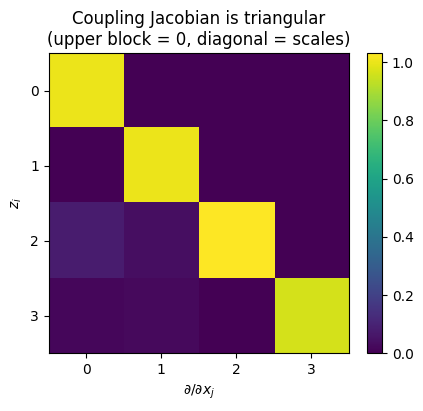
The strictly-upper-triangular block is exactly zero, the passive diagonal is 1, and the three estimates of the log-det agree to machine precision. This is the whole reason coupling flows scale: a general invertible map needs an determinant, but a coupling layer’s is an sum — and the conditioner can be arbitrarily expressive without changing that, because it only fills the off-diagonal block, which the determinant ignores.
3. The inverse never inverts the network
Inverting a coupling is just as cheap, and this is the second surprise. Given :
Because the conditioner reads the unchanged half, we recover for free, recompute the same parameters θ with a forward pass, and invert only the simple bijector . The conditioner network — which may be huge — is never inverted. We round-trip to confirm.
x_batch = jr.normal(jr.key(2), (2000, d))
z_batch = jax.vmap(coupling.transform)(x_batch)
x_rec = jax.vmap(coupling.inverse)(z_batch)
print(f"round-trip max error = {float(jnp.abs(x_batch - x_rec).max()):.2e}  (no network inversion)")

# log-det of inverse is the negative of the forward, also free
_, ld_fwd = coupling.transform_and_log_det(x)
_, ld_inv = coupling.inverse_and_log_det(z)
print(f"forward log_det = {float(ld_fwd):+.5f}, inverse log_det = {float(ld_inv):+.5f} "
      f"(sum = {float(ld_fwd + ld_inv):.1e})")
round-trip max error = 4.44e-16 (no network inversion)
forward log_det = -0.00768, inverse log_det = +0.00768 (sum = 0.0e+00)
Machine-precision round-trip, and the inverse log-det is exactly the negative of the forward — both obtained by a forward evaluation of the conditioner. This asymmetry-free invertibility is why coupling flows give fast sampling and fast density, unlike autoregressive flows where one direction is sequential.
4. The bijector is swappable — affine → mixture-CDF
Nothing above used the affine form of beyond “elementwise and invertible”. Swap
for a more expressive monotone bijector and the pattern — triangular Jacobian,
free log-det, analytic inverse — is unchanged. gauss_flows ships a menu;
MixtureGaussianCDFCoupling uses the Gaussian-mixture CDF of Part 1 as . We
check it has the same structural properties.
mix = gf.MixtureGaussianCDFCoupling(jr.key(0), shape=(d,), n_components=8,
                                    nn_width=32, nn_depth=2)
xm = jr.normal(jr.key(3), (d,))
zm, ldm = mix.transform_and_log_det(xm)
Jm = jax.jacfwd(mix.transform)(xm)
xm_rec = mix.inverse(zm)
print("MixtureGaussianCDFCoupling:")
print(f"  triangular?  upper |·| max = {float(jnp.abs(jnp.triu(Jm, 1)).max()):.1e}")
print(f"  log-det matches diagonal-sum? "
      f"{bool(jnp.allclose(ldm, jnp.sum(jnp.log(jnp.abs(jnp.diag(Jm))))))}")
print(f"  round-trip = {float(jnp.abs(xm - xm_rec).max()):.1e}")
print("  -> same coupling contract, a more expressive transform")
MixtureGaussianCDFCoupling:
triangular? upper |·| max = 0.0e+00
log-det matches diagonal-sum? True
round-trip = 3.7e-07
-> same coupling contract, a more expressive transform
Identical structure, richer — the bijector and the conditioner are independent choices, which is exactly why the next two notebooks can tour them separately.
Recap
| property | why | cost |
|---|---|---|
| split , | conditioner reads the unchanged half | — |
| triangular Jacobian | ⟂ ; elementwise in | , |
| analytic inverse | recompute , invert only | no network inversion |
| swappable bijector | structure independent of ’s form | affine → mixture-CDF → spline |
A coupling layer transforms only half its inputs, so a single layer is not a full bijector of all coordinates — you alternate the mask (Part 5 03 — mask design) so every coordinate is both transformed and used as context.
Next up. The triangular trick works for any monotone .
01 — Bijector menu tours the choices gauss_flows
offers — affine, mixture-CDF, deep-sigmoid, rational-quadratic spline — and what
each buys in expressiveness.
- Dinh, L., Sohl-Dickstein, J., & Bengio, S. (2017). Density Estimation using Real NVP. International Conference on Learning Representations (ICLR).