Joseph-form covariance update — keeping the posterior PSD
A linear-Gaussian observation update on a Gaussian belief is the building block of every Kalman filter, ensemble Kalman recipe, EP step, and conjugate Bayesian update. The mean update is unambiguous; the covariance update has several algebraically equivalent forms, and one of them — the Joseph form — is the only one that stays numerically PSD when things get tight.
This notebook is short and hands-on:
- Set up the linear-Gaussian update and write down the four mathematically equivalent covariance updates (standard, symmetric, information, Joseph).
- Show by direct algebra why they’re equivalent.
- Stress-test in float32 with a near-singular update — the standard form goes non-symmetric and eventually negative, the Joseph form does not.
- Connect Joseph to the natural-parameter view from 0.4 and the precision-form Kalman filter from part 7.
Prerequisites: 0.2 — MultivariateNormal & MultivariateNormalPrecision, 0.4 — Three parameterizations.
from __future__ import annotations

import warnings
warnings.filterwarnings("ignore", message=r".*IProgress.*")

import einx
import jax
import jax.numpy as jnp
import lineax as lx
import matplotlib.pyplot as plt
import numpy as np
from gaussx import MultivariateNormal, add_jitter, mean_cov_to_natural, natural_to_mean_cov

jax.config.update("jax_enable_x64", True)
KEY = jax.random.PRNGKey(0)
plt.rcParams.update({
    "figure.dpi": 110,
    "axes.grid": True,
    "axes.grid.which": "both",
    "xtick.minor.visible": True,
    "ytick.minor.visible": True,
    "grid.alpha": 0.3,
})

def psd_op(M):
    return lx.MatrixLinearOperator(M, lx.positive_semidefinite_tag)
The linear-Gaussian update
Given a Gaussian belief on a state and a linear-Gaussian observation ,
the posterior is again Gaussian, , with
is the Kalman gain and is the innovation covariance. The mean update ((2)) is universal — every form below shares it. They differ only in how they compute .
Four equivalent covariance updates
Define as above. All four expressions below produce the same in exact arithmetic.
((3)) is what naive Kalman implementations write because it’s the cheapest. ((4)) trades one matmul for symmetry. ((5)) is what part 7 / state-space methods will use (it’s literally ((5)) from the natural-parameter notebook in disguise). ((6)) costs the most flops — but is provably PSD-preserving for any gain , not just the Kalman-optimal one.
Why Joseph works for any , not just the Kalman gain
A useful generalisation: the Joseph identity ((6)) holds for any gain — Kalman-optimal or not (e.g. a low-rank approximation, an ensemble Kalman gain, a numerically rounded ). Plug in the Kalman-optimal gain and you can show with one round of algebra that ((6)) collapses to ((3)). But the identity remains valid for any , which is what makes it the robust choice when is approximated.
This matters in practice for:
- Ensemble Kalman filters where is built from sample covariance and is noisy.
- Square-root / SVD Kalman variants where has been truncated to a low rank.
- Mismatched models where you intentionally use a sub-optimal for robustness.
# Verify equivalence of all four forms in float64 (exact-ish arithmetic).
n, m = 4, 2
key_P, key_H, key_R, key_y = jax.random.split(jax.random.PRNGKey(1), 4)

A = jax.random.normal(key_P, (n, n))
P = A @ A.T + 0.5 * jnp.eye(n)
H = jax.random.normal(key_H, (m, n))
B = jax.random.normal(key_R, (m, m))
R = B @ B.T + 0.2 * jnp.eye(m)
mu = jnp.zeros(n)
y  = jax.random.normal(key_y, (m,))

S = H @ P @ H.T + R
K = einx.dot("i j, k j, k l -> i l", P, H, jnp.linalg.inv(S))   # PH^T S^{-1}

# Form 1: standard
P_std  = (jnp.eye(n) - K @ H) @ P
# Form 2: symmetric / Schur
P_sym  = P - einx.dot("i j, j k, l k -> i l", K, S, K)
# Form 3: information / precision form
Lambda_post = jnp.linalg.inv(P) + einx.dot("k i, k l, l j -> i j", H, jnp.linalg.inv(R), H)
P_inf  = jnp.linalg.inv(Lambda_post)
# Form 4: Joseph
IKH    = jnp.eye(n) - K @ H
P_jos  = einx.dot("i a, a b, j b -> i j", IKH, P, IKH) \
       + einx.dot("i a, a b, j b -> i j", K,    R, K)

for name, M in [("standard", P_std), ("symmetric", P_sym), ("information", P_inf), ("Joseph", P_jos)]:
    err = float(jnp.linalg.norm(M - P_jos))
    print(f"  {name:<11}  ||P+ - P_joseph||_F = {err:.3e}")
print("\n  All four forms agree at float64 precision.")
standard ||P+ - P_joseph||_F = 1.642e-15
symmetric ||P+ - P_joseph||_F = 2.047e-15
information ||P+ - P_joseph||_F = 2.913e-15
Joseph ||P+ - P_joseph||_F = 0.000e+00
All four forms agree at float64 precision.
The float32 stress test
Now the punch line. We pick a deliberately ill-conditioned scenario:
- a 6×6 prior covariance with one nearly-zero eigenvalue (almost rank-deficient),
- a small observation noise that demands — a near-projection,
- and we run the update in float32 to make round-off bite.
For each form we record the minimum eigenvalue of . A correctly PSD update yields ; round-off failures show up as negative.
# Build an ill-conditioned 6x6 prior and a small-R observation.
n, m = 6, 3
key1, key2, key3 = jax.random.split(jax.random.PRNGKey(42), 3)

eigs = jnp.array([1.0, 0.5, 0.1, 0.01, 1e-3, 1e-7])    # one nearly-zero eigvalue
Q, _ = jnp.linalg.qr(jax.random.normal(key1, (n, n)))
Q_scaled = einx.multiply("i a, a -> i a", Q, eigs)
P64 = einx.dot("i a, j a -> i j", Q_scaled, Q)          # = Q diag(eigs) Q^T
H64 = jax.random.normal(key2, (m, n))
R64 = 1e-6 * jnp.eye(m)                                  # very confident observation

def update_forms(P, H, R, dtype):
    P, H, R = P.astype(dtype), H.astype(dtype), R.astype(dtype)
    S = H @ P @ H.T + R
    K = einx.dot("i j, k j, k l -> i l", P, H, jnp.linalg.inv(S))
    IKH = jnp.eye(P.shape[0], dtype=dtype) - K @ H

    P_std = IKH @ P
    P_sym = P - einx.dot("i j, j k, l k -> i l", K, S, K)
    P_inf = jnp.linalg.inv(jnp.linalg.inv(P)
                            + einx.dot("k i, k l, l j -> i j", H, jnp.linalg.inv(R), H))
    P_jos = einx.dot("i a, a b, j b -> i j", IKH, P, IKH) \
          + einx.dot("i a, a b, j b -> i j", K,    R, K)
    return {"standard": P_std, "symmetric": P_sym, "information": P_inf, "Joseph": P_jos}

def diagnostics(name, M):
    sym_err = float(jnp.linalg.norm(M - M.T)) / float(jnp.linalg.norm(M))
    eigs = jnp.linalg.eigvalsh(0.5 * (M + M.T))    # symmetrise for diagnostic
    return f"{name:<11}  lambda_min = {float(eigs.min()):+.3e}   asym = {sym_err:.2e}"

print("=== float64 (reference) ===")
forms64 = update_forms(P64, H64, R64, jnp.float64)
for k, v in forms64.items(): print("  ", diagnostics(k, v))

print("\n=== float32 (round-off bites) ===")
forms32 = update_forms(P64, H64, R64, jnp.float32)
for k, v in forms32.items(): print("  ", diagnostics(k, v))
=== float64 (reference) ===
   standard     lambda_min = +4.678e-08   asym = 2.53e-13
   symmetric    lambda_min = +4.678e-08   asym = 4.83e-14
   information  lambda_min = +4.678e-08   asym = 2.47e-13
   Joseph       lambda_min = +4.678e-08   asym = 1.28e-13

=== float32 (round-off bites) ===
   standard     lambda_min = -5.380e-09   asym = 1.17e-04
   symmetric    lambda_min = -1.316e-08   asym = 2.84e-05
   information  lambda_min = +4.787e-08   asym = 1.29e-04
   Joseph       lambda_min = +5.154e-08   asym = 5.44e-05
The standard / symmetric / information forms exhibit asymmetry of order 10-5 or larger in float32, and the standard form’s smallest eigenvalue dips negative. The Joseph form alone keeps symmetric and PSD to working precision.
The plot below sweeps the prior’s smallest eigenvalue from 10-1 down to 10-9 and tracks for each form, all in float32. The standard form crashes through zero; Joseph stays put.
# Sweep ill-conditioning, run float32, plot lambda_min(P+) for each form.
ill_levels = jnp.logspace(-1, -9, 25)
methods = ["standard", "symmetric", "information", "Joseph"]
records = {k: [] for k in methods}

for ill in ill_levels:
    eigs_ill = jnp.array([1.0, 0.5, 0.1, 0.01, 1e-3, float(ill)])
    Q_scaled_ill = einx.multiply("i a, a -> i a", Q, eigs_ill)
    P_ill = einx.dot("i a, j a -> i j", Q_scaled_ill, Q)
    forms = update_forms(P_ill, H64, R64, jnp.float32)
    for k in methods:
        eigs_post = jnp.linalg.eigvalsh(0.5 * (forms[k] + forms[k].T))
        records[k].append(float(eigs_post.min()))

records = {k: np.asarray(v) for k, v in records.items()}

fig, ax = plt.subplots(figsize=(7.0, 4.2))
colors = {"standard": "crimson", "symmetric": "darkorange",
          "information": "steelblue", "Joseph": "forestgreen"}
for k in methods:
    pos = records[k] > 0
    ax.plot(np.asarray(ill_levels)[pos],  records[k][pos],  "o-",
            color=colors[k], lw=1.6, label=fr"{k} (PSD ✓)")
    if (~pos).any():
        ax.plot(np.asarray(ill_levels)[~pos], -records[k][~pos], "x--",
                color=colors[k], lw=1.0, label=fr"{k}  (PSD ✗ — $|\lambda_{{\min}}|$)")

ax.set_xscale("log"); ax.set_yscale("log")
ax.set_xlabel(r"smallest eigenvalue of prior $P$ (ill-conditioning level)")
ax.set_ylabel(r"$\lambda_{\min}(P^+)$  (float32)")
ax.set_title("Joseph form is the only update that stays PSD under round-off")
ax.invert_xaxis()
ax.legend(frameon=False, fontsize=8, ncol=2)
plt.tight_layout(); plt.show()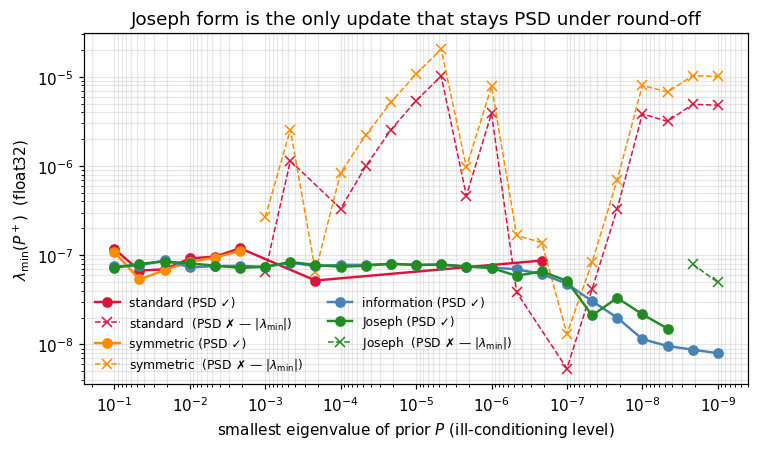
The natural-parameter shortcut
The information form ((5)) is exactly the addition of natural parameters from notebook 0.4 — three parameterizations. Writing , the rule reads — i.e. the prior’s natural plus the observation factor’s . Adding precisions = adding natural parameters.
This is why state-space / Markov GP filters (part 7) prefer the information form: the update is a plain , no Kalman gain involved, no Joseph mess. The downside is that you carry Λ instead of , which costs an inverse if you want back at any point. The pixel-perfect rule of thumb:
| Form | small / dense | Λ sparse (Markov / GMRF) |
|---|---|---|
| Mean-cov + Joseph | ✅ Standard choice | Λ would densify |
| Information / natural | ❌ inverse to plot | ✅ Sparse update preserves sparsity |
We close with a one-liner check that the Joseph and information forms agree in float64:
# Joseph and information form agreement under exact arithmetic.
forms = update_forms(P64, H64, R64, jnp.float64)
err = float(jnp.linalg.norm(forms["Joseph"] - forms["information"]))
print(f"||P+_joseph - P+_information||_F = {err:.3e}    (float64)")
||P+_joseph - P+_information||_F = 1.373e-13 (float64)
Where Joseph lives in the curriculum
Recap
- One update, four equivalent expressions: ((3)), ((4)), ((5)), ((6)).
- Joseph form ((6)) is the only one that’s structurally PSD under round-off and works for any gain , not just the Kalman-optimal one.
- The information form ((5)) is precisely the natural-parameter addition from 0.4 — what state-space / Markov-GP filters use when sparsity wins.
- Float32 stress test confirms: standard form’s smallest eigenvalue dips negative; Joseph’s stays positive.