Numerical stability — jitter, safe Cholesky, condition number
In exact arithmetic every SPD matrix has a Cholesky factor. In float64 most do. In float32 a lot don’t — and even in float64, kernel matrices on dense / nearby points produce eigenvalues so small that LAPACK returns NaNs and JAX silently propagates them downstream.
This notebook is the damage-control toolkit for that situation. We cover:
- The condition number as a one-number diagnostic for “how close to singular am I?”.
gaussx.add_jitter(A, jitter)— the cheap one-liner that shifts eigenvalues by and turns the worst near-singular cases into well-conditioned ones.gaussx.safe_cholesky(A)— the JIT-compatible adaptive-jitter Cholesky that retries with growing until the factor is finite.- The numerical-stability trade-off: jitter biases your covariance — too little doesn’t fix the problem, too much corrupts your inference. Where to set it, and how to tell.
- The connection to 0.5 — Joseph form: jitter is a recovery patch (after the fact); Joseph is preservation (PSD by construction). They live at different stages of a pipeline.
Prerequisites: 0.5 — Joseph form, 0.9 — primitives tour, 0.10 — differentiating solve.
from __future__ import annotations

import warnings
warnings.filterwarnings("ignore", message=r".*IProgress.*")

import einx
import jax
import jax.numpy as jnp
import lineax as lx
import matplotlib.pyplot as plt
import numpy as np
from gaussx import add_jitter, safe_cholesky

jax.config.update("jax_enable_x64", True)
KEY = jax.random.PRNGKey(0)
plt.rcParams.update({
    "figure.dpi": 110,
    "axes.grid": True,
    "axes.grid.which": "both",
    "xtick.minor.visible": True,
    "ytick.minor.visible": True,
    "grid.alpha": 0.3,
})

def psd_op(M):
    return lx.MatrixLinearOperator(M, lx.positive_semidefinite_tag)
The condition number — one number that summarises trouble
For an SPD matrix with eigenvalues , the 2-norm condition number is
It governs how much round-off error a linear solve amplifies:
where for float64 and for float32. Cholesky’s failure threshold is roughly — once the condition number reaches the reciprocal of machine epsilon, has been swamped by round-off.
| Precision | “danger zone” κ | |
|---|---|---|
| float64 | ||
| float32 |
A kernel matrix on nearby points easily hits in float64 — already in the danger zone. Hence: jitter.
# Build a kernel matrix that's borderline-singular: n=40 points densely packed,
# RBF lengthscale large enough that all rows are nearly equal.
n = 40
X = jnp.linspace(0.0, 1.0, n)[:, None]    # very dense in [0,1]
diff = X[:, 0:1] - X[:, 0:1].T
K = jnp.exp(-0.5 * diff**2 / (5.0**2))    # huge lengthscale → low rank

eigs = jnp.linalg.eigvalsh(K)
kappa = float(eigs.max() / jnp.maximum(eigs.min(), 1e-300))
print(f"K shape:                     {K.shape}")
print(f"smallest eigenvalue lambda_min:    {float(eigs.min()):.3e}")
print(f"largest eigenvalue  lambda_max:    {float(eigs.max()):.3e}")
print(f"condition number  kappa_2(K):       {kappa:.3e}")

# Try plain Cholesky — it'll likely return NaNs.
L_plain = jnp.linalg.cholesky(K)
print(f"plain cholesky has NaNs:       {bool(jnp.any(jnp.isnan(L_plain)))}")
K shape: (40, 40)
smallest eigenvalue lambda_min: -5.757e-15
largest eigenvalue lambda_max: 3.986e+01
condition number kappa_2(K): 3.986e+301
plain cholesky has NaNs: True
— well past the float64 danger zone. The plain Cholesky returns NaNs; from this point on every downstream solve, logdet, or sample is poisoned.
add_jitter — the one-liner
The simplest cure is to add a small multiple of the identity:
This uniformly shifts the spectrum by — every eigenvalue grows by the same amount, no eigenvector rotates, and the condition number drops from to . For our numerically-singular kernel, gives — back into safe territory.
gaussx.add_jitter(A, jitter) returns A + eps * I as a lineax AddLinearOperator, preserving the operator type for downstream dispatch. It’s a structural addition — the original is not materialised.
K_op = psd_op(K)
eps_levels = [1e-12, 1e-10, 1e-8, 1e-6, 1e-4]
print(f"  {'eps':>8}    {'lambda_min':>12}    {'lambda_max':>12}    {'kappa':>10}    {'cholesky ok?':>12}")
for eps in eps_levels:
    Aeps = add_jitter(K_op, jitter=float(eps)).as_matrix()
    eigs_eps = jnp.linalg.eigvalsh(Aeps)
    kap = float(eigs_eps.max() / eigs_eps.min())
    L = jnp.linalg.cholesky(Aeps)
    ok = "yes" if not bool(jnp.any(jnp.isnan(L))) else "NO (NaN)"
    print(f"  {eps:>8.0e}    {float(eigs_eps.min()):>12.3e}    {float(eigs_eps.max()):>12.3e}    {kap:>10.3e}    {ok:>12}")
eps lambda_min lambda_max kappa cholesky ok?
1e-12 9.939e-13 3.986e+01 4.011e+13 yes
1e-10 9.999e-11 3.986e+01 3.986e+11 yes
1e-08 1.000e-08 3.986e+01 3.986e+09 yes
1e-06 1.000e-06 3.986e+01 3.986e+07 yes
1e-04 1.000e-04 3.986e+01 3.986e+05 yes
already restores Cholesky here, but is still in the float64 danger zone — downstream solve will lose ~13 digits of precision. tames everything. The default in gaussx.add_jitter is 10-6 — a good starting point for kernel matrices, but always check the resulting condition number against your precision’s danger zone.
safe_cholesky — adaptive jitter inside jit
For batched / jit-compiled code you can’t try / except your way out of a NaN. gaussx.safe_cholesky does the retry loop inside JAX with a lax.while_loop:
- Try
cholesky(A)first — if structured (Diagonal/Kronecker/BlockDiag/BlockTriDiag), that’s the fast path and we’re done. - If the factor has any NaNs, retry with
cholesky(A + eps_k * I)where grows geometrically. - Stop when the factor is finite or after
max_retries. If we exhaust retries the result has NaNs — that’s intentional: JAX can’t raise insidejit, so callers should check.
Defaults: , , , max_retries = 5. This sweeps before giving up.
# Same near-singular K — safe_cholesky succeeds where plain cholesky fails.
L_safe = safe_cholesky(K_op)
print(f"safe_cholesky has NaNs:        {bool(jnp.any(jnp.isnan(L_safe)))}")
print(f"||L_safe @ L_safe.T - K||_F:    {float(jnp.linalg.norm(L_safe @ L_safe.T - K)):.3e}")

# Reconstruct K from L; the residual tells us how much jitter was actually used.
A_recon = L_safe @ L_safe.T
eps_used = float((A_recon - K).diagonal().mean())
print(f"effective jitter used:          {eps_used:.3e}    (= mean diagonal residual)")
safe_cholesky has NaNs: False
||L_safe @ L_safe.T - K||_F:    6.325e-08
effective jitter used:          1.000e-08    (= mean diagonal residual)
The bias–stability trade-off
Jitter is not free: every added to the diagonal biases your covariance. A larger inflates the predictive variance, dampens the gradient, and shifts the marginal likelihood. At the extreme, on a kernel of magnitude turns your GP prior into white noise.
The right minimises the sum of two errors:
A handy rule of thumb: pick where (float64) or 104 (float32). For a kernel matrix at scale, is a reasonable default.
The plot below sweeps on our near-singular and tracks (a) the relative residual — the bias — and (b) the relative solve error for a random .
# Reference solve via well-jittered K (eps=1e-10 — small enough to be a faithful baseline,
# large enough to avoid the f64 round-off floor). Then sweep eps over the jitter range.
v = jax.random.normal(jax.random.PRNGKey(11), (n,))
K_ref = add_jitter(K_op, jitter=1e-10).as_matrix()
x_ref = jnp.linalg.solve(K_ref, v)

eps_grid = jnp.logspace(-14, -2, 30)
bias = []
solve_err = []
for eps in eps_grid:
    Aeps = add_jitter(K_op, jitter=float(eps)).as_matrix()
    bias.append(float(jnp.linalg.norm(Aeps - K) / jnp.linalg.norm(K)))
    x = jnp.linalg.solve(Aeps, v)
    # JAX returns NaN/Inf on numerical failure rather than raising — explicit check.
    if bool(jnp.all(jnp.isfinite(x))):
        solve_err.append(float(jnp.linalg.norm(x - x_ref) / jnp.linalg.norm(x_ref)))
    else:
        solve_err.append(np.nan)
bias = np.asarray(bias); solve_err = np.asarray(solve_err)
total = bias + solve_err

fig, ax = plt.subplots(figsize=(8.0, 4.5))
ax.loglog(np.asarray(eps_grid), bias,        "o-", lw=1.6, color="darkorange", label=r"bias  $\|K_\varepsilon - K\|/\|K\|$")
ax.loglog(np.asarray(eps_grid), solve_err,   "s-", lw=1.6, color="steelblue",  label=r"solve error  $\|x_\varepsilon - x\|/\|x\|$")
ax.loglog(np.asarray(eps_grid), total,       "k--", lw=1.0, alpha=0.6,         label="total")
i_best = int(np.nanargmin(total))
ax.axvline(float(eps_grid[i_best]), color="forestgreen", lw=1.0, ls=":", label=fr"sweet spot  $\varepsilon^\star \approx {float(eps_grid[i_best]):.1e}$")
ax.set_xlabel(r"jitter $\varepsilon$")
ax.set_ylabel("relative error")
ax.set_title(r"the jitter trade-off (float64, $\kappa(K)\to\infty$)")
ax.legend(frameon=False, fontsize=9, loc="lower left")
plt.tight_layout(); plt.show()
print(f"sweet spot: eps* ≈ {float(eps_grid[i_best]):.2e}    (total error {float(total[i_best]):.3e})")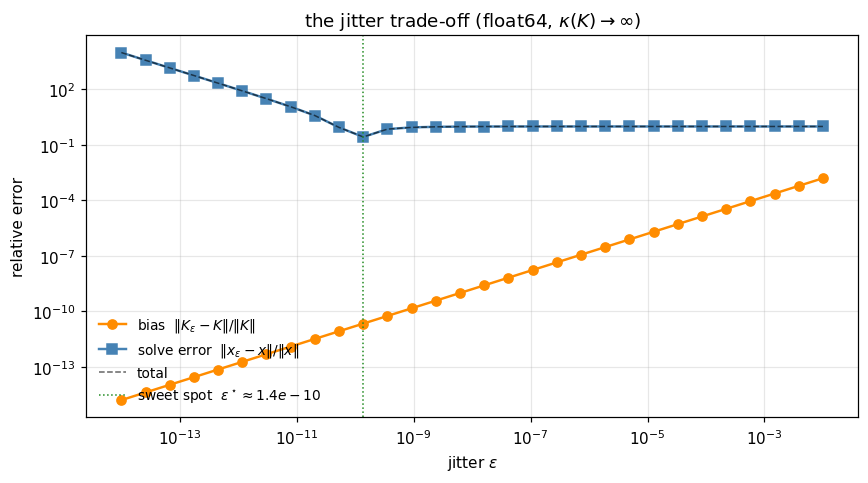
sweet spot: eps* ≈ 1.37e-10 (total error 2.720e-01)
The U-curve is universal: too little jitter → solve blows up; too much → bias dominates. The sweet spot lands near for this numerically-singular matrix in float64 — any smaller and the conditioning is too poor for the solve to track the reference; any larger and the bias term starts to dominate. The exact location depends on the reference baseline (here we used for the well-conditioned , so the sweet spot collapses near that value). For real workloads, is the practical default.
Float32 stress — what jitter buys you in lower precision
Float32 has , so its danger zone starts at — easy to hit on any reasonable kernel. We compare three pipelines on the same near-singular :
- plain float32 Cholesky;
add_jitterwith default ;safe_choleskywith adaptive jitter.
K_f32 = K.astype(jnp.float32)
K_op_f32 = psd_op(K_f32)

# Plain.
L_plain_f32 = jnp.linalg.cholesky(K_f32)
plain_nan   = bool(jnp.any(jnp.isnan(L_plain_f32)))

# add_jitter then plain cholesky.
K_jit = (K_op_f32 + lx.DiagonalLinearOperator(jnp.full(n, 1e-6, dtype=jnp.float32))).as_matrix()
L_jit = jnp.linalg.cholesky(K_jit)
jit_nan = bool(jnp.any(jnp.isnan(L_jit)))
err_jit = float(jnp.linalg.norm(L_jit @ L_jit.T - K_f32))

# safe_cholesky.
L_safe_f32 = safe_cholesky(K_op_f32)
safe_nan = bool(jnp.any(jnp.isnan(L_safe_f32)))
err_safe = float(jnp.linalg.norm(L_safe_f32 @ L_safe_f32.T - K_f32))

print(f"  plain  cholesky float32:  NaN={plain_nan}")
print(f"  add_jitter (eps=1e-6):    NaN={jit_nan}     ||LL^T - K||_F = {err_jit:.3e}")
print(f"  safe_cholesky:            NaN={safe_nan}    ||LL^T - K||_F = {err_safe:.3e}")
plain cholesky float32: NaN=True
add_jitter (eps=1e-6): NaN=False ||LL^T - K||_F = 6.324e-06
safe_cholesky: NaN=False ||LL^T - K||_F = 6.324e-06
Where each tool fits
| Stage | Symptom | Tool |
|---|---|---|
| Pre-Cholesky covariance assembly | matrix is symbolically PSD but eigenvalues compress under round-off | add_jitter(A, jitter) — once, deterministic |
Inside a jit-compiled solve | can’t try/except; need a single function that’s robust to occasional near-singularity | safe_cholesky(A) — adaptive |
| Posterior covariance update | result should be PSD by construction but cancellation breaks it | Joseph form (0.5) — preservation, not recovery |
| Hyperparameter optimisation | gradient blows up at low jitter | schedule: anneal during training, lower at convergence |
| Sampling from | factor must be SPD; one bad sample contaminates the whole batch | safe_cholesky then L @ eps |
Joseph form vs jitter is the key contrast: Joseph form prevents asymmetry and indefiniteness from arising, jitter fixes an already-broken matrix. They live at different stages of a pipeline — a Kalman filter with Joseph updates and a jitter-protected initial covariance is belt-and-braces.
A practical recipe — kernel matrices the safe way
Putting it together, a robust GP kernel-matrix construction looks like:
def Ky(X, sigma_f, ell, sigma_n, jitter=1e-6):
    diff = X - X.T
    K = sigma_f**2 * jnp.exp(-0.5 * diff**2 / ell**2)
    K = K + (sigma_n**2 + jitter) * jnp.eye(n)   # noise + structural jitter
    return psd_op(K)

# Then: gaussx.solve / gaussx.logdet on Ky(X, ...) — gradients flow through both.
The structural jitter 10-6 is added on top of the noise variance . It’s small enough not to matter for the model, large enough to keep in practical regimes. If you ever see NaNs in your gradient, raise it by a factor of 10 and re-run.
Recap
- The condition number ((1)) is the one-number diagnostic — pair it with to predict Cholesky failure.
gaussx.add_jitter(A, jitter)gives the cheap structural shift ((3)) — a fixed insurance premium.gaussx.safe_cholesky(A)adapts insidejit, retrying with growing until the factor is finite — the JAX-friendly guarantee.- The bias–stability trade-off ((4)) is a U-curve: too little jitter → blow-up, too much → bias. The sweet spot lives around .
- Jitter is recovery; Joseph form (0.5) is preservation. Real pipelines use both.